zenpundit.com » twitter

Archive for the ‘twitter’ Category

Games of telephone and counter-telephone?

Wednesday, October 3rd, 2012

[ by Charles Cameron — embassy or consulate — a minor detail for an editor, perhaps, but all the difference in the world for Ambassador J Christopher Stevens ]
.

Here’s a screen grab of a piece posted on the Atlantic site today:


.

The article itself is worth your time, and I’ll get back to the screen grab later. Here’s the text para that interests me:

In the famous “Bin Ladin Determined to Strike in US” Presidential Daily Brief of August 6, 2001, one of the major analytic points was that “Al-Qa’ida members — including some who are US citizens — have resided in or traveled to the US for years, and the group apparently maintains a support structure that could aid attacks” (emphasis added). Notice that this analysis uses two hedges in a single sentence. Given the lack of certainty on the issue, such linguistic dodging made sense — as it does in report after report where individuals are discussing information below the level of actionable intelligence.

Leah Farrall has been tweeting about the way this characteristically cautious phrasing used by analysts gets lost as “the higher up the food chain an analytical report goes the greater the tendency for bosses in [the] food chain to add their two cents worth” — so that by the time it reaches the politicians, “there is absolutely WMD.”

The shift from “apparently” to “absolutely” is an interesting one.

**

The 2007 National Intelligence Estimate featured a section on the nomenclature of such distinctions, which I trust and imagine was directed more at its readers than towards the analysts who produced it:

What We Mean When We Say: An Explanation of Estimative Language

When we use words such as “we judge” or “we assess”—terms we use synonymously — as well as “we estimate,” “likely” or “indicate,” we are trying to convey an analytical assessment or judgment. These assessments, which are based on incomplete or at times fragmentary information are not a fact, proof, or knowledge. Some analytical judgments are based directly on collected information; others rest on previous judgments, which serve as building blocks. In either type of judgment, we do not have “evidence” that shows something to be a fact or that definitively links two items or issues.

Intelligence judgments pertaining to likelihood are intended to reflect the Community’s sense of the probability of a development or event. Assigning precise numerical ratings to such judgments would imply more rigor than we intend. The chart below provides a rough idea of the relationship of terms to each other.

We do not intend the term “unlikely” to imply an event will not happen. We use “probably” and “likely” to indicate there is a greater than even chance. We use words such as “we cannot dismiss,” “we cannot rule out,” and “we cannot discount” to reflect an unlikely—or even remote—event whose consequences are such it warrants mentioning. Words such as “may be” and “suggest” are used to reflect situations in which we are unable to assess the likelihood generally because relevant information is nonexistent, sketchy, or fragmented.

In addition to using words within a judgment to convey degrees of likelihood, we also ascribe “high,” “moderate,” or “low” confidence levels based on the scope and quality of information supporting our judgments.

• “High confidence” generally indicates our judgments are based on high-quality information and/or the nature of the issue makes it possible to render a solid judgment.
• “Moderate confidence” generally means the information is interpreted in various ways, we have alternative views, or the information is credible and plausible but not corroborated sufficiently to warrant a higher level of confidence.
• “Low confidence” generally means the information is scant, questionable, or very fragmented and it is difficult to make solid analytic inferences, or we have significant concerns or problems with the sources.

**

You could think of these as counter-telephone measures — attempts to avoid the distortions and corruptions that tend to arise when a message is passed from one person to another, And that’s important a fortiori when an ascending food-chain of transmitters may wish (or be persuaded) to formulate a message that will assure them the favorable attention of their superiors — but also because the higher the report goes, the closer it gets to decision-time..

As the Atlantic article says, this kind of “linguistic dodging” (aka attention to nuance) makes sense “in report after report where individuals are discussing information below the level of actionable intelligence.”

Inevitably there’s a shift in tempo between contemplation and action.

**

Anyway, messages tend to get distorted as they’re passed along.

Consider, for instance, the caption to the photograph that graces the Atlantic piece at the top of this post:

The U.S Embassy in Benghazi burns following an attack in September. (Reuters)

There’s only one problem there. The US didn’t have an Embassy in Benghazi — they had a Consulate — and that’s not a distinction that lacks a consequence. Whatever else may be the case, Ambassador Stevens would certainly have been better guarded had he been back in Tripoli in his embassy.

Whoever wrote that caption wasn’t as deeply immersed in the situation as the former CIA analyst who write the article. And when you’re not deeply immersed, it is perilously easy to get minor but important details wrong.

Let not thy left hand know what thy right hand doeth

Tuesday, October 2nd, 2012

[ by Charles Cameron — this post is about comparisons — what you make of them, and what they make of you, death calculus, and Handel ]
.


.

Scraped from my morning read, these two quotes — a tweeted headline from Breitbart and a gobbit of the Jerusalem Post — neatly illustrate a paradox I’ve been wrestling with, the way more profound souls wrestle with angels [link is to Rilke].

It’s the paradox of comparison.

**

On the one hand, I can barely imagine what it would be like to build — with, say, enough funds for a latter-day Manhattan Project — a Department whose job it was to monitor all activities and ensure even-handedness in the allocation of resources.

So that not ever would a Presidential aide on vacation receive a security detail until each and every ambassador had an equivalent force of marines around them at any given moment, in embassy or out.

I mean, what about consuls, or CIA heads of station — are they ambassadorial enough? Members of the cabinet on vacation? Members of the National Security Council? How far do we need to go with our even-handedness? Is Benghazi different from London? Londonistan?

How would one possibly assure oneself that no “hand” of government, left, right, center, upper, lower, or oblique to all of the above, ever arranged things in a way that compared foolishly with the way some other “hand” of government had arranged something more or less similar?

**

Let’s go to what my friend Bryan Alexander calls the death calculus. Since we’re interested in terrorism here, I’ll pull quotes from a couple of pieces that you can read in full if this topic interests you. Two paras from TomDispatch:

In 2008, 14,180 Americans were murdered, according to the FBI. In that year, there were 34,017 fatal vehicle crashes in the U.S. and, so the U.S. Fire Administration tells us, 3,320 deaths by fire. More than 11,000 Americans died of the swine flu between April and mid-December 2009, according to the Centers for Disease Control and Prevention; on average, a staggering 443,600 Americans die yearly of illnesses related to tobacco use, reports the American Cancer Society;5,000 Americans die annually from food-borne diseases; an estimated 1,760children died from abuse or neglect in 2007; and the next year, 560 Americans died of weather-related conditions, according to the National Weather Service, including 126 from tornadoes, 67 from rip tides, 58 from flash floods, 27 from lightning, 27 from avalanches, and 1 from a dust devil.

and:

The now-infamous Northwest Airlines Flight 253, carrying Umar Farouk Abdulmutallab and his bomb-laden underwear toward Detroit on Christmas Day 2009, had 290 passengers and crew, all of whom survived. Had the inept Abdulmutallab actually succeeded, the death toll would not have equaled the 324 traffic fatalities in Nevada in 2008; while the destruction of four Flight 253s from terrorism would not have equaled New York State’s 2008 traffic death toll of1,231, 341 of whom, or 51 more than those on Flight 253, were classified as “alcohol-impaired fatalities.”

Two paras from a Salon piece [copied here sans links and emphases]:

“The number of people worldwide who are killed by Muslim-type terrorists, Al Qaeda wannabes, is maybe a few hundred outside of war zones. It’s basically the same number of people who die drowning in the bathtub each year,” said John Mueller, an Ohio State University professor who has written extensively about the balance between threat and expenditures in fighting terrorism.

Last year, McClatchy characterized this threat in similar terms: “undoubtedly more American citizens died overseas from traffic accidents or intestinal illnesses than from terrorism.” The March, 2011, Harper’s Index expressed the point this way: “Number of American civilians who died worldwide in terrorist attacks last year: 8 — Minimum number who died after being struck by lightning: 29.” That’s the threat in the name of which a vast domestic Security State is constructed, wars and other attacks are and continue to be launched, and trillions of dollars are transferred to the private security and defense contracting industry at exactly the time that Americans — even as they face massive wealth inequality — are told that they must sacrifice basic economic security because of budgetary constraints.

**

My points?

On the one hand, that the world is far too complex to avoid disparities that can draw mockery down on the heads of those one might wish to mock.

And on the other, that comparisons also have an invaluable role to play in giving us a sense of the relative peaks and valleys of the terrain we live in — and may be literally or metaphorically mountaintop removal / valley fill coal mining in preparation for our children’s children…

**

Here’s a “DoubleQuote” for you:

Or for the musically inclined:

Now there’s a fascinating comparison (between the mining and the music) that doesn’t tell you much. Or does it?

**

Onwards to the issue of that sacred plateau in Jerusalem, featured as my second “reading for the day” at the top of this post.

It appears that you can be arrested for carrying a concealed knife on the Noble Sanctuary — or tallit or tefillin on Temple Mount — same place, different perspective.

That’s the sort of comparison that makes me catch my breath with wonder.

As the Famous Thinkers School might ask, giving you a pencil and a blank sheet of paper: can you draw this conclusion?

**

The full text of Matthew 6.3 reads in the KJV:

But when thou doest alms, let not thy left hand know what thy right hand doeth:

Marangolo P and associates uses a significant variant of that verse in the title of a learned paper: Let not thy left hand know what thy right hand knoweth. The case of a patient with an infarct involving the callosal pathways.

Brain malfunctions (and brain surgeries) can provide windows of considerable interest on our human condition, as the writings of Oliver Sacks so eloquently demonstrate.

AQ wants the SEAL dead, Rev Jones wants…

Saturday, August 25th, 2012

[ by Charles Cameron — miscellaneous appearances today of the traditional “Wanted” motif ]
.

Just another instance of the close proximity of opposite ends of a spectrum…

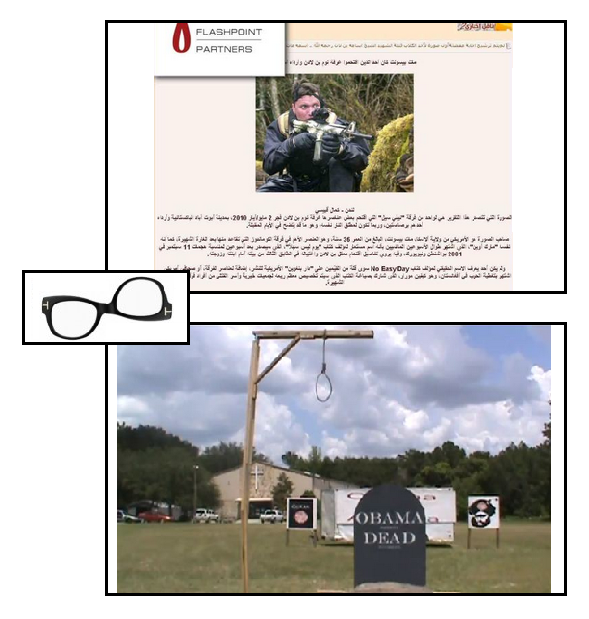
A poster on one of the Al-Qaida forums would like to see the SEAL who was on the raid that killed bin Laden dead, while the Reverend who delights in burning other people’s scriptures appears to want the head of his President in a noose… metaphorically, perhaps?

Sources:

Screenshot of threat to Navy SEAL author posted on “Al-Fidaa”, an officially-sanctioned Al-Qaida web forum, with h/t Evan Kohlmann @IntelTweet
Dr Terry Jones says Obama dead in 2012, with h/t JM Berger @intelwire…

As JM says: Stay classy, Terry Jones.

Yiddish humor, US Presidential Election

Friday, August 24th, 2012

[ by Charles Cameron — Jewish Democrats suggest humorous barbs for Jewish Republicans to digest ]
.

As those who follow my strand of posts her on Zenpundit know by now, I’m not a great one for taking sides: I imagine very few bridge builders are, and my real interest is in building bridges.

I am also, in general, interested in the ephemeral signals that go on between and within opposing camps — because they’ll often portray a different side of things from what’s in the official pronouncements.

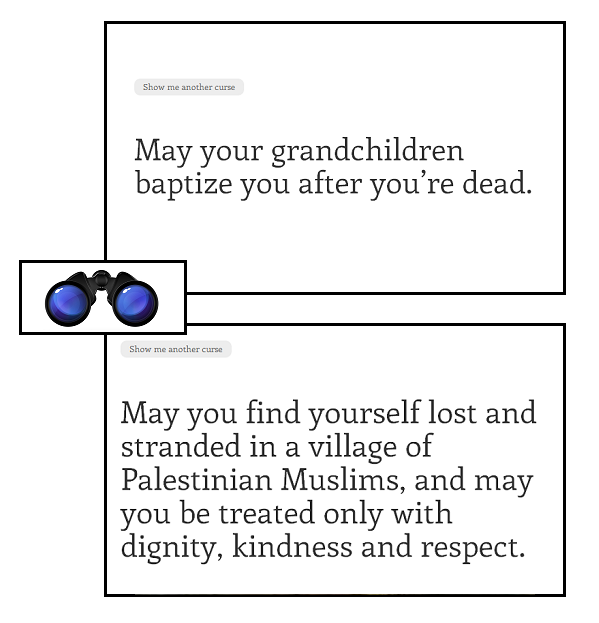
What I’m offering here, then, is a fleeting glimpse into some Jewish humor from the Democratic side of things:


.
— two “curses” from the from the Yiddish Curses for Republican Jews website.

As wry humor, I’m okay with these. As embittered humor, not so much.

And I don’t know the people who posted these “curses” — though I’m reasonably sure they didn’t intend them as actual, may G*d do this to you and I mean it, curses.

Frankly, I’m interested in the religious content.

**

I’m interested in the jokes.

I’m interested in the leaflets, the comments in the comment sections of websites — and in the winks, the nudges and the nods.

I’m interested in the differences between “in-house” and “external” explanations of things, what the differences may actually mean, and what they may get interpreted to mean. I’m interested in the asides, the sneers and smears, the jokes, the ambiguous threats, the real hatreds, the moments of reflection, the metanoias, changes of heart, repentances.

At times, the materials I run across are threatening, at times witty or droll, at times insightful, and at times completely unhinged from reality, but they usually have something to teach us about undercurrents — about the variousness of human thoughts and feelings.

We humans are a strange lot, each one of us so singular that we have a hard time getting our heads around the differences between us — differences that can make all the difference between peace and war, life and death.

**

I’m not going to explain the jokes, but I am going to take just a quick look at their religious content.

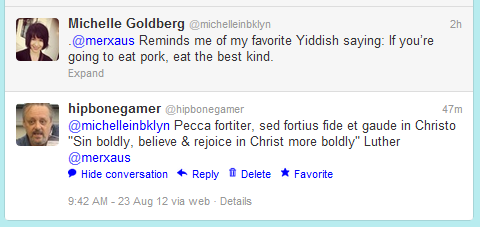
One of the qualities that is, IMO, most likeable about Jewish culture is that it delights in self-mockery. The New York Times journalist Michelle Goldberg tweeted a Jewish joke yesterday, to which I responded with a quote from Martin Luther:

Now I don’t know about Michelle, but I didn’t intend my quote from Luther — “sin boldly” — as representing either my personal advice to the world at large, or Luther’s, except perhaps in a very limited sense such as the one Dietrich Bonhoeffer offered as his explanation of Luther’s meaning.

Bonhoeffer’s question is the obvious one:

Is this the proclamation of cheap grace, naked and unashamed, the carte blanche for sin, the end of all discipleship? Is this a blasphemous encouragement to sin boldly and rely on grace? Is there a more diabolical abuse of grace than to sin and rely on the grace which God has given?

And his response?

Take courage and confess your sin, says Luther, do no try to run away from it, but believe more boldly still. You are a sinner, so be a sinner, and don’t try to become what you are not. Yes, and become a sinner again and again every day, and be bold about it. But to whom can such words be addressed, except to those who from the bottom of their hearts make a daily renunciation of sin and of every barrier which hinders them from following Christ, but who nevertheless are troubled by their daily faithlessness of sin? Who can hear these words without endangering his faith but he who hears their consolation as a renewed summons to follow Christ? Interpreted in this way, these words of Luther become a testimony to the costliness of grace, the only genuine kind of grace there is.

**

So no, I don’t think all religiously-themed tweeting and web-based cursing is to be taken literally.

But I do find it interesting that Michelle jokes about kosher, and I joke about sinning boldly — and that the Yiddish humor displayed on the “curses” website includes references to the LDS practice of proxy baptism for the dead and an indication that it might be uncomfortable for those with strong anti-Muslim feelings to meet the generous hospitality that so often characterizes Muslim cultures.

So let’s dig into those two themes in a little more depth.

**

Official Latter-day Saints doctrine teaches:

Jesus Christ taught that baptism is essential to the salvation of all who have lived on earth (see John 3:5). Many people, however, have died without being baptized. Others were baptized without proper authority. Because God is merciful, He has prepared a way for all people to receive the blessings of baptism. By performing proxy baptisms in behalf of those who have died, Church members offer these blessings to deceased ancestors. Individuals can then choose to accept or reject what has been done in their behalf.

And while the practice of baptizing the dead by proxy may seem strange to most Christians, the Latter-day Saints can point to I Corinthians 15.29:

Else what shall they do which are baptized for the dead, if the dead rise not at all? why are they then baptized for the dead?

and I Peter 4.6 for precedent:

For for this cause was the gospel preached also to them that are dead, that they might be judged according to men in the flesh, but live according to God in the spirit.

Maybe so — but Saints Peter and Paul, though Jewish by birth, are now generally reckoned Christians, having accepted the belief that Jesus was the awaited Jewish Messiah, the Christ — so their epistles are not canonical texts for mainstream Judaism.

**

Feelings in the Jewish community can run pretty strongly on the issue of Mormon believers’ baptisms of Jewish believing dead:

The wrongful baptism of Jewish dead, which disparages the memory of a deceased person is a brazen act which will obscure the historical record for future generations. It has been bitterly opposed by many Jews for a number of years. Others say they will never stop being Jews, simply because there is a paper saying they had been baptized, that the act of posthumous baptism is unimportant and should be ignored. We think this to be a narrow, parochial, and shallow view. We will continue opposing this wrongful act which assimilates our dead to the point where it will not be possible to know who was Jewish in their lifetimes.

[ … ]

A protest drive initiated by Jewish genealogists escalated it to a nationally publicized issue that was followed by public outcry. American Jewish leaders considered it an insult and a major setback for interfaith relations. They initiated discussions with the Mormon Church that culminated in a voluntary 1995 agreement by the Church to remove the inappropriate names. Activists continue to monitor Mormon baptismal lists, seeking removal of inappropriate entries.

Indeed, in February of this year it was discovered that the Holocaust victim Anne Frank had been baptized by proxy — for what one researcher said was the ninth time.

The Nobel laureate Elie Wiesel responded with passionate anger, and the Mormon Church with an apolpogy and a firm statement that the practice was prohibited.

LDS spokesman Michael Purdy made it clear that the Church “is absolutely firm in its commitment to not accept the names of Holocaust victims for proxy baptism.”

There are serious issues here: as humans, we can listen to one another with respect, and work them out.

**

Palestinian Muslim hospitality towards Jews?

Miftah is an Ethiopian who visited some Palestinian shepherds in company with people sympathetic to the Palestinian cause:T

he group I went with was a mostly Israeli – international activists’ group that accompanies shepherds in the village as they graze their herds. Since these shepherds face attacks from settlers and soldiers frequently, the purpose of the trip was to document and confront the settlers or soldiers if they try to harass the shepherds.

These were people the Palestinians had reason to respect, Israelis and foreign activists sympathetic to their cause — but the degree of hospitality they were shown nicely illustrates the innate courtesy of so many pastoral peoples…

As we were heading back from the hills to where our mini-van was, these shepherds we had met offered to take us home for some tea and coffee. Mind you, it’s the Ramadan fasting season and all of them were fasting. They would offer us water, coffee and bread even though the last meal they had was at dawn that morning and would not have any food or water until dusk that evening. In Ramadan, even people who don’t fast don’t eat in public or in front of people who fast. But out of true hospitality, they extended their “‘Mitzvah’ – their act of kindness” to us, as one of the Israeli activists put it

**

The story is an old one: the person of few possessions who will kill one of their handful of sheep to feed the passing stranger…

In this second “curse” we glimpse the long tradition of hospitality to strangers without which the great trade routes of the ancient would would not have permitted China to supply Europe with silks, nor Roman jewelry to have found its way into Japanese tombs

Pussy Riot, Holy Foolishness and Monk Punk

Sunday, August 19th, 2012

[ by Charles Cameron — mystery beyond the senses, holy of holies behind the veil, altar beyond the iconostasis, and other considerations bearing on Orthodoxy, Pussy Riot, holy folly and monastic punk ]
.

Life is full of surprises.
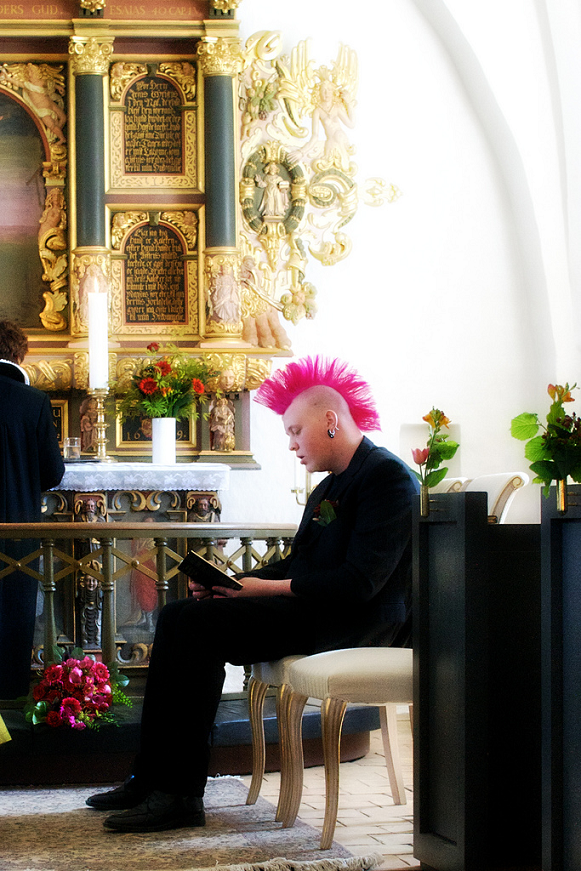
glorious photo credit: choir punk by teosartori under cc license

.

Okay, I started fishing around the web the way I do because when I first ran across the Pussy Riot story, I kept seeing press reports that said the grrls had been protesting on the altar of Christ the Savior Cathedral [Russian Orthodox] in Moscow.

**

What surprised me about this was that the altar in an Orthodox church would be behind the closed doors of the Iconostasis, because what takes place on the altar is too mysterious for us to grasp through the unaided senses.

Aside: there’s a lot of religious “clash of civs” going on in the Pussy Riot affait, so let me untangle some of the interesting threads, and then see where that leads us.

You may recall that when Christ died on the cross outside the City walls, there was a parallel incident inside Jerusalem: “the veil of the temple was rent in twain from the top to the bottom; and the earth did quake, and the rocks rent” [Matt 27.51]. This could, it seems to me, be an involuntary gesture of mourning on the part of the earth and temple — but it also opens the holy of holies..

In very broad strokes then, there are three spaces in Orthodoxy, separated by two doors, and they correspond to three ways of knowing.

    • Outside the church, there’s the realm where the senses and rational mind can be pretty much relied on for the kinds of transactions that humans mostly engage in, food, drink, shelter, exchange of goods…
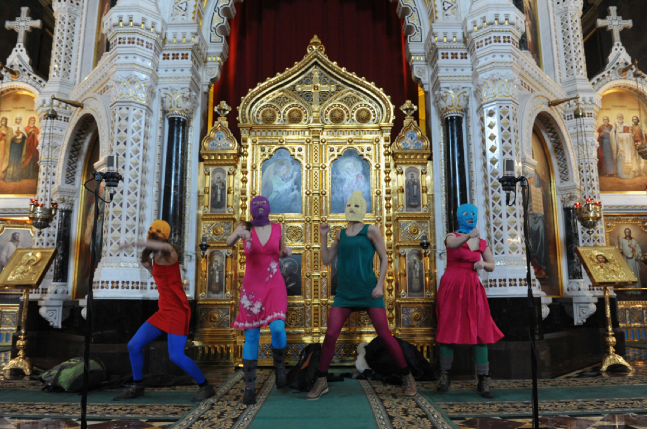
    • Passing in through the church door we are in a space of devotion, the nave, in which attention is focused on the second doorway, that of the iconostasis, where the icons are presented. Here the mental activity is typically one of prayer, and the icons are available to lead the senses and mind towards that which the mind cannot comprehend.

.
.

  • And passing, as only the ordained may, through the doors of the iconostasis into the Sanctuary, we enter the space of the altar and the sacramental transformation of the Eucharist — which neither rational mind nor senses can apprehend, and which is accordingly the realm of Mystery properly defined.

The Pussy Riot grrls are clearly dancing (and singing and prostrating and crossing themselves in the video) in front of the doors of the iconostasis — not “on the altar” — a big difference, which I would suggest is comparable in kind to the difference between human prayer and divine revelation.

No, they were not “staging an anti-Kremlin protest on the altar of Moscow’s main cathedral” [Telegraph], nor “performing what they called a ‘punk prayer’ on the altar of Moscow’s Christ the Savior Cathedral” [ABC News].

**

By way of giving you some context, Eurasia Review has the religious politics:

The actions of Pussy Riot inspired indignation on the part of Church leaders and regime officials. Patriarch Kirill called their action a “mockery of a sacred place.” Sergei Lavrov, the Russian foreign minister, said it was “blasphemy.” The women were described as “satanic devils” and “prostitutes” and there were calls for them to be ripped to pieces on the ancient execution site in Red Square.

What was lost in all this was the identification of the Russian Orthodox Church with the Putin regime. Putin’s inauguration was marked by the ringing of church bells in the Kremlin. Kirill held a special prayer service for his “health” and “success in government,” in the Cathedral of the Assumption in the Kremlin. In the Novodevichy Monastery, the nuns sang psalms round the clock for Putin’s health.

And then there was that 2009 London Times article:

The Russian Orthodox Church will choose tomorrow between three alleged former KGB agents as its next spiritual leader.

More than 700 priests, monks and lay representatives will decide who should become the new Patriarch in the first Church election since the collapse of the Soviet Union.

The contest at Christ the Saviour Cathedral in Moscow pits the favourite, Metropolitan Kirill of Smolensk and Kaliningrad, against two rivals who also rose through the heirarchy at a time when the Church was under strict Communist control.

**

Here are the lyrics to the “punk-prayer” Virgin Mary, Put Putin Away that they were singing:

(choir)

Virgin Mary, Mother of God, put Putin away
?ut Putin away, put Putin away

(end chorus)


Black robe, golden epaulettes
All parishioners crawl to bow
The phantom of liberty is in heaven
Gay-pride sent to Siberia in chains

The head of the KGB, their chief saint,
Leads protesters to prison under escort
In order not to offend His Holiness
Women must give birth and love

Shit, shit, the Lord’s shit!

(Chorus)

Virgin Mary, Mother of God, become a feminist
Become a feminist, become a feminist

(end chorus)

The Church’s praise of rotten dictators
The cross-bearer procession of black limousines
A teacher-preacher will meet you at school
Go to class – bring him money!

Patriarch Gundyaev believes in Putin
Bitch, better believe in God instead
The belt of the Virgin can’t replace mass-meetings
Mary, Mother of God, is with us in protest!

(Chorus)

Virgin Mary, Mother of God, put Putin away
?ut Putin away, put Putin away

(end chorus)

Here’s a linguistic comment, which I can neither affirm nor refute, from The Economist:

“The Lord’s Shit!” is a literal translation, while the expression “Sran’ Gospodnya” found in the lyrics is an equivalent of English “holy shit”, which is a totally diferrent matter.

And then there’s this:

But prosecutors sought to downplay the political angle and highlight the blasphemy, overriding the defense’s objections with the help of Syrova’s many “question disallowed!”

“Do you believe it acceptable to say ‘Holy sh*t!’ in the church?” a prosecutor asked a father of one of the defendants in the courtroom.

The man denied it, pointing out Russia’s ancient tradition of skomorokhi – traveling actors afforded the degree of freedom of speech that apparently exceeded that allowed to Pussy Riot. Of course, the skomorokhi sometimes faced burning at the stake, but this was not mentioned at the hearing.

**

Which brings us to the entire issue of holy fools in Orthodoxy…
The holy fools are understood to “feign madness in order to provide the public with spiritual guidance” — but I wonder if that’s a rationalization of behaviors that were simply sane, direct and challenging at the time. Consider this description from the National Catholic Register:

In Russian history the greatest of the “holy fools” was Basil the Blessed, a man so revered that the famous Cathedral in Moscow’s Red Square next to the Kremlin was named in his honor. Basil walked through Moscow wearing nothing more than a long beard. He threw rocks at wealthy people’s houses and stole from dishonest traders in Red Square.

Few doubted Basil’s holiness. Tsar Ivan the Terrible feared no one but Basil. Basil was also given to eating meat on Good Friday. Once he went to Ivan’s palace in the Kremlin and forced the tsar to eat raw meat during the fast saying, “Why abstain from eating meat when you murder men?” Countless Russians died for much less but Ivan was afraid to let any harm come to the saintly Basil.

And the grrls explicitly claimed the Holy Fools inspired their mode of protest:

Nadia said. “We were searching for real sincerity and simplicity, and we found these qualities in the yurodstvo [the holy foolishness] of punk.”

Well, there are similarities, and there are differences. The canonical Holy Fools were presumably orthodox in their beliefs, which the Riot may not be — but on the other hand, they are clearly “speaking truth to power” to use the admirable Quaker phrase.

Folly is a tad under-appreciated these days.

**

On the other hand, maybe it’s demonic possession. From the examination of “altar warden Vasily Tsyganyuk, classified as a victim because he claimed to have suffered psychological trauma as a result of the performance” during the trial:

VICTIM: “Those who are possessed can exhibit different behaviors. They can scream, beat their heads against the floor, jump up and down…”

DEFENSE ATTORNEY NIKOLAI POLOZOV: “Do they dance?”

VICTIM: “Well, no.”

JUDGE: “Stop questioning him about those who are possessed. Tsyganyuk is not a medical professional and is not qualified to render a diagnosis.”

Nah, not possessed — possession would be a medical diagnosis.

**

Hey — the name Pussy Riot is a riot — and riots are not always comfortable.

Who would have imagined the name “Pussy Riot” would appear on the digital tongue of Archbishop Cranmer — who only the other day was chastised for saying that British Olympic athletes had “given the nation a veritable golden shower of success after success” when the kind of golden shower he was thinking of was presumably the kind Zeus showered on Danae.

But the good Archbishop — or at least the conservative Christian blogger who has taken that name — has in fact been vociferous in support of the Pussy Tribe, their name notwithstanding:

This is foolish. If history teaches us anything about the murky fusion of religion and politics – the spiritual with the temporal – it is that you cannot persecute the prophets of truth without multiplying the message and spreading the cult. These women had no bombs or bullets: they are not terrorists, but anarchic artists. The more inflated and preposterous the charges laid against them, the more they are elevated to martyrdom. The longer they rot in prison at the behest of a puffed-up Patriarch, the more that martyrdom becomes a cause.

Pussy Riot have nailed their 95 Theses firmly to the door of the Cathedral of Christ the Saviour. You can’t kill a movement by crucifying the radicals.

That’s theology!

But look, ecclesial nomenclature can be ambiguous in its own right. The original Archbishop Cranmer was a Puritan divine, and Richard Hooker the latitudinarian divine who wrote the classic Of the Lawes of Ecclesiastical Politie.

I think we can be safely if secretly amused that one of Cranmer’s respondents in the Pussy matter has chosen the online moniker “The Judicious Hooker”. In fact he’s the one who posted:

I realise that YG was rather plain in the chancel department (praise God for the Laudian revival!) but the ‘prisoners of conscience’ were not dancing on the altar. The Orthodox Holy Table lies behind the iconostasis screen and access is confined to sacred ministers.

The Orthodox – of all Christians – still maintain the sense of the sacred. The Cathedral’s iconostasis – where icons of our Lord and his Saints are displayed for veneration – looks rather impregnable and its doors firmly shut against profanation.

But I digress, I contain multitudes, I know.

**

One of the more interesting blogs I’ve run across discussing the Putin Pussy event has been Khanya — here’s a taste:

Is there an Orthodox culture, and does it have anything to say about this?

Yes, I believe there is an Orthodox culture, and it is well expressed in one of the hymns we sing repeatedly in the Paschal season.

Let God arise, let his enemies be scattered
Let those who hate him flee from before his face.

Does that apply to Pussy Riot?

Yes, I believe it does.

But you have to come to the end of the hymn to see how it applies.

This is the day of resurrection.
Let us be illumined by the feast.
Let us embrace each other.
Let us call “Brothers” even those that hate us, and forgive all by the resurrection, and so let us cry:
Christ is risen from the dead
Trampling down death by death
And upon those in the tombs bestowing life.

So what do we call the members of Pussy Riot?

Sisters.

And what do we do with them?

Embrace them, forgive them by the resurrection and tell them that God loves them and we love them too.

That’s Orthodox culture.

**

Another insightful blog has been Registan, where Sarah Kendzior came at things from a different angle:

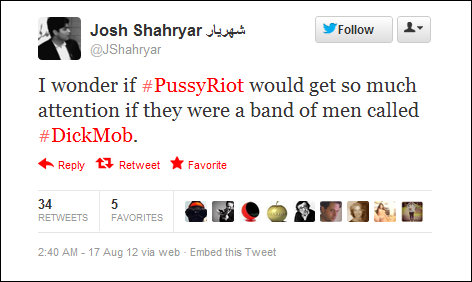
Media outlets that regularly cover Russian politics have noted how male Russian dissidents have been ignored as Pussy Riot draws world sympathy.
.
.
Removing Pussy Riot from the broader problem of political persecution in Russia is a mistake, but the case also raises specific questions about gender, media and politics.

In the same week that Pussy Riot was profiled in the New York Times style section, the Boston Review republished a 2010 interview with Hillary Clinton, in which she was asked who her favorite designer was. “Would you ever ask a man that question?” she snapped. “Probably not, probably not,” the reporter replied. The American media embraced Clinton’s riposte, reprinting it widely. But when it comes to foreign female dissidents, they promote the values Clinton rejects.

**

Meanwhile — and I mean meanwhile, since this has nothing directly to do with Pussy Riot, and a great deal to do with them in indirect ways — in my own beloved California:

In the wilderness of Northern California, Monks John and Damascene searched in hopes of finding a way to reach out to the Punk scene, which John had escaped. Seeing that the scene was full of kids that were sick of themselves and crippled by nihilism and despair, the Monks set out to give them the same hope that they found in Ancient Christianity. To do this, they decided to submit an article about Father Seraphim Rose in the popular magazine, Maximum Rock and Roll.

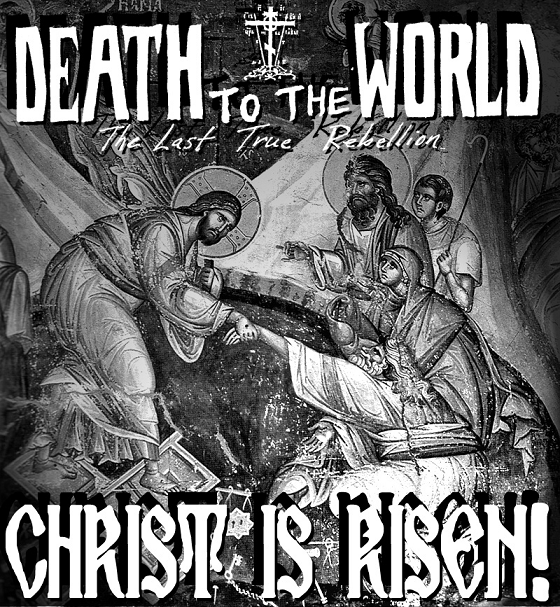
When Father Damascene read over the magazine, he knew that they would never publish something like it. Struggling to show truth to the darkened subcultures, they tried again, but this time only placing an ad for Saint Hermans Brotherhood. They got a response from the editor, saying “What the @#*% is a Brotherhood?” and the Monks were told “We only run ads for music and ‘zines*.” A light bulb went on and thus, Death to the World was born.

The first issue was printed in the December of ’94 featuring a Monk holding a skull on cover. The hand-drawn bold letters across the top read “DEATH TO THE WORLD, The Last True Rebellion” and the back cover held the caption: “they hated me without a cause.” …
.

.

The first issue, decorated with ancient icons and lives of martyrs inside, was advertised in Maximum Rock and Roll and brought letters from all around the world. People from Japan, Lithuania, and Ireland wanted to get their hands on this new radical magazine. The mailing list grew and grew and the ‘zine was distributed at punks shows and underground hangouts. It was photocopied and passed around by hundreds who wanted to read about the radical lives of the lovers of truth and the mystery of monasticism. It was estimated that at one time, there were 50,000 in circulation.

Father Paisius, who is a Monk at the monastery, said, “This subculture is raucous and deeply disturbed because of their own pain. They see life as worthless. We want to show them an ideal that is worth their life. These are marginalized youth who are wounded, and Death to the World is meant to touch with a healing hand that wound.”

Writing and putting together issues 1-12, the Monks lived in the forests of Northern California in the midst of deer, bears, mountain lions, and rattlesnakes, translating and publishing wisdom from the holy fathers and mothers of ages past. The Monks and friends of the monastery also went to rock concerts and festivals, distributing Death to the World ‘zines and t-shirts, together with icons and other books that the monastery published. The Monks did not put out any issues after issue 12, but they continued to share and hand out back orders of Death to the World.

**

That may be where the guy up there in the choir with the shocking pink mohawk comes in.


Switch to our mobile site