zenpundit.com » christianity

Archive for the ‘christianity’ Category

Happy Easter, with a Bach blessing

Sunday, April 16th, 2017

[ by Charles Cameron — from the heart, may it go to the heart, as Beethoven once said ]
.

Yesterday, Nicholas Kristof posed the question, President Carter, Am I a Christian? His subhead read, Christians celebrate Easter on Sunday. But wait — do we really think Jesus literally rose from the dead?

Here’s a taste:

NICHOLAS KRiSTOFF: How literally do you take the Bible, including miracles like the Resurrection?

PRESIDENT CARTER: Having a scientific background, I do not believe in a six-day creation of the world that occurred in 4004 B.C., stars falling on the earth, that kind of thing. I accept the overall message of the Bible as true, and also accept miracles described in the New Testament, including the virgin birth and the Resurrection.

KRiSTOFF: With Easter approaching, let me push you on the Resurrection. If you heard a report today from the Middle East of a man brought back to life after an execution, I doubt you’d believe it even if there were eyewitnesses. So why believe ancient accounts written years after the events?

CARTER: I would be skeptical of a report like you describe. My belief in the resurrection of Jesus comes from my Christian faith, and not from any need for scientific proof. I derive a great personal benefit from the totality of this belief, which comes naturally to me.

**

Et Resurrexit, from the Credo, Bach’s Mass in B Minor, performed by Akademie für Alte Musik Berlin under the baton of Daniel Reuss:

**

I guess I’m a reverse Bultmann: I don’t want to de-mythologize Christianity, I love to re-mythologize it.

If the Bible opened with the words, “Once upon a Time, God created the heavens and the earth..” and the Creed, “I make-beieve in One God, The Father Almighty..” we would still be in story, but no longer subject to the same kind of debate as to the historicity or dubiosity of the narrative’s claims. It’s a move that the literary critic Northrop Frye made on a more intimate scale when he called the Book of Revelation:

a fairy tale about a damsel in distress, a hero killing dragons, a wicked witch, and a wonderful city glittering with jewels”

I’m not interested in this move because it’s literary criticism; I’m interested in it because it rescues the great story corpus of our civilization from blind literalism on one side and blind debunking on the other.

**

Bach, I believe, in his towering Mass in B Minor — written by a fervent Lutheran to the Latin, hence Catholic, text of a rite he would have celebrated in Luther’s and his own native German — offers those who cannot believe the literal truth another avenue to experience the majesty of the ideation. This at least need not be disavowed by those leabving the faith, and may serve as a welcome portal to those entering it.

Wishing you a happy and blessed Easter, one and all..

Annunciation, framed

Monday, April 10th, 2017

[ by Charles Cameron — the war of content and context, Coptic / ISIS version ]
.

You are in a museum of the fine arts. You may recognize the painting is of the Annunciation.

You are in a church. The angel Gabriel announces to Mary that she will bear a son, and call his name Jesus:

He shall be great, and shall be called the Son of the Highest: and the Lord God shall give unto him the throne of his father David: And he shall reign over the house of Jacob for ever; and of his kingdom there shall be no end.

You are in a war zone: see, as much as you can see.

**

The photographer is in the war zone, catches a glimpse of the art, and takes the photo.

The returning devotee, I’d suggest, grieves the impact of war, pierces through and beyond it with his or her devotional gaze.

Cherry blossom season 02

Sunday, April 9th, 2017

[ by Charles Cameron — cherry blossoms and kamikaze, Palm Sunday and istishhad ]
.

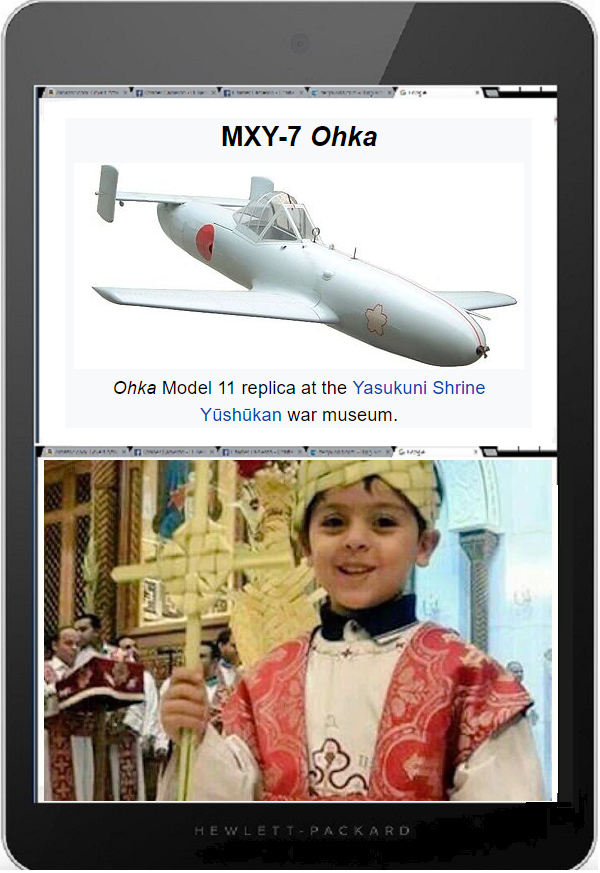
It’s cherry blossom season, it’s Palm Sunday. Blossoms fall, while temporary followers of Christ — they’ll abandon him to crucifixion later in the week — celebrate Christ’s arrival in Jerusalem strewing palm leaves at this feet.

**

In the upper panel, Japanese self-sacrifice with intent to kill Americans:

The Yokosuka MXY-7 Ohka (“cherry blossom”) was a purpose-built, rocket powered human-guided anti-shipping kamikaze attack aircraft employed by Japan towards the end of World War II

Kamikaze pilots — the term translates to “divine wind” — drew strong associations between the transience of cherry blossoms and their own lives.

From WIkipedia:

The names of four sub-units within the Kamikaze Special Attack Force were Unit Shikishima, Unit Yamato, Unit Asahi, and Unit Yamazakura.[22] These names were taken from a patriotic death poem, Shikishima no Yamato-gokoro wo hito towaba, asahi ni niou yamazakura bana by the Japanese classical scholar, Motoori Norinaga. The poem reads:

If someone asks about the Yamato spirit [Spirit of Old/True Japan] of Shikishima [a poetic name for Japan] — it is the flowers of yamazakura [mountain cherry blossom] that are fragrant in the Asahi [rising sun].

From Emiko Ohnuki-Tierney, Kamikaze Diaries: Reflections of Japanese Student Soldiers:

As Hayashi entered the military and struggled to come to terms with death, he came to identify himself with cherry blossoms. In a letter to his mother, he laments his fate: the cherry blossoms at the Wo?n-san Base in Korea, where he was stationed, have already fallen, and yet the time for his sortie has not come. To his younger brother he writes from the Kanoya Base: “Cherry blossoms are blooming and I am going” (90). Hayashi consciously draws an analogy between himself and the fl owers; their falling signifi es the time for his death.

Other people also used the metaphor of cherry blossoms to refer to Hayashi. A poem written by his mother after the end of the war contains the idiomatic expression the “falling of my son,” applying the word conventionally used for the falling of cherry petals to the death of Ichizo¯. Hayashi’s friend Hidemura Senzo¯ laments that “Hayashi’s youth is fallen,” like cherry petals, but adds: “Peace arrived but not the peace you wished to bring through your sacrifi ce; it is only in the miserable aftermath of defeat.” Hidemura concludes, “Beauty appears in a sensitive vessel and life is short” (143–47).

See also: Ohnuki-Tierney, Emiko (2002). Kamikaze, Cherry Blossoms, and Nationalisms: The Militarization of Aesthetics in Japanese History.

**

In the lower panel, the face of a child killed in the ISIS-claimed suicide bombing of a church in Egypt this Palm Sunday, following an earlier ISIS announcment that they would be targeting Egyptian (Coptic) Christians.

ISIS Claims 2 Deadly Explosions at Egyptian Coptic Churches on Palm Sunday

TANTA, Egypt — Islamic State suicide bombers attacked two Coptic churches in Egypt on Palm Sunday, killing at least 40 worshipers and police officers stationed outside in the deadliest day of violence against Christians in the country in decades.

The militant group claimed responsibility for both attacks in a statement via its Aamaq news agency, having recently signaled its intention to escalate a campaign of violence against Egyptian Christians.

The first explosion occurred about 9:30 at St. George’s Church in the Nile Delta city of Tanta, 50 miles north of Cairo, during a Palm Sunday Mass. Security officials and a witness said that a suicide bomber had barged past security measures and detonated his explosives in the front pews, near the altar.

At least 27 people were killed and 71 others injured, officials said.

Hours later, a second explosion occurred at the gates of St. Mark’s Cathedral in the coastal city of Alexandria. That blast killed 13 people and wounded 21 more, the Health Ministry said.

The patriarch of the Egyptian Coptic Church, Pope Tawadros II, who is to meet with Pope Francis on his visit to Egypt on April 28 and 29, was in the church at the time but was not injured, the Interior Ministry said.

See also:

‘God gave orders to kill every infidel’ ISIS vows to massacre Christians in chilling video<

**

The joyous palm leaves of Sunday, greeting Christ‘s arrival in Jerusalem, will ritually and symbolically turn to ashes later in the week, as the adoring crowd turns vicious and demands his crucifixion.

Palm Sunday surprise

Sunday, April 9th, 2017

[ by Charles Cameron — with Holy Week good wishes ]
.

What drives us is narrative. Narrative is (generally speaking) sequential in time. Sequence in time is marked on calendars. One purpose of calendars is to make each day sacred in its measure.

Today is Palm Sunday in the Christian calendar; I wish all ZP readers a profound and safe Holy Week to follow..

Footnoted readings 02 – Acts of corporal mercy

Sunday, April 2nd, 2017

[ by Charles Cameron — a note at the intersection of material with spiritual ]
.

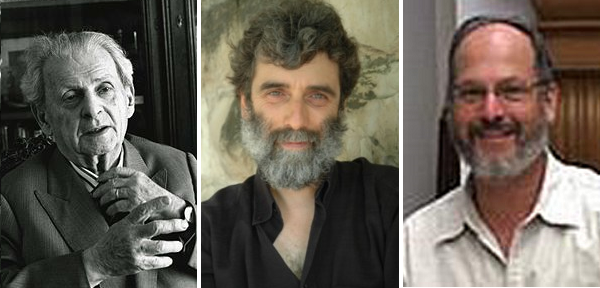
left to right: Emmanuel Levinas, Gershom Gorenberg, Elliott Horowitz

**

Gershom Gorenberg in March 28th’s Washington Post tells three stories from his own life of what I believe Catholicism would call “acts of corporal mercy” — feeding the hungry, giving drink to the thirsty, clothing the naked, visiting prisoners, visiting the sick, harboring strangers, and burying the dead (Matthew 25. 34-40). He concludes, honoring his mentor, Israeli historian Elliott Horowitz:

He said, without pride or embarrassment, that he acted out of religious conviction. In Israel, the political stereotype of Orthodox Jews is of people concerned exclusively with settling the occupied territories. In the world, commitment to the most traditional forms of faith — Jewish, Christian, Muslim or other — is often confused with building walls between people.

Elliott believed that faith demanded breaking down barriers between human beings created in God’s image. I believed that, too, but he pushed me to act.

**

It’s a story by and about a friend, and about human goodness. Apart from those two sterling but not uncommon facts, why should I care?

I care because the story illustrates the Jewish proverb of which Emmanuel Levinas reminds us:

the other’s material needs are my spiritual needs

It’s not easy to bridge the gap between subjective experience and objective, physical reality, which is why the hard problem in consciousness is called the hard problem in consciousness — but this quote bridges the gap effortlessly, and in a manner that instructs us.


Switch to our mobile site