zenpundit.com » islamic world

Archive for the ‘islamic world’ Category

At a distance of three caliphs

Friday, August 31st, 2012

[ by Charles Cameron — caliphal succession as a marker in Egyptian-Iranian diplomacy at NAM ]
.


.

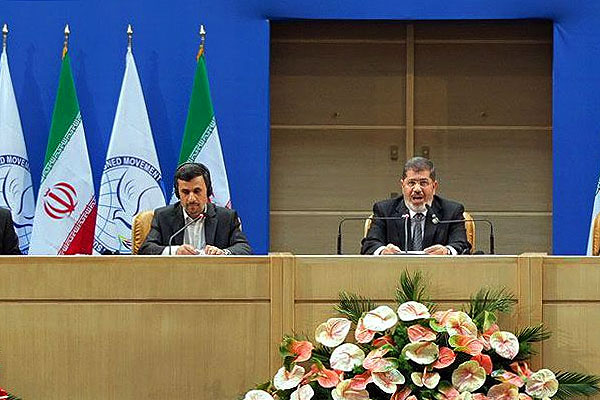
Describing Egyptian President Morsi‘s speech in Iran at the Non-Aligned Movement conference, Rodger Shanahan of Australia’s Lowy Institute wrote, tellingly:

Invoking the names of the first four caliphs (which never goes down well in uber-Shi’a Iran), his condemnation of the Syrian regime (an Iranian ally) caused the walkout of the Damascene delegation and stole much of the positive messaging that Iran would have been hoping for from this meeting.

Sunni Islam recognizes four “rightly guided” Caliphs as the successors to the Prophet: first among them was Muhammad‘s friend Abu Bakr, who was succeeded by Umar — who when he conquered Jerusalem, is said to have entered it on foot, and guaranteed the protection of the Christians and their churches – third, Uthman, remembered for establishing the definitive text of the Quran, and finally the Prophet’s cousin and son-in-law, Ali ibn Abi Talib.

Of these, Ali alone is recognized by the Shia, who consider him the Prophet’s rightful heir and their own first Imam.

As the photo above suggests, Morsi, a Sunni, and Ahmadinejad, a Shia, are precisely three caliphs apart.

Of a fault line, and of the Qibla

Tuesday, August 28th, 2012

[ by Charles Cameron — Sunni and Shia, Mecca and Qom, Saudi and Iran and the balances between them, with special attention to Mecca — and sideways comparisons with Las Vegas and Somoza’s Nicaragua ]
.

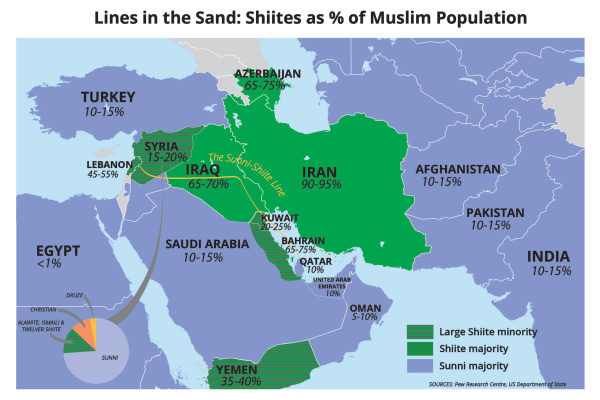
Consider this map:


.

It was ZenMeister who pointed me today, via Notes from Thermopylae, to Stephen Crittenden and his Global Mail piece, The Clash Within Civilisations: How The Sunni-Shiite Divide Cleaves The Middle East, from which the map above is taken. Crittenden writes:

There is a dangerous 2,000-kilometre fault line running through the Middle East between Beirut and Bahrain via Damascus and Baghdad, which marks the present line of demarcation between the two main branches of Islam, Sunni and Shiite.

The 1,300-year-old schism between Sunnis and Shiites was caused not by a theological dispute (those came later), but by rival clans in Muhammad’s tribe, the Quraysh, squabbling over the succession after his death in 632 AD.

Mostly the “Sunni-Shia Line” lies dormant, and ordinary Sunnis and Shiites live out their separate lives, side-by-side in relative harmony. In Lebanon and Iraq it has not been uncommon for Sunnis and Shiites to intermarry. But the Line is still always there, just below the surface, and it has recently re-emerged as the most significant factor reshaping geopolitical relationships in the Middle East, a region where religion and politics are always inextricably intertwined.

**

Suppose it, at least for now. And in that context, consider as a counterweight to all the talk about Iran, two fascinating pieces by the Pakistani novelist Maniza Naqvi.

Naqvi’s piece The Remit of Fear in 3 Quarks Daily today is worth reading — you may be interested in any one or more of her various critiques of the House of Saud:

I fear the perverse purchase of petrodollars from Saudi Arabia: the twin ideologies of Salafism and Islamophobia. …

[ … ]

I fear to imagine a county which produces no art, film, theater, song or dance. Yet such is the country created by the State of Saudi Arabia. I fear the reasons which cause 16 million citizens most of whom are not Saud in Saudi Arabia to remain silently compliant. The bulk of this population is under the age of 25 and disempowered and is ruled absolutely by old men who do not tolerate dissent or diversity of opinion. I fear the mindset that treats women as blots and clots to be erased or managed.

There’s plenty of food for thought there, not least about Pakistan:

I fear that the people unlearned and illiterate impressed by influence and the purchasing power of Saudi Arabia might be confused and unable to distinguish the House of Saud as being apart from the origin and the authors of Islam. I fear that this may be the case for Pakistan where matters are so far gone that if the father of the Nation, Mohammad Ali Jinnah were alive today he would not be able to go about freely for fear of being shot to death for being a Shi’a.

My own interest, as usual, draws me to the religious drivers at work and their impact:

I fear that after thirty years of petrodollar bonanzas and propaganda, Muslims are unable to delink Islam from the House of Saud. There are 5000 Saud and in comparison there are 1.2 billion Muslims all over the world. A majority of whom, for a myriad of reasons including illiteracy, poverty and sudden wealth are unable to resist or protest against the Saudi influence upon them. I fear that the populations of the world are unable to resist, protest and fight against the privatization of all that is their sacred to them: their lands where they grow their food, to the places where they congregate and live, to their own thoughts and even their bodies.

**

But you should read too her linked critique of the remaking of Mecca, The Architects of the War on Islam, from August 6th:

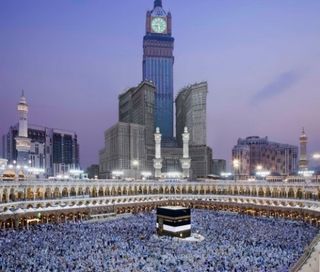
This is addressed to Muslims who think that Islam is under attack: They are right. Just take a look at the images of the House that Abraham built, the Ka’aba and see how progresses that ancient attack. Just look at the transformation of the environs of the Ka’aba and the Haram Shareef into a garish resort rivaling Las Vegas or Atlantic City.

Just look, at the transformation of the sacred environs of the Haram Shareef into a shopping mall and Disney world–to understand the war on Islam and who is responsible for waging it. Just look at this and see how Islam has been trafficked as though it were a bonded slave, dressed up in bells and baubles to be whipped and sold in the marketplace.

**

Note finally her remarks, in today’s piece, on fear and silence:

Much is at stake if people are not silent. Much is at stake if people remain silent.

[ … ]

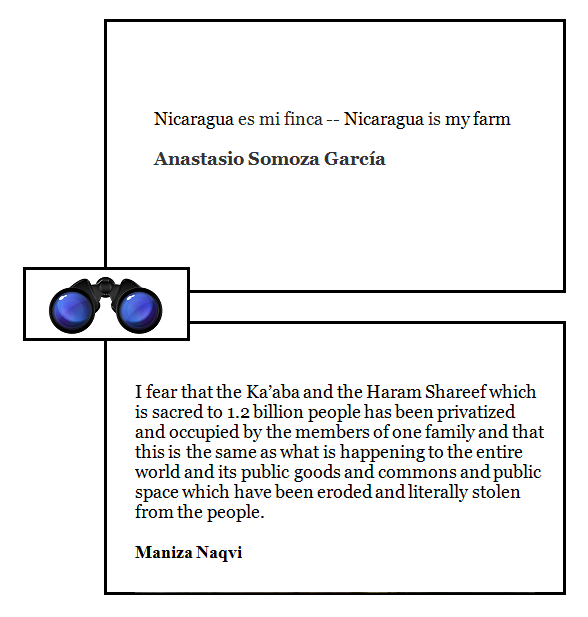
I fear that Haj and the Ka’aba, a central principal of Islam, sacred to 1.2 billion people have been privatized, by an estimated 5000 people belonging to one family. Why? How is the privatization of the Ka’aba different from the wholesale seizure and privatization of the commons and public lands and spaces all over the world? I fear that the Ka’aba and the Haram Shareef which is sacred to 1.2 billion people has been privatized and occupied by the members of one family and that this is the same as what is happening to the entire world and its public goods and commons and public space which have been eroded and literally stolen from the people.

And now you can see, too, why I am reminded of Somoza and his farm, Nicaragua:

With this profound difference: that the Ka’aba is the Qibla, the point of orientation to which all Muslim prayer turns, as others orient their prayers towards Jerusalem.

Pakistan’s Strategic Mummery

Saturday, August 18th, 2012

A while back, Charles Cameron had a post on the Ghazwa E Hind that served as my introduction to an oddball Pakistani agitator named  Zaid Hamid The colorful Mr. Hamid seems to be Pakistan’s fully militarized version of Glenn Beck fused with an Islamist George Friedman, with perhaps an astrologer and Rip Taylor thrown in for good measure. In discussing this figure, ZP commenter Omar offered:

….But this clown has serious backers. The deep state systematically uses these clowns to prepare the “information space” for their plans. ..and they are not kidding around. 

Zaid Hamid made a recent appearance in another post by Charles, so I felt inspired to look at him more closely and discovered that Hamid, who has a fondness for 4GW verbiage, has his own think tank, Brasstacks which publishes “geostrategic analysis”, largely about alleged “Hindu Zionist” (?) conspiracies to destroy Pakistan. These papers are fascinating, in a car-crash sort of way, much like a political intelligence letter from the LaRouchies. There is also a blog by Hamid, where his latest post remarkably declares Pakistan’s late dictator, the ruthless General Zia ul-Haq, a “shaheed”.

My question, since Hamid appears to stir controversy and criticism within Pakistan, is what is his real level of influence in Paskistani society? Comments welcome.

IVN Article:Competition in the Age of Frenemies

Saturday, August 4th, 2012

I have a short piece up at IVN:

Competition in the Age of Frenemies 

competition in the age of frenemies 47130 Competition in the Age of Frenemies

Credit: lib.utexas.edu

Ideology is being replaced by realpolitik in the world political arena, with competition and cooperation between frenemies perhaps becoming the norm. The war on terror began on September 11, 2001 in New York City and Washington DC, where teams of terrorists professing a militant brand of Sunni Islamism killed thousands of Americans using commercial airliners, brought down the World Trade Center, damaged the Pentagon and caused roughly $100 billion in direct and indirect economic damage and possibly $2 trillion in subsequent expenditures on military operations and security.

….By 2012, the global picture has drastically changed. Osama bin Laden is dead and his fanatical followers are able to operate freely only in the poorest, most remote or desolate regions of the earth – northern deserts of Mali, the lawless hinterlands of Yemen, Pakistan’s wild tribal belt and ruined villages in war-torn Syria. Instead of a laser-like focus on al Qaida, the next President will have to  worry more about economic collapse in Europe, China bullying it’s neighbors over the South China Sea, civil wars in Mexico and Syria and Iran’s quest for the nuclear bomb. 

Read the rest here. 

This is a quick synopsis of an idea I am playing with lately.

It is of course, contingent. If Egypt takes a nasty turn and a post-Assad Syria falls to Salafi-Takfiri extremists ( creating a religious variant of the old Nasserite UAR alliance) we might be talking about a “Sunni Axis” with a radicalized Pakistan giving new life to transnational, revolutionary jihadism.

Without that , the prospects for al Qaida’s vision of political Islam look increasingly grim. As the the AQ strategist al-Suri noted, the loss of Afghanistan in 2001 as a secure base of operations, training ground and state sponsor was a heavy blow to the forces of radical Islamism.  A lack of replacement after ten years is an embarrassing state of affairs for a militant movement whose political center of gravity in the Islamic world is the claim of doing God’s will against the infidel.

Recommended reading: the meat

Sunday, July 22nd, 2012

[ by Charles Cameron — a couple of courteous debates on topics of considerable interest ]
.

I’d like to draw your attention to two recent conversations:

The first begins with Mark Jacobsen‘s Armed Forces Journal piece, How to teach about Islam, and continues with a guest post from Tim Mathews at Abu Muqawama, Insha’Allah they learn something useful. Mark then responds to Tim at his own blog, Building Peace.

Mark lays out the problem:

Much of the debate now hinges on which voices educators should trust. The question is no longer “What is Islam?” but “Who should teach about Islam?” Government agencies struggle to answer that question, because they often feel compelled to choose between two camps: those who believe extremism is intrinsic to Islam itself, and those who see no relationship whatsoever between Islamic doctrine and extremism. Although much thoughtful and scholarly discussion of Islam does exist, it is these two camps who now dominate the popular conversation.

Government agencies will never escape their dilemma if they continue searching for an authority who can speak for “true” Islam. Islam is a deeply contested religion, even among Muslims, and the arguments of both extremes are shot through with truth, falsehood, exaggerations, omissions and assumptions. Much of the debate about Islam in the United States is intellectually dishonest. Rival voices are less concerned with sincere discussion than with heavy-handed tactics to dominate the conversation, such as efforts to control government classrooms. The only way out of this dilemma is also the most intellectually honest one: to understand the battle for American perceptions of Islam, to map out the topography of the debate and to teach students to critically evaluate rival arguments.

Tim responds:

As should be clear, I agree with problems that the author identifies in the US. However, I fail to see what this has to do with the issue of educating our personnel. We are not training our personnel to be foot soldiers in a culture war fought on cable television and weblogs in the United States. We are training our personnel to conduct operations in foreign countries.

[ … ]

The problem that he identifies is not relevant to preparing our personnel for deployments to conduct, and provide support for, operations in majority-Muslim countries. What the author has advocated is a program to help our educators avoid being pulled into battles of a culture war on US soil and, along the way, educating our personnel. The primary focus should be educating and the secondary focus on mitigating public pressure from fringe organizations.

Mark’s response:

I’m very glad to see your thoughtful response to my article. More than anything, I had hoped to spark some discussion about how Islam is taught in various government agencies, so am glad to see you carrying the discussion forward.

[ … ]

One reason you might disagree with aspects of my article is because you viewed it primarily through the lens of preparing deploying soldiers. That is an important part of what I’m writing about, but I actually intended the article to encompass a much broader range of government needs. Government employees have many different reasons they might need to understand something about Islam. Congressmen and their staffs are trying to make sense of the alleged “shariah threat” and calls for anti-shariah legislation; law enforcement agencies and the FBI need a way to understand and delineate between “moderates” and “extremists”, so they can hone in on real threats while respecting the civil liberties of ordinary Muslims; military commanders concerned with preventing the next Ft. Hood want to know how they can recognize extremist ideology; government agencies involved in any sort of outreach to Muslim communities struggle to find partners they can work with, because the largest American-Islamic organizations that claim to speak for American Muslims are tarnished by alleged links to extremism and terrorism.

All three pieces are worth reading in full — it was hard to pull quotes that did any of them justice, they’re all packed! And FWIW I do think Mark is right in ranging beyond the constraints of “preparing our personnel for deployments” — Tim’s more focused concern — because the war of ideas is won or lost as much in terms of how the US is perceived WRT Islam as it is by the behavior of troops, village by village, “in the field”.

**

The second begins with a David Briggs piece in Huffington Post, Is It Time to Reconsider the Term Islamist?, which leads Daveed Gartenstein-Ross and Lauren Morgan to respond at Gunpowder & Lead with Islamism in the Popular Imagination — which in turn generated Bernard Finel‘s post On Islamists and Rick Santorum. Daveed then comes back with Islamists and Rick Santorum: A Response to Bernard Finel.

I’m not going to quote Briggs, whose piece strikes me as light-weight, except to note that he introduces the question of comparisons between Obama and Rick Santorum (potential “Christianists”) with “Islamists”:

At this year’s National Prayer Breakfast, President Barack Obama said his policies were grounded in his Christian beliefs. In a 2008 speech, former GOP presidential contender Rick Santorum said America was in the middle of a spiritual war in which “Satan has his sights on the United States of America.”

Are Obama and/or Santorum Christianists?

The answers to those questions would depend on how the term is defined. But it is unlikely you will hear any Christian politician or activist referred to in that way.

What American and western audiences are increasingly hearing, however, since the political and social upheaval that accompanied the Arab spring, is the term Islamist.

Daveed and Lauren:

You would be hard pressed to find anything beyond a few fringe commentators who are worried about Islamism because politicians representing this movement refer to Islamic principles in their rhetoric. Rather, it is the specific relationship between religion and state that worries observers. (I mean, really, does Briggs think that Obama will make canon law the law of the land if given a second term?)

Briggs bolsters his case by quoting Mansoor Moaddel, an Eastern Michigan University sociologist, as saying that in his interviews, he found that “‘in some respects, Mr. Santorum is more extremist’ than leading figures of Egypt’s Muslim Brotherhood.” Nor is Briggs the only Western commentator to fatuously compare Santorum to Islamic extremists. To actually approach the claim being made by Briggs and others — that Islamist politicians possess an agenda that is less extreme than that of Rick Santorum — a better approach is to look at the practice in Middle Eastern states, as well as the policies advocated by Islamist politicians with significant audiences (as opposed to mere fringe players). That is what we do in this entry.

And do they indeed do — detailing with bullet points and commentary the practical behaviors of a variety of Islamic nations in respect to apostasy, blasphemy, the rights of women, and gay rights in the rest of their lengthy and instructive piece.

Enter Bernard Finel, who draws a fine distinction:

GR argues convincingly that policies put in place by Islamist parties throughout the Middle East are more extreme than Santorum. And indeed, on issues like religious freedom, women’s rights, and gay rights, GR is quite correct. Islamist regimes are worse than anything Santorum has proposed.

But I’d argue this is an apples to oranges comparison. Santorum’s limits are defined, I think, more by the limits imposed by American institutions rather his ideology per se. In other words, GR is comparing institutionally unconstrained ideological positions with those heavy constrained by institutions. It actually is not at all difficult to find actors on the right who would like to see religious freedom severely curtailed. Indeed, there is even a “Constitutional theory” out there among right wingers than Muslims should not receive First Amendment protections because either Islam is a “cult” or because it was not extant in any significant way in the United States when the Bill of Rights was ratified.

I’ll get into the issue of “actors on the right who would like to see religious freedom severely curtailed” in an follow up to this post — and touch on the usage “Christianist” there also — here, I’ll just say that Finel is articulating something I’ve “felt but not thought” or perhaps “thought but not articulated” myself quite a few times, and while I’m not entirely satisfied with his phrasing about “constraint by institutions” I think there’s a serious point in there, and I’m glad to see it surfaced.

Back to Daveed:

In comparing the relative extremes of Santorum versus those of Islamist parties, we were not trying to offer a moral judgment on the relative righteousness of those two actors (to be clear: we use “actor” in the loosest possible sense here, since Islamist politicians are by no means a unified actor). Rather, we were comparing exactly what we have just specified: the policies Santorum has advocated or implemented versus those that Islamist parties have advocated or implemented. It is true that institutional constraints play a role in defining said policies, but our goal was illuminating policies that are likely to have an impact on anyone’s life, and not judging Santorum’s “heart of hearts.” Hence, it is a direct apples to apples comparison of what policies are advocated by these two different actors. It would only be an apples to oranges comparison if our goal were moral judgment.

Fair enough: then there are at least two kinds of comparisons to be made… one between policies advocated by the respective parties, and one between the political realities constraining those whose ideals may be comparable.

**

Again, with such rich material it is difficult if not impossible to pick quotes without cherry-picking them — and I must repeat that my intention here has not been to summarize these debates so much as to lead you into them…

Finel actually has a further post today in which he characterizes Daveed (and Laurel) as making “an ill-conceived and pointless attempt to haul Rick Santorum into the mix” on the way to another discussion. For the record, it was Briggs, not Daveed and Laurel, who introduced Santorum into the discussion.

I’ll have two follow-ups to this post, one adding a couple of points to the Gunpowder & Leaf / Finel discussion in regard to “Christianism” and the theological underpinnings of a contemporary movement for church-state fusion, the other adding a couple of other intriguing details to the mix.
Switch to our mobile site