zenpundit.com » islamic world

Archive for the ‘islamic world’ Category

The symmetry: Charlie Hebdo

Saturday, September 22nd, 2012

[ by Charles Cameron — my apologies for an earlier incomplete draft, quickly withdrawn — first of two, on loose cannonry and mirror imagery — second will deal with recent events in Benghazi ]
.

.

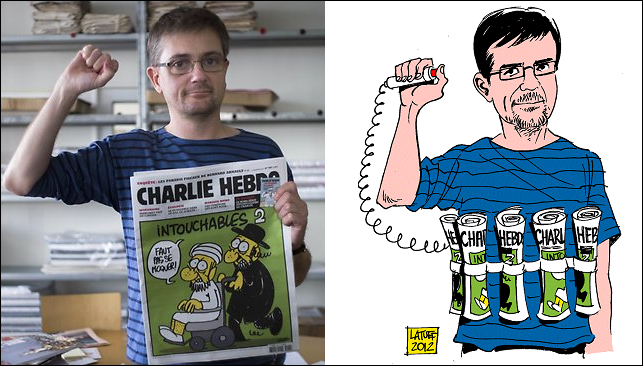
Charlie Hebdo recently published some cartoons featuring the prophet…

Okay, I’m always on about symmetry.

I posted a piece titled Messianic symmetries on ZP a while back, noting that both Ahmadinejad and Netanyahu can be viewed as exercising “leadership that makes decisions out of messianic feelings” — the quote comes from an unimpressed ex-Shin Beth director describing Bibi; Ahmadinejad makes the case for his own Mahdist leabings quite well himself.

Symmetry seems like an important analytic category to me, either because it’s there in the build of the world, or because it’s there in the build of the mind. Either way, I think we should take careful notice of symmetries.

Asymmetries I’ll talk about in my next post.

**

What about the cartoon above, right? It’s clearly based on the photo above, left, which shows Stéphane Charbonnier, the editor of Charlie Hebdo, holding his magazine with its offensive cartoons / vindication of free speech. And the suggestion is clear that he’s some kind of suicide bomber.

But who is he blowing up, exactly? Himself, and perhaps his staff and anyone else who happens to be within a few yards of his office at the time? France, Europe, the western world — the world itself? And how much irony should we read into the cartoon portrait?

They may have learned the technique from the Tamil Tigers, but these days, in the immediate wake of widespread rioting over the video clip and in the context of someone publishing cartoons that satirize the prophet, it’s clearly Islamist suicide bombers who provide the model for the cartoon of the cartoonist above.

Tit for tat? An eye for an eye? You’re just setting yourself up for a fatwa like Salman Rushdie?

**

Incendiary rhetoric on one side leads to incendiary behavior on the other, validating the incendiary rhetoric and making the escalation to incendiary behavior all the more probable.

Some of the incendiary rhetoric has its origin in holy books, which also preach peace.

There are Coptic Christians utterly blindsided by the virulence of the video, attributed to one of their number. There are Libyan Muslims utterly blindsided by the virulence of the attack on the US Embassy, attributed to some of their own.

**

I want to focus not on the specifics of the topic, but on the symmetry.

One writer, observing the partition of India and Pakistan, wrote:

The rioters brought the train to a stop. Those who belonged to the other religion were methodically picked out and slaughtered. After it was all over, those who remained were treated to a feast of milk, custard pies and fresh fruit.

Before the train moved off, the leader of the assassins made a small farewell speech: “Dear brothers and sisters, since we were not sure about the time of your train’s arrival, regretfully we were not able to offer you anything better than this most modest hospitality. We would have liked to have done more.”

Commenting on this paragraph, Ali Sethi wrote recently in the New Yorker:

That is all there is: murder—methodical and quick—followed by a feast and an ingratiating speech. Note the withholding of tags: we don’t know the location of the massacre or the religion of the killers. All we have is a spurt of base instincts.

The point here is that whenever you see a symmetry of opposites, it’s worth considering that symmetry in the abstract, as well as weighing the particular issues that drive your own side or the other.

That, I’d suggest, is one of the implications of that Paul van Riper remark I’m fond of quoting:

What we tend to do is look toward the enemy. We’re only looking one way: from us to them. But the good commanders take two other views. They mentally move forward and look back to themselves. They look from the enemy back to the friendly, and they try to imagine how the enemy might attack them. The third is to get a bird’s-eye view, a top-down view, where you take the whole scene in. The amateur looks one way; the professional looks at least three different ways.

**

I am concerned about hatred, simmering here, boiling over there. I am concerned about what sparks hatred, and what fans it. What I want to draw your attention to here, though, is the process by which one hatred fuels abother, the process of mirror imaging.

Mark Juergensmeyer, a terrific scholar of religion who has published on topics ranging from Gandhi‘s nonviolence to the violence of religionists who consider themselves sanctioned by the scriptures of various religions, makes the point in a recent Religion Dispatches post thus:

The US-based Islamophobes behind the insulting and amateurish video “The Innocence of Muslims,” and those behind the violent protests it allegedly caused around the Muslim world, are kindred hatemongers. Both are extremists with a political agenda, and both want to use this incident to discredit the legitimacy of the moderate governments in power in their respective countries. There is a symbiotic relationship between the strident protesters and the bigoted filmmakers; each needs the other.

We are in a hall of incendiary mirrors, with plenty of kindling: in my view, we should avoid playing with matches.

**

Thank God, there are also asymmetries.

In a companion post, I’ll take a look at recent, very promising events in Benghazi (h/t to Pundita for a pointer to this particular article), the not particularly unsurprising but unwelcome attitude of a Pakistani minister, and the imbalances that go along with the dangerous balances I’ve discussed in this post.

**

Oh, and let me digress…

I won the Divinity essay prize back in my schooldays at Wellington College, and received my chosen prize book, the Liber Usualis with its glorious collection of Gregorian Chants, from the then Minister of Defence, John Profumo, MP. Not long thereafter, it was discovered that he pillow talked with one Christine Keeler, a night lady of class, who also pillow talked with the Russian defence attaché. And the story was broken, week by glorious week, by the British satirical magazine, Private Eye.

Which I consequently have an affection for, after all these years. And I tell you this, because Charlie Hebdo, or Weekly Chuck as we might call it over here is, I’d suggest, a plausible latter-day French rough equivalent of Private Eye.

I don’t really like our guys posting inflammatory materials, you see, but I also have an affection for freedom of speech — and for magazines with a satirical bite, too…

So sue me, I contain multitudes.

Nir Rosen Among the Alawites

Thursday, September 20th, 2012

Controversial journalist Nir Rosen is, by my standards, a left-wing extremist with carcinogenic political views. On the other hand, he is also a fearless and skillful war correspondent who goes places to report where few others dare; as a result, Rosen is usually worth reading, particularly as he seldom is treading a well-worn path:

London Review of Books: Among the Alawites -Nir Rosen reports from Syria 

….When Abu Laith took me to Rabia itself, news of our arrival spread quickly. Thousands of residents staged a seemingly spontaneous but clearly sincere demonstration in support of the regime in the centre of town, next to a statue of Hafez al-Assad holding an olive branch and a sword. The statue, paid for by locals, was erected after the uprising started. Behind it was a massive poster with a picture of Hafez and Bashar. On it was written ‘Rabia is the lion’s den,’ a play on the word assad, which means ‘lion’. I was dragged from house to house so people could speak of their dead and wounded relatives, and of Rabia’s 42 martyrs. I told one group of local men that when I visited opposition strongholds like Baba Amr in Homs I always heard similar stories about fathers or sons being martyred. ‘Our sons were just going to work,’ an army colonel whose nephew was killed in Idlib said in reply. ‘There is a difference between killing a man going to work for the state and killing an armed man taking up weapons against the state. Is it peaceful demonstrators who kill five officers at a checkpoint?’

For the past year Rabia’s Alawites have clashed with neighbouring Sunni villages. Last summer the town’s students couldn’t travel into the city of Hama to take their exams because the opposition had blocked the road. Around thirty Alawite families from one nearby majority Sunni village have settled in Rabia, feeling it was no longer safe to stay where they were. The displaced families were disappointed with the government’s response. ‘We didn’t have any weapons or we would have fought back,’ one man told me. ‘They should have sent in tanks but the opposition blocked the roads. We want the state to solve our problems and the army to return us to our land. The army has to enter the villages, but the army is busy in Hama. Why is the state taking its time?’ Abu Laith’s father, a retired soldier, agreed. ‘Only the army can solve this,’ he said. ‘If we respond ourselves it will be seen as sectarian violence and other villages will join them against us. They will outnumber us.’

From Rabia I headed north-west towards Aziziya, a remote Alawite village which has clashed with the neighbouring Sunni village of Tamana. As in most Alawite villages, the majority of its men work in security or the army. Its Sunni neighbours all support the opposition, and opposition militias have been operating in the area since last spring. Salhab, the nearest town of any size, contains hundreds of displaced Alawite mothers and children who have fled the village. The fight between Aziziya and Tamana showed no sign of abating and in the town I found several families in a near hysterical state. A woman who’d recently reached Salhab shouted at me: ‘We left under fire! Our dignity is precious! Our leader is honourable! They are traitors! Everything for Bashar!’

The Alawites and Syria’s Christian minorities are not going to fare well if Syria falls to the increasingly Salafist-tinged opposition. Their back is against the wall. The Druze and Kurds, with potential ethnic allies in neighboring states, may have greater leverage if the Baathist regime collapses.


Obama’s Foreign Policy Gamble on the Moderate Islamists

Wednesday, September 12th, 2012

As you probably already know, the US Embassy in Cairo Egypt was stormed today by Islamists supposedly angry about a video on Youtube supposedly made or endorsed by anti-Muslim Quran-burner and bigot Rev. Terry Jones. The embassy, deliberately left without sufficient protection by the Egyptian government of Islamist President  Mohamed Morsi, was overrun, Islamists tore down the US flag and hoisted the black flag of al Qaida while a senior Muslim Brotherhood official has called on the US to “apologize”. All on the anniversary of 9/11.

The US Consulate in Benghazi, Libya was attacked by an Islamist militia with RPGs and small arms, sacked and burned, killing at least one American.

The Obama administration has gambled heavily upon a Mideast policy of engagement verging into appeasement and sponsorship of Sunni Islamist groups’ political and even revolutionary aspirations in the hopes of  co-opting “moderate” or “pragmatic” Islamists into a durable partnership with the United States. The new regime of American-educated Mohammed Morsi, represents the cornerstone of this policy, alongside the Libyan Revolution that toppled Gaddafi. This initiative has been delicately balanced, Nixon-style, with a very tough campaign of unapologetic targeted drone strikes on hard-core al Qaida terrorists in Afghanistan, Pakistan, Yemen and Somalia.

If you have a sense of deja vu, you are harkening back to 1979, when another Democratic administration and an arrogantly uninformed group of senior State Department officials severely misread another, that time Shia, Islamist revolution. We lost several embassies then as well and endured a national humiliation of the Iranian hostage crisis.

But give the Carter administration, it’s due: when the embassy in Teheran was seized or the one in Islamabad burned by military-sponsored Islamist mobs, no State Department official at the time responded with quite this level of truckling moral cowardice and incompetence:

@Mbaha2

@USEmbassyCairo you say all humans are equal but the truth is you hate Muslims and describe us as terrorists when u are the real terrorists

@USEmbassyCairo

@mbaha2 No, that’s not true. We consistently stand up for Muslims around the world and talk abt how Islam is a wonderful religion

Perhaps the time for anxiously politically correct FSOs describing Islam as “a wonderful religion” to an online Salafist hater could wait a few days, at least until Egypt restored the American embassy to it’s sovereign status with an apology and the body of the slain American diplomat is returned to their family from Libya for a decent burial?

The administration’s policy teeters on a knife’s edge. Their so far craven and confused response today to two of our diplomatic missions being attacked by the forces they themselves have engaged could potentially cause a snowball effect across the region. Their would-be “allies” are  currently calculating the costs of biting the hand that fed them vice the dangers of their own swarming fanatics in the streets. The administration’s officials as of today seem to have little awareness of the effects of their bizarrely conciliatory words and a stubborn determination to double-down rather than correct their course  have begun to reevaluate at least their rhetoric. The policy is another question.
.
Perhaps for our next hostage crisis, we will see an American ambassador beheaded live on al Jazeera……
.
UPDATE:
.
Events in Libya were worse than news reports yesterday indicated. Ambassador Stevens and three other diplomatic personnel were killed and the security situation in Libya remains dicey.
.
When this terrible incident is examined by Congressional committees, one focus will be on the security provided to the embassy and Ambassador Stevens by the State Department and the government of Libya, whose security minister reported that the government safe house sheltering American diplomatic personnel had been discovered by the attackers. “Where were the Marine guards?” is a question already being asked privately by national security and defense professionals which will soon be put forward in public.
.
UPDATE II:
.
Now policy may be changing sharply in the direction of realism. Good

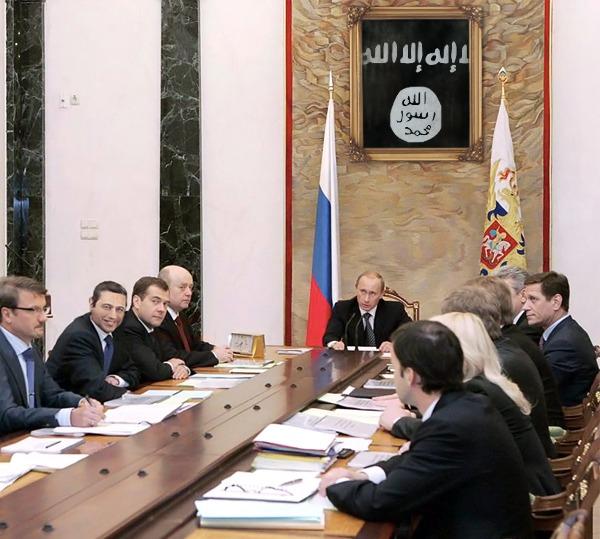
A slight change of ideology at the Kremlin?

Monday, September 10th, 2012

[ by Charles Cameron — with irony, skepticism, and just a dash of dry humor ]
.

image from the Ansar forum, h/t to Aaron Zelin

**

You’re probably familiar with the idea of a jihadist flag flying over the White House. Anjem Choudry, the British radical Islamist preacher told Christiane Amanpour on ABC This Week a while back:

Indeed, we believe that one day the flag of Islam will fly over the White House. Indeed, there’s even a narration of the prophet where he said that ‘the Judgment will not come until a group of my Ummah conquered the White House’.

I’ve dealt with this hadith before as it happens, and pointed out that in one telling the Prophet is asked which “white palace” he’s referring to and replies that he’s referring to the palace of Khosrau (Chosroes) I of Persia:

Jabir b. Samura said:

I heard the Messenger of Allah (may peace be upon him) say on Friday evening, the day on which Ma’ez al-Aslami was stoned to death (for committing adultery): A small force of the Muslims will capture the white house. I said: Kisra? he replied Kisra.

**

Never mind, Choudary thinks the jihadist flag will fly over the White House on Pennsylvania Avenue — and like-minded protesters in New York even carried a photoshopped image of the concept (below) as a placard at a 2006 rally in New York.

**

Hey! Put those two ideas together — a little “more of the same” photoshopping should do the trick — and you’d have a magnificent end to the Cold War, eh?

Maybe that’s what Choudary meant when he said, earlier in the same conversation with Amanpour:

Well, just let me say that Islam has a solution for all of the problems that mankind faces.

I suppose that’s one way to avoid a clash of civilizations — have just one guy holding both cymbals, right?

Three dreams: the Saudi King’s, Dr. King’s and Rodney King’s

Saturday, September 1st, 2012

[ by Charles Cameron — a pub in Wiltshire, Abu Aardvark, monarchical survival in the Middle East, Kanye West, C Peter Wagner, spiritual warfare, diabolic possession, Amaterasu ]

.

Three Crowns, Brinkworth
image hommage: The endless British pub crawl

.

It looks to me as though Abu Aardvark aka Marc Lynch — associate professor of political science and international affairs at George Washington University and one of the prime go-to blogger on matters Middle Eastern — first mentioned monarchy on his FP blog in December of last year, writing:

Finally, there’s a widespread sense that the Gulf monarchies have proven more resilient than their non-monarchical Arab counterparts. The wealthy Gulf states seem relatively immune to the popular mobilizations which have challenged most of the other regimes in the region. Advocates of the Gulf exceptionalism stance point to small citizen populations, huge government employment and patronage opportunities, and monarchical legitimacy as buffers against popular outrage.

In June of this year, he picked up the thread, saying:

Explaining this variation in regime survival and which strategies and structures proved more effective in the face of popular challenge will likely be a major preoccupation of the field in the coming years.

One common answer has been particularly contentious among academics: monarchy. Is there a monarchical exception, or some reason to believe that monarchies are more resilient in the face of popular grievances? For some, the answer is obvious: none of the fallen regimes were monarchies, while non-monarchies have struggled or fallen at historic rates. As Michael Herb argues,“the regimes most seriously affected by the Arab Spring were not monarchies, with the exception of Bahrain.” But others are far more skeptical that monarchy makes the difference. After all, Gulf monarchies such as Bahrain, Kuwait, and Oman all experienced significant mobilization, as did non-oil monarchies such as Jordan and Morocco, which gives lie to any sense of their greater innate legitimacy. Other factors such as oil wealth, ethnic polarization or external support may be more important than monarchy as such. The significance of monarchy in regime stability should be a vibrant debate in academic journals in the coming years.

And then yesterday his entire post was titled Does Arab monarchy matter?, in which he says:

The advantages of monarchy have taken on the feel of “common sense” among the public and in academic debates. But I remain highly skeptical about the more ambitious arguments for a monarchical exception. Access to vast wealth and useful international allies seems a more plausible explanation for the resilience of most of the Arab monarchies.

and throws in for good measure a delightful reworking of a line from (apparently) Kanye West:

To paraphrase one of our great living philosopher kings, the Arab monarchies may be forced to choose among three dreams: the Saudi King’s, Dr. King’s and Rodney King’s.

**

I do want to suggest to Abu Aardvark that ideas like the divine right of kings [link is to James I] never quite fade away, that there is a deep thirst for the mandate of heaven [Shu Jing], that there may in short be a quasi-sacramental force to the issue.

I don’t think that this guarantees the continuation of monarchical lineages, in the Middle East, the UK, China or elsewhere — but it may favor them, other things being equal.

**

But okay. I said some months back that I hoped to tackle the issue of monarchism in a post at some point, and I’m still eager to disagree with the Christian evangelist C Peter Wagner, who can be seen on YouTube saying:

There is a spirit called a Harlot, a principality, who dominates nations, who dominates territories, who dominates people groups very, very clearly to such an extent that she has fornication with kings. And I can give you an example of how she does this: Japan, as a nation, is one of the nation’s of the world which has consciously, openly invited national demonization.

The Sun Goddess visits him in person and has sexual intercourse with the Emperor. It’s a very, very powerful thing. So the Emperor becomes one flesh with the Sun Goddess and that’s an invitation for the Sun Goddess to continue to demonize the whole nation.

Since the night that the present emperor slept with the Sun Goddess, the stock market in Japan has gone down. It’s never come up since.

I’m serious about this. I’ve been out and bought myself a copy of DC Holtom‘s The Japanese Enthronement Ceremonies — Sophia ed, 1972, what a gorgeous book! — and downloaded a number of learned papers on the topic by Felicia Bock, Carmen Blacker, and Adrian Mayer. Japanese court ceremonial is not exactly an easy study — but time permitting, I should be able to bring you something a little more subtle than Wagner’s demponically-challenged interpretation one of these days.


Switch to our mobile site