zenpundit.com » Specs

Archive for the ‘Specs’ Category

That’s one remarkable sentence

Wednesday, July 11th, 2012

[ by Charles Cameron — an expat’s nostalgia ]
.

While the eye reads the letters of a text the mind’s eye is forming images, and some of them can be startling. From today’s (UK) Metro:

Residents yesterday lost their High Court battle to prevent surface-to-air missiles being deployed on the roof of their apartment block.

**

But we don’t need to use our imaginations: the BBC has filmed the building, and the Telegraph has photographed the missiles

**

Taking a look at the BBC’s brief video of the apartments (screen-shot: upper image above) I’m reminded of the British poet John Betjeman‘s famous 1937 lines about a dreadful (from his pastoral point of view) English town whose name, “Slough”, rhymes with “plow” rather than “rough”:

Come friendly bombs and fall on Slough!
It isn’t fit for humans now,
There isn’t grass to graze a cow.

I’m sure, though, that the residents of Slough didn’t appreciate that particular poem, and the people who live in those apartments may curse them at times, but they almost certainly love them too — those apartments are their homes.

**

Tenant: But, but — an Englishman’s home is his castle!
High Court: Precisely — and we’re requisitioning the battlements for our archers.

**

Sigh. Ah well, we survived the Blitz.

A chilling reminder

Wednesday, July 11th, 2012

[ by Charles Cameron — Marisa Urgo on Zawahiri ]
.

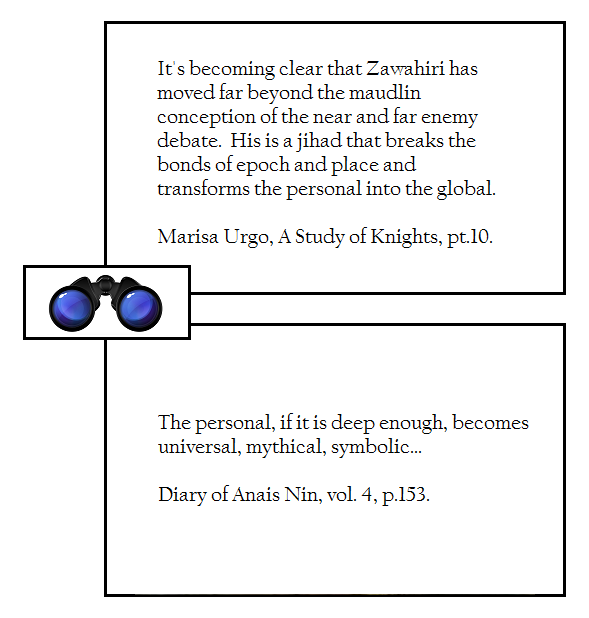
I have long been familiar with the second quote in this pair, the one by Anais Nin, and regard it as one of the touchstones of my understanding of the creative process. Anais Nin is exactly right in thinking that in terms of the arts, it is the deeply felt personal detail that profoundly touches the artist’s audience, and thus becomes universal.

It was therefore with quite a shock of recognition that I read Marisa Urgo‘s latest post in her series on Zawahiri‘s Knights Under the Banner of the Prophet. If Zawahiri’s spiritual autobiography draws this sort of response from an analyst giving it a close reading, it’s likely something we should be paying attention to.

.

.

Marisa’s series thus far can be read in reverse order here.

Morsi and the Socratic gadfly wannabe

Thursday, June 28th, 2012

[ by Charles Cameron — comparing presidential candidates, here and there ]
.

The ability to compare and contrast is an amazing business — you can get online tutorials in how to do it, and it even shows up in xkcd:
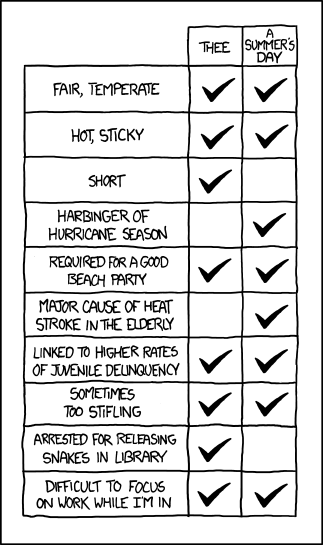
Compare and contrast is a basic human activity, in fact, closely allied with choice, and IMO can be crafted into a very powerful engine for understanding — if we first clear away the tangle of other thoughts with which we generally surround it, focus in on it, and use it to probe our assumptions and generate our creative insights…

**

In that spirit, then, let me pose my compare and contrast question for the day.

Compare and contrast:

The first quote presents one of Mr. Morsi‘s actual statements — hand-picked for scary — and there’s even a MEMRI video clip to prove it. The second is admittedly far more vague; it’s from a New York Times piece assessing and guessing at Mr. Romney’s likely foreign policy, which doesn’t actually quote him in any detail — instead, it lays out the basis for current speculation.

What I’m really trying to get at here, though, is how we read Mr. Morsi’s words — and my quote regarding Mr. Romney is in this instance mostly a foil, a way to suggest that at home, we don’t imagine what a candidate says is necessarily what he intends.

So my question, really, boils down to this: how ready would you be to agree that Mr. Morsi may have been making election promises in the full knowledge that he could not, would not, or might not even wish to keep them?

**

Different people will put different weights on Mr. Morsi’s campaign statements and those of Mr. Romney. There may be some interesting patterns to be found in the demographics of those differences.

I for one certainly don’t imagine that both Mr. Romney and Mr. Morsi would keep all their campaign promises to the letter if elected — but then neither do I imagine they would necessarily both deviate from their promises to the same extent under the pressures they, respectively, are under. And as I have indicated, I expect that different outside observers will bring different assumptions and expectations to their evaluations of the likely degree to which each of these men will / would if elected adhere to or deviate from their promises.

The pressures and constraints the two men find themselves under will differ — their respective most basic fears and ideals will very likely differ considerably, too.

And we ourselves, to the extent that we compare and contrast them, will do so from different angles — and come to different conclusions…

**

So: realistically and without prejudgment, how would we compare and contrast the element of what the NYT writer nicely called “political rhetoric” in these two cases?

How seriously should we take Mr. Morsi’s calls for shariah, for jihad, for “our most lofty aspiration” — death for the sake of Allah?

Question: Could Morsi be quoting Jefferson?

Monday, June 25th, 2012

[ by Charles Cameron — is that a Jefferson reference in Morsi’s speech? ]
.

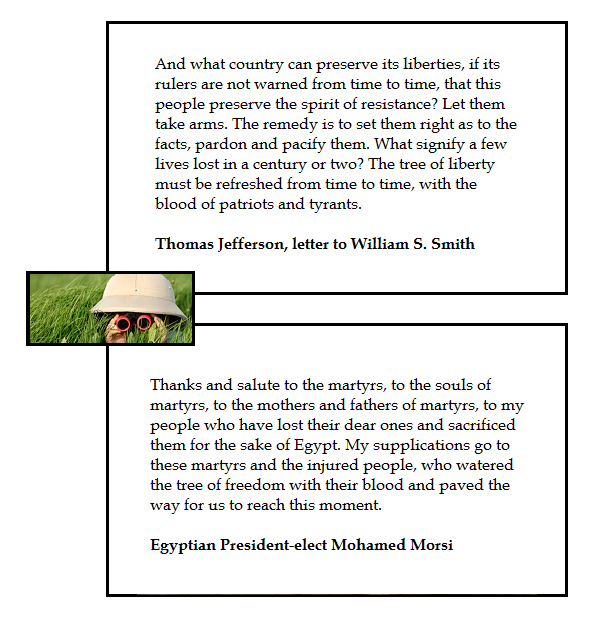
Can someone tell me whether that phrase in Morsi‘s speech about those who “who watered the tree of freedom with their blood” is a decent translation of Morsi’s own text, or a transposition into a well-known western metaphor? Because if that’s word for word what Morsi said, we’re either looking at something pretty archetypal and universal, or it’s a subtle shout out to Thomas Jefferson and the US…

Coincidence? Contrivance?

I’m asking because I notice, but don’t know.

FWIW, Morsi got his doctorate at USC and taught for a while at Cal State, Northridge…

*

I don’t do transliteration, btw — I usually use whatever the person I’m quoting uses: Juan Cole has Mursi, Borzou Daragahi has Morsi, and Allah knows best.

Egypt as Pac-Man?

Sunday, June 24th, 2012

[ by Charles Cameron — jeu d’esprit ]
.


.

I know it’s just an artefact of Juan Cole choosing a very light blue for “Classic Liberals” in his blog post on Mursi and the Brotherhood in a Pluralist Egypt — but his image of the Egyptian political landscape irresistably conjured up Pac-Man — and viewed in the light of Mursi‘s victory today, Pac-Mac begins to look a lot like a westernized, stylized portrayal of the star and crescent…

Maybe we’re hoping the Ikhwan will go chasing the djenoun


Switch to our mobile site