On fire: issues in theology and politics – i
Sunday, February 26th, 2012[ by Charles Cameron — suicide, protest, martyrdom, the self-immolation of Buddhist monastics ]
.
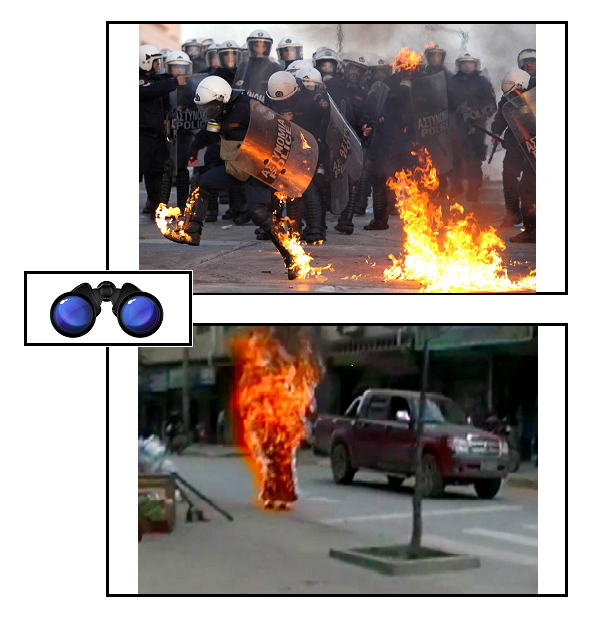
You can set your enemies on fire, you can set yourself on fire, you can blow yourself and your enemies up…
Protest, mayhem, suicide, martyrdom?
*
As usual, my interest is in the theological sanctions and constraints involved — in this case, by Buddhist self-immolation — so this excerpt from a Q&A with Lobsang Sangay, the prime minister of the Tibetan government-in-exile caught my eye:
Q: Does Buddhism allow self-immolation?
A: It’s a complex issue. One could refer to Jataka tales, which concern the previous births of the Buddha. In one story, the Buddha, in a previous incarnation, gives up his body to feed a starving tigress and her four cubs. Some other stories also talk about self-sacrifice by the Buddha.
Although suicide is violent and prohibited in Buddhism, some Buddhists believe it depends on the motivation. If you do it out of hatred and anger, then it is negative. But if you do it for a pure cause … it’s such a complex theological issue. You can’t go either way or have a definitive answer. But the action is tragic, so painful.
That’s a start: it’s a theologically complex issue…
The young Karmapa Lama, second in influence only to the Dalai Lama himself, is quoted in a Guardian report as discouraging this form of protest:
These desperate acts … are a cry against the injustice and repression under which they live. But I request the people of Tibet to preserve their lives and find other, constructive ways to work for the cause of Tibet.
In Buddhist teaching life is precious. To achieve anything worthwhile we need to preserve our lives.
It should be noted, however, that a number of monks in exile from China are depicted in the same article, bearing posters that call the self-immolators “burning martyrs”.
Robert Thurman, Je Tsongkhapa Professor of Indo-Tibetan Buddhist Studies at Columbia and president of New York’s Tibet House, provides his own justification for such acts:
When you destroy your body, you violate your own life, the lives of what Buddhists call “the 84,000 cells” that constitute it. This does seem violent. Yet in this case, the individual sacrifices herself to appeal to her enemy, to convey the perhaps all-too-subliminal message that they have nothing to fear from her, that she will resist their relationship of fear and harm by removing herself from being the target of their ultimately self-destructive, evil behavior. That is true non-harming—perfect resistance by complete surrender. If your victim prevents you from harming her by harming herself and taking herself out of your reach, then why were you afraid of her and wanting to harm her in the first place? Since she won’t harm you, she must love you. She wants you to stop fearing and hating; she wants you to be happy! Indeed, she cries out to you with her very life to wake up and behold the power of love—how it does not fear death, how it gives itself away to reality, how it overwhelms hatred.
And we should remember that even within Buddhism, self-immolation is not an exclusively Tibetan phenomenon. Here’s the celebrated Vietnamese zen monk and poet Thich Nhat Nanh, hearkening back to the days of the Vietnam War in his open letter “In Search of the Enemy of Man” (addressed to Martin Luther King):
The self-burning of Vietnamese Buddhist monks in 1963 is somehow difficult for the Western Christian conscience to understand. The Press spoke then of suicide, but in the essence, it is not. It is not even a protest. What the monks said in the letters they left before burning themselves aimed only at alarming, at moving the hearts of the oppressors and at calling the attention of the world to the suffering endured then by the Vietnamese. To burn oneself by fire is to prove that what one is saying is of the utmost importance. There is nothing more painful than burning oneself. To say something while experiencing this kind of pain is to say it with the utmost of courage, frankness, determination and sincerity. During the ceremony of ordination, as practiced in the Mahayana tradition, the monk-candidate is required to burn one, or more, small spots on his body in taking the vow to observe the 250 rules of a bhikshu, to live the life of a monk, to attain enlightenment and to devote his life to the salvation of all beings. One can, of course, say these things while sitting in a comfortable armchair; but when the words are uttered while kneeling before the community of sangha and experiencing this kind of pain, they will express all the seriousness of one’s heart and mind, and carry much greater weight.
The Vietnamese monk, by burning himself, says with all his strength and determination that he can endure the greatest of suffering to protect his people. What he really aims at is the expression of his will and determination, not death. To express will by burning oneself, therefore, is not to commit an act of destruction but to perform an act of construction, that is to suffer and to die for the sake of one’s people.
In a later post, I’ll return to Nhat Hanh‘s comment about monastic ordination, comparing it with the symbolism of the “red” given to cardinals on their elevation to that dignity.
*
Someone who is neither a monk or nun, nor a Tibetan, nor even a Buddhist — a Tunisian street vendor named Mohamed Bouazizi — set himself on fire in Sidi Bouzid not so long ago, and the rippling wave of events triggered by that act have included the toppling of long-entrenched dictators — is it so remarkable that an 18 year old nun, Tenzin Choedon, and other Tibetans too might hope that an act of self-immolation would galvanize the population around them and the world, resulting in the toppling of the hated Han regime in their part of the world?
I am not sure whether Prof. Thurman’s attempt to tie the Buddhist monastics’ mode of self-sacrifice to the notion, “see, we’re no threat” really works, but it is surely worth considering when it comes from a man who often speaks as a western mouthpiece for the Dalai Lama…
There are of course differences between monastics and laypeople.
Bouazizi’s self immolation was an act of despair, Tenzin Choedon’s an act of courage — as the photos of her standing there, ablaze and unflinching, while another woman offers a silk scarf into the flames in the traditional gesture of respect clearly show.
And when Prof. Thurman declares that the nun wanted her people to be happy, he surely doesn’t mean that she wanted them to be pleased at the sight of her standing there in the middle of the street ablaze — but that she wanted her people to be liberated from the repressive yoke they were and are under, and to feel the joy that comes with liberation from dictatorship.
But Bouzazi’s act, too, must have required considerable courage, while Tenzin Choedon’s act was surely also born of desperation. We humans, as individuals, are by our very nature blended beings.
***
As an Addendum:
Khenpo Karthar Rinpoche in his book, Dharma Paths, tells the Jataka tale of the Buddha giving his body to feed some tiger cubs as follows:
In one of his previous lives, the Buddha was born as the youngest of three princes. When he was only five years old, the three princes were in a forest playing together at hide-and-seek and other games. As they were walking in the forest, they came to a cave where they saw a wounded female tiger with five cubs. The mother tiger was very weak and was unable to provide food for the baby tigers. The Buddha’s older brothers went to search for some food, and they asked the young prince to stay near the cave to take care of the mother tiger and the five cubs.
While the Buddha was taking care of the wounded tiger and her five cubs, he began to think that it was not proper to kill other beings and give their flesh to the tiger. He found some large thorns and pressed them into neck, and as the blood came out, he let the cubs and their mother suck the blood. In fact, he gave his whole body to the five cubs and their mother as an act of generosity. As he did this, the Buddha prayed, “Right now I am only able to give temporary help to these starving beings, just removing their hunger. May these tigers who are enjoying my flesh, blood, and bones be reborn to a higher realm, and may I be able to teach them and lead them out of cyclic existence.”
We are naturally entitled to take the Jataka tales as scriptures, morality tales, or legends, fairy-tales — but the Rinpoche makes it clear in his telling that the bodhisattva who would later become Gautama Buddha “gave his whole body”.
In the Chod ritual of Tibetan Buddhism, practitioners symbolically give their own flesh to sate the hungry demons…