zenpundit.com » Taliban

Archive for the ‘Taliban’ Category

Dateline, June 5th 2012

Monday, June 10th, 2013

[ by Charles Cameron — screengrabs from a very recently posted video, mostly Taliban with just a smidgeon of NSA ]

[edited to add: please see warning in comment below]
.

Scary, hunh? Yeah?

**

No, this is not from a NSA / Prism video — I’ll have just a little more on that topic later.

Nor is it from your local mafiosi

In fact, it’s from the Islamic Emirate of Afghanistan

i.e the Afghan Taliban.

And it’s addressed to Saakashvili and the people of Georgia (FSU), telling them:

and:

**

What interests me here is this: I tend to think of the Islamic Emirate as mainly Afghanistan-centric, so viewing this video I wondered whether they’ve announced similar intent to raid or attack other nations. Alex Strick van Linschoten responded to my query as to whether he’d seen this sort of message before:

He also pointed me to his book, An Enemy We Created: The Myth of the Taliban-Al Qaeda Merger in Afghanistan, where (p. 277 in my uncorrected proof) we read:

It was around this time that Dadullah started to make increasingly strident statements of support for a global jihad, one in which attacks in Europe and the United States were not to be ruled out.101 Dadullah was, in contrast to most other Talibs of his generation, a ‘true believer’ in this rhetoric. Some commentators have suggested this is pathological, but a possible explanation can be found in the time he spent with foreign jihadis both on the northern fronts during the 1990s as well as post-2001, when he was in South Waziristan. He was frequently used as a go-between for the Taliban in Pakistan and retained ties to the foreign al-Qaeda affiliates as well.

So this kind of thing is not entirely unknown, and indeed “revenge” strikes outside Afghan territory would fit the model Dadullah himself proposed for strikes within Afghanistan (pp. 273-73):

Our tactics now are hit and run; we attack certain locations, kill the enemies of Allah there, and retreat to safe bases in the mountains to preserve our mujahidin. This tactic disrupts and weakens the enemies of Allah and in the same time allows us to be on the offensive. We decide the time and place of our attacks; in this way the enemy is always guessing.

Mullah Dadullah died in 2007, but it seems his thinking still exerts some influence…

** ** **

And NSA — or Nonesuch as I was taught to call it, back in the day?

I stand by the idea I tweeted to JM Berger yesterday:

I’d only add that three days doesn’t seem long enough in this case, and that when the dust settles we may still find ourselves holding just a few loose ends of a multiply-tangled web…

Apocalyptic Fire in Azan #2

Wednesday, June 5th, 2013

[ by Charles Cameron — on end-times rhetoric and having no need of sun or moon ]
.

Detail from a Commentary on the Apocalypse by Beatus of Liebana

**

On the whole, the “signs of the end times” described in the installment of Maulana Asim Umar‘s Third World War and Dajjal, pp. 23-31, and now posted in the second issue of Azan on pp 83-89 are standard fare of the “wars and rumors of wars” type that could fit pretty much any time n history, including our own — “When the most despicable person of a nation would be its leader” would fit an astounding number of rulers across recorded history, depending on your point of view, including Nero and Diocletian, George III and Abe Lincoln, and a slew of Saddams, Mubaraks and Assads

There was one section, however, that struck me as a powerful piece of visionary apocalyptic, and I wanted to bring it to the attention of those interested in such things.

The Maulana writes [I’ve omitted the Arabic honorifics since I lack Arabic, and corrected one typo in Enlish]:

“Hazrat Abu Hurayrah narrates that the Prophet of Allah said that the Day of Judgment would not occur before a fire erupts from Hijaz and lights up the necks of the camels of Basra.” [Bukhari, Muslim]

The incident mentioned in this Hadith has already occurred according to Hafiz Ibn Kathir (RA) and other historians. This fire appeared in 650 H on the Day of Jumu’ah in some valleys of Madinah Munawwarah and remained for about a month. The narrators have said that the fire suddenly erupted from the direction of Hijaz. The scene looked like a whole city of fire – containing a whole castle, tower or battlement etc. Its height was 4 “farsakh” (around 12 miles) and its width was 4 miles. The fire would melt any mountain it reached as if the mountain was made out of wax or glass. Its flames had the sound of thunder and the energy of river waves. Blue and red-colored rivers looked to be coming out of the fire. In such a (horrible) state, the fire reached Madinah Munawwarah. But the curious thing was that the wind that was emanating from the direction of the flames felt cool in Madinah. The scholars have written that the fire had encompassed all the jungles of Madinah such that in the Haram-e-Nabwi and in Madinah, all the houses were lit up as if from the sun. The people would do all their work in the night from the light (of the fire); in fact, the light of the sun and the moon would became faded because of the light of the fire.

Some people of Makkah (at the time of the fire) bore witness that they saw the fire while they were in Yamama and Basra.

A strange quality of the fire was that it used to burn the stones to coal but it would not have any effect on the trees. It is said that there was a large stone in a jungle – half of it was in the limits of Haram-e-Madina and half of it was outside the limits. The fire burnt to coal the half of the stone that was outside the limits of the Haram-e-Madina. However, it cooled when it reached to the other half and hence, this half remained safe.

The people of Basrah bore witness that they saw the necks of camels light up from the light of the fire…

[The Beginning and the End: Ibn Kathir (RA)]

**

You know my interest in semblances and parallelisms. Compare:

in fact, the light of the sun and the moon would became faded because of the light of the fire

in that narrative with:

the city had no need of the sun, neither of the moon to shine in it, for the glory of God did lighten it

in Revelation 21:23.

I am not arguing that there is an echo between the two accounts, nor that they describe the same phenomenon — simply that the rhetoric of each has a similar poetic intensity. This just happens to be one of those occasions when there are more things in heaven than are dreamed of in your natural sciences.

Boston special issue promoted in Azan #2

Wednesday, June 5th, 2013

[ by Charles Cameron — for the record, there’s a Boston “special edition” of Azan, though I’ve only seen the ad! ]
.

The second issue of Azan magazine is out, and not all that exciting — but just as I did last time, I’ve scanned it for bits that interest me, and come up with a couple — but first I’d like to note is the teaser on p. 49 (below) for a “special issue” on the Boston bombings, dated 15/5 on the cover and claiming to have been published “soon after the attacks”:

I haven’t seen it, but there’s corroboration. SITE appears to have found a copy and announced it in this tweet on May 25th:

So somewhere between Azan #1 and Azan #2, there would seem to have been an out of series issue. Since it concentrates on Boston, however, and not Khorasan, there’s probably not much in it along my line of interest, so knowing it’s out there only piques my curiosity just a tad.

Hysteria about Afghan schoolgirl hysteria

Sunday, April 28th, 2013

[ by Charles Cameron — Reuters publishes scary stuff, should have checked their facts with WHO epidemiologists first ]
.

Last time, it was the Jerusalem syndrome — this time it’s mass hysteria, not poison.

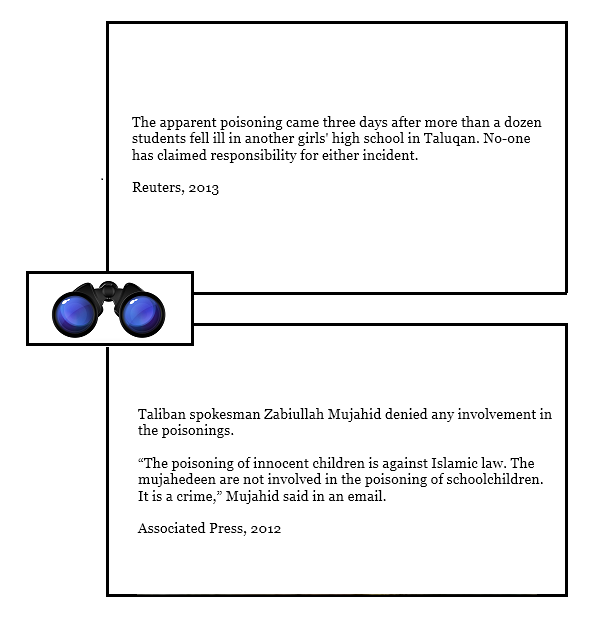
The Reuters article, Afghan girls’ school feared hit by poison gas by Folad Hamdard (upper frame, above) was posted on April 21, 2013, just one week ago.

Its key paragraphs in terms of etiology and blame are these:

As many as 74 schoolgirls in Afghanistan’s far north fell sick after smelling gas and were being examined for possible poisoning, local officials said on Sunday.

While instances of poisoning are sometimes later found to be false alarms, there have been numerous substantiated cases of mass poisonings of schoolgirls by elements of Afghanistan’s ultra-conservative society that are opposed to female education.

and:

Between May and June last year there were four poisoning attacks on a girls’ school in Takhar, prompting local officials to order principals to stay in school until late and staff to search the grounds for suspicious objects and to test the water for contaminants.

Takhar has been a hotbed of militancy and criminal activity since 2009, with groups such as the Taliban and the Islamic Movement of Uzbekistan active.

One wonders: Does Reuters employ fact checkers?

**

One wonders because…

An Editorial Note on the 2012 article Mass Psychogenic illness in Afghanistan (lower frame, above) in the WHO’s Weekly Epidemiological Monitor (Vol 5 # 22, 27 May) reads in part:

This is the fourth year where episodes of suspected mass poisoning of school girls is reported from Afghanistan. Like in the previous years the events are triggered off with one girl developing symptoms of headache, weakness, dizziness, nausea and fainting. Often these outbreaks were believed to be the work of political elements in the country who oppose girls education. Reports of stench smells preceding the appearance of symptoms have given credit to the theory of mass poisoning (chemical/bioterrorism). However, investigations into the causes of these outbreaks have yielded no such evidence so far. In the last four years over 1634 cases from 22 schools have been treated for Mass Psychogenic Illness (MPI) in Afghanistan. There are no related deaths reported.

Reuters is read by a whole lot more people than some WHO epidemiological weekly, eh?

**

Luckily, the NY Times at least posted a blog post by Matthieu Aikins writing from Kabul, The ‘Poisoned’ Girls of Afghanistan, by way of alerting us to the WHO report:

I’m willing to bet that there was no poison.

Over the past few years, thousands of girls have fallen victim to waves of alleged poisonings in Afghan schools. The government, media and education activists have blamed the Taliban, and the police in a number of provinces have produced the “guilty” parties, with some of them confessing on national television.

But last July when I investigated the subject for Newsweek, I discovered never-released reports showing that the United Nations, the World Health Organization and NATO’s International Security Assistance Force had investigated the incidents for years and had never found, despite extensive laboratory tests, any evidence of toxins or poisoning — a fact that may explain ISAF’s conspicuous silence on the issue.

I’m glad that’s been cleared up.

**

Here’s another DoubleQuote for you:

Of course, the Taliban spokesman was addressing a 2012 outbreak of the same hysteria story, and the “no claim of responsibility” report is from one of this year’s versions.

But why would anyone claim responsibility in any case, if the actual cause is mass hysteria rather than poisoning? There’s history to these things — they didn’t begin in Afghanistan:

The cases the Afghanistan incidents most resemble are the Tanganyika laughter epidemic of 1962, in which hundreds of people, mostly schoolgirls, were overcome by fits of mirthless, extended laughter, in what is now known as Tanzania, and the West Bank fainting epidemic of 1983.

The similarities between the heavily studied epidemic in the occupied West Bank and Afghanistan are particularly striking. Both places are in a state of conflict, where political violence is a fact of life, and both have powerful local rumor mills. The incidents follow a similar pattern: First a single report of a bad smell, then a small number of girls come down with symptoms, then it spreads. Local media fueled the rumors and the incidents spread in Afghanistan, just as they did in Israel and Palestine.

Albert Hefez, Israel’s lead psychiatric investigator of the incident, wrote in his 1985 study “The Role of the Press and the Medical Community in the epidemic of ‘Mysterious Gas Poisoning’ in the Jordan West Bank” that Israeli newspaper reports of “poisoning” at the start of the epidemic added fuel to the flames. A front page article in Haaretz on March 28, 1983 even claimed that Israeli military investigators had found traces of nerve gas and quoted “army sources” as saying they suspected Palestinian militants were poisoning their own people in order to blame Israel and provoke an uprising. Palestinian leaders followed up with accusations that Israel had poisoned them in an attempt to drive them from the West Bank.

And such things don’t only happen “abroad” — as detailed in that same NYT blog post I quoted above:

The phenomenon of groups of people falling ill for psychological, rather than physical, reasons is not unknown, nor is it limited to Afghanistan. Moreover, the typical victims are school-age girls. In late 2011, when a group of girls in Le Roy, New York, fell victim to a mysterious twitching illness, medical authorities eventually concluded it was psychogenic.

Mourning the loss of Monte Cassino

Friday, January 18th, 2013

[ by Charles Cameron — destruction of sacred spaces ]
.

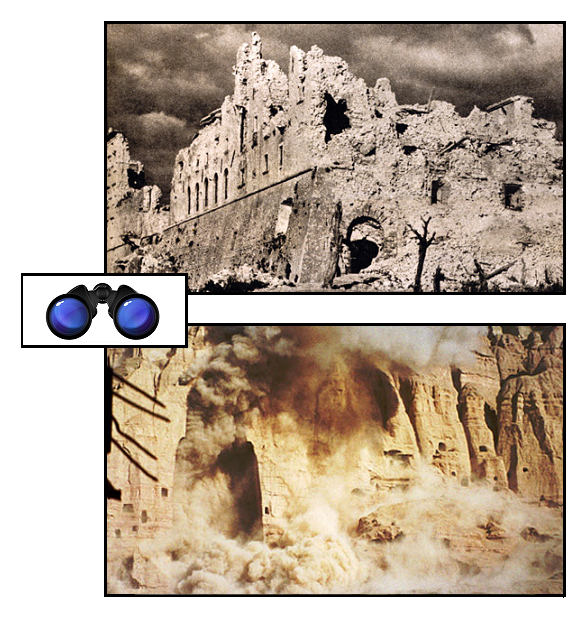
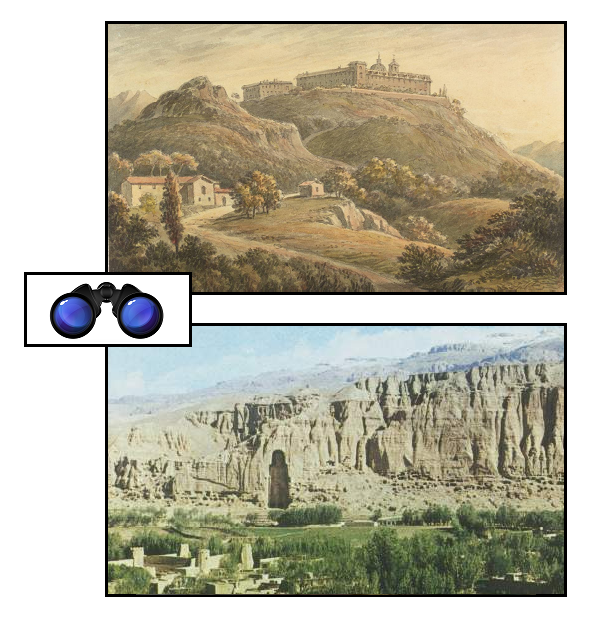
Do we grieve the destruction of the Abbey of Monte Cassino as we grieve the destruction of the Bamiyan Buddhas?

**

With playful and appropriate scholarly tongue-in-cheek, Umberto Eco describes the importance of monasteries — and of the Benedictine Order specifically — in preserving culture, literacy, the arts and sciences through dark ages in his novel, The Name of the Rose:

“Monasterium sine libris,” the abbot recited, pensively, “est sicut civitas sine opibus, castrum sine numeris, coquina sine suppellectili, mensa sine cibis, hortus sine herbis, pratum sine floribus, arbor sine foliis. … And our order, growing up under the double command of work and prayer, was light to the whole known world, depository of knowledge, salvation of an ancient learning that threatened to disappear in fires, sacks, earthquakes, forge of new writing and increase of the ancient. … Mundus senescit. If God has now given our order a mission, it is to oppose this race to the abyss, by preserving, repeating, and defending the treasure of wisdom our fathers entrusted to us.

Monte Cassino is the spiritual home of the Benedictine monastic order. It was here that Saint Benedict of Subiaco built a retreat in 529 CE, here that he wrote his Regula Monachorum or monastic Rule, the central text of western monasticism, and though the monastery had been previously sacked by the Lombards in 585, the Saracens in 884, and the Normans in 1046, it was devastated anew during the Battle of Monte Cassino 1944, an American artillery commander telling his men:

I don’t give a damn about the monastery. I have Catholic gunners in this battery and they’ve already asked me for permission to fire on it…

Harold Bond, in his book Return to Cassino A Memoir of the Fight for Rome, describes the scene as 256 American heavy bombers began dropping 576 tons of munitions on the abbey in waves, in words echoes by the video below:

There was no anti-aircraft fire from the Germans, either, just the drone of the big planes. They were very close now, and the first formation flew in over the abbey, releasing the bombs. We could see them fall, looking at this distance like little black stones, and then the ground all around us shook with gigantic shocks as they exploded. Another formation flew in, and then another, each followed by thunderous detonations. Now where the abbey had been there was only a huge cloud of smoke and dust which concealed the entire hilltop.

**

The bombing appears to have been authorized on the basis of a mistranslation. An intelligence intercept of the question “Ist Abt in Kloster?” — “is the Abbot in the Monastery” — was translated by the US as though Abt was short for Abteil, “Is the HQ in the Abbey?” The recorder answer “Ja” then led to the bombing.

Three days after the bombing, the Abbot was interviewed in person by the commander of XIV Panzer Corps, himself a lay brother of the Benedictine order, and reported:

Until the moment of the destruction of the Monte Cassino abbey there was within the area … neither a German soldier, nor any German weapon, nor any German military installation.

Thankfully, the abbey was restored and reconsecrated in 1964 by Pope Paul VI and remains to this day the mother house of the Order of St. Benedict.

**

I hope to review relevant portions of Peter Caddick-AdamsMonte Cassino: Ten Armies in Hell, available in the UK and due to be released in the US in April 2013, later this year. A review copy has been my source for details of the Battle of Monte Cassino described above.

Image sources, upper pair:

Destruction of the taller Bamiyan Buddha, CNN via Wikipedia
Montecassion destroyed, from Monte Cassino Tour

Image sources, lower pair:

Bamiyan Buddhas, from Random Walks
Monte Cassino by John `Warwick’ Smith, from the Tate


Switch to our mobile site