zenpundit.com » sports

Archive for the ‘sports’ Category

.. and including any and all interesting game language & stories ..

Wednesday, September 19th, 2018

[ by Charles Cameron — a 75-year old poker club in DC, more ]
.

It seems I’m moving from collecting only sport and game metaphors for politics, via sport and game metaphors more generally to sport and game language and stories — whatever catches my fancy. The paragraphs from William Finnegan, Off Diamond Head which I quoted in Storm special, surf’s up would have fit here nicely, and were my first signal, or perhaps one of my first, that my search interests might be widening.

Lets start with A club of their own: The story of a secret poker society started by pioneering African Americans. It’s a great story of a poker club that’s been going 76 years now:

In 1942, a group of university professors, doctors, lawyers and other black professionals in Washington wanted to get together on weekends and play poker. But they had a problem. Not only did segregation in the District bar them from joining country clubs or other social organizations where men could gather, but the president of Howard University, where many of them taught, was a religious man who did not approve of card-playing.

So they started a monthly gathering in their homes and came up with a name to mask its true nature — the Brookland Literary and Hunting Club.

The founding members of the club included a College president and consultant on Brown v. Board of Education, and the first black chief judge of DC’s federal court, and one of the the oldest current members at 96 — none of the founders are still with us — was a Tuskegee Airman. Over the last seventy-five years, these men have seen, and shaped, history. Their club is named the Brookland Literary and Hunting Club as code rather than abstract camouflage — “literary” because they’ve always discussed the topics of the day, from WWII via the Civil Rights movement to the present, and “hunting” because players are always hunting for a good hand when playing cards..

Play..

There were two tables — the big table, where hundreds of dollars exchanged hands over five-card stud, and the little table, whose participants played for coins or dollar bills and peppered the games with wild cards. Men would start at the little table and sometimes move up to the big one. As they got older and went on fixed incomes, some would move back to the little table.

And the spirit of play:

We’ve had great games and there’s never anybody who ran out of money, because somebody says: ‘Here, take some more. Just take it. Give it to me when you can,’

**

And it looks as though I can’t evade the sports and social parallelism business either. How can I resist What Serena Williams’s defeat tells us about the criminal-justice system? And how better to get at its essential than via another of today’s WaPo pieces, Yes, get consent. But be human, too.?

After describing the two opinion camps around the kerfuffle between Serena Williams and chair umpire Carlos Ramos, the WaPo opinion writer Marc Howard, a professor of government and law at Georgetown, indicates the closeness of the parallel between tennis and social justice:

This disagreement is about more than tennis, or even sports. It connects with a much deeper American divide about policing and criminal justice, with strong undertones connecting to race and racism.

and later:

Just like the criminal-justice system, tennis and many other sports depend on the subjective discretion of neutral arbiters to apply a set of supposedly objective “rules.”

Ramos did indeed follow the code, and each of the three sanctions had some justification, thus satisfying the “rules” camp. But for two of the three violations (the racket smashing was unambiguous), he used his discretion to punish Williams for acts — coaching and heated exchanges with an umpire — that occur routinely in tennis but are seldom punished.

So one “deeper .. divide” is about “policing and criminal justice” — but another deep divide exists between “rules” and what I’ll call “fairness” camps, following this paragraph:

In all of these instances, one can always say, “Well, this person didn’t follow the rules,” and on an individual basis that may seem sufficient to justify the consequences. What gets lost, however, is that rules are rarely applied regularly, consistently or fairly..

You’ll have to read the whole article to get many of the details, but the analogy between a sport and the judicial and penal systems is clear.

How does this relate to the WaPo piece on consent in potential sexual aggression situations?

The question there is whether, in the pithy words of a feminist writer quoted by WaPo:

consent is just a hurdle you have to clear in order to Get The Sex

Consent is the rulebook, and the missing ingredient when consent is the only consideration, is the human context, in the words of the same writer, the need to see our sexual partners:

not simply as instrumental to our own pleasure but as co-equal collaborators, equally human and important, equally harmable, equally free and equally sovereign.

I’m not sure that even that doesn’t smack a bit of the “rules” camp, but it’s certainly a strong step beyond the bare=bones “consent” rule towards an understanding of human circumstances. But the parallelism between that and the Serena Williams piece wouldn’t have struck me so forcefully without this exchange:

“Yeah,” one, a junior, agreed. “The logic is sort of Cartesian.” (Oh, college!) “Do this, not that. Don’t break the rules ..

That really nails it — as Lao Tzu would say:

The rules can be codified in a rulebook aren’t the subtle rules of wisdom.

That’s my Tao Te Ching translation #207 I know, but I think it’s apt for this occasion.

Comments?

Extended chess and baseball metaphors

Sunday, September 9th, 2018

[ by Charles Cameron — a light-hearted look at Trump Chess, and an umpire explains millisecond decision-making ]
.

The first of two pieces I’ll explore here is from the New Yorke, Rules for Trump Chess by Andrew Paul. It’s a humor piece, but not without its satirical effect, as you can tell from Rule #1:.

Each turn is referred to as a “news cycle.”

At times, the hunmor gets a bit sour, as with Rule #4:

A handful of new pieces will be introduced during game play, scattered haphazardly across the board. They include: two overcooked macaroni noodles (Kushners), a shrivelled white raisin with lint on it (Sessions), and a washcloth soaked in warm Johnnie Walker (Bannon). Their permitted moves are unclear, but every news cycle, players must select one to put in their mouths until they gag.

Links to an earlier (and more balanced) form of chess are not entirely absent, as exemplified by Rule #11:

Knights still move in that ridiculous two-squares-up, one-square-over path. They think they are being very clever. Their creepy horse faces must always be turned to face the king.

You can read the rest at the New Yorker site

**

Of deeper interest, though with less immediate application to politics, is Jim Evans‘ WaPo piece, Sorry, judges, we umpires do more than call balls and strikes. Here’s the setup:

I don’t remember when I first heard the popular analogy comparing judges to umpires calling balls and strikes, but recently it’s been everywhere. When Brett Kavanaugh was first nominated to the Supreme Court, Tony Perkins of the Family Research Council called him “a constitutionalist — someone who will call balls and strikes.” This past week, as Kavanaugh’s confirmation hearings began, Sen. John Cornyn (R-Tex.) described him as “somebody who calls balls and strikes and doesn’t come up with his own strike zone.” Supposedly a judge is, and should be, as mechanical as an ump.

Mechanical, eh?

It’s true that there are similarities. Umpires have always been considered authority figures, like judges. Both are subject to a lot of scrutiny, and we do what we think is right by rule and tradition. Umpiring is a special calling and a learned skill that requires extraordinary mental toughness. When you put on your uniform, you are supposed to leave all your subjective feelings in that dressing room. Personal integrity and respect for the game are at stake.

I’ve seen similar said about judges when they put on their robes.. But even the simple “calling balls and strikes” level of analogy lacks subtlety:

Seeing the televised rectangle that allegedly represents the strike zone, you might surmise that any 3-year-old should be able to tell whether that little white sphere is in or out of that box. Replay has reinforced the feeling that it’s simple and obvious.

Yet there are many intangibles when it comes to calling balls and strikes. What the umpire’s actually doing is gauging a baseball’s relative position as it travels 95 miles an hour into a three-dimensional area. You’re judging a pitch as it leaves the pitcher’s hand and goes to the catcher’s mitt in less than half a second.

Getting into greater finesse:

For example, the rule book states that a runner must avoid a fielder in the act of fielding a batted ball. If you collided with a shortstop who was bent over in the act of fielding a ground ball, you would be guilty of interference. But if the shortstop had completed the act of fielding and was attempting to tag you when the collision occurred, there would be no penalty. Among elite athletes, this all happens in milliseconds, and to the untrained eye, the plays look the same — both violent collisions with the ball on the ground. This requires an interpretation of when one act ended and another began, and whose rights are in effect. This is a judgment call.

Interesting final sentence, that.

Okay, it would be neat if an appellate or superior court judge could write a similar piece on the niceties of judicial judgment..

**

Umpires and referees..

I’ve always tended to think of umpires as the cricket equivalents of referees, and referees as the soccer equivalents of umpires, but what do I know?

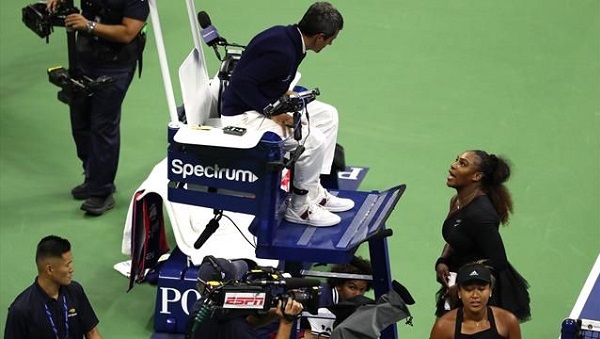
Chair Umpire Carlos Ramos arguably interfered in the match, bringing both repeated champion Serena Williams and first-time winner Naomi Osaka to tears.

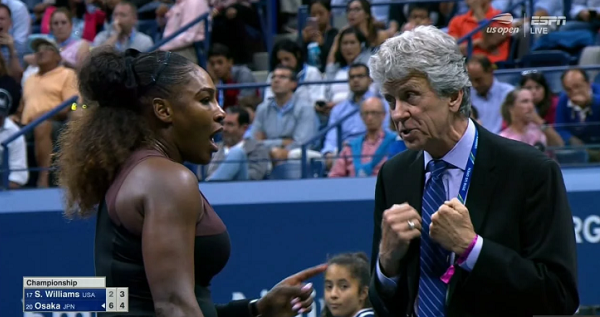
Match Referee Brian Earley holds his fists in, exemplifying both the passion and restraint in play in the US Open final

In the Serena Williams objection to penalties allotted her during the second set of her finals match with Japan’s young winner Naomi Osaka, I’ve learned today that in tennis, the umpire, usually seated in a high chair at center court makes unassailable rulings of fact, while the referee can overrule him in matters of tennis law — effectively making the umpire analogous to the jury, and the referee to the judge, in a trial by jury.

And thus the analogical web widens..

Speaking in two tongues — at least

Monday, August 27th, 2018

[ by Charles Cameron — sacred tongues, the split tongues of serpents, gestural languages, the languages of conflict — language itself fascinates, ne? ]
.

Here’s the language of Psalm 139 in the King James Version:

If I ascend up into heaven, thou art there: if I make my bed in hell, behold, thou art there. If I take the wings of the morning, and dwell in the uttermost parts of the sea; Even there shall thy hand lead me, and thy right hand shall hold me.

And here, as recorded in The Atlantic‘s Mike Pence’s Outer-Space Gospel, is the VP’s language at the inaugural meeting of the National Space Council:

As President Trump has said, in his words, “It is America’s destiny to be the leader amongst nations on our adventure into the great unknown.” And today we begin the latest chapter of that adventure. But as we embark, let us have faith. Faith that, as the Old Book teaches us that if we rise to the heavens, He will be there.

and again more recently:

And as we renew our commitment to lead, let’s go with confidence and let’s go with faith — the faith that we do not go alone. For as millions of Americans have believed throughout the long and storied history of this nation of pioneers, I believe, as well, there is nowhere we can go from His spirit; that if we rise on the wings of the dawn, settle on the far side of the sea, even if we go up to the heavens, even there His hand will guide us, and His right hand will hold us fast.

So that’s our destiny — our clear and manifest destiny you might say, although it’s not clear whether drilling for oil, fracking, strip mining, or mountain top removal qualify for our destiny also, making our bed in hell..

**

And our President?

His language is seldom Biblical; he prefers mob talk. Let’s begin here, with the actual and admitted prosecutor / mob analogy:

Last November, a person close to the Trump administration speaking to the Washington Post invoked a chilling metaphor. “This investigation is a classic Gambino-style roll-up,” the source said. “You have to anticipate this roll-up will reach everyone in this administration.” This turns out to be a perfectly apt and quite literal description not only of the investigation, but of Trump’s own ethos and organizing principles.

So many people have been dissecting Trump’s mafia-like language recently that I’ll confine myself to one headline:

One cluster:

One TV header:

One image:

and the cuttingest insult of all:

Trump may imagine that he’s Michael Corleone, the tough and canny rightful heir—or even Sonny Corleone, the terrifyingly violent but at least powerful heir apparent—but after today he is Fredo forever.

**

Language games, Witty Wittgenstein would have called them, and they’re played semi-consciously at best..

Here’s another language, that of the gentlemanly art of boxing as photographed by Muybridge, Eadweard Muybridge:

and as verbally captured by the Marquess of Queensbury Rules:

1. To be a fair stand-up boxing match in a twenty-four foot ring or as near that size as practicable.

2. No wrestling or hugging allowed.

3. The rounds to be of three minutes duration and one minute time between rounds.

4. If either man fall through weakness or otherwise, he must get up unassisted, ten seconds be allowed to do so, the other man meanwhile to return to his corner; and when the fallen man is on his legs the round is to be resumed and continued until the three minutes have expired. If one man fails to come to the scratch in the ten seconds allowed, it shall be in the power of the referee to give his award in favour of the other man.

5. A man hanging on the ropes in a helpless state, with his toes off the ground, shall be considered down.

6. ..

and so on and forth.

Gentlemanly, I said — and with the approval of the Marquess, maybe Noble even.

A one-two punch for the president, and three

Wednesday, August 22nd, 2018

[ by Charles Cameron — Cohen and Manafort, drones & CBRN, and when wave fronts meet at Big Sur and elsewhere ]
.

NY Times email, Wednesday:

A one-two punch, two wave fronts crashing / clashing, wave upon wave — but how to represent such things graphically, to model them, to open our too-literal minds to their complexity?

**
Here’s an example of two dangerous waves overlapping on the world stage, world scale:

One:

Bunker, Sullivan &c on the drone attack in Baja, Small Wars Journal:

On Tuesday, 10 July 2018, an armed drone targeted the residence of Gerardo Sosa Olachea, the public safety secretary/Secretario de Seguridad Pública Estalal (SSPE) of Baja California, in colonia Los Laureles in Tecate—a border city in the San Diego-Tijuana etropolitan area. A second drone, which may have been utilized for ISR (intelligence, surveillance and reconnaissance) and C2 purposes, was seen over the incident scene. At least one of the drones was equipped with a video camera link and was armed with two IEDs that did not detonate. For a number of international security professionals tracking cartel and gang violence in Mexico—including the authors of this note—an incident like this has been expected for some time now, given the earlier I&W (Indications & Warnings) event that took place in Guanajunto state in October 2017 when a weaponized drone was seized from Cártel de Jalisco Nueva Generación (CJNG) operatives.

Now think of ricin delivery by drone..

Two:

Daniel Koehler, Mapping Far-right Chemical, Biological, Radiological, and Nuclear (CBRN) Terrorism Efforts in the West:

The threat of chemical, biological, radiological and nuclear (CBRN) terrorism is widely attributed to collective actors based on a religious ideology, e.g. globally operating Salafi-jihadist groups like al-Qaeda or ISIL. Only limited attention has been given to the CBRN threat of violent domestic extremists in general or far-right terrorists specifically. Nevertheless, a number of incidents involving far-right activists and CBRN agents in Western countries are known to the public, even though these have had comparatively little impact on public threat perception. This study systematically collected public information about far-right CBRN incidents to identify their main characteristics. The authors were able to identify 31 incidents in Western countries since 1970, which display features contrary to generally assumed forms of CBRN terrorism. Far-right CBRN terrorism appears to be predominantly a lone-actor phenomenon oftentimes involving middle-aged and comparatively well-educated male perpetrators, mostly motivated by non-religious forms of far-right ideology (i.e. neo-Nazism, non-religious white supremacism) and indiscriminately targeting victims. Overall, far-right actors attempting to weaponize CBRN agents have been few and generally technically inept. However, the characteristics of the plots pose potential challenges for effective counter-measures and intervention, should the number of actors or the technical sophistication of plots increase in the future.

Consider the overlap of those two very current waves — and there are others, at all scales, up and down the metaphorical coast of risk

Then think Aum Shinrikyo, as an example of a non-state religious sect utilising sarin gas in an attack in Tokyo:

The 1995 Aum Shinrikyo attack on the Tokyo subway system was a seminal event in the history of chemical, biological, radiological, and nuclear (CBRN) weapons. It marked the first major use of a Chemical weapon by a non-state actor that received widespread worldwide attention, and led to efforts to combat the threat of CBRN terrorism around the world.

**

Out there in Manafort > Cohen > Manafort wave land, there are two waves whose wavefronts met and clashed (“mutually reinforced”) yesterday, with a third wave following up behind the first, and more, wave upon wave, body blow upon body blow.. I don’t have the graphical skills to represent this, but multiple wave fronts intersecting would be a useful model to have depicted — and not unlike waves clashing at Big Sur.. where such things are multiplied and magnificent ..

— not unlike clashing waves at Big Sur..

For the Cohen and Manafort wavefronts and their possible combined implications, readings from this morning’s Washington DC post:

  • WaPo, After two convictions, pressure mounts on Trump
  • WaPo, Manafort convicted on 8 counts; mistrial declared on 10 others
  • WaPo, Michael Cohen: Trump’s greatest fear comes true
  • WaPo, Michael Cohen says he worked to silence two women ‘in coordination’ with Trump
  • WaPo, Cohen’s claim about Trump may spark calls for impeachment
  • WaPo, Manafort’s verdict and Cohen’s plea gave Trump his worst day so far
  • WaPo, ‘Doesn’t involve me’: Trump tries to distance himself from Cohen, Manafort cases
  • The Post’s View, Twin convictions are a stunning rebuke of Trump
  • Also, from the New York sister city and publication:

  • NY Times, Trump, Cohen and Manafort: What’s Next?
  • Oh, and btw:

  • The Atlantic, Christopher Steele’s Victory in a D.C. Court
  • The Hill, Senate Intelligence Committee leaders want Cohen to testify
  • **

    — not unlike clashing waves at Big Sur ..

    terrific photo from Teresa Espaniola Gallery

    .. up and down the metaphorical coast of risk ..

    Metaphors v, We use sports terms all the time

    Sunday, August 12th, 2018

    [ by Charles Cameron — I’m not the only one thinking sports metaphors are important, though I’ve been collecting a whole lot more examples ]
    .

    **

    There’s a NYT article — We Use Sports Terms All the Time. But Where Do They Come From? — as you see, tucked away in the Sports section, which I’d really like to transport over here whole, because it’s a sports metaphor article, not a sports article, and sports metaphors are a specialty du maison here at ZP.

    Let’s see if I can ferret out the gist:

    We’re talking about sports idioms, those everyday phrases ingrained in our lexicon, handed down from generation to generation. We use these terms all the time, without really knowing where they came from. Some of their origins are pretty clear: front-runner, on the ropes, the ball is in your court. But there are many others whose provenances are not so apparent.

    The world of sports is a particularly fertile ground for such terms, said Katherine Connor Martin, head of U.S. dictionaries at Oxford University Press. “Sports are written about and discussed a lot, and so have generated a great deal of colorful, specialized vocabulary. And competition exists in many other spheres of life, so sports terms are well suited to be borrowed into other domains, such as business or politics.”

    **

    **

    As I’ve suggested, the whole piece is a rich trove of materials for the sort of exploration I’ve been working on. Just a few minutes ago, as it happens, I heard someone on TV say in regard to the 2020 presidential election:

    If Michael Avenatti wants to throw his hat into the ring, great.

    As it happens, throwing one’s hat into the ring is one of the examples the NYT piece explores a little deeper. Their example:

    In The New York Times: Mr. Mahathir threw his hat in the ring in the recent national elections. Opinion, May 12.

    Their comment:

    Back in the days when boxing was a quasi-legal, rough-and-tumble affair, fighters and even spectators who had an interest in getting into a bout would signal it by tossing in a hat. It’s mostly used now in the rough-and-tumble field of politics to announce that one is running for office.

    Its first use, according to the Oxford English Dictionary, came in The London Times in 1804, in its literal sense: “Belcher first threw his hat into the ring, over the heads of the spectators.”

    Throwing in the towel would be, I suppose, the equal and opposite phrase..

    **

    Other examples they went into in similar detail:

    Wild-Goose Chase

    We need to get a little lost, pursue “productive and instructive disorientation, distraction, wild-goose chases, dead ends.” Book Review, June 4.

    Throw in the Towel

    Anthony Barile, the owner of this wood-oven veteran where other pizza-makers honed their skills, said he was tired and throwing in the towel after nearly 26 years. Food, March 27.

    Out of Left Field

    It was so out of left field and something so different than anything I’ve done. Movies, July 6.

    Hands Down

    Sue is, hands-down, the best at this. I would marry her in a minute. Television, June 21.

    Wheelhouse, Strong Suit, Forte

    One of the many subspecialities within Wright’s wheelhouse is Italian glass. Arts, April 17.

    and so forth, Back to Square One, Across the Board, and my favorite as a Brit:

    Sticky Wicket

    But ad-driven nostalgia is a sticky wicket. Australia, Feb. 7.

    **

    **

    That last quote, under the Sticky Wicket header, was from Australia, a little far from New York. The writer Victor Mather writes, almost as an apology for straying so far afield:

    “Cricket is the U.K.’s baseball,” when it comes to the lexicon, Ms. Martin said. It’s beyond our purview to get into British English too deeply here; there are British alternatives for many terms in American sports.

    I don’t know, however, that any American can suggest a baseball term or phrase as beautiful as the British cricketer’s triple pun:

    bowling a maiden over

    Over and out.


    Switch to our mobile site