Archive for the ‘Islam’ Category
Boston: Apocalyptic Hopes, Millennial Dreams and Global Jihad
Sunday, April 19th, 2015[ by Charles Cameron — “The now defunct Center for Millennial Studies at Boston University (1996-2003) brings to the public one final conference on apocalyptic beliefs” ]
.
If this was a movie, I’d say the speakers at this conference were a “stellar cast”! Will McCants, Graeme Wood, Cole Bunzel, Timothy Furnish, David Cook, JM Berger, Husain Haqqani.. Paul Berman and Ayaan Hirsi Ali..
I participated in several of the old Center for Millennial Studies conferences that Richard Landes organized around the turn of the millennium, and they were intense academic highlights for me. I thought it very short-sighted when CMS funding was cut after the turn of the year 2000, agreeing with Dr Landes that millenarianism was unlikely to go away any time soon — and AQ, and IS even more so, have more than proven his point — hence this “final” conference.
If you can attend, by all means do — highly recommended. I’m delighted to have been invited to attend myself, and hope to keep Zenpundit readers well informed.
**
Apocalyptic Hopes, Millennial Dreams and Global Jihad: May 3-4, 2015, Boston University
Sponsored by the BU History Department and Scholars for Peace in the Middle East
Most Westerners associate the terms apocalyptic and millennial (millenarian) with Christian beliefs about the endtime. Few even know that Muhammad began his career as an apocalyptic prophet predicting the imminent Last Judgment. And yet, for the last thirty years, a wide-ranging group of militants, both Sunni and Shi’i, both in coordination and independently, have, under the apocalyptic belief that now is the time, pursued the millennial goal of spreading Dar al Islam to the entire world. In a manner entirely in keeping with apocalyptic beliefs, but utterly counter-intuitive to outsiders, these Jihadis see the Western-driven transformation of the world as a vehicle for their millennial beliefs, or, to paraphrase Eusebius on the relationship between the Roman Empire and Christianity: Praeparatio Califatae.
The apocalyptic scenario whereby this global conquest takes place differs from active transformative (the West shall be conquered by Da’wa [summons]) to active cataclysmic (bloody conquest). Western experts have until quite recently, for a wide range of reasons, ignored this dimension of the problem. And yet, understanding the nature of global Jihad in terms of the dynamics of apocalyptic millennial groups may provide an important understanding, both to their motivations, methods, as well as their responses to the inevitable disappointments that await all such believers. The now defunct Center for Millennial Studies at Boston University (1996-2003) brings to the public one final conference on apocalyptic beliefs, co-sponsored by the BU History Department and Scholars for Peace in the Middle East (SPME).
**
Schedule:
*All events will take place in the Stone Science Building (645 Commonwealth Ave), room B50
Sunday, May 3
10:00-12:00 Introduction:
1. Richard Landes, “Globalization as a Millennial Praeparatio Califatae: A Problematic Discussion
2. William McCants, Brookings Institute: “ISIS and the Absent Mahdi: Studies in Cognitive Dissonance and Apocalyptic Jazz”
3. Graeme Wood, Yale University, Atlantic Monthly: “On the Resistance to seeing Global Jihad as Apocalyptic Movement”12:00-1:30 Break for Lunch
1:30-3:30 Panel II: The Millennial Goal: Global Caliphate
1. Cole Bunzel, Yale U.: ISIS: From Paper State to Caliphate: Hotwiring the Millennium
2. Timothy Furnish, Independent Scholar: “Varieties of Transformative (non-violent) Jihadi Millennialism
3. Jeffrey Bale: Monterey Institute of International Studies, “The Persistence of Western ‘Mirror Imaging’ and Ideological Double Standards: Refusing to Take Islamist Ideology Seriously4:00-5:30 Panel III: Case Studies in Apocalyptic Jihad
1. David Cook, Rice University: “ISIS and Boko Haram: Profiles in Apocalyptic Jihad”
2. JM Berger, Brookings Institute, “The role of communications Technology in mediating apocalyptic communities”
3. Mehdi Khalaji, Washington Institute of Near East Policy: “Apocalyptic Revolutionary Politics in Iran”
Monday, May 4
10:0-12:00 Panel IV: Conspiracy Theory and Apocalyptic Genocide
1. Itamar Marcus, Palestinian Media Watch, “Anti-Semitism, Conspiracy Theory and Apocalyptic Global Jihad”
2. Charles Small, “Ideology and Antisemitism: Random Acts or a Core Element of the Reactionary Islamist Global Jihad?”
3. Richard Landes, BU, “Active Cataclysmic Apocalyptic Scenarios, Demonizing and Megadeath: Taiping, Communists, Nazis, and Jihadis.”
Comments: David Redles, Michael Barkun12:00-1:30 Break for Lunch
1:30-4:00 Final Panel Discussion
Paul Berman, Independent Scholar
Ayaan Hirsi Ali, Independent Scholar
Jessica Stern, Harvard University
Husain Haqqani, Hudson Institute
Charles Strozier, John Jay College
Brenda Brasher, Tulane University
**
Selected Work
Ayaan Hirsi Ali
Read “Those Who Love Death: Islam’s Fatal Focus on the Afterlife” from Heretic (2015) HereJeffrey Bale
Read “Islamism and Totalitarianism” (2009) Here
Read “Political Correctness and the Undermining of Counterterrorism” (2013) HereJ.M Berger
Read “The ISIS Twitter Consensus” (2015) Here
Professor Berger’s latest book, coauthored with Jessica Stern, ISIS: State of Terror, can be purchased HerePaul Berman
Read “Why is the Islamist Death Cult So Appealing?” (2015) HereCole Bunzel
Read “From Paper State to Caliphate: The Ideology of the Islamic State” (2015) HereMedhi Khalaji
Read “Apocalyptic Politics: On the Rationality of Iranian Policy” (2008) HereRichard Landes
Read “Enraged Millennials” from Heaven on Earth: The Varieties of the Millennial Experience (2011) HereWilliam McCants
Read “The Sectarian Apocalypse” (2014) HereJessica Stern
Read “The Coming Final Battle” from ISIS: State of Terror (2015) HereCharles Strozier
Professor Strozier’s book, The Fundamentalist Mindset can be purchased HereGraeme Wood
Read “What ISIS Really Wants” (2015) Here

Those demned Sunni Shiites
Friday, April 17th, 2015[ by Charles Cameron — for those unused to the word, and potentially troubled by it, demned is a cussword much favored by The Scarlet Pimpernel ]
.
The Prophet said “War is deceit” according to Sahih al-Bukhari, the most highly respected collection of ahadith — as did Sun Tzu before him, writing “All warfare is based on deception” according to one translator. I shouldn’t have been surprised, therefore, by this reversal of understanding reported by journo Richard Engel, captured, then released, then very surprised himself by what he later discovered about his captors:
Source:
Both quotes, which we can call “before” (upper panel) and “after” (lower panel) are drawn from Richard Engel’s New Details on 2012 Kidnapping of NBC News Team in Syria
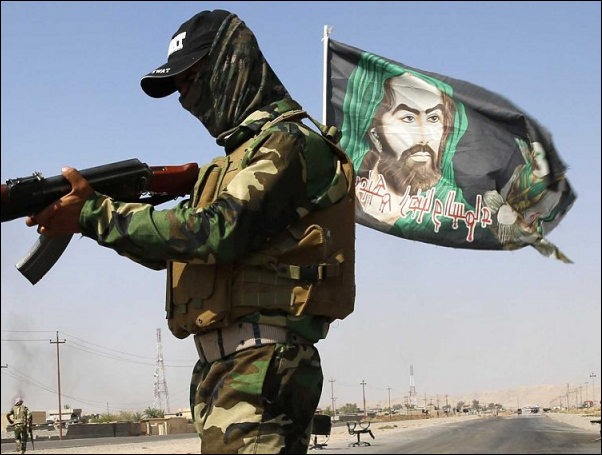
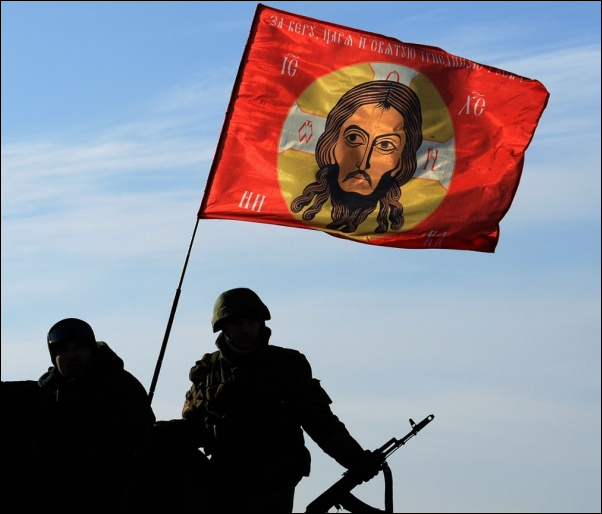
The battle flags of religion
Sunday, March 29th, 2015[ by Charles Cameron — vexilla regis prodeunt, comparative version ]
.
Two recent examples of religious iconography on the battle field.. from the Badr Brigade, outside Amerli, Iraq:
and from Pro-Russia fighters near the eastern Ukrainian city of Starobeshevo:
**
The Vexilla regis is a hymn written by Venantius Fortunatus to welcome the procession bringing a fragment of the True Cross to St Radegunda‘s convent in Poitiers: the first line translates to “The banners of the king go forth”.
Here it is, illustrated with battle flags flown by Catholic and Royalist troops during the War in the Vendée:
**
Sources:
Iraq Ukraine
When the promise of the miraculous is disappointed
Saturday, March 21st, 2015[ by Charles Cameron — the role of promise and illusion in recruitment, disappointment and disillusion in CVE ]
.
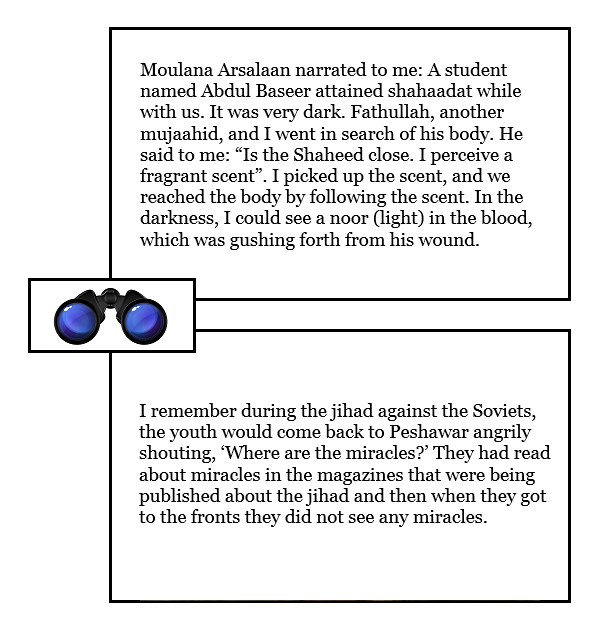
Here’s an example of promise and disillusionment from the early Afghan jihad: upper quote below from Abdullah Azzam, lower quote from Mustafa Hamid.
**
It seems that disappointed hopes are and/or should be a major focus in countering violent extremism, ie places where the jihadist recruitment “narrarive” fails when it comes in contact with ground reality. Because a caliphate that is losing ground is no caliphate. Because a caliphate that diverges from its own ideals and standards is no caliphate. Because the food is terrible, or battle turns out to be more real than bargained for:
[ order of these two NYT paragraphs reversed here at Zenpundit ]
During nearly a year in contact with New York Times reporters, Abu Khadija expressed gradually growing discontent. His grievances ranged from relatively mundane issues like eating canned food and being deployed to a front line far from his family because of a lack of fighters, to discomfort with the group’s strategic priorities and its extreme violence.
“I can’t eat, I feel I want to throw up, I hate myself,” he said, adding that the executioners had argued over who would wield the knives and finally settled the issue by lottery. “Honestly, I will never do it. I can kill a man in battle, but I can’t cut a human being’s head with a knife or a sword.”
Jessica Stern makes a similar point on NPR:
I think that we need to hear a lot more from people who leave ISIS – somebody who says, gosh, I joined. I thought I was going to be making the world a better place, and it turned out that it really wasn’t what I imagined, that there were atrocities that I didn’t want to be involved in. There are people who are saying that. We need to amplify those messages.
**
The quote in the upper panel of the DoubleQuote above comes from Azzam’s collection, The Signs of Ar-Rahmaan in the Jihad of Afghanistan. There are many miracles (both mujizat and karamat) described there. Among them, one of the most interesting to me concerns the Miraj and al-Aqsa mosque:
Informing the people of the details of Baitul Maqdis after the night of Me’raaj.
Rasulullah sallAllaahu alayhi wa sallam said: When the people denied (the Me’raaj), Allaah Ta’ala revealed the Baitul Maqdis to me and I informed the people of its details whilst looking at it.”
The Miraj was the prophet’s night journey to the Noble Sanctuary / Temple Mount (Bait al-Maqdis) in Jerusalem, from whence he ascended the heavens and was given the instructions for Muslim prayer. The Noble Sanctuary was Islam’s first Qibla or direction of focus in prayer.
The quote in the lower panel above comes from Mustafa Hamid in his forthcoming book with Leah Farrall, The Arabs at War in Afghanistan. In it, Hamid illustrates both the spiritual aspirations and disappointed hopes at play in that earlier jihad.
I have discussed Azzam’s and others’ descriptions of miracles previously in such posts as Of war and miracle: the poetics, spirituality and narratives of jihad, Azzam illustrates Levi-Strauss on Mythologiques, and Gaidi Mtaani, the greater scheme of things. Such stories are profoundly moving to those who are open to believing them.
In Mustafa Hamid’s words, we see the equal and opposite influence unleashed when such stories, offered as promises in recruitment, prove unsubstantiated by reality.
A hat-tip to Myra MacDonald, who pointed me to this quote.
_______________________________________________________________________________________________________
Side note:
Students of comparative religion may find the following paragraphs, quoted in the Azzam compilation from the Deobandi scholar Ashraf Ali Thanwi of interest:
Karaamaat and Mu’jizah do not occur by a person’s design — that whenever the Nabi or Wali wishes he can execute such an act. Such acts only occur when Allaah Ta’ala in His Infinite Wisdom wishes to exhibit the act. It then occurs whether a person desires it or not.]
A karaamah does not indicate that the person performing such an act is better than others. In fact, sometimes the karaamah decreases his status in the sight of Allaah, due to fame and vanity entering his heart. It was for this reason that many of the pious personalities used to make istighfaar (seek forgiveness) when a karaamah would manifest itself at their hands, just as they would make istighfaar when sins are committed
The statement “It then occurs whether a person desires it or not” reminds me, for instance, of the tale told of St Teresa of Avila, friend and colleague of St John of the Cross:
Legend tells it that as Teresa was in the choir singing among her sisters one day, she began to levitate. When the other nuns started to whisper and point, Teresa lowered her gaze and realized that she had risen several inches above the stone floor. “Put me down!” she demanded of God. And he did.
There’s a deeper truth hidden in St Teresa’s request, I suspect: grace is not taken, it is given.