zenpundit.com » Islam

Archive for the ‘Islam’ Category

Sex fatwas: N so very SFW

Monday, July 29th, 2013

[ by Charles Cameron — a comparative view of one of the more alluring byways of the religious imagination ]
.

You’ll occasionally see reports of outré sexually-oriented fatwas emerging from the Middle East — and sometimes they’re entirely fictitious. This DoubleQuote is to remind us that outré sexually-oriented religious teachings can crop up all over the place, exercise a momentary thrill, and are soon forgotten.

The upper of the two images relates to a recent report in Al-Arabiya titled Pro-Mursi protesters are awaiting signal for ‘sexual Jihad’.

The lower of the two was taken from a “Flirty Fishing” pamphlet put out decades ago by the then Children of God aka The Family — the practice of FFing has since been discontinued. See also (highly NSFW):

  • FF Reports (the bureaucracy!)
  • Bought with a Price
  • God’s Whores, and
  • God’s Love Slave!
  • When last I looked, the best academic text on CoG and FFing was David van Zandt‘s book, Living in the Children of God. Sociologist of religions (and my e-colleague) Stuart Wright has a book chapter titled From “Children of God” to “The Family”: Movement Adaptation and Survival on The Family International’s current site.

    Of the arm, fist and rifle

    Thursday, July 25th, 2013

    [ by Charles Cameron — product from a neat, brief convo with Ibn Siqilli aka Chris Anzalone ]
    .

    I found the upper image in the same Visual References post from Chris Anzalone that I recommended recently in two comments here [figs 2, 3, 3B] and here. If you look closely — or is just my poor eyesight? — you’ll see the arm, fist and rifle to the left of the black banner in the upper half of the upper image.

    Black banner? Did I just say black banner?

    That upper image is the “logo of the Brigade of the Awaited Savior (Katibat al-Mahdi al-Muntazar)” according to Chris, and the text below reads, “O’ One Who Arises (al-Qa’im) [from] the family of Muhammad.”

    So there you have Mahdism (the titles al-Muntazar and al-Qa’im are both indicators of the same returning great one as the term al-Mahdi itself) along with the well-known banner…

    **

    What follows I have taken from a post on the Lebanese Expatriate blog, with some minor format changes to give the contents better graphical integration with the rest of the post:

    For those with the slightest knowledge about Hezbollah and the Middle East, I am not sharing with you something new, but for those who receive this information as a revelation, check out the resemblance between the emblem of Hezbollah and that of the Pasdaran, a.k.a Army of the Guardians of the Islamic Revolution.

    .
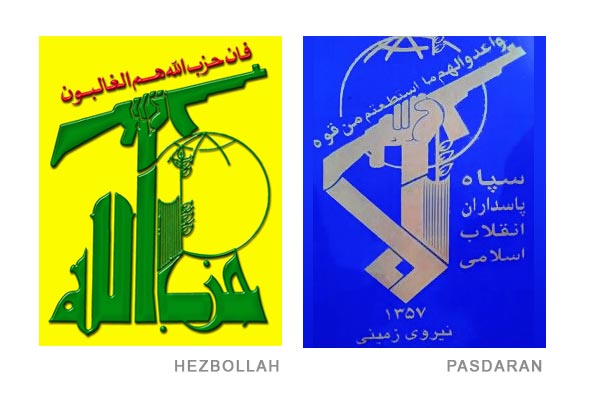
    — Hezbollah emblem to the left in yellow. Pasdaran emblem to the right in blue.
    .

    So what’s new? Why am I shedding light on what is already obvious? Why target Hezbollah today, out of all the parties that have been selling Lebanon?

    Today, more than ever, Hezbollah and Iran owe Lebanon an explanation. Take a look at the 10 Riyal postage stamp that is circulated in Iran.


    Iranian 10 Riyal postage stamp showing the emblem of Hezbollah covering the whole map of Lebanon. A clear symbol of the hidden intentions and a direct breach for the sovereignty of Lebanon’s independence as a nation.

    The stamp commemorates the martyrs of Hezbollah in Lebanon. Isn’t this an obvious breach of Lebanon’s sovereignty as a nation? I understand the bff relationship between Iran and Hezbollah, but why does Iran need to have Hezbollah’s emblem covering the Lebanese territories instead of the Lebanese flag? Why does Iran need to commemorate the Lebanese martyrs in the first place?

    What does Hezbollah have to say about this in the first place? How can Hezbollah justify such a demeaning document? What can its big-bellied, tie-less MPs and representatives say to logically justify this? Will they even attempt to justify it, or consider it normal and not even worth concealing with the whole world’s knowledge of its non-matrimonial marriage to Iran.

    As a Lebanese, I ask my government (which is controlled by Hezbollah) to question the Iranian ambassador about the motives of this stamp and ban its circulation.

    As a Lebanese, I ask Hezbollah to denounce the usage and circulation of this stamp in Iran and ask the Iranian state for an apology to the Lebanese people and its government.

    That’s taken from a post made in January, but I think it is no less relevant today, and adds to the general picture I’m painting.

    **

    I put this post together as the result of an exchange with Chris in which I asked him whether a raised arm with slanted rifle was now a characteristic motif across many or all Shi’a jihadist movements, to which he responded:

    Those groups influenced by Hizbullah &, by extension, Iranian Gov’t, seem to favor it, likely b/c it’s used by the Pasdaran.

    I then asked whether he’d say Hizbollah got the motif from the Pasdaran or vice versa, to which he replied:

    The former.

    I stumbled across the DoubleQuote image and accompanying Lebanese Expatriate post myself, searching for the best image of a Pasdaran flag or logo while following up on Chris’ pointer to the Pasdaran — and that gave me yet another use of DoubleQuotes in the wild!

    Hat-tip, #FF and thanks, Chris!

    **

    Quiet note to self: compare the arm, fist and rifle motif here with the name of the Covenant, Sword, and Arm of the Lord group in 1970s Arkansas. Most interesting, the way we display value systems in titles and images…

    Religions in the speech of Malala Yousafzai

    Saturday, July 13th, 2013

    [ by Charles Cameron — a speech worth close attention ]
    .


    .

    I bypassed several opportunities to hear or read Malala‘s speech today, until Shivam Vij tweeted that she had mentioned Badshah Khan. That caught my attention — Khan is not the most well-known of figures, but he’s one that I admire — and when I watched Malala’s speech, I found him in some pretty significant company:

    I do not even hate the Talib who shot me. Even if there was a gun in my hand and he was standing in front of me, I would not shoot him. This is the compassion I have learned from Mohammed, the prophet of mercy, Jesus Christ and Lord Buddha. This the legacy of change I have inherited from Martin Luther King, Nelson Mandela and Mohammed Ali Jinnah. This is the philosophy of nonviolence that I have learned from Gandhi, Bacha Khan and Mother Teresa. And this is the forgiveness that I have learned from my father and from my mother. This is what my soul is telling me: be peaceful and love everyone.

    That’s really quite a paragraph. And if the lives and thoughts of Gandhi or Mother Theresa, Mandela or Martin Luther King, Buddha, Christ or Muhammad seem important to you, and you are unaware of Bacha or Badshah Khan, I can recommend to you Eknath Easwaran‘s Nonviolent Soldier of Islam: Badshah Khan: A Man to Match His Mountains.

    In these times of religious conflict too, it is worth noting that this young Muslim woman speaks, on her sixteenth birthday and before the UN General Assembly, of the inspiration she has received not only from fellow Muslims — from the Prophet of her own faith, Muhammad, from the Father of her Nation, Muhammad Ali Jinnah, and from Benazir Bhutto, whom she terms shahid or martyr — but also from Buddha, Christ, and Gandhi, a Hindu.

    **

    As my regular readers know, I make a habit of noting patterns where I can find them, so I was struck by one rhetorical trope in particular within Malala’s speech:

    Dear sisters and brothers, we realize the importance of light when we see darkness. We realize the importance of our voice when we are silenced. In the same way, when we were in Swat, the north of Pakistan, we realized the importance of pens and books when we saw the guns.

    The relationship is a subtle one: darkness is juxtaposed to light not as silence is to voice but as being silenced is — while in the third clause, pens and books is to guns as darkness is to light, a powerful and thought-provoking juxtaposition.

    **

    Malala’s speech, full text:

    Our books and our pens are the most powerful weapons

    Malala’s speech in video:

    DoubleQuotes in the wild

    Wednesday, July 10th, 2013

    [ by Charles Cameron — “found objects” as they call them in the art world, relating directly to my DoubleQuotes forrmat ]
    .

    Here’s a terrific example, visual with textual accompaniment, of the power of DoubleQuotes, and the spontaneous uses that others make of them:

    **

    The textual element is kindly provided in translation by this tweet from Will McCants:

    **

    I’ll be using this post as a place to capture other instances of DoubleQuotes in the wild, just as I’ve been using A feast of form in my twitter-stream today to capture and comment on a series of instances of recursion in the twittersphere.

    Ramadan Mubarak…

    Of short stories and a dark sacrament

    Monday, July 8th, 2013

    [ by Charles Cameron — a powerful tale of “de-radicalization” as metanoia ]
    .

    Munir

    .

    Munir, by his own account, was drifting under the influence of various radical Muslim clerics, Abu Hamza al-Masri among them. One’s never too sure about the exactness of journo quotes, but here’s one media report to be going on with:

    “Look who I ended up with,” he said.
    “We had a fantastic relationship. It was a match made in heaven – his anger, my lack of self-esteem.
    “He wanted me to die on the battlefield.”

    It was, mashallah, not to be — Munir had a change of mind and heart, and now works to offer potentially susceptible British youth alternatives to the “al-Qaeda narrative”.

    Here is his story in two brief tweets:

    Sources:

  • Tweet 1: I once held a spoon
  • Tweet 2: That same spoon gouged
  • **

    That little double event — the holding of a spoon, the revelation of its invisible history — I am calling a dark sacrament. I draw the word “sacrament” my own theological background, but also from Joseba Zulaika‘s analysis of Basque terrorism in his fine book Basque Violence: Metaphor and Sacrament, wherein he quotes GB Ladner:

    The sacrament is altogether a very different kind of symbol: it not only signifies, but also effects what it symbolizes.

    I call this passing of the spoon a dark sacrament in two interwoven but opposite senses. The one who gave Munir the spoon intended it as a gesture making and marking a symbolic connection between Munir himself and its history, a gift of intensification in the dark religion of terror which calls on Islam for its justification.

    And yet it was also sacramental in another sense entirely from the one intended: it reached deep enough into that darkness to turn Munir himself towards the light — Islam rediscovered as the struggle of the soul to reorient from ignorance towards the Niche for Lights mentioned in the Verse of Light in the Qur’an, 24.35:

    God is the Light of the heavens and the earth; the likeness of His Light is as a niche wherein is a lamp (the lamp in a glass, the glass as it were a glittering star) kindled from a Blessed Tree, an olive that is neither of the East nor of the West whose oil wellnigh would shine, even if no fire touched it; Light upon Light; (God guides to His Light whom He will.) (And God strikes similitudes for men, and God has knowledge of everything.)

    Note those two last sentences: God strikes similitudes for men, so that each moment may be a signpost if we do but see it. And God guides to His Light whom He will.

    **

    Professional writers naturally have an affinity for all kinds of form, from the epic epic via the novel, novella, short story, sestina and sonnet to the haiku, and Twitter has unsurprisngly engaged their imaginations. Thus the New Yorker Fiction account, @NYerFiction, has been running a short story in tweets by Jennifer Eagan, while Teju Cole, more to my taste, has posted Seven short stories about drones in a tweet apiece.

    But those are prize-winning professional writers, which as far as I know Munir makes no claim to be: he is simply offering us his personal story, unvarnished — yet his effort effortlessly matches theirs. Here is a signal to myself and to the rest of us who try to understand radicalization, CVE and de-radicalization: that true epiphanies — sacramental signs, sacred moments — unleash a power into the system that no amount of calculation could predict.


    Switch to our mobile site