zenpundit.com » Islam

Archive for the ‘Islam’ Category

How to win souls and be worthy of emulation?

Tuesday, June 4th, 2013

[ by Charles Cameron — considering a rare attribute in two religious leaders ]
.

**

Christopher Anzalone tells a story about the Grand Ayatollah Sadiq al-Sadr (above, left), Moqtada‘s father, in his highly recommended podcast on Jihad & Martyrdom in Contemporary Muslim Militants with Karl Morand.

I’m very slow at transcription, but this story hit me with its insight into an aspect of religion that — as the story itself illustrates — is not always recognized, and i was able to find the same story told elsewhere, though not with the flair Chris brings to the telling. Here it is, as recounted by Patrick Cockburn in his book, Muqtada Al-Sadr and the Battle for the Future of Iraq:

One former disciple of Mohammed Sadiq tells an anecdote illustrating his master’s pragmatism. “One day, I was sitting with Mohammed Sadiq in his office, when a man came in to ask the price of tomatoes,” he says. “The question infuriated me: I thought he had come to mock us. But al-Sadr, wiser and smarter than I am, gave him a detailed answer, giving him the price of different kinds of tomatoes. He had understood what the question was about. I caught up with the man as he left the office and asked him why he had asked the question. He replied: ‘In selecting a marji’ [a religious figure to emulate and whose rulings he would accept], I choose the one who knows my suffering, who is close to the poor and the disinherited.'”

**

Pope Francis has a similar direct and simple approach, and from the very start of his pontificate it has been winning him admirers, both religious and secular. He refuses the limo, preferring to take the bus. He pays his own bill as he checks out at the hotel front desk (above, right). He telephones the guy in Buenos Aires whose newsstand supplied his daily newspaper, to thank him and cancel his subscription…

Person to person.

Every day is Ashura, every place is Kerbala

Wednesday, May 29th, 2013

[ by Charles Cameron — an Ayatollah’s video take-down of the Grand Mufti ]
.

Today’s latest news from the Long War Journal is titled Egyptian jihadists call for attacks in Shiite countries and opens with the paragraph:

Twenty Egyptian jihadists have issued a statement calling upon Sunnis to launch attacks in Shiite-led countries in response to the Assad regime’s offensive in Qusayr, a city in western Syria near Homs. The chief signatory on the statement is Mohammed al Zawahiri, the younger brother of al Qaeda emir Ayman al Zawahiri.

**

**

I’ve been having some conversations on Twitter recently in which I’d been verifying my own sense that Hezbollah‘s ethos and imagery of martyrdom would presumably extend beyond the poppies and doves depicted here to include also the martyrdom of Husayn at Kerbala, and I’m grateful to Phillip Smyth for his confirmation and elaboration on that theme.

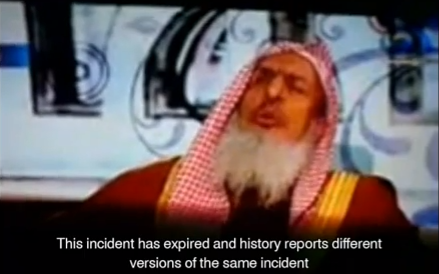
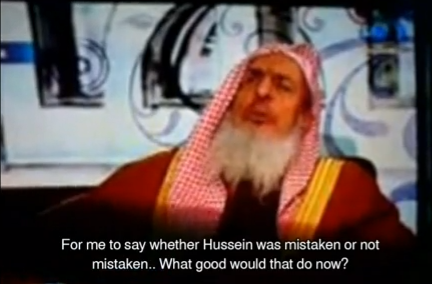
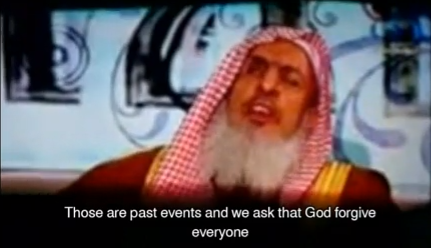
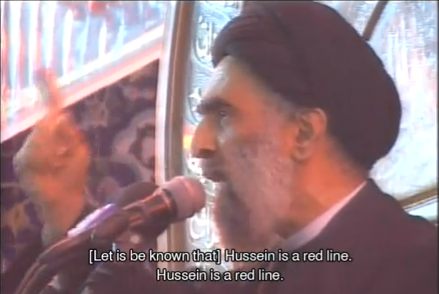
Somehow in my wanderings, I came across this video, in which Ayatollah Sayed Hadi al Modarresi, a senior Shia cleric, bookends his even more senior Sunni counterpart the Grand Mufti of Saudi Arabia, Sheikh Abdul Aziz al-Sheikh, with his own commentary, speaking from the very heart of Shia passion — the shrine of Imam Husayn in Kerbala.

The Ayatollah challenges the Grand Mufti’s assertion that Husayn erred in refusing his oath of obedience to Yazid, thus bringing his own death upon himself at the ensuing battle of Kerbala:

**

Things that impressed me:

The simple but rhetorically effective use of one video quoted within another.

The incredible passion of the crowd in Kerbala, which the poster called to our attention with a note saying:

Keep watching to see the fury of the audience..

The half-accusatory, half-conciliatory way in which the Grand Mufti expressed himself, with phrases that suggested Husayn — may God be pleased with him — was in error, while asking God to forgive him…

and:

and in response, the Ayatollah’s use of the imagery of the “red line”:

**

If the Long War Journal piece shows us an aspect of the current situation, this stunning video offers us a window into the passions such events are poised to arouse.

Love, Death, and Jihad by Pen and Sword

Wednesday, May 29th, 2013

[ by Charles Cameron — with Wagner and Abu Dujana as examples, the cognitive sting here is in the tail — the power of a double image to engage both emotion and insight ]
.

Love and death.

**

The human mind thinks in parallelisms and oppositions.

My lords, if you would hear a high tale of love and of death, here is that of Tristan and Queen Iseult; how to their full joy, but to their sorrow also, they loved each other, and how at last they died of that love together upon one day; she by him and he by her.

Thus begins Bédier‘s version of The Romance of Tristan & Iseult as Hilaire Belloc presents it in its classic English form. The parallel there, between love and death, is found also in Freud’s binary opposition of Eros and Thanatos, which he suggests in Civilization and Its Discontents:

The name libido can again be used to denote the manifestations of the power of Eros in contradistinction to the energy of the death instinct.

and in Wagner’s Liebestod — by way of returning to Tristan and Iseult:

**

Likewise, there’s a parallelism between jihad by pen (jihad bil qalam) and by sword (jihad bil saif) — shown in Abu Dujana al-Khurasani‘s move from writing on the forums to martyrdom in Khost — which al-Awlaki phrases in terms of ink and blood in eulogizing Sayyid Qutb in Constants on the Path of Jihad:

We see that in our contemporary times with people like Syed Qutb. He wrote with ink and his own blood. People like Shaykh Abdullah Azzam and Shaykh Yusuf al ‘Uyayree. They wrote amazing books, and after they died it was as if Allah made their soul enter their words to make it alive; it gives their words a new life

and which appears, contrariwise, in the hadith — considered weak by some and cherished by others:

The ink of the scholar is more sacred than the blood of a martyr

**

Which brings me to my own parallelism of the day — a parallelism between two uses of graphical similarities, to convey powerful messages:

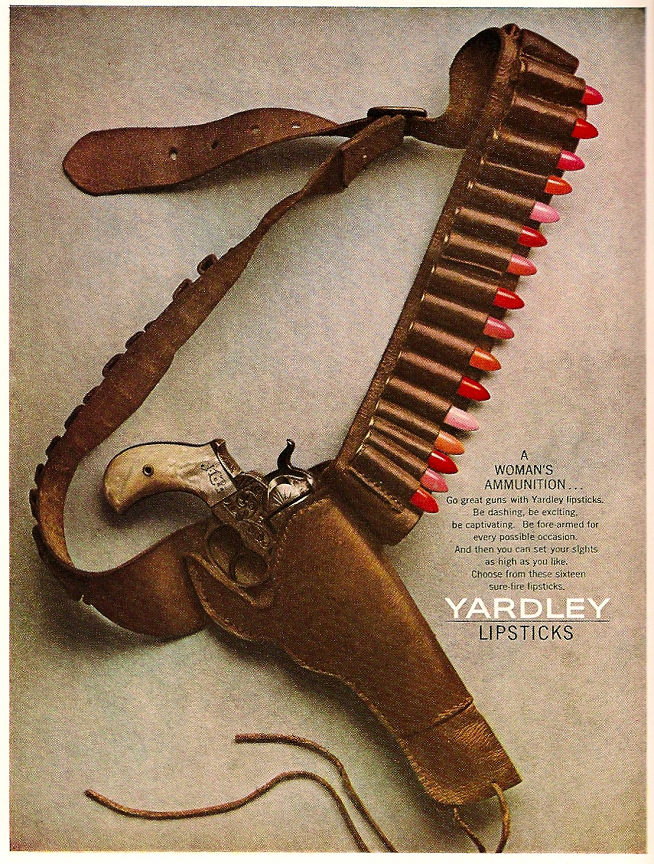
The upper panel shows a Yardley‘s lipstick ad that I must have seen forty years ago on the London Underground — it stunned me then, and it stuns me today to have rediscovered it on the net — which I have long thought of as a brilliant illustration of “rhyme” in images.

And the lower panel? It’s the parallelism between jihad bil qalam with jihad bil saif, extended into the cyber realm. Again, a powerful image, because when two items “rhyme” in some way that’a apparent to us, there’s an instinctive summoning of all that they mean to us close to the surface of consciousness, and other aspects of their relatedness can then become clear to us in a flash of insight.

**

Here’s the full Yardley’s ad, still very much as I remember it from so long ago:

It’s a weird, wild world

Sunday, May 26th, 2013

[ by Charles Cameron — Omar Bakri Muhammad, al-Muhajiroun, Tom Jones and The Hour — also: hot-wiring the apocalypse, I think not ]
.

As we all know by now, it turns out that the primary Woolwich suspects were associated with al-Muhajiroun. Accordingly, a couple of days ago I watched John Ronson‘s recently reposted documentary about their sheikh, Omar Bakri Muhammad, titled Tottenham Ayatollah Revisited. Bakri is about as far from an ayatollah as two peas can get inside a single pod, but never mind, here’s the video:

At the 13.56 mark, Bakri is preparing to negotiate arrangements for a rally he hopes to hold in a venue that hosts a variety of events, and what I’d say is a majorly weird exchange between the director and Bakri is captured on film:

The rally is scheduled between a Tom Jones concert and a show called The wonderful World of Horses. Omar has never heard of Tom Jones, and he is shocked to discover that women throw their underwear onstage.

“Oh my God, is that a sign of the Hour, a sign of the Hour?”

Is it?

“Of course, people start take off their, you know, their own knickers and their underwear, that is sign of the Hours.”

Now, I happen to think Bakri is joshing about not knowing Tom Jones, but the form his joshing takes is interesting.

The Hour in question would be the Hour mentioned in the Quran:

They will question thee concerning the Hour, when it shall berth. What art thou about, to mention it? Unto thy Lord is the final end of it. Thou art only the warner of him who fears it. It shall be as if; on the day they see it, they have but tarried for an evening, or its forenoon. [Q 79.42-46]

and:

They will question thee concerning the Hour, when it shall berth. Say: ‘The knowledge of it is only with my Lord; none shall reveal it at its proper time, but He. Heavy is it in the heavens and the earth; it will not come on you but suddenly!’ They will question thee, as though thou art well-informed of it. Say: ‘The knowledge of it is only with God, but most men know not.’ [Q 7.187]

and — perhaps most interestingly:

Those that believe not therein seek to hasten it; but those who believe in it go in fear of it, knowing that it is the truth. Why, surely those who are in doubt concerning the Hour are indeed in far error. [Q 42.18]

**

Hey. we’re in apocalyptic time again… Here’s my question:

We read quite often of the possibility that the Iranians — or Al-Qaida — might wish to “hot-wire the apocalypse” or “hasten the coming of the Mahdi”. I’d read that last verse as strongly suggestive that “hastening” might put one in the category of disbelief.

Is that an argument that has been offered against the idea, in either Sunni or Shi’a circles?

Hezbollah and related graphics

Sunday, May 26th, 2013

[ by Charles Cameron — insights into symbolism on both sides of the Syrian conflict, including Nasrallah as Dajjal and Pinocchio, Star Trek darkness, more ]
.

I thought it might be instructive to compare the Hezbollah flag:

with a couple of variants seen recently:

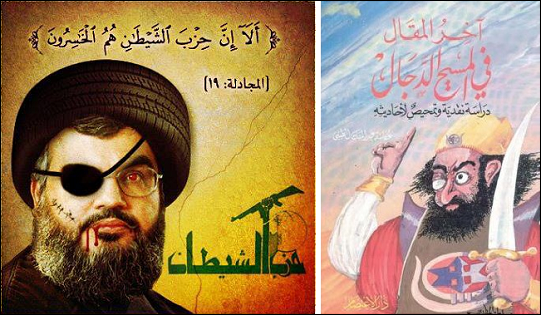
The version on the left is captioned Syrian opposition activists re-imagining Hezbollah’s logo after absorbing heavy losses in Qusayr. The one on the right is from another image mocking Hezbollah, this one picturing Nasrollah as the Dajjal.

Note that in the second image, the gun is pointing down — in a sort of “shoot your own foot” gesture, perhaps?

**

That second image, with the gun reversed, comes from a portrayal of Nasrallah as the Dajjal (below, left) — the one-eyed figure in Muslim apocalyptic serving roughly the same function as the Antichrist in Christian eschatology (depicted in a popular book cover,found by J-P Filiu, below, right):

Not also the tire substituting for Nasrallah’s black turban.

This image of Nasrallah is itself a variant on this one, also portraying him as the Dajjal:

but without the vampiric attributes and tire-turban of the other version.

**

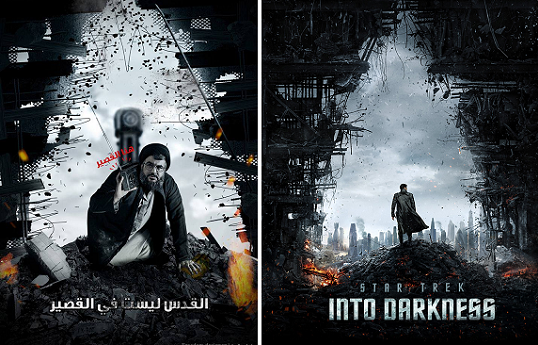
These guys are quick, incidentally — see how fast Nasrallah appeared in StarTrek guise

**

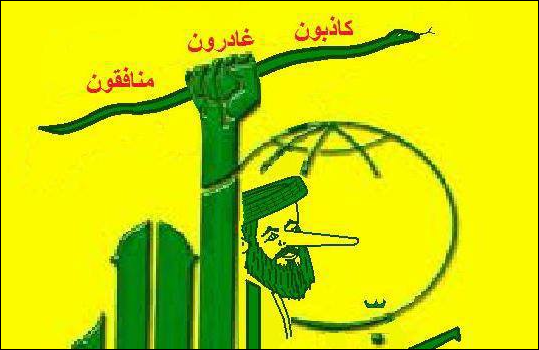
Here are a couple more variants on the Hezbollah flag:

I’m intrigued by the Pinocchio image, which — if I’m not mistaken — features the tire-turban once again:

It was lying that made Pinocchio’s nose extend itself, and just as the Devil in Christianity is “the Father of Lies” (John 8.44), so in Islam the term al-Dajjal means “the Deceiver”. And see how the gun has turned into a Serpent, complete with forked tongue?

**

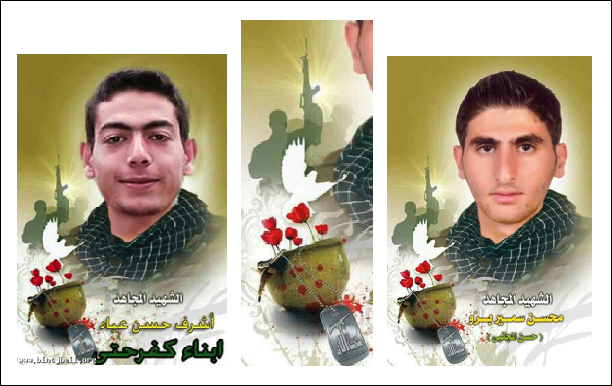
Finally, Phillip Smyth has been posting a series titled Hizballah Cavalcade at Aaron Zelin‘s Jihadology blog, and a couple of details caught my eye in what Smyth terms the “official Hizballah martyrdom posters” for Ashraf Hasan ‘Ayyad and Musen Samir Birro.

As you can see, each of these posters features the Hezbollah emblem on dog-tags, a soldier’s helmet with poppies growing from it, the outline of a white dove, silhouette of a soldier with rifle raised, and the glint of the sun behind it.

If anyone has a detailed exegesis of this cluster of images to offer, I’d be most interested.

**

Hat tips to Mr Orange for pointing me to the Nasrallah Dajjal graphics, and to Aaron Zelin for Jihadology…


Switch to our mobile site