zenpundit.com » Islam

Archive for the ‘Islam’ Category

Dajjal and Antichrist: the family resemblance

Sunday, May 26th, 2013

[ by Charles Cameron — on the assignment of archetypal roles to members of the British Royal Family ]
.

For those having trouble distinguishing the Dajjal from the Antichrist, I thought I’d post two screen-caps from a video of the Royal Wedding of Prince William and Kate Middleton, one of whom is identified as the Dajjal:

together with the cover of a book identifying the Antichrist — by his coat of arms — as Prince Charles:

In true conspiracist connect-the-dots fashion, then, the Antichrist is the Dajjal’s father.

**

Dajjals, Antichrists, Messiahs and Mahdis all function as Rorschach blots on which people project their hopes and fears, associating celebrities and leaders they despise and admire with archetypal instances of the final evil and the final savior.

By now, we should surely have figured out that this tells us more about those making the attributions than it does about the supposed, dreaded or hoped for end of days…

Some good news aka gospel

Saturday, May 25th, 2013

[ by Charles Cameron — the Greek word for gospel, euangelion, literally means good news — these news items from the last month or so are good ]
.

Sources:

  • Times of Israel, Hard to deny a Holocaust your father saved Jews from
  • Ha’Aretz, In one hard-knock British city, a secret Muslim donor helps save a synagogue
  • Sura 9 invoked: correction regarding the Woolwich transcript

    Thursday, May 23rd, 2013

    [ by Charles Cameron — update to follow ]
    .

    I’m sorry to have to inflict this on you, but I have yet to see an accurate transcript of the Woolwich attacker’s televised explanation published.

    So far, we have two transcripts, both found in a piece by Max Fisher in the Washington Post. The first goes like this:

    We swear by Almighty Allah we will never stop fighting you. The only reasons we have done this is because Muslims are dying every day. This British soldier is an eye for an eye a tooth for tooth. We apologise that women had to see this today but in our lands our women have to see the same. You people will never be safe. Remove your government. They don’t care about you.

    Then there’s an update to Fisher’s piece, which say the WP’s Anthony Faiola “listened to the ITV video very carefully and came away with a different quote than the one circulating in British media … Here’s the quote as heard by Faiola”:

    There are many, many ayah throughout the Koran [referring to religious verses] that says we must fight them as they fight us, an eye for an eye and a tooth for a tooth. I apologize that women had to witness this today but in our land women have to see the same. You people will never be safe. Remove your government, they don’t care about you.

    That’s definitely an improvement, and yet…

    **

    I must apologize for the fact that I cannot read or write Arabic, and therefore no doubt mix up different transliteration schemes at times like this — but I think this is one off those cases where a little religious knowledge helps ones ability to make out what’s being said by someone offering religious justification for their acts. The clip begins in mid-sentence with a clear reference to a Sura from the Quran — Sura 9, at-Taubah, The Repentance — and then continues with a reference to ayat , the plural of ayah, the term for a Qur’anic verse.

    Here’s what I hear:

    … Sura at-Taubah — many, many ayat throughout the Koran that, we must fight them as they fight us, an eye for eye and a tooth for a tooth. We, I apologize that women had to witness this today, but in our lands, our women have to see the same. You people will never be safe. Remove your government, they don’t care about you.

    The other notable divergence between my text and Faiola’s is that I hear “our lands” where he hears “our land”. But listen to the video — without the ITV reporter’s voice over obscuring part of the text — on this Guardian page.

    **

    It is worth noting that Sura 9 is the only sura in the Quran which does not begin with the Bismillah, “In the Name of God”.

    One commentator, referencing Ali ibn Abi Talib, notes:

    It should also be mentioned that this surah does not start with ‘Bismillah’ as do all other surahs in the Qur’an, because ‘Bismillah’ is an assurance of protection and mercy and as per report of Ali (RAA) this surah was revealed with a sword in its hand, and thus could not have the assurance of peace and mercy for the disbelievers.

    This presumably ties in with the fact that this is the sura which contains the “verse of the sword” — Sura 9.5, given here in the Arberry version:

    Then, when the sacred months are drawn away, slay the idolaters wherever you find them, and take them, and confine them, and lie in wait for them at every place of ambush. But if they repent, and perform the prayer, and pay the alms, then let them go their way; God is All-forgiving, All-compassionate.

    **

    I do not believe it serves justice, let alone mercy, for us to leap to the conclusion — rush to the judgment — that “Islam” is a monolithic entity, all of whose members are by definition disposed to violence.

    I do think it is important, once again, for us to understand that the speech here is religious speech.

    Putting it very mildly, and with deep sadness in my heart, today’s event in Woolwich was barbaric.

    Words, words — what’s a bunch of Wordsworth?

    Sunday, May 19th, 2013

    [ by Charles Cameron — bemused again, “jihad” (the word) in the news, “big data” too, plus Google expecting Mahdi ]
    .

    I suppose I should be glad — or should I? — that the word jihad is now in the news.

    It’s about time. Jihad (the word, the concept, the interpretations) should have been in the news at least since 9/11, don’t you think? or since the World Trade Center bombing in February 26, 1993, perhaps? or at least since Osama bin Laden’s Declaration of Jihad Against the Americans Occupying the Land of the Two Holy Mosques of September 2, 1996?

    In any case, the word finally seems to have arrived, if the entry from the National Geographic site last month (upper panel, above) can be trusted:

    And Big Data (lower panel)?

    President Obama launched his Big Data Initiative on March 29, 2012, but I’m not sure how long the term has been in active use. I’m told there’s no “big data” listing in the 2009 Oxford English Dictionary on CD-ROM, I have the sense that three days ago’s Foreign Policy is far more up to date than last month’s National Geographic in any case — and just a month or two ago the CTO of CIA, Ira “Gus” Hunt, situated Big Data somewhere between “the cloud” and right now, telling his audience at GigaOM:

    Big Data was so last year, right, all those breathless articles and all the front page covers — I was expecting BD to be Time’s Man of the Year, right. This year what we’re really talking about is how do we get value out of the stuff?

    That quote, of course, is so “two months ago”…

    **

    So what does National Geographic tell us about jihad?

    The Boston marathon bombing has focused attention on the word “jihad.”

    Vice President Biden characterized the alleged bombers as knockoff jihadis.” The Associated Press reported that the elder brother had “vaguely discussed jihad” with his mother over the phone in 2011.

    Origins

    “Jihad” is derived from the Arabic word juhd (meaning effort, exertion, or power) and literally translates to “struggle” or “resistance” for the sake of a goal. Used 30 times and in multiple contexts in the Koran, jihad most often denotes a struggle against external enemies, the devil, or one’s self. One example from the Koran (49.15) is: “The believers are those who believe in Allah and His Messenger … and jahadu (do jihad) with their properties and selves in the way of Allah.”

    Mark Wilks, an early 19th-century British author, introduced jihad into the English lexicon, defining it as a Muslim “holy war,” in his Historical Sketches of the South of India. It’s retained that meaning in English; the Oxford English Dictionary defines jihad as “a religious war of Muslims against unbelievers.”

    History

    Because of its roots and context in the Koran, jihad has a positive meaning to Muslims. Whatever form jihad may take, the struggle is always noble. When the term is evoked against external enemies, it can be used only during just or defensive wars.

    I’m sorry, but that last para beginning “Because of its roots and context in the Koran, jihad has a positive meaning to Muslims” isn’t terribly clear. When al-Zawahiri talks about jihad, for instance, does the writer imagine all Muslim readers imagine he’s talking about something noble? I fear there are some subtleties being missed her that not everyone who reads National Geographic may understand.

    **

    And what does Foreign Policy want to tell us about Big Data?

    The promoters of big data would like us to believe that behind the lines of code and vast databases lie objective and universal insights into patterns of human behavior, be it consumer spending, criminal or terrorist acts, healthy habits, or employee productivity. But many big-data evangelists avoid taking a hard look at the weaknesses. Numbers can’t speak for themselves, and data sets — no matter their scale — are still objects of human design. The tools of big-data science, such as the Apache Hadoop software framework, do not immunize us from skews, gaps, and faulty assumptions. Those factors are particularly significant when big data tries to reflect the social world we live in, yet we can often be fooled into thinking that the results are somehow more objective than human opinions. Biases and blind spots exist in big data as much as they do in individual perceptions and experiences. Yet there is a problematic belief that bigger data is always better data and that correlation is as good as causation.

    **

    Mr Orange had something to say about the word “jihad” in his War Tracker blog the other day, under the title What’s in the names of terrorist groups (1): Jabhah al-Nusrah li-Ahl al-Shâm min Mujâhidî al-Shâm fi Sahât al Jihâd:

    … they still use a religious term in their name: One that is quite negatively understood in the West but not so in the Arab and Muslim world namely Jihâd.

    They are Mujâhidîn – those who do Jihâd (religious struggle – in this case fighting) – on the fields of Jihâd. Mujâhidîn has a positive, religiously legitimizing ring to it – see here is someone who struggles for the religion – and is furthermore including. Whether you are with the FSA (even one of the rather secular parts of that group mind you) or with an independent Islamist group or with Jabhah al-Nusrah all do use the term Mujâhîd and all may be identified by that term (Granted there was a time when Thuwâr (revolutionaries) was en vogue but no longer so).

    That, IMO, gets us a lot closer to understanding a term that has a range of meanings, a range of users, and a range of audiences — from something along the lines of divinely obligated warfare to something akin to conscience (or what Rilke calls “being defeated, decisively, by constantly greater beings”) , and from those who use it for glorious self-identification to those for whom it is a euphemism for terrorist (irhabi), and from those itching for a fight to those longing, praying and working devotedly for peace…

    **

    So — since we’re talking big data and jihad, here’s a tiny snippet of jihad-related skew from Google, one of the giants of big data…

    I came across it via SelfScholar, who posted a very interesting response re the Iranian nuclear fatwa issue here a few days ago, in a post titled Google Translate’s Khomeini Problem.

    It appears that Google Translate has a distinctly unsecular view when it comes to major figures in Shi’ite theology — specifically, it adds religious honorifics to their names when translating from English into Farsi. As you might imagine, I wanted to know how they dealt with the Mahdi — and behold, my prayer was answered:

    So Google awaits his blessed return?

    It seems pretty clear that SelfScholar would be skeptical about that. He ends his blog post, in fact, with an indication that he neither awaits nor expects it — choosing for his final example “to highlight the inanity of it all, just one for the road…”:

    **

    Prof. Dr. Muhammad-Reza Fakhr-Rohani has an interesting piece titled Rendering Islamic Politeness Markers into English, which he concludes thus:

    There remain some Desiderata to be dealt with. First, the Arabic pre-nominal honorifics as well as post-nominal honorific-cum-optative sentences must be re-translated with a view to remove the items which make the language sound odd, and perhaps ungrammatical. Secondly, appropriate abbreviations must be devised for them. Finally, they must find their ways into English dictionaries, hence registered as part of the language.

    On eating one’s enemy

    Saturday, May 18th, 2013

    [ by Charles Cameron — not good branding, not Islamic, dumbstruck? — not a whole lot else to say ]
    .

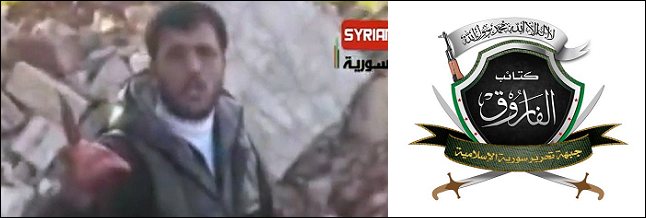
    Commander Abu Sakkar / the Farouq Brigades logo


    Let’s take the bald facts first:

    Commander Abu Sakkar of the Farouq Brigades, Free Syrian Army, had himself videotaped this month cutting open and seeming to eat the flesh of a just-killed Syrian soldier loyal to President Assad — to send a message. According to a New York Times “Lede” blog-post, he preceded this act with the words:

    I swear to God, soldiers of Bashar, you dogs — we will eat your heart and livers! … God is great! Oh, my heroes of Baba Amr, you slaughter the Alawites and take their hearts out to eat them!

    His rhetoric as reported speaks of eating the heart: in the event, it is a portion of lungs that he eats, or mimics eating.

    **

    This has to be seen in many contexts — one of them, the branding of the Syrian rebels in general and the Farouq Brigades in particular.

    This is taken from an article a couple of weeks ago on a WSJ blog titled For Some Syrian Rebels, It’s a Battle of the Brands:

    Twelve activists in an office in Reyhanli, Turkey near the border run Farouk’s Facebook page, web site, and Twitter account. They’re working on the TV channel, which Mr. Awad says they’ve envisioned as a tool to resocialize fighters off the battlefield.

    “The regime will fall one day,” he says. “We have 20,000 fighters–they all won’t stay fighters. They will put down their weapons, and need to integrate into the world. TV, radio, these things will help.”

    The media office’s latest brand offering? A three-dimensional version of the Farouk logo, which will be used in videos and other online material.

    “The guys complained the logo wasn’t nice enough,” Mr. Awad said, laughing. “They wanted a 3D one.”

    **

    Moralizing about someone eating the flesh of a deceased enemy is pretty easy to pull off — unless one still thinks it’s a potent way to acquire one’s enemy’s courage, which is now something of a curiosity in the anthropologist’s cabinet of concepts. Here, dug up from the section on Homeopathic Magic of a Flesh Diet in Sir JG Frazer‘s 1922 edition of The Golden Bough, now long out-dated, is the picture as it used to be seen:

    When Basutos of the mountains have killed a very brave foe, they immediately cut out his heart and eat it, because this is supposed to give them his courage and strength in battle. When Sir Charles M’Carthy was killed by the Ashantees in 1824, it is said that his heart was devoured by the chiefs of the Ashantee army, who hoped by this means to imbibe his courage. His flesh was dried and parcelled out among the lower officers for the same purpose, and his bones were long kept at Coomassie as national fetishes. The Nauras Indians of New Granada ate the hearts of Spaniards when they had the opportunity, hoping thereby to make themselves as dauntless as the dreaded Castilian chivalry.

    Even as a cannibal delicacy, the white man’s heart seemed to have special virtue! As I say, though — that’s all a little out of date.

    **

    Eating one’s enemy, however, is a distinctly un-Islamic behavior, whatever century we’re in. One early Islamic narrative concerns Hind bint ‘Utbah avenging deaths in her own family by eating the heart of a great Muslim warrior, dear to the Prophet — far from being an example of what is permitted in Islam, she’s an example of what Muhammad was up against by way of enemies in the early days of his preaching:

    Hind Bint `Utbah, the wife of Abu Sufyaan, ordered Wahshiy to bring her Hamzah’s liver, and he responded to her savage desire. When he returned to her, he delivered the liver to her with his right hand, while taking the necklaces with the left as a reward for the accomplished task. Hind, whose father had been killed in the Battle of Badr and whose husband was the leader of the polytheist army, chewed Hamzah’s liver hoping to relieve her heart, but the liver was too tough for her teeth so she spat it out and stood up shouting her poem:

                        For Badr we’ve paid you better
                        In a war more flaring than the other.
                        I was not patient to revenge the murder of
                        `Utbah, my son, and my brother.
                        My vow’s fulfilled, my heart’s relieved forever.

    Hind did eventually become a Muslim — but on account of this very event, was never fully included among “the Companions of the Prophet”.

    **

    I don’t want to moralize over Commander Abu Sakkar‘s act, not having been in his shoes — but it is vile under pretty much any moral standard you might choose. A problem arises, though, when one attempts to use it to justify one side or another, in a conflict in which brutality of one kind or another seems to be present on both sides. As Sakkar himself told a Time correspondent:

    You are not seeing what we are seeing, and you are not living what we are living. Where are my brothers, my friends, the girls of my neighborhood who were raped?

    **

    Peter Bouckaert of Human Rights Watch is quoted giving another kind of context to the affair:

    Abu Sakkar is just one man, and there are many other armed fighters in Syria who reject such sectarian actions and would be horrified by the mutilation and desecration of a corpse — let alone an act of cannibalism. But he is a commander in a decisive battle in Syria — hardly a marginal figure.

    **

    Not without reason did Kurtz whisper at the end of Joseph Conrad‘s Heart of Darkness, as in Francis Ford Coppola‘s Apocalypse Now:

    The horror! The horror!


    Switch to our mobile site