zenpundit.com » counterterrorism

Archive for the ‘counterterrorism’ Category

Thomas Hegghammer on Morten Storm

Tuesday, January 15th, 2013

[ by Charles Cameron — in case you missed TH’s tweets on Storm today ]
.

.

Here’s a quick overview of Morton Storm, the complex figure who is reported to have brought Anwar al-Awlaqi a bride from Europe — and thus betrayed Awlaqi’s whereabouts to the Agency:

After converting to Islam, a former member of a Danish motorcycle gang travels to Yemen to study the Quran and soon comes in contact with radical preachers waging holy war against the West.

On the verge of becoming a jihadist, he abruptly abandons his faith and embarks on a dangerous undercover mission to help Western intelligence agencies capture or kill terrorists.

Morten Storm, 37, claims he worked for six years as an informant for the CIA, Britain’s MI5 and MI6 and Denmark’s security service, PET. All declined to comment for this article.

“Could they just say `he never worked for us’? Sometimes silence is also information,” Storm told AP in Copenhagen. “I know this is true, I know what I have done.”

Storm’s unlikely story, told in a new book and an interview with The Associated Press, has the drama and intrigue of a “Homeland” episode. But the burly, red-bearded Dane insists his tale isn’t fiction.

Storm said he decided to reveal his secret-agent life to the media – he first spoke to a Danish newspaper in October – because he felt betrayed by his agent runners.

In particular, he was upset that he wasn’t given credit for the airstrike that killed Anwar al-Awlaki, a senior al-Qaida figure, in Yemen in 2011.

**

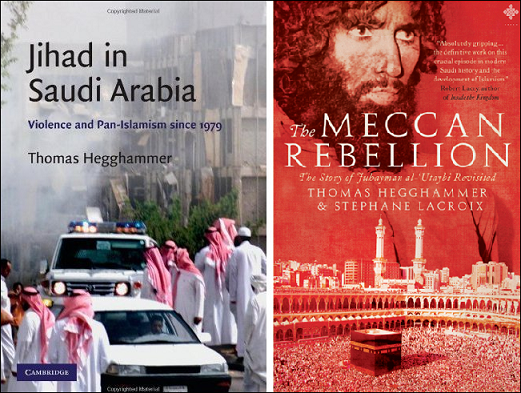
Thomas Hegghammer, author of the two books depicted above, and a highly respected academic specialist in terrorism and poliical violence, tweeted:

Enjoying new book on Danish ex-jihadi Morten Storm. Some highlights:

1) Regents pk mosque da’i sends Storm to Muqbil in Yemen in 97

2) Storm travels from Sanaa to Dammaj with “Rashid”, aging Afro-American Korea vet. They join 3000 Salafists in “gigantic boy scout camp”

3) in 98, after 8 months wMuqbil, Storm goes to Sana’a to find wife. Connects with jihad vets from Bosnia, Afgh. Weds, divorces Djbouti girl

4) Back to UK, Denmark; marries in Morocco; to Yemen again in 2001; almost goes to pre 9/11 Afgh; preaches jihad in Ta’iz (2001-2) instead.

5) Returns to DK in 2002 with wife and son Osama. Joins radicals in Vollsmose. “Jihad training” (obstacle course and paintball) in Odense

6) Moves to Luton in 2003; meets Omar Bakri, Taymour Abdelwahhab; demonstrates and jihad trains (in Barton Hills) with al-Muhajiroun

7) Thought 7/7 bombings were “cool”; found Bakri and Choudhry too soft; went to Yemen again in Jan 2006 but found no jihadis to join

8) Prepared to fight in Somalia in late 2006, but trip called off. Annoyed, he starts to doubt; turns completely after 2 weeks of googling

9) becomes PET informant in Jan 2007; sent to Tripoli, Lebanon in April to report on Raed Hlayhel, Omar Bakri, Fath al-Islam.

10) Meets w/MI6 and CIA (Jennifer Matthews) in spring of 2007; sent to UK for spy training; then travels between DK, UK, Kenya and Yemen.

11) Storm had taken classes with Awlaqi in 2006; Awlaqi helped Storm find a wife. Storm back in Sana in Aug 2008, they reconnect.

12) Aug: 2008: Awlaqi visits Storm’s flat; Awlaqi impressed by Dane’s Shabaab contacts. Awlaqi and Warsame speak on Storm’s mobile

13) next meeting in Sep 2009 in al-Hawta (Shabwa); Awlaqi mentions plots in West; wants fridge to store explosives, and help finding wife

14) Late 2009: Storm helps US-led operation against Saleh Nabhan in Somalia. Storm stays in touch w Awlaqi by email in 2009-2010

15) late Nov 2009: random female Awlaqi fan from Croatia contacts Storm via FB fanpage. Storm vets her and puts her in touch wAA.

16) Storm meets “Aminah” in Vienna in March 2010; shows her video from AA and records one of her for AA; gives her CIA-bugged suitcase.

17) On 2 June 2010 Aminah flies to Yemen. On arrival, cautious AA aides discard her suitcase. Storm still gets $250k cash from CIA.

18) New plan in spring 2011: go to Yemen, send AA a tracked USB. In Sanaa, Storm connects wAA, shops ladies items for Aminah on his request.

19) early Sep 2011: AA courier picks up tracked USB from Storm. AA killed on 30 Sep. Storm, back in DK, expects recognition as key agent

20) Storm, outraged at lack of recognition and reward, plots revenge. He secretly records next CIA meeting, then contacts press. THE END

Then:

PS: E-book version of the Morten Storm biography (Danish only) available here: http://tiny.cc/2wfxqw Sorry for overposting – I’ll shut up now

**

I’d asked Hegghammer’s impression of the book’s (and Storm’s) credibility, while Aaron Zelin had commented on TH’s #7 above:

Right before the jailbreak in Feb ’06.

To which Hegghammer responded:

Exactly. It’s details like this (plus pics, receipts, recording etc) that makes it very credible

Will McCants has the last word…

also, his last name gives him superhero status

**

The brief account of Morton Storm at the top of this post is from Huffington Post. Name links are to twitter feeds, all are recommended. Hegghammer’s books are available on Amazon.

Profiling Baader-Meinhof

Tuesday, January 15th, 2013

[ by Charles Cameron — fast cars, bumper stickers — and no mention of loose women ]
.

-- I'm not a member of the Baader-Mainhof gang

.
The sentence that drives my title is this one, from How BMW Became A Terrorist Icon In The 1970s (And How It Made Them Cool) on Jalopnik:

police would set up roadblocks and stop only BMWs in an attempt to root out the gang members from the general population.

That’s profiling for you, eh?

**

Here’s a longer excerpt, so you see where this comes from — and how it turned out, at least for as the makers of BMWs:

In the early 1970s, the extreme left wing Baader-Meinhof Gang terrorized the people of West Germany with a campaign of bombings and assassinations aimed at dismantling a capitalist system they considered no better than the Third Reich.

The terrorists’ ride of choice? BMW New Class sedans and coupes, according to this documentary from historian Richard Huffman, an expert on the Baader-Meinhof Gang.

Huffman says cars became so strongly associated with the group’s acts of terror that police would set up roadblocks and stop only BMWs in an attempt to root out the gang members from the general population.

People even started saying that “Bavarian Motor Works” actually stood for “Baader-Meinhof Wagen.” Some BMW drivers even had to slap bumper stickers on their cars specifying that they weren’t terrorists.

You might expect this to have been a major PR crisis for BMW, then a small and nascent regional automaker nowhere near as prominent as it is today. But it wasn’t. That’s because the Baader-Meinhof Gang, later known as the Red Army Faction, enjoyed a surprising amount of support from people in West Germany, especially among young people and members of the left-leaning counterculture. This went a long way toward making the car seem hip in German youth culture.

Then the gang stopped being theoretical revolutionaries and actually started murdering Germans and U.S. soldiers. When the body count began to rise, public support evaporated. As for BMW, they emerged unscathed from the crisis, and started growing into the luxury giant they are today.

**

Now, what kind of analytic model would predict a series of twists and turns and hairpin bends like that?

The Battle of Algiers / Black Friday koan

Saturday, November 17th, 2012

[ by Charles Cameron — a tale of two films, two conflicts, two cities ]
.

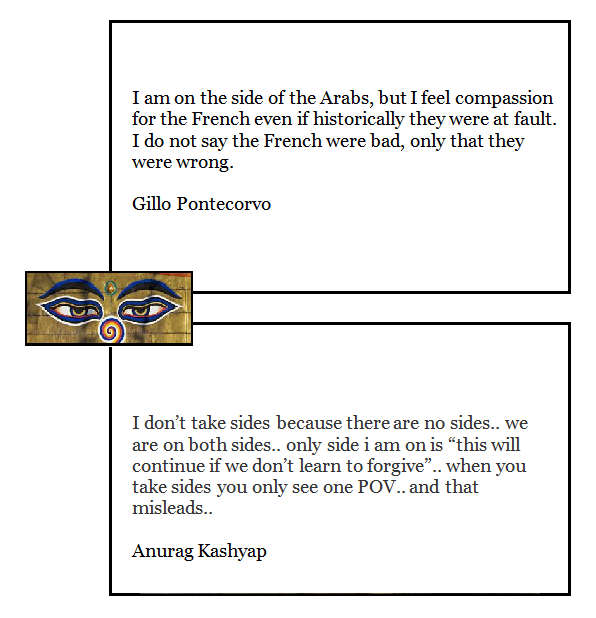
Are these two positions — take one side, take both sides — reconcilable?

That’s the koan, the paradox that’s facing me, after seeing two terrific films by these two directors again, this time back-to-back. The two films their respective directors are discussing are Gillo Pontecorvo‘s Battle of Algiers and Anurag Kashyap‘s Black Friday.

Elie Weisel triggered this set of reflections for me when I saw his stark statement of the “one side” position:

We must always take sides. Neutrality helps the oppressor, never the victim. Silence encourages the tormentor, never the tormented.

Let’s turn to the films.

**

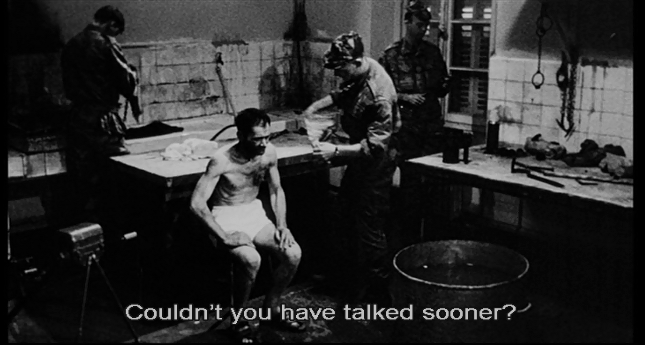
Pontecorvo’s Battle for Algiers is a rightly-celebrated classic, and it’s opening shot confirms the director’s claim to show compassion for both sides:

That’s an unexpected question from torturer to the victim he has just “broken”, and speaks volumes about the director’s intent — as does this quote from the french paratroop commander, Col. Mathieu, speaking of Larbi Ben M’Hidi, a leader of the National Liberation Front (FLN) whom he has captured and questioned — and who in “RL” was in fact murdered, though his death was reported at the time as a suicide:

Pour ma part, je peux seulement vous dire que j’ai eu la possibilité d’apprécier la force morale, le courage et la fidélité de Ben M’Hidi en ses propres idéaux. Pour cela, sans oublier l’immense danger qu’il représentait, je me sens le devoir de rendre hommage à sa mémoire.

For my own part, I can only tell you that I had the opportunity to appreciate Ben M’Hidi’s moral strength, his courage and his loyalty to his own ideas. On that account, and without overlooking the immense danger he represented, I feel obliged to salute his memory.

That reads to me as the respect of courage for courage.

The Pentagon, FWIW, held a screening of Battle for Algiers in September 2003, issuing a flyer indicating their reason to be interested in the film:

How to win a battle against terrorism and lose the war of ideas. Children shoot soldiers at point-blank range. Women plant bombs in cafes. Soon the entire Arab population builds to a mad fervor. Sound familiar? The French have a plan. It succeeds tactically, but fails strategically. To understand why, come to a rare showing of this film.

Yes indeed, it does sound a tad familiar.

**

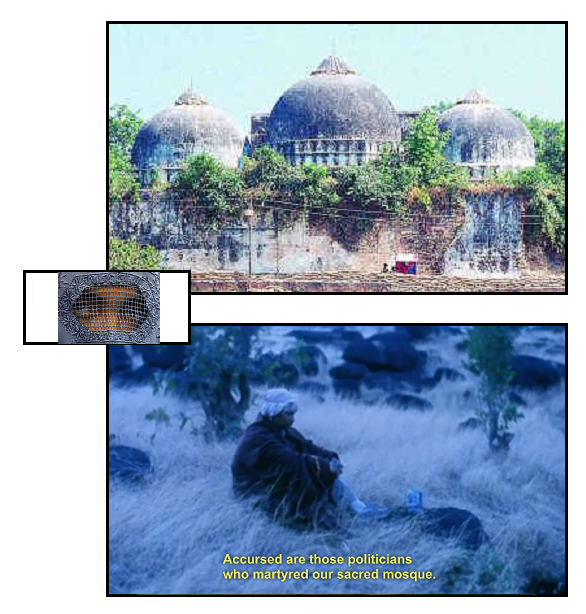
I’ll represent Kashyap’s Black Friday visually with a pair of images, the top one showing the Babri Mosque in Ayodhya / Oudh, which was leveled in December 1992 by an angry Hindu mob who claimed it had been built on the birthplace of Lord Rama, the avatar of Vishnu whose story is told in the Mahabharata

while the lower one represents Muslim rage at that event, making use of voice-over and that remarkable phrase, “martyred our sacred mosque”, to good effect.

Kashyap, then, can understand the feelings behind the horrific series of terrorist bombings that shook Bombay — as well as those of the bombed and terrorized population of that city. As Oorvazi Irani explains in her commentary on the film, Kashyap’s own views are expressed in the voice of DCP Rakesh Maria in the “chapter” on the interrogation of Badshah Khan:

Badshah Khan very proudly takes credit for the bombings and says Muslims have taken the revenge for the atrocities done to their Muslim brothers. That’s when Kay Kay Menon who plays the cop says and speaks in the voice of the director “…Allah was not on your side, on your side was Tiger Memon. He saw your rage and manipulated you. He was gone before the first bomb was even planted. ..he fucked you over. you know why? Because you were begging for it. All in the name of religion. You are a fucking idiot. You are an idiot and so is every Hindu, who murders one of you. Everyone who has nothing better to do … but to fight in the name of religion is a fucking idiot.”

**

Can there be a right side and a wrong side in a game? There can certainly be a winning side and a losing side — but a right side and a wrong side?

I ask, because the connection between wars and games is an ancient one. Can there be a right side and a wrong side in war? Looking at World War II, which was almost certainly the war that Elie Weisel was thinking of, the answer is pretty obviously yes. But what about the reasons given for “our side” being the right side?

Is our cause just because God is on our side? Because might makes right, and the big battalions are on our side? Or simply because it is our side — my country, right or wrong?

And then there is civil war to consider — for all wars are civil wars, when seen within the context of that greater “nationality”, the human race.

Abraham Lincoln, from his Second Inaugural:

Both parties deprecated war, but one of them would make war rather than let the nation survive, and the other would accept war rather than let it perish, and the war came. … Neither party expected for the war the magnitude or the duration which it has already attained. Neither anticipated that the cause of the conflict might cease with or even before the conflict itself should cease. Each looked for an easier triumph, and a result less fundamental and astounding. Both read the same Bible and pray to the same God, and each invokes His aid against the other. … The prayers of both could not be answered. That of neither has been answered fully. The Almighty has His own purposes…

The whole issue of the just war — or of jihad, its Islamic approximate equivalent — revolves around the question of whether there can be a wrong side in war.

**

If there can be a wrong side, it may be shredded. As Mark Twain once prayed:

O Lord our Father, our young patriots, idols of our hearts, go forth to battle — be Thou near them! With them — in spirit — we also go forth from the sweet peace of our beloved firesides to smite the foe. O Lord our God, help us to tear their soldiers to bloody shreds with our shells; help us to cover their smiling fields with the pale forms of their patriot dead; help us to drown the thunder of the guns with the shrieks of their wounded, writhing in pain; help us to lay waste their humble homes with a hurricane of fire; help us to wring the hearts of their unoffending widows with unavailing grief; help us to turn them out roofless with little children to wander unfriended the wastes of their desolated land in rags and hunger and thirst, sports of the sun flames of summer and the icy winds of winter, broken in spirit, worn with travail, imploring Thee for the refuge of the grave and denied it — for our sakes who adore Thee, Lord, blast their hopes, blight their lives, protract their bitter pilgrimage, make heavy their steps, water their way with their tears, stain the white snow with the blood of their wounded feet! We ask it, in the spirit of love, of Him Who is the Source of Love, and Who is the ever-faithful refuge and friend of all that are sore beset and seek His aid with humble and contrite hearts. Amen.

**

There are things to be said for being on the winning side of a conflict: you get to write history. There may be things to be said for being on the losing side: you gain the sympathy that accrues to the underdog. There are things to be said for supporting neither side, for being on the sidelines to pick up the pieces.

Then again, as Buddha observed in the Dhammapada, there are disadvantages to being on either side —

Victory breeds hatred. The defeated live in pain. Happily the peaceful live giving up victory and defeat.

while Christ muddies the simplicity of the whole business with a further contrarian note:

love your enemies.

Peace is not a bad side to be on, but perhaps love is more nuanced.

**

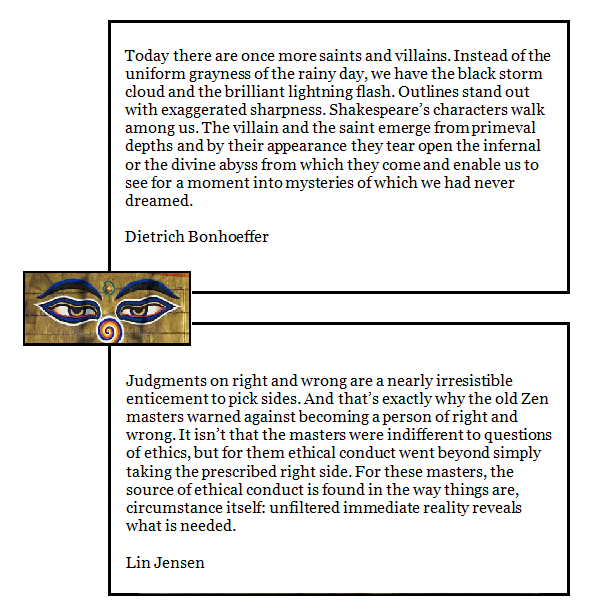
To bring us full circle, here’s another statement of the Elie Weisel position, this time in the words of Dietrich Bonhoeffer, the Lutheran pastor and theologian involved in the plot to assassinate Hitler and executed in one of the concentration camps — together with a response to the question I’ve been posing for myself here which may perhaps providinge some measure of reconciliation, this one from a contemporary Zen Buddhist, someone for whom the appreciation of koans is a way of life:

Quick update / pointer: GR & AZ on prisoner release

Friday, October 12th, 2012

[ by Charles Cameron — prisoner releases in Arab springtime, abu Musab and Dr Fadl; Daveed G-R and Aaron Z; two major rules of expertise: detail and humility ]
.

video edit-bay photo credit http://www.cdmastercopy.com

.

When you watch a well edited movie, the experience is seamless — despite the fact that the film itself was made with hundreds of cuts and splices. Film critics, mavens and the director’s fellow auteurs who make close readings and detailed studies of the film will see and appreciate the juxtapositions and graphic matches, the fine-tuned timing of the edits and the rhythm they give the film — but for the regular viewer, one continuous fabric of story unspools from opening to final credits. The editor’s skill lies in getting the splices right to a degree beyond the perceptual acuity of the audience.

Similarly, a fine carpenter will often want to make joints that are imperceptible to the client, seeking a sensitivity to changes in height that is an order of magnitude greater than that required for the quick, cheap performance of the same task.

True expertise is at least one order of magnitude deeper and more self-critical than it needs to be to satisfy a cursory examination.

**

Thus when Daveed Gartenstein-Ross and Aaron Zelin tackle the important — and easily overlooked — question of How the Arab Spring’s Prisoner Releases Have Helped the Jihadi Cause in the Atlantic, they offer us both far more than we knew we needed to know, and yet less than they themselves know about the topic, let alone the broader current of jihadist movements of which this particular topic is a single strand.

It’s a significant topic, though, as their opening paragraphs neatly show:

The investigation of the devastating Sept. 11 attack on the U.S. consulate in Benghazi, Libya, that killed American ambassador Christopher Stevens — limited as it is by security concerns that hampered the FBI’s access to the site –has begun to focus on a Libya-based Egyptian, Muhammad Jamal (a.k.a. Abu Ahmad al Masri). As a detailed Wall Street Journal report explains, Jamal is notable not only for having fighters under his command and operating militant training camps in the Libyan desert, but also for having recently gotten out of Egyptian prison.

This latter fact makes Jamal part of a trend that has gone largely unremarked upon in the public sphere since the beginning of the “Arab Spring” uprisings: prisons in affected countries have been emptied, inmates scattering after being released or breaking free. In many cases, it is a good thing that prisoners have gone free: the Arab dictatorships were notorious for unjustly incarcerating political prisoners, and abusing them in captivity. But jihadists have also been part of this wave of releases, and we are now beginning to see the fruits of the talent pool that is back on the streets.

I recommend it highly, as does at least one other more knowledgeable than I.

**

A short piece in the Atlantic is just right for an overview, but not the place to lay out the next level of detail, though — and there are three people in particular whose names I am always on the lookout for, names of people who vanished from public view into some form of imprisonment, and who are of considerable interest to me personally — primarily for their theological significance.

The first of these is the Imam Musa al-Sadr, whose “disappearance” in Gaddafi’s Libya at the age of 50 in 1978 deprived the Lebanon of an inspiring leader — in a manner that eerily paralleled the ghayba or “occultation” of the Twelfth Imam of the Ithna ‘ashariyah.

The second would be Sayyed Imam Al-Sharif, aka Dr. Fadl, whose book The Essentials was one of the major works of AQ ideology and the #2 jihadist manual downloaded from the net according to the CTC Atlas (p.10), and who recanted it from Egyptian prison, writing his Rationalizing Jihad in Egypt and the World which so severely critiqued AQ-style jihad that al-Zawahiri felt obliged to pen a 200-page counter-argument. In Dr Fadl’s case, the interest would be to see what he would say if liberated now.

And my third “person of interest”? That would be Mustafa Setmariam Nasar aka Abu Musab al-Suri, whose massive Call to Global Islamic Resistance is a key document that chides bin Laden for “leading them to the abyss”, says “Al Qaeda is not an organization, it is not a group, nor do we want it to be. It is a call, a reference, a methodology”, and calls for “terrorism created by individuals or small autonomous groups (see Lawrence Wright, The Master Plan). Abu Musab, who may have been released from prison in Syria recently, is of interest to others as potentially the jihadi’s foremost strategist — and to me chiefly because of his use of apocalyptic forecasting in his Call.

**

Since their Atlantic piece was a short context-setter rather than a longer analytic paper, I asked Gartenstein-Ross and Zelin — Daveed and Aaron — net acquaintance and friendship is a funny thing, we haven’t worked out the etiquette as yet — about Dr Fadl and Abu Musab, not mentioned in the piece itself but surely not far from their thoughts.

Twitter, of course, is even more drastically reduced than a piece in the Atlantic, so you can think of their tweeted responses as something along the lines of snapshots of footnotes. Nevertheless, they give me, as an inquiring mind, a quick glimpse of what a couple of those at least an order of magnitude deeper into these things know or conjecture about two people whose names and potential activities we should all keep stashed quietly away on some easily accessible mental shelf.

Three things emerge from these tweets — how little we actually know, how important what we don’t know may be, and how honest the best analysts are about the limits of their knowledge. I’d tweeted, congratulating them on their piece and saying:

hipbonegamer: i note no mention of Musab a-S – any idea what’s up with Dr Fadl? Dead? Released? Still held?

And they responded:

Aaron Y. Zelin: Details still too murky on Abu Mus’ab and no info on Dr. Fadl.

D. Gartenstein-Ross: However, I think the question “where is Dr. Fadl, and why haven’t we heard from him?” is important for many reasons.

D. Gartenstein-Ross: But Aaron is right: I haven’t seen any open source info that speaks to his fate.

That’s two things at once: not very much, and a great deal.

**

So if lesson #1 of this post is that True expertise is at least one order of magnitude deeper and more self-critical than it needs to be to satisfy a cursory examination, lesson #2 must be…

True expertise never claims knowledge that is one order of magnitude deeper or more exact than is actually known.

Putting that in other terms: having an accurate mapping of one’s archipelago of knowledges within one’s oceanic ignorance is a highly significant form of meta-knowledge, lacking which one’s knowledges have blurred edges and little definitional value.

And that in turns means — especially in terms of human intelligence — humility.

**

It’s Follow Friday (#FF) on Twitter: @DaveedGR and @azelin are two folks you can follow and trust.

Form is insight: the funnel, part 1

Thursday, October 11th, 2012

[ by Charles Cameron — a post in my importance of form in intelligence series — Afghanistan, the complexity — also a Blackfoot Tale from Grinnell ]
.

Funnel image credit: Oxsite

.

One of my favorite tales of all time is the Blackfoot legend of The Bull Band, which begins thus in Grinnell‘s telling:

The people had built a great pis’kun, very high and strong, so that no buffalo could escape; but somehow the buffalo would not jump over the cliff. When driven toward it, they would run nearly to the edge, and then, swerving to the right or left, they would go down the sloping hills and cross the valley in safety. So the people were hungry, and began to starve.

Somehow I’d come by a sense that the pis’kun was a sort of funnel – perhaps from Joseph Campbell, whom I once heard tell this tale in his own words – and today I looked around my foolscap-sized screen and discovered that John Canfield Ewers reports what he calls a “buffalo fall” pretty much how I’d imagined the thing, in his Indian Life on the Upper Missouri:

The Piegan band called Never Laughs was camped on the Teton River a few miles north of the present town of Choteau. Their chief announced, “Now we are going to make a buffalo fall.” They built a corral below the cliff and piled rocks in a great V-shape on the slope above the fall. Then they chose a man to lead the buffalo to the fall. But each time he lured them in between the lines of rocks they broke away before they reached the cliff edge. After this had happened three times, young Many Tail Feathers became angry…

So that’s the shape I’m thinking of here: “a great V shape” – let’s call it a funnel.

**

I want to use the funnel to illustrate a movement in time, an imperative in intelligence, and a loss in nuance.

First, some background.

**

We are in a tricky situation here, because our minds would like to grasp a problematic reality (which resembles a landscape) by means of a thought (which resembles a road sign).

What’s up in Afghanistan?

Drought, and a huge humanitarian catastrophe, say those whose eyes are focused on human beings as fellow creatures in need of food, water and shelter. Preparations for getting the oil in Khazakstan to market, say those who focus on geology, resources, economics. The start of a strategic corridor that also includes Tibet and Kashmir, contested by India and Pakistan, the nuclear locals, and Russia and China, the nuclear regionals, in a four-sided tug of war. Islam itself, the religion of God, or a perverse and puritanical variant thereof. Or one man, Osama bin Laden.

Clearly a complex landscape – and we would like, depending which road sign we follow, to bomb the shit out of them, bring in truckloads of food and medicines, establish a stable government with which to ink a pipeline deal, export their Wahabi brand of Islam to the world — or discreetly support the US in its mission to extirpate the terrorists of Al-Qaida without rousing the more fundamentalist and simplistic of our citizens to topple the government and institute a radical Islamist state.

So much depends on whether we are in Peshawar or the Pentagon, in poverty or power. So much depends on our perspective, and the parallax it brings with it.

Because no matter what point of view we choose to consider the landscape from, some parts of the terrain will seem so close together as to be indistinguishable which we can understand to be worlds apart if we can only view them from another angle, in a different perspective.

I am not arguing for moral relativism. I am arguing for a recognition of complexity, and for an admission that sound bites and white papers cannot handle this style of problem. I have painted a highly impressionistic portrait of the complexities at work here, where China touches the tip of the eastwards panhandle of Afghanistan, where Kandahar can stand proxy for Jerusalem, where the national sport is a sort of polo with a goat’s head for a ball, and the tea served in thin, curved glasses is green and sweet.

**

I have checked Google and Dogpile, and as far as I can tell from poor memory, my sense of my own style, and the absence of the same text in the search engines, the above is my own work — the text of the bulk of which I found somewhat haphazardly on my hard drive while working on Part 2 of this post. If anyone else claims copyright, count me an admirer and let me know. I believe it’s “mine” for whatever that concept may be worth, I’m skeptical about solo creativity in any case, myself.

In part 2 of this post, which is definitely almost all borrowed from bright other beings, I’ll try to illustrate the funnel as it applies to America, Afghanistan, Obama and Osama, in a series of “zeroing in” quotes illustrating the complexity of the situation and analysis as contrasted with the “yes” of a kill-decision…


Switch to our mobile site