zenpundit.com » nuclear

Archive for the ‘nuclear’ Category

CENTCOM, Rosenberg and Islamic eschatology, pt I

Monday, March 11th, 2013

[ by Charles Cameron — who’s giving advice to the head of CENTCOM these days? — a “prophetic” thriller novelist whose latest book concerns nuclear weapons and Iran ]
.
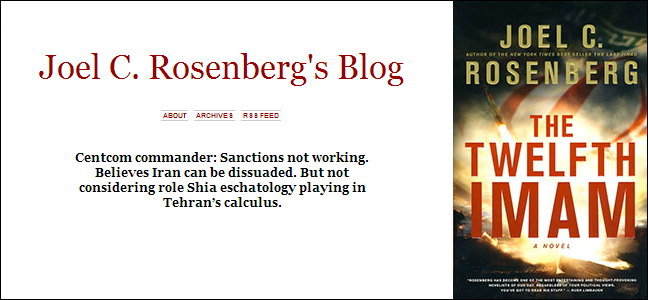
Here’s the advice apocalyptic thriller writer and political consultant Joel Rosenberg gave GEN Mattis, just two days ago:

I have deep respect for General Mattis as a military leader. Thus, I would encourage him to consider the role eschatology is playing in Tehran’s calculus. Iran’s Ayatollah Khamenei and President Ahmadinejad and their inner circle of advisors are not being driven by normal geopolitical and economic calculus, but rather by a Shia Islamic End Times theology.

I’m very interested in Islamic end times theology myself, and have a question:

What does Rosenberg claim that theology is, and what does he see as its ramifications in terms of CENTCOM — whose remit most notably includes Afghanistan, Egypt, Iran, Iraq, Saudi Arabia, Syria, Pakistan and Yemen?

**

Here’s what he says:

They believe the End of Days is at hand. They believe their messiah known as the Twelfth Imam or the “Mahdi” is coming soon.

That’s the theology as he describes it — the rest is geopolitical interpretation, no doubt favoring as well as influencing his own political ideas:

They believe that the way to hasten the coming of the Mahdi is to annihilate Israel (which they call the “Little Satan”) and America (which they call the “Great Satan.”) I wrote about this in detail in my non-fiction book, Inside The Revolution. And I factor this thinking into my current novel series, including The Twelfth Imam, The Tehran Initiative, and Damascus Countdown to consider how it could play out in real life. Such eschatology requires Iran’s leaders to acquire nuclear weaponry and the means to deliver it in order to please Allah and their coming messiah and king. As a result, the international is unlikely to convince them to disobey their most-deeply held religious beliefs through diplomacy or sanctions. A credible military threat might work, but we’re nearly out of time. Actual military action may soon be the only option. No one wants a war. I don’t. But we don’t want to have a genocidal cult to obtain and use nuclear weapons.

Hey, I don’t want a nuclear war, either. But does the Ayatollah Khamenei? Really?

**

Do you think nobody in DC listens to Rosenberg? Even before he wrote his books, when he was still only 27 and a “legman” for Rush Limbaugh, the New York Times carried a feature on him calling him “a Force in the Capital” which quoted a Senior VP at the Heritage Foundation:

I’ve been at meetings of conservative activists, and they have paid extraordinary deference and have been solicitous of him.

— but you can read the whole piece. And now, eighteen years later, he has a strong of NY Times best-sellers to his name, both fiction and non-fiction — and for his latest thriller, Damascus Countdown, published this week, Porter Goss, ex CIA Director, writes:

Whenever I see a new Joel Rosenberg book coming out, I know I need to clear time on my calendar. His penetrating knowledge of all things Mid-eastern — coupled with his intuitive knack for high stakes intrigue — demand attention.

So it’s worth asking — just how penetrating is that knowledge? And in particular, just how penetrating is it about the Iranian Twelfth Imam or Mahdi, who features prominently in his most recent series of books?

**

Three years back, Glenn Beck interviewed this same Joel Rosenberg, who writes about end-times Christianity and Islam and the need to support Israel from an end-times perspective — and the pair of them put out a sadly and dangerously muddled message. This excerpt from the transcript is worth noting for the significance it attributes to Mahdist eschatology and thus insinuates into the minds of millions of Americans:

BECK: OK. So, the Ayatollah Khomeini and the revolution of ‘79, he said these 12ers are too crazy for even him. What happened, because — is Ahmadinejad the only one? Are there a lot of them? It’s my understanding that the government now is full of these people. Is that true?

ROSENBERG: That’s right. Well, the Ayatollah Khamenei, the current supreme leader, was a disciple of the Ayatollah Khomeini.

BECK: OK.

ROSENBERG: Apparently, it’s turned out that he has been a secret closet 12er, because he clearly believes the same thing as Ahmadinejad.

Here’s what’s wrong: both Beck and Rosenberg seem to have confused “Twelvers” (the Ithna’ashariyya who make up about 85% of all Shi’a, though there are important smaller sects such as the Ismai’li) with a small and secretive faction within the Iranian Shi’a, almost certainly the Hojjatieh.

Beck says:

I want to talk to you about something that nobody seems to ever notice when they talk about Iran. When we’re talking about Iran, we’re talking about people, the leaders, that are called, they’re called “Twelvers” — they believe in the Twelfth Imam, the Mahdi. This is one spooky dude. Twelvers are so dangerous that the Ayatollah Khomeini at one point banned them, said we’ve gotta kill ’em all because they’re too crazy — the Ayatollah Khomeini said that.

It makes absolutely no sense to say that the Ayatollah Khomeini condemned the Twelvers — he was their leader in Iran — but he did oppose the (arguably extremist) Hojjatieh, which was basically a secret society — and that is almost certainly the group that Beck was thinking of.

But then Joel Rosenberg seems to get swept up in Beck’s confused and confusing rhetoric, and goes on to call the Ayatollah Khamenei “a secret, closet Twelver” — a phrase he also uses in his 2010 book, The Twelfth Imam (pp. 178, 259), and which is particularly inept since Rosenberg knows enough to have discussed the Hojjatieh in his book Inside The Revolution (copyright 2009, 2011), in which he writes (pp. 161-62):

During this same period, it appears Ahmadinejad was also involved in a shadowy Islamic society known as the Hojatieh, whose leaders taught that the Twelfth Imam was coming soon and whose members believed they were required to take spiritual (but not political) actions to hasten his coming. … the movement discouraged people from being fully devoted to creating an Islamic state, preferring instead to wait for it to come from the sky. In 1983, therefore, Khomeini actually banned the Hojatieh, and Ahmadinejad seems to have subsumed his sympathies for the group to protect his opportunities for career advancement.

**

I am happy to report that Joel Richardson, the other Joel currently writing about Islamic apocalyptic from a Christian end-times perspective, corrects Beck and Rosenberg on this point in his blog, Joel’s Trumpet:

Beck needs to have me on sometime. He gets a lot of his info wrong. Ayatollah Khomeini never banned “Twelvers”, as he himself was one. He banned the Hojjatieh of which Ahmadinejad is arguably a member of and which Mesbah Yazdi below is as well.

Beck’s the one Joel Richardson was addressing, but his critique applies equally to both Beck and Rosenberg. But this post is getting overlong, so I’ll continue with background from a scholar friend in a continuation of this post…
Gaming Gandhi

Saturday, November 17th, 2012

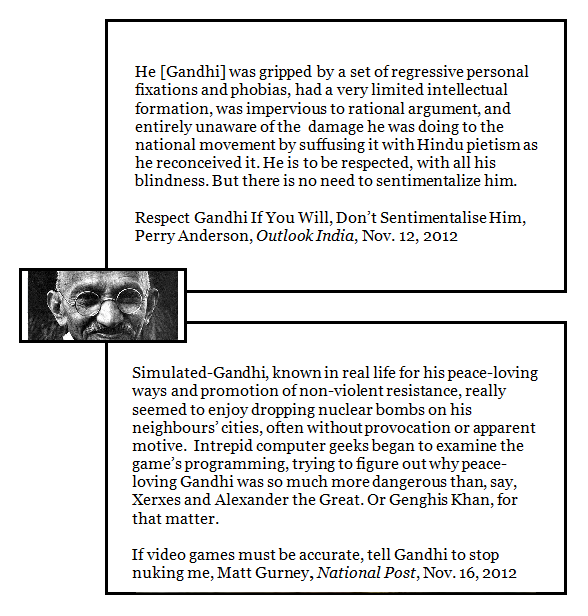
[ by Charles Cameron — two clashing quotes about Gandhi that followed one another in my RSS feed today, funny & strange ]
.


.

Strange, to say the least.

Gandhi was a strategist — as a friend of mine once wrote, “he achieved self determination for the largest number of individuals with the lowest cost in human life” of any rebel known to history —

He managed this feat by holding a position of non-violent non-cooperation, while showing that the ‘civilized’ opponent of the United Kingdom could not live up to its own imposed standards of conduct or law.

And at least some of the time, he was notably unwilling to romanticize himself — he once said:

My nonviolence does not admit of running away from danger and leaving dear ones unprotected. Between violence and cowardly flight, I can only prefer violence to cowardice. I can no more preach nonviolence to a coward than I can tempt a blind man to enjoy healthy scenes. Nonviolence is the summit of bravery. And in my own experience, I have had no difficulty in demonstrating to men trained in the school of violence the superiority of nonviolence. As a coward, which I was for years, I harbored violence. I began to prize nonviolence only when I shed cowardice.

So he’s not the total pacifist he’s sometimes portrayed as.

But nuclear weapons? “Much more dangerous than, say, Xerxes and Alexander the Great. Or Genghis Khan, for that matter”?

Not in India, not back then. In one of Hugh Everett‘s “many worlds”? — perhaps. And in Civ2, the game? — apparently, yes.

**

Quote sources: Outlook India and National Post, with a tip of the hat to Rex Brynen at PAXSims.

A little diligence makes for a long post, 1: Kahlili

Wednesday, October 24th, 2012

[ by Charles Cameron — first part of a post on misreading Mahdism in Iran ]
.

book credit: amazon -- Mahdist graphic credit: Tim Furnish / MahdiWatch

.

Our blog friend Pundita has been relying on Reza Kahlili, the pseudonymous Iranian author of A Time to Betray: The Astonishing Double Life of a CIA Agent Inside the Revolutionary Guards of Iran, quite a bit recently, pointing to his recent discussion with John Batchelor and some reports of his on World Net Daily.

There are a number of people whose views on the religious issues surrounding an Iranian nuclear weapons program interest me — I leave other aspects of the problem to others better informed than I — some because they have insight, some because they have megaphones, and so on.

I’m not the person you’d want to ask whether Reza Kahlili was a CIA source, whether he was trusted, and if so, on what issues – issues which might range from troop movements to popular opinion of the IRG rank and file to theology and apocalyptic, a range that no single source is likely to be omnicompetent in – but WND is a media source I’ve followed off and on for a dozen years, it’s strongly associated with one of the strands of recent Christian apocalyptic with its own messianic take on Islam and Mahdism, and it isn’t necessarily a source I’d trust without verification…

**

So I did some checking of my own on Reza Kahlili, and found that he, or more likely some ghost writer employed to write his book for him (along with his publisher’s copy editor), simply doesn’t know what a hadith is. A hadith is a statement attributed to the Prophet (or in the Shi’a case, one of the infallible Imams who succeeded him) and passed down through an authoritative train of transmission (isnad). For a practicing Muslim, the corpus of hadith is second only to the Qur’an, and knowing what a hadith is is like knowing what the Epistles are for a practicing Christian: basic. For a theologically nuanced scholar from Qom or Najaf, it’s kindergarten.

Kahlili gets the use of the word “hadith” right early on in his book, but when he starts talking about the return of the Twelfth Imam or Mahdi he writes (p. 334.):

Like others who think as he does, Ahmadinejad believes that many of the signs of Mahdi’s return have emerged. Known as hadiths, these signs include the invasion of Afghanistan, the bloodshed in Iraq, and the global economic meltdown. According to prophecy, the hadiths will grow increasingly furious as Mahdi’s return comes closer, including “persecution and injustice” engulfing the earth, “chaos and famine,” and “many wars.” The hadiths predict that “many will be killed and the rest will suffer hunger and lawlessness.” People like Ahmadinejad so completely believed that these conditions would hasten the return of the twelfth Imam that they were willing to foment universal war, chaos, and famine to bring it about.

That’s at best very sloppy writing — the signs are known as ayat (as are the verses of the Quran), and the Quran states (28.59):

Nor was thy Lord the one to destroy a population until He had sent to its centre a messenger, rehearsing to them Our Signs; nor are We going to destroy a population except when its members practise iniquity.

Some translators actually render what this translation calls “signs” as “verses”.

Giving this passage from Kahlili a charitable reading, it could be understood to mean that signs as described in reliable hadith “include the invasion of Afghanistan, the bloodshed in Iraq, and the global economic meltdown” – though there’s a lot of interpretive scope in there, as there is in locating Gog and Magog (are both place names, or is one a prince of the other?) in comparable Christian eschatological circles.

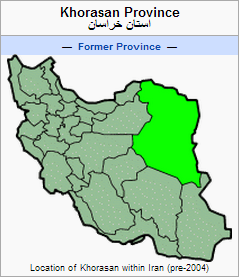
Taliban recruiters (Sunni) certainly take “Khorasan” as mentioned in some Mahdist hadith as referring to “Afghanistan” – see Ali Soufan‘s book, The Black Banners – but an Iranian would read “Khorasan” as referencing the region of that name in Iran, or perhaps a wider zone that includes it, but also encompasses portions of Afghanistan and other neighboring states – it was, after all, the name of Iran’s largest province until divided in three parts, North, South and Razavi Khorasan in 2004:

Interestingly too, the hadith traditions in question are considered likely to have been written by and for the Abbasids. David Cook, for instance, in his magisterial Contemporary Islamic Apocalyptic Literature writes of Khorasan (p. 173.):

The ‘Abbasids sought to present their movement as the fulfillment of messianic expectations, and so they produced a great quantity of materials given in the form of hadith traditions to indicate that the Mahdi would come from this region.

— not that scholarship of this kind is liable to influence popular apocalyptic sentiment…

**

Okay, so with a little creative forgiveness, we can read that first passage of Kahlili’s as saying that within the hadith can be found signs such mentions of Afghanistan / Khorasan, bloodshed in Iraq, and economic woes. But then we read this (p. 337.):

With the eyes of the world on them, the mullahs and the thugs who took orders from them fought mercilessly to hold on to the power that had never been their right, using extreme force to deny that their time was over. In their minds, Mahdi was coming and the blood they shed now was yet another hadith.

C’mon, now, has Kahlili even read his own book? Blood shed equals hadith?

The most charitable thing I can find to say is that Reza Kahlili may or may not have been some level of CIA source, but his credibility in matters involving any aspect of Iranian theology is utterly unconvincing.

**

Jeff Stern, in a WaPo piece from 2010, doesn’t sound any too convinced that Kahlili is worth our trust in other matters either, writing:

Reza Kahlili, a self-proclaimed former CIA “double agent” inside Iran’s Revolutionary Guards, appeared in disguise at a Washington think tank Friday claiming that Iran has developed weapons-grade uranium and missiles ready to carry nuclear warheads.

The pseudonymous Kahlili, whose previous accounts have been greeted with widespread skepticism, also said Iran was planning nuclear suicide bombings with “a thousand suitcase bombs spread around Europe and the U.S..

and:

Several current and former U.S. intelligence officials in the audience “rolled their eyes” at Kahlili’s claims, said one observer who was present.

Some in attendance compared Kahlili with Ahmed Chalabi, the former Iraqi exile who helped convince the George W. Bush administration that Iraqi leader Saddam Hussein had weapons of mass destruction. After the U.S.-led invasion of Iraq, the claims were proved false.

My personal knowledge-map features huge areas of ignorance where many others have strong opinions. On matters religious, Kahlili is not to be believed. On the siting of nuclear labs, or weapons development and deployment, we’re in areas that bear the legend “Here there be Smoke and Mirrors” on my map.

Thus endeth my blog-epistle to Pundita, whose knowledge of many of the other moving parts in the wider geopolitical situation far exceeds my own.

**

I’ll follow up with part II of this essay, in which I’ll talk a bit about Glenn Beck and Joel Rosenberg, and some other significant ways in which Shi’ite eschatology is being misrepresented via popular media in the west.

For those following the development of my book / media project, I am hoping the project will include a section of longer essays such as this one, in which I pull apart some of the myths currently surrounding western understanding of Islam, while pulling together major strands of a more nuanced view.

Every Day is the Day of Something

Wednesday, August 29th, 2012

[ by Charles Cameron — days, months, years, Saints, Josaphat, Buddha, problems, issues, solutions — I think that about captures it all ]
.

Josaphat, the Bodhisattva Saint

.

Today is the International Day against Nuclear Tests — and since I don’t much like tearing open the fabric of the world I’m living in to witness and geiger-count the radiance it usually hides, I favor the idea. But the Day was already a Festival as far as I’m concerned: I woke up.

**

Look, there are International and National Days, Weeks, Months and Years — this month, for instance, in addition to Spinal Muscular Atrophy Awareness Month was also National Catfish Month. It was Don’t be a Bully Month and National Dirty Harry Month, quite a pair! It was also Never Leave a Child Unattended in a Car Purple Ribbon Month, National Water Quality Month – which needs to be Internationalized – and Win with Civility Month. And there are many more

See — we have enough issues to go around twenty-four slash seven slash three-sixty-five plus one on leap years…

That remarkable fellow Anthony Judge is largely responsible for the Union of international Association’s Encyclopedia of World Problems and Human Potential, which includes:

a World Problems database with 56,000+ entries and 276,000+ links
a Global Strategies and Solutions database with 32,000+ entries and 284,000 links
a Human Values database with 3,200+ entries and 119,000+ links
a Human Development database with 4,800+ entries and 19,000+ links, and
a Patterns and Metaphors database with 1,200+ entries and 4,500+ links.

**

So that’s how many problems we have, and how many solutions, and naturally we can offer prayers about the problems, and perhaps the prayers will be answered by the solutions, or with new ideas…

So it’s also not surprising that there are a vast number of saints who can intercede for us…

And since my birthday happens to fall on November 27, I have a special affection for St Josaphat, whose Feast Day that is.

He’s the fellow preaching in the panel at the top of this post, from a 12th Century Greek manuscript…

**

Josaphat’s story is recounted in Wikipedia:

According to the legend, King Abenner or Avenier in India persecuted the Christian Church in his realm, founded by the Apostle Thomas. When astrologers predicted that his own son would some day become a Christian, Abenner had the young prince Josaphat isolated from external contact. Despite the imprisonment, Josaphat met the hermit Saint Barlaam and converted to Christianity. Josaphat kept his faith even in the face of his father’s anger and persuasion. Eventually Abenner converted, turned over his throne to Josaphat, and retired to the desert to become a hermit. Josaphat himself later abdicated and went into seclusion with his old teacher Barlaam.

A fine tale it is, and curiously reminiscent of that of the young bodhisattva Siddhartha, who was to become known as the Buddha:

Siddhartha Gautama was also a prince whose birth was accompanied with a prophecy that he would become a great holy man but not a king. He was also protected from the outside world by his father but on leaving the palace he also recognised that the world was full of suffering. He sought to pursue an ascetic life and to reach enlightenment but during this process he was subjected to many attempts to deflect him from this path. He was tempted by the demon Mara who sent his three beautiful daughters, Tanha (desire), Raga (lust), and Arati (aversion) to try to seduce him while he sat meditating under a banyan tree. After resisting these temptations, the prince attained Buddhahood at the age of thirty five.

And yes, that would make an excellent DoubleQuote!

**

In fact, stories travel — and the Buddha we know became Josaphat as his story traveled from India via St John Damascene to the farthest west:

Bodhisattva in Sanskrit became rendered as Bodhisav in Persian, then as Budhasaf in Arabic, Iodasaph in Georgian, Ioasaph in Greek and then finally Josaphat in Western Europe

I used to collect books about the kindly teacher Barlaam and his student Saint Josaphat the Boddhisattva: most of them are now in storage, alas.

And you can now see how the Catholic in me feels warmly-disposed towards the Buddhist, while the Buddhist in me is on amicable terms with the Catholic.

**

And i haven’t even begun to talk about the Sufis yet…

Pew II: Prevalence of belief in the Jinn

Monday, August 13th, 2012

[ by Charles Cameron — Corbin on Queen Bilqis, Qur’an and hadith regarding jinn, Pew statistics on belief in jinn — with some earlier Natsec implications & a non-serious suggestion from contemporary physics ]
.

La Jinn the Mystical Genie of the Lamp
from the Yu-Gi-Oh card game

.

I’ve been “fond” of the jinn (djenoun) since first encountering them in the brilliant short stories of Paul Bowles, and notably his A Hundred Camels in the Courtyard.

But that’s a literary fondness, neither science nor belief-based on my part. In my view, that’s only right and proper, since djenoun belong in the realm of imagination — or better said, the Imaginal, as Henry Corbin terms it — see note 16, p, 326. of his Creative Imagination in the Sufism of Ibn ‘Arabi, where he speaks of the Sheikh’s Bilqis Queen of Saba in his poetry as a being “born from a jinn and a woman” — it’s a fascinating passage, connecting Bilqis with Jesus in terms of the (unorthodox) angelology that Corbin envisioned uniting the Abrahamic faiths at a visionary level.

**

Here are two of the mentions of jinn in the Qur’an:

And the Jinn race We had created before from the fire of a scorching wind. [Sura 15, 27]

Say: It has been revealed to me that a company of Jinns listened (to the Qur’an). They say ‘We have really heard a wonderful Recital! It gives guidance to the Right and we have believed therein: We shall not join (in worship) any (gods) with our Lord. And exalted is the Majesty of our Lord: He has taken neither a wife nor a son.’ [Sura 72, 1-3]

And here is a tale of the Prophet and a jinn, as narrated by the Companion Malik ibn Anas:

The Prophet said to the jinni: “This is the stride of a jinni, as well as the tone of his voice!” The jinni replied: “My name is Hamah ibn Laqqis ibn Iblis.” The Prophet said: “Only two generations seperate you from him [Iblis].” He replied: “True.” The Prophet asked: “How long have you lived?” The jinni replied: “Almost all of time. I was a small boy when Abel was killed. I believed in Noah and repented at his hands after I stubbornly refused to submit to his call, until he wept and wept. I am indeed a repentant — God keep me from being among the ignorant! I met the prophet Hud and believed in his call. I met Abraham, and I was with him when he was thrown in the fire. I was with Joseph, too, when his brothers hurled him into the well—I preceded him to its bottom. I met the prophet Shu’ayb, and Moses and Jesus the son of Mary, who told me: ‘If you meet Muhammad, tell him Jesus salutes thee!’ Now I’ve delivered his message to you, and I believe in you.” The Prophet said: “What is your desire, 0 Hamah?” He said: “Moses taught me the Torah, Jesus the Gospels, can you teach me the Qur’an?” So the Prophet taught him the Qur’an.

The Tasneem Project

**

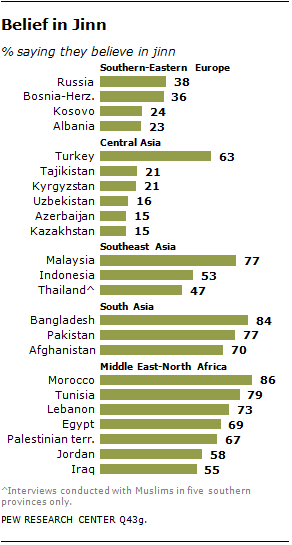
Literal vs metaphorical, let alone imaginal belief is not something the interviewers who conducted the Pew poll had the leisure to distinguish — but for the record, here are their findings as to the Muslim belief in jinns:

According to the Quran, God created jinn as well as angels and humans. Belief in jinn is relatively widespread – in 13 of 23 countries where the question was asked, more than half of Muslims believe in these supernatural beings.

In the South Asian countries surveyed, at least seven-in-ten Muslims affirm that jinn exist, including 84% in Bangladesh. In Southeast Asia, a similar proportion of Malaysian Muslims (77%) believe in jinn, while fewer in Indonesia (53%) and Thailand (47%) share this belief.

Across the Middle Eastern and North African nations surveyed, belief in jinn ranges from 86% in Morocco to 55% in Iraq.

Overall, Muslims in Central Asia and across Southern and Eastern Europe (Russia and the Balkans) are least likely to say that jinn are real. In Central Asia, Turkey is the only country where a majority (63%) of Muslims believe in jinn. Elsewhere in Central Asia, about a fifth or fewer Muslims accept the existence of jinn. In Southern and Eastern Europe, fewer than four-in-ten in any country surveyed believe in these supernatural beings.

In general, Muslims who pray several times a day are more likely to believe in jinn. For example, in Russia, 62% of those who pray more than once a day say that jinn exist, compared with 24% of those who pray less often. A similar gap also appears in Lebanon (+25 percentage points), Malaysia (+24) and Afghanistan (+21).

The survey also asked if respondents had ever seen jinn. In 21 of the 23 countries where the question was asked, fewer than one-in-ten report having seen jinn, while the proportion is 12% in Bangladesh and 10% in Lebanon.

**

Two markers concerning National Security concerns regarding Pakistan, nuclear weapons and those who believe (literally, energetically) in jinns — from the early 2000s, but dating back by implication to the era of Zia ul-Haq:

Just after the September 2001 terrorist attacks in the U.S., Pakistan’s intelligence service detained two retired nuclear scientists who had met with senior members of al Qaeda, including Mr. bin Laden, during charity work in Afghanistan. One, Sultan Bashiruddin Mahmood, was a former director at the Pakistan Atomic Energy Commission and a controversial Islamic scholar who had postulated that energy could be harnessed from fiery spirits called djinns.

WSJ, Inside Pakistan’s Drive To Guard Its A-Bombs

But as a subscriber to a brand of what is known to practitioners as “Islamic science,” which holds that the Koran is a fount of scientific knowledge, Mr. Bashiruddin Mahmood has published papers concerning djinni, which are described in the Koran as beings made of fire. He has proposed that these entities could be tapped to solve the energy crisis, and he has written on how to understand the mechanics of life after death.

NY Times, Pakistani Atomic Expert, Arrested Last Week, Had Strong Pro-Taliban Views

— together with a Pakistani critique:

If a scientist is European or Hindu he will be restricted in his vision by reason. A Muslim scientist has unlimited scope; he will relate his science to miracles, mostly performed by himself. Sultan Bashiruddin, our top enrichment expert, believed he could draw electricity from a captured jinn. (For Pakistan’s needs just one jinn would suffice.)

Khaled Ahmed, Scientists, our kind

There are times when beliefs have, or might just have, consequences.

**

Jinn are significant not only for their own sakes, so to speak, but also for their etymological implications. To quote again from the Tasneem Project:

One saying of the Prophet (aws) mentions that, “God divided the jinn and the humans into ten parts. One part makes up the human race, and the other nine parts is made up of the jinn.” The invisible is everywhere. The Arabic language itself bears witness to how the invisible realm insinuates itself on everyday life. In Arabic, each time the two letters jeem and nun occur together, as in jinn, they convey the meaning of invisible or hidden. Thus, paradise is jannah because paradise is hidden from the human sight; janin is the foetus in the womb; the expression ajannahu al-layl means the night covered him.

The jinn, like paradise itself, are among the hidden secrets…

**

And how large is the universe, that it might encompass the angels and jinn? Hugh Everett III quite brilliantly argued for what has come to be known as the “many worlds” hypothesis in quantum measurement while still a grad student:

Hugh Everett III was a student in his mid-twenties in 1957 when he presented his revolutionary formulation of quantum mechanics in his PhD thesis. Everett himself called his theory variously; pure wave mechanics, the relative-state formulation of quantum mechanics, and the theory of the universal wave function. His theory, however, came to be popularly known as the many-worlds interpretation, because it predicts that everything that might happen, does in fact happen. As the physicist Bryce DeWitt later described it, Everett’s theory predicts that our universe is composed of countless parallel universes that are each constantly splitting into yet further copies, and in the process, creating copies of each observer, each of which subsequently observes a different quantum universe and splits into further copies.

While a science fiction fan might embrace such a theory simply by dint of how cool it would be if something like that were true, one might naturally wonder what good scientific reason one might have for believing that our universe is in fact composed of countless parallel splitting universes.

**

The whole article from which that quote was taken, The Quantum Measurement Problem and the Everett Interpretation, is indeed worth reading. But whereas physicists and (most) science fiction writers might confine their “many worlds” to physical, “materialist” universes, students of the imaginal are under no such restriction, as the same Tasneem Project article suggests:

The Muslim universe has always been made up of multiple worlds – the Qur’an itself refers to “universes” in the plural, in its open chapter al-fatihah. According to prophetic tradition, the cosmos consists of 18000 universes. …

So the jinn when summoned might come — somewhat unexpectedly — from one of Everett’s more hidden “many worlds”, perhaps?


Switch to our mobile site