zenpundit.com » 2012

Archive for 2012

Life imitates (political, Islamophobic) artifice

Sunday, July 8th, 2012

[ by Charles Cameron — Dutch Islamophobia offers a terrible example of the sign turning into the signified ]
.

Jan van Breughel, 2012? -- photo credit: Eric Brinkhorst, Algemeen Dagblad

.

The quote that follows is offered without much comment, except to note that the formal correspondences between the two instances of “Henk and Ingrid” are as compelling as the two situations themselves.

From Islamophobia Watch:

As the Netherlands heads for a general election, barely a day passes without a mention of “Henk and Ingrid”, or Mr and Mrs Average, in a political debate that has revolved around the economy and the euro zone debt crisis.

The invention of populist politician Geert Wilders – who heads the anti-immigration, anti-euro Freedom Party – this mythical couple attracted a different kind of notoriety after a real Dutch Henk, with a wife called Ingrid, killed a Turkish immigrant, prompting commentators to warn that populism can backfire.

**

Compare the strange story of the writing and real-life enactment by the avatar of Vishnu of Valmiki‘s Ramayana, which I alluded to in a comment on William Benzon’s blog:

I recall that when I was in India more than thirty years ago, I was told the Ramayana was written by Valmiki, first among poets — and it was only afterwards, and under the poem’s inspiration, that Vishnu did indeed take the form of Rama and come to earth to live out the story already depicted in Valmiki’s epic.

Byzantium, Constantinople, Istanbul

Sunday, July 8th, 2012

[ by Charles Cameron — different styles of online communication, main topic: Istanbul in three Islamic videos ]
.

There’s passionate and visceral communication, and there’s communication that’s more scholarly, dispassionate and calm. Let’s begin and end with calm.

**

Visceral communication is essential for getting people out of a theater on fire, but a 30% application of scholarly distance and calm may be prerequisite for avoiding panic — and scholarly communication may be important for conveying in detail the high-dimensionality of a complex topic, but a drop of visceral may ease the salient points into more general circulation.

In an earlier, text heavy post — Damascus, Dearborn, Rome, Vienna? — I belabored you with details as to just how much ambiguity and fog surrounds the use of place names in scriptural and prophetic contexts. Here I’d like to give you a visceral sense of what some prophetic voices are doing with those place names.

One of the easiest ways to move from scholarly to visceral is to switch from text quotation to video clip, so that’s what I’ll do here — but my first video clip will be relatively calm and scholarly as video clips go, the next one more visceral and exhortatory, while the third and final clip will use all the tricks of the feature movie trade to provide a Tolkien-heroic account of the Muslim siege and taking of then-Christian Constantinople in 1453.

**

First, a very short clip from Adnan Oktar, aka Harun Yahya, widely known in the Islamic world for his lavishly illustrated books, CDs and DVDs presenting an Islamic version of creationism, the Mahdist end times — which he sees as entirely peaceable — and more besides.

In this clip, he’s talking about Istanbul, and he means that very city, even if it has sometimes been called Byzantium or Constantinople — or even on occasion, Rome.
.

**

My second clip is far longer, and presents an interview with Sheikh Imran Nazar Hosein, Islamic scholar, sometime Trinidadian diplomat and sometimes fiery YouTube preacher, whom I have quoted previously in Al-Awlaki and the former and latter rains and elsewhere.

Hosein discusses the prophecies of the conquest of Constantinople by Muslim forces as part of the background for a grand sweep overview of what he terms the first and second Arab Springs — which he locates a century apart and views as both engineered by an Anglo-American alliance to advance a Zionist agenda — and contemporary events in Bahrain, Saudi, Syria, Iran, Israel, and Russia:
.

.

It’s an hour-long interview, perhaps you didn’t watch the whole way through. Hosein concludes this interview, centered in Islamic prophecy about Constantinople, with a Saudi-American alliance facing off against an Iranian-Russian alliance in service to very long term Zionist interests, making the video a window not only on the Sheikh’s own worldview but also on how widely perceptions of the world situation can diverge:

I want the viewing audience to know that a situation is evolving in the world before our eyes, and we must understand it, that the two major powers in the world are now moving in a collision course, that collision course between these two major powers, the American-led alliance and the Russian-led alliance, is going to lead to nuclear warfare of such a magnitude that there is only one word that we can look for in the vocabulary to fit it, and that’s called Armageddon, that is, millions and millions and millions are going to die, most of them probably in North America and Europe, Europe of the East and Europe of the West — and what is left of the world after that, the Zionists hope that they can cope with it, and they can somehow survive and come out on top and Israel will rule the world, the rump that is left after the two giants engage in a war of mutual destruction, That is what we are facing now…

Is that what you thought scholarly Islamists were thinking? By what paths did a highly educated and world traveled man come to that conclusion?

**

My third clip speaks for itself. It is a trailer for an upcoming motion picture about the siege of Constantinople, presented as heroic spectacle with improbable but striking feats of arms, beautiful but not excessively modestly dressed women, obligatory mass choruses of Allahu Akbar, and at least one reference to the Antichrist.
.

.

I can’t wait to see it — but I expect to do so with mixed emotions. Perhaps they will stir up a decent blog post or two.

What emotions will they stir in those who identify with the heroic Mehmet II, and how much of an echo will those emotions find in the world around us? Long shot — any Turkey-NATO impact?

**

To return to a calmer clime:


.

Byzantium, Constantinople, Istanbul. I have prayed in the Sultan Ahmed — click image above to glimpse its beauty — I have relaxed deliciously at a nearby hammam.

The history of Istanbul could be the rich study of many lifetimes, its promise — for better or worse or a little of both — may have been variously prophesied or predicted, but remains to be seen.

Elkus and Zen at Pragati Magazine

Saturday, July 7th, 2012

My amigo Adam Elkus and I each have an article up at the newest issue of Pragati magazine:

Adam Elkus – Confront, Conceal, Leak 

David Sanger’s Confront and Conceal is best used as a Rosetta stone for deciphering DC discourse. Its true utility lies not in its uneven discussion of Barack Obama’s national security decisions, but in the way it reveals both mundane and alarming traits of American foreign policy debate. Sanger’s obsession with a supposed “split” between values and interests, mistaken belief that international security should be conducted according to the Golden Rule, and exposure of sensitive leaks all tell a story about the state of national security debate in 21st century Washington. Although the message is muddied and the narrator unreliable, Confront and Conceal is gripping reading.

Sanger’s self-designated task is to illuminate, through judicious research and both on and off the record interviews, the Obama administration’s struggle to operationalise its new vision of foreign policy. Sanger is at his best when exploring the way high-level officials engage in bureaucratic judo. His Obama is a canny political operator that compensates for relative inexperience with self-awareness and vigor. Even in the face of strategic surprise and bureaucratic infighting, Obama keeps a firm hand on the steering wheel. Sanger aggressively promotes a reading of Obama as driven operator rather than spectator, a portrayal that rings true when compared to other popular accounts of Obama’s foreign policy leadership style…. 

Mark Safranski –Drone invasions and cyber dystopias 

….Of the two, drones have the older history, going back almost a century to the Great War where experiments in auto-piloted planes were financed by the US Navy, but for much of the twentieth century, military applications for drones (or “remotely piloted vehicles”) were sharply limited. The technological capabilities of drones always lagged far behind the advances in manned aircraft and they were extremely vulnerable to modern anti-aircraft systems, or in some cases, small arms fire. While drones had some marginal utility for battlefield surveillance or as decoys, during the Cold War they were never the primary collection tools for sensitive intelligence that the U-2 Blackbird, listening posts and spy satellites were.

Several factors in the twenty-first century have pushed drones to the forefront as a weapon of choice for the Pentagon and the militaries of major powers. First, has been the relative decline of the probability of major interstate war since the collapse of the Soviet Union and the corresponding rise of irregular warfare in the form of insurgency by terrorists, guerrillas and rebellious tribes. Generally, these low-tech combatants reside in poor and remote areas and lack the capacity to detect or defend against drones except by concealment. Secondly, drones offer a tremendous economic advantage and battlefield return on investment (ROI) per enemy killed over advanced fighter aircraft.  A new F-22 costs $150 million to buy and $45,000 an hour just to fly with a pilot whose training costs the USAF $2.6 million; a reusable, propeller-driven Predator only costs slightly over $4 million. About the price of two and half Tomahawk cruise missiles….

Of the sacred, III: saliva redux

Friday, July 6th, 2012

[ by Charles Cameron — yet another angle on religious violence ]
.

Religion can be a lot stranger than one might think.
.

Wrathful deity, Tibet


Here, I’m going to tie in my recent post about Iranian clerics claiming Khamenei‘s saliva could cure diseases with the notions of religious danger and religious violence.

Bear with me, this will give us a richer understanding of how religious violence may work with people who are naturally rule-averse — and I’m thinking here of criminals who get into a mix of religion and violence, including criminals who get involved in jihad, but also the cultic side of cartel violence in Mexico.

My aim is not to explicate either of these phenomena specifically, nor to claim they necessarily resemble each other or the punk or Hindu practices I’ll reference, but simply to suggest again, from another angle, how astonishingly diverse, powerful — and frankly surprising, disgusting and on occasion dangerous — religious expressions can be.

**

In my post about Iranian clerics’ claims of virtue for the Ayatollah’s saliva, I drew on other examples in Islamic, Hindu and Christian traditions where the saliva of saints was considered capable of conferring blessings. Marcus Ranum replied with a hilarious, down to earth comment about Chuck Norris‘ saliva, and Derek Robinson then chimed in with a link to a story about punk rockers and spit:

It was the glorious contemptuousness of spitting, of course, that lay behind its enthusiastic adoption by rock stars and others attempting an instant badge of streetwise chic. Spittle’s finest hour came when the activity was adopted as a collective pastime by fans of punk in the 70s, although, according to Jon Savage, the author of England’s Dreaming, a history of the period, the affection for flob may initially have been accidental. “There are various theories as to how it all started but it seems to have originated, with Johnny Rotten blowing his nose on stage when he had a bronchial problem. He may have started the whole thing, unconsciously.” What probably gave the habit legs, he says, was the penchant of the Damned to go to other bands’ gigs and spit at them from the mosh pit as a sign of disapproval.

“The interesting thing about punk spitting was that it was supposed to be friendly, a gesture of solidarity. It was a clever inversion by the punk audience: if you call us disgusting, we’ll show you that we can be disgusting. Bands at the period routinely complained about having to come offstage because they couldn’t play with their hands slipping all over their guitars, however, and if you look at footage of the period – there is some of the Clash in 77 – they are operating in a hail of spit. Completely disgusting.” The power of sputum in punk reached its zenith when Joe Strummer, the band’s lead singer, caught hepatitis after accidentally catching a blob of goo on stage.

What’s clear from this quote, I think, is that the idea behind all this spitting is what some scholars call “transgressive” — there’s a delight here in going beyond accepted boundaries? — and I think FWIW that that’s very much part of what some tantra is about.

**

So we’re in the realm where excitement is generated by doing what’s against the code — moral, legal, social, whether written or unwritten. There’s a frisson of excitement there, in crossing the line, and in religion the technical term for religious practices that explore the crossing of lines and breaking of taboos is “antinomian”.

There are plenty of examples of antinomian behavior in religion. They often crop up when new religious movements are born in defiance of an existing order perceived as unjust, corrupt or hypocritical — as when some medieval heresies held that stealing from wealthy bishops to share food with the poor was more in line with Christ‘s teaching than paying tithes to support the bishop in his splendor.

Perhaps the most interesting example in Christian history is that of the agapetae or subintroductae, who in the early church made the experiment of sleeping together as couples without sex, as if to demonstrate by deed that their love in Christ (agape) was stronger than the love of sexual desire (eros). As Charles Williams noted, the experiment often failed, and the Church Fathers accordingly shut it down.

It’s instructive, I think, that Mahatma Gandhi attempted the same experiment, inviting his 19-year-old grand-niece Manu to share his bed without sexual relations. As Stanley Wolpert put it in Gandhi’s Passion: The Life and Legacy of Mahatma Gandhi (OUP, 2002):

Gandhi was testing the “truth” of his faith in the fire of “experience.” His had always been a practical philosophy, an activist faith. He appears to have hoped that sleeping naked with Manu, without arousing in himself the slightest sexual desire, might help him to douse raging fires of communal hatred in the ocean of India, and so strengthen his body as to allow him to live to 125 in continued service to the world.

I have an extensive set of notes on both the subintroductae and Gandhi’s prayog, prepared as a briefing for a scholar friend’s use in legal proceedings, available on my Forensic Theology blog for further reading. Here, I’d simply note that the breaking of codes and taboos regarding purity, cleanliness and sexuality forms part of the approach to spiritual liberation known as tantra, in which all the energies of human desire, including those normally repressed, may be brought into play under focused, conscious spiritual direction, in the effort to achieve transcendance.

**

Some Tantric practices are not transgressive of any boundaries — forms of meditation focusing on the energy of breath (pranayama) within the seated body, for instance. But some are, as we can see from Loriliai Biernacki‘s book, Renowned Goddess of Desire: Women, Sex, and Speech in Tantra (Oxford UP):

What do we mean when we talk about the “transgressive” in Tantra? The idea of the transgressive gets neatly encapsulated within the Tantric tradition in a simple and pervasive list of words all beginning with the letter m. The “Five Ms,” a list of five substances, including, for instance, liquor and sex, become incorporated within ritual worship of the goddess. The five elements are meat (mamsa), fish (matsya), alcohol (madya), parched grain (mudra), and illicit sexual relations (maithunam). The transgressive ritual that incorporates these substances is designated as “left-handed,” following a nomenclature also prevalent in the West where the right hand is the auspicious and normatively socially acceptable hand and the left represents that which must be repressed and expelled.

The “Five Ms” have elicited a concatenation of emotional Western and Indian appraisals of Tantra ranging from a Victorian repulsion and embarrassed dismissal to ecstatic embrace by contemporary popular culture in the West.

Another aspect of the same tantric strategy consists in arousing and transmuting the energies of disgust by meditating in charnel grounds — the location favored by Lord Siva himself. Mark Taylor has a fascinating and thought-provoking commentary on the cross-cultural role of bones, skulls and skeletons in religious practice in his Cabinet article, Sacred Bones.

**

Now let’s get back to the our starting point: saliva.

Alf Hiltebeitel in his book Criminal Gods and Demon Devotees: Essays on the Guardians of Popular Hinduism (SUNY Press) describes how the god Shiva (Siva) pulled a devotee of his who was a hunter “completely out of the web of conventions that make up the communal life of hunters”. I think you can get the gist even if you don’t know all the technical terms in these paragraphs, but “apna” is love or devotion, and a “linga” is the god Shiva worshiped in the form of a symbolic, stone penis, and the Agamas are scriptures:

When Tinnanar decided to clean his Lord up and to feed him, he did so in complete ignorance of the Agamas and acted as an infatuated Untouchable hunter would. He brought to the linga pig’s meat that he chewed in order to find the tastiest morsels, water that he carried in his mouth, and flowers that he stuck in his hair. He then performed puja in ways that the Agamas rank as defiling. He brushed the linga off with the sandal on his foot, he bathed it by spitting water over it, he dropped the flowers from his head onto Siva’s, and he fed him the saliva-drenched pork. He did this for six days.

In the meantime, Kalattiyappa explained to a Brahman who served the linga while Tinnanar was away hunting why he enjoyed Tinnanar’s abominable ritual, a lengthy explanation summed up by one example: “The water The water that he spits on us from his mouth, because it flows from the vessel made of love called his body, is more pure to us than even the Ganges and all auspicious tlrthas. Anpu is the normal experience we have when our feeling, thinking, and speaking are unified in an attentiveness to another that we call infatuation, but infatuation for Siva may carry one far beyond normal moral boundaries.

**

Humans come in all shapes and sizes, qualities and kinds — and it appears that at least in this Indian example, the divine is prepared to bless the human “where the human is at” — in a manner according with his own nature.

If we can understand this, perhaps we can understand also the curious paradox by which the book Wild at Heart by the Colorado Springs evangelist John Eldredge, becomes part of the “Bible” of La Familia, the Mexican narco-terror group, how the deceased Mexican bandit, now a folk-saint, Jesus Malverde, receives prayers like “Lord Malverde, give your voluntary help to my people in the name of God. Defend me from justice and the jails of those powerful ones” — and how more generally, terror groups with a strong religious ideology can easily number petty criminals and the like among their enthusiastic members, without ceasing to draw on religious motivation.

*****

ADDENDUM regarding the illustration at the top of this post:

A wrathful deity is characteristically wrathful in the sense of Malachi 3.2:

And who can stand when He appears? For He is like a refiner’s fire…

Speaking generally, the purpose of the wrath is purification. It may be helpful to bear this in mind as you contemplate the full image of that wrathful Tibetan deity which heads this post:
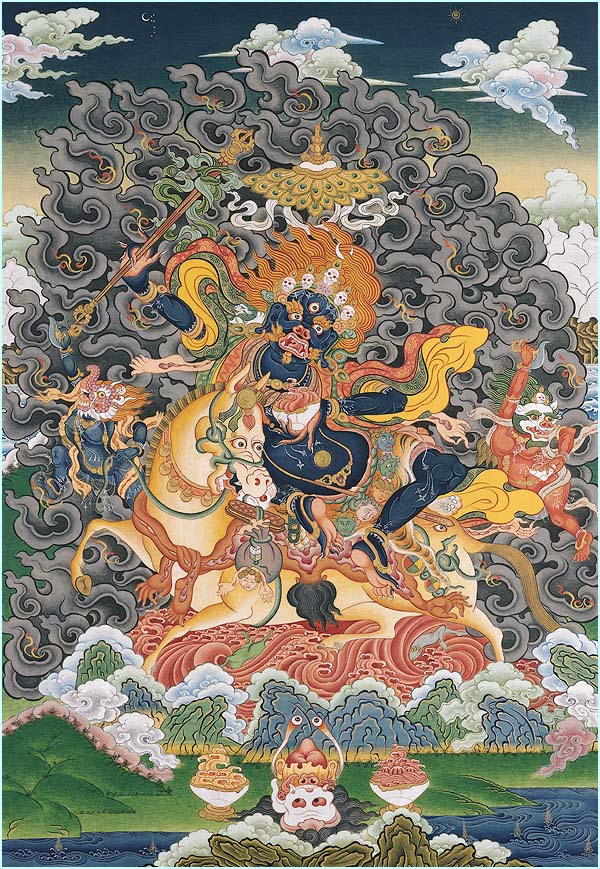
Full image of Tibetan wrathful deity seen above

Book Review: Thucydides:The Reinvention of History by Donald Kagan

Thursday, July 5th, 2012

Thucydides: The Reinvention of History by Donald Kagan 

Donald Kagan, who has been a professor of history and classics at Yale University almost as long as I have been alive has written a provocative book about Thucydides that challenges both conventional scholarly wisdom regarding the man who shares the title of “The Father of History” and the purpose of the book Thucydides meant to be “a possession forever”, The Peloponnesian War. In Kagan’s interpretation, Thucydides is the father of historical revisionism whose careful methodology furthered a political agenda: to defend the record of the Periclean state in Athens, where democracy was moderated by the wise statesmanship of the old aristocratic elite; and lay the blame for the downfall of Athens at Spartan hands on the vulgar hubris of radical democracy of mob and demagogue.

Thucydides is tightly focused argument about Thucydidean omissions, juxtapositions and treatment of sources and bias in his analytical rendering of military events and debates in the Assembly, not a comprehensive examination of  The Peloponnesian War. Specifically, the treatment of Pericles and Nicias (whom Kagan argues Thucydides favors and whom Kagan blames for failures of strategy and execution, especially the latter) vs. that he meted out to Cleon, Alcibiades and Demosthenes. Kagan criticizes Thucydides for the deliberate omission of speeches of Periclean opponents in debates where he  had been present and purporting to know the thoughts of actors where definitely had been absent, in exile; of faulty military analysis of the situation of the Spartan garrison besieged on Sphacteria due to personal enmity with Cleon and of the original expedition to Syracuse, because of favortism toward Nicias.

On Nicias in particular, a fellow aristocrat in favor of strategic restraint whom Kagan ascribes blame for the disaster in Sicily, did Thucydides seek a radical revision of the contemporary Athenian opinion. It was Thucydides belief that the post-Periclean democracy was a reckless, superstitious and greedy mob that led him, Kagan argues, to craft his narrative as an apologia for the inept statesmanship and incompetent generalship of Nicias that brought Athens to utter ruin in Sicily. Kagan’s accusations of bias on Thucydides part are more persuasive than his contention that the original expedition to Syracuse of sixty ships was a justifiable and sensible endeavor.

Kagan’s charges against Thucydides indirectly raise the larger question of politics in postwar Athens. A democracy shorn of it’s empire, long walls and fleet, defeated in external war but triumphant in brutal civil strife over it’s internal oligarchic enemies, was in all likelihood a dangerous place. Xenophon felt as a follower of Socrates, who had been associated with the reviled Alcibiades and Critias, that it was politic to leave Athens for his march upcountry under the banner of Cyrus. Socrates was unjustly put to death by the democratic faction. Writing from retirement in the luxury of a distant estate was a wiser option for a man of Thucydides’ opinions in that era than a return to the political fray in Athens and in part, would explain his supposed “revisionism”.

Strongly recommended.


Switch to our mobile site

