zenpundit.com » 2012 » April

Archive for April, 2012

Mountains and Rivers [with or] Without End

Sunday, April 15th, 2012

[ by Charles Cameron — just poetry — Gary Snyder, Han Shan, Dogen, Thoreau, Smokey & MIT ]

Gary Snyder is the fellow in the upper panel with the mountains behind him. Han Shan — whose name means Cold Mountain, which was also the name of the place he lived — is the fellow showing a poem to his friend in the lower panel. Dogen Zenji is the fellow who gave us the Mountains and Rivers Sutra. Thoreau is the fellow who retired for a while to Walden Pond. Smokey the Bear you know. And MIT is where Gary Snyder received the Henry David Thoreau Prize last Tuesday.

All are worthy of your attention, but in combo they’re unbeatable.

 
MIT:

MIT’s an interesting place to crop up in an account of Snyder — a poet, a Californian living high and away in the Sierras, and one of the first westerners to sit Zen and study in a monastery in Japan… And yet it’s curiously appropriate. Snyder is not here to banish science with poetry, but to enhance poetry with science, science with poetry, and both with his keen eye for context and honest detail.

He’s interested in weather. Understanding weather is in all our interests, but Snyder is actively interested. He’s interested in mountains and rivers, which comes to much the same thing — and he would surely have been interested in this exhibit that opened at MIT on Friday, just three days after his award ceremony there:

I dropped this image in here because it shows mountains and glaciers — but not without end. The loss of glaciation would concern Snyder — we know he’s interested in such things both immediately and in the long term, not only from his ecological writings in prose, but also because there’s a section of his epic Mountains and Rivers Without End that opens with these words:

“The 15 billion cubic kilometers of water on the earth are split by photosynthesis and reconstituted by respiration once every two million years or so.”

Even on that time-scale, Snyder’s interest in such things is personal: that section is titled We Wash Our Bowls in This Water.

So that’s the MIT part of the package.

 
Han Shan:

The terrific tale [link includes poems, too] of how a Chinese official learned that Han Shan and Shih-te, his laughing companion pictured above, were in fact great bodhisattvas though they looked like vagabonds could have come straight out of Jack Kerouac‘s Dharma Bums days. The official describes Han Shan:

He looked like a tramp. His body and face were old and beat. Yet in every word he breathed was a meaning in line with the subtle principles of things, if only you thought of it deeply. Everything he said had a feeling of Tao in it, profound and arcane secrets. His hat was made of birch bark, his clothes were ragged and worn out, and his shoes were wood. Thus men who have made it hide their tracks: unifying categories and interpenetrating things.

And here he describes how he arranged for the publication of Han Shan’s poetry:

I ordered Tao-ch’iao and the other monks to find out how they had lived, to hunt up the poems written on bamboo, wood, stones, and cliffs – and also to collect those written on the walls of people’s houses. There were more than three hundred. On the wall of the Earth-shrine Shih-te had written some gatha (Buddhist verse or song). It was all brought together and made into a book.

Gary Snyder it was, by the way, who turned Kerouac and the Beats onto Buddhism, and who features as Japhy Ryder in Kerouac’s Dharma Bums.

 
Gary Snyder:

Here’s Snyder again:

The first question that arises for me when I see photos of Gary Snyder like the ones above, I’ll admit, is whether it’s somehow axiomatic that his face should be as creased and rugged as the mountains he loves.

That’s a question for the intuition, really — but it may be worth noting that Emily Bronte saw a similar yet somewhat different correspondence between face and land and mentioned it in Wuthering Heights:

Catherine’s face was just like the landscape – shadows and sunshine flitting over it in rapid succession; but the shadows rested longer, and the sunshine was more transient; and her poor little heart reproached itself for even that passing forgetfulness of its cares.

People, and their eventual likeness to the places they live?

Let’s take this a little deeper. With respect to mountains, rivers and sages specifically, the great zen master Dogen teaches us in his Mountains and Rivers Sutra:

From time immemorial the mountains have been the dwelling place of the great sages; wise ones and sages have made the mountains their own chambers, their own body and mind. And through these wise ones and sages the mountains have been actualized. However many great sages and wise ones we suppose have assembled in the mountains, ever since they entered the mountains no one has met a single one of them. There is only the actualization of the life of the mountains; not a single trace of their having entered remains.

 
Dogen Zenji:

Dogen composed the Mountains and Rivers Sutra, which as far as I can tell is not available in book form except as a section of his longer work, the Shobogenzo. Snyder worked from 1956 to 1996 on his long poem series, Mountains and Rivers without End. The Cleveland Art Museum houses a scroll painting from the Northern Sung dynasty, Streams and Mountains Without End:

 
Translation — hey, second cousin to reincarnation?

An ancient Han Shan poem that’s also an early Snyder poem, Snyder here translating Han Shan:

I settled at Cold Mountain long ago,
Already it seems like years and years.
Freely drifting, I prowl the woods and streams
And linger watching things themselves.
Men don’t get this far into the mountains,
White clouds gather and billow.
Thin grass does for a mattress,
The blue sky makes a good quilt.
Happy with a stone under head
Let heaven and earth go about their changes.

Of both men you might say: the dwelling place is where the mind dwells.

 
Smokey the Bear:

Snyder has his own sutra. It is called the Smokey the Bear Sutra, and it’s both fierce and hilarious: I have a beautiful copy in storage somewhere, in the beautiful Fudo Trilogy edition, that Snyder kindly inscribed for me, “Well met”.

It contains the following gloss on mountains and rivers:

My obstinate compassion is schist and basalt and granite, to be mountains, to bring down the rain.

Science, mountains, weather patterns, rivers…

The poetry in Synder’s Mountains and Rivers has its rapids and still waters, its simple poetry and dazzling prose:

A day on the ragged North Pacific coast get soaked by whipping mist, rainsqualls tumbling, mountain mirror ponds, snowfield slush, rock-wash creeks, earfuls of falls, sworls of ridge-edge snowflakes, swift gravelly rivers, tidewater crumbly glaciers, high hanging glaciers, shore-side mud pools, icebergs, streams looping through the tideflats, spume of brine, distant soft rain drooping from a cloud,

sea lions lazing under the surface of the sea…

 
HD Thoreau:

Walden Pond is one of the great power centers of America Snyder mentions in the Smokey the Bear Sutra — and Snyder borrowed one of Thoreau’s lines for a poem of his own:

The sun is but a morning-star: each day represents a new opportunity to recover the nobility of life, another chance to turn aside from use to wonder.

Like Han Shan, Thoreau is among the ancestors. And as Thoreau’s own friend Emerson wrote, “The world is young: the former great men call to us affectionately.”

And what’s this about the former great men? Snyder goes way back before Emerson and Thoreau, and even Han Shan — he once said:

As a poet, I hold the most archaic values on earth. They go back to the late Paleolithic; the fertility of the soil, the magic of animals, the power-vision in solitude, the terrifying intuition and rebirth; the love and ecstasy of the dance, the common work of the tribe.

 
Now:

Perhaps that’s what keeps him relevant, fresh. Once again in Mountains and Rivers Without End he writes:

Alive       in the Sea of Information.

As are we all. How’s that for archaic meets MIT?

Going to Try this App

Sunday, April 15th, 2012

Paper for iPad


New Book: THE SNAKE EATERS by Owen West

Friday, April 13th, 2012

The Snake Eaters by Owen West 

Just received a review copy yesterday, courtesy of Simon & Schuster.  Full disclosure, by happenstance, I am on a private listserv with Major West, but you can take data point that alongside the fact that until today I hadn’t realized he was also the son of Bing West.  🙂

Judging from West’s already accomplished biography, the apple does not fall far from the tree.

Flipping through briefly, this book seems to be part high octane action story, part memoir,  part COIN treatise by other narrative means. The “novel-like” format appears to be an emerging trend in military and national security publishing distinguished from traditional, eye-in-the-sky, synthesizing, narratives like Steve Coll’s Ghost Wars.  Pre-publication materials sent described The Snake Eaters, thusly:

….The Snake Eaters takes readers into the streets, schools and homes of Khalidya [Iraq] – where the people WQest’s team were trying to protect were indistinguishable from the enemy they were trying to kill, and the the Iraqi battalion they mentored was both amateurish and hostile….By the end of the mission, the Snake Eaters was the first Iraqi battalion granted independent battle space, the insurgency was wiped off the streets of Khalidya, and peace was restored

Ok, that is just PR stuff which can be taken with a grain of salt, but the respected Bill Roggio of  The Long War Journal was embedded with the Snake Eaters in Iraq 2007 in the deadly Anbar province, when they were under Major West’s tutelage:

….Instead of moving out on Humvees, the Snake Eater’s platoon of scouts, accompanied by 5 MTTS and myself, struck out on foot from the battalion base, which sits on a hill overlooking Khaladiya, and moved into the city. The patrol moved through the desert hills between the base and the town. This approach is dangerous, particularly during the day, as soldiers are silhouetted behind the sky when coming over the hills, perfect targets for the snipers in the area.

On the march into Khaladiya, we overheard four mortars fall into one of the bases in the distance. The mortars were blind fired and we were told they didn’t hit a thing. The ever present semi-wild Iraqi dogs howled in the distance, and their howls grew louder as we approached and they shadowed our patrol. The insurgents couldn’t ask for a better early warning system.

This group of Iraqi Army scouts were the most disciplined and tactically proficient Iraqi soldiers I have seen while accompanying Iraqi troops outside the wire. They moved sharply, covered dangerous intersections and rooftops, effectively used hand and arm signals, and maintained their intervals. The scouts clearly embraced the idea of the “predator-prey” relationship. On the streets of Khaladiya, they were the hunters.

That doesn’t hurt the street cred (though TTP is way, way outside my area of expertise – I’ll leave that for folks who know what they are talking about to assess).

Incidentally, the FID/advisory/transition ops theme of The Snake Eaters is likely to make it very relevant reading in 2012 -2013.

A review will be forthcoming – have a bit of a backlog of reviews that I need to clear  (The End,  All In and The Hunt for KSM)

Simultaneity II: the pictorial eye

Wednesday, April 11th, 2012

[ by Charles Cameron — when sequence becomes simultaneous, the pictorial eye, rethinking thinking, continuing from Simul I ]
.

What better day to begin writing this second post on simultaneity than the day on which Google celebrated the birthday of Eadweard Muybridge with a Google Doodle — not that I’ll get the post finished within those same 24 hours!

The film — sequence of frames? stills? which would you call it? — that Muybridge took of a horse, used in that Google Doodle [view it in motion, here], is celebrated as showing beyond a doubt that when galloping, all four of a horse’s hooves may be in the air at the same time.

But is it — Muybridge’s work product — sequential, ie a film, or simultaneous, ie the presentation of many moments at one time?

That question gets to the heart of an issue that all narrative faces, as we shall see. First, the pictorial side of things.

*

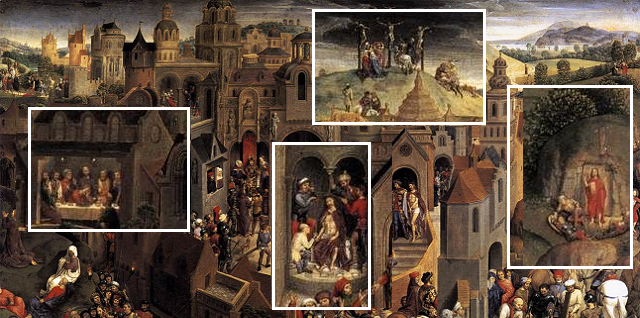
Hans Memling‘s Passion of Christ (above) tells the gospel narrative, from Christ’s entry into Jerusalem and the Last Supper through his crucifixion, entombment and resurrection to his appearances in Emmaus and by the sea of Galilee in one canvas, much as Bach’s Matthew Passion [link is to Harnoncourt video] tells major portions of the same narrative in three hours of unfolding musical drama.

*

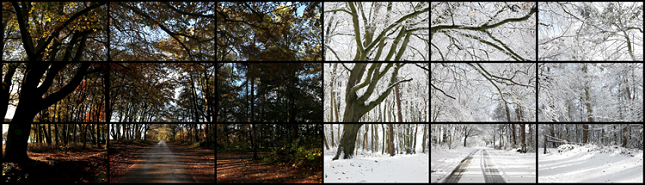
David Hockney has recently been working on forms of what I can only call “asynchronous synchrony” — as exemplified here:


Stills from Woldgate 7 November 2010 11:30 AM (left) and Woldgate 26 November 2010 11 AM (right). Credit: ©David Hockney

This image comes from a fascinating article describing Hockney’s current work by Martin Gayford, titled The Mind’s Eye, which you can find in MIT’s Technology Review, Sept/Oct 2011:

We are watching 18 screens showing high-definition images captured by nine cameras. Each camera was set at a different angle, and many were set at different exposures. In some cases, the images were filmed a few seconds apart, so the viewer is looking, simultaneously, at two different points in time. The result is a moving collage, a sight that has never quite been seen before. But what the cameras are pointing at is so ordinary that most of us would drive past it with scarcely a glance.

As with the Muybridge video above, “the viewer is looking, simultaneously, at different points in time”. Here Hockney does this with video cameras — but he achieves something of the same effect of time-displacement with still photos, too, as you can see in his brilliant portrait of the sculptor Henry Moore, hosted on the British Council’s Venice Biennale site.

Here is Gayford’s concluding paragraph, tying Hockney’s work into the larger context of our need for multiple frames of reference:

“Don’t we need people who can see things from different points of view?” Hockney asks. “Lots of artists, and all kinds of artists. They look at life from another angle.” Certainly, that is precisely what David Hockney is doing, and has always done. And yes, we do need it.

*

Memling again — and here I have enlarged and “framed” four of the 23 scenes from the passion of Christ which he has incorporated in the one painting: the Last Supper, the Crowning with Thorns, the Crucifixion, the Resurrection — Thursday evening through Sunday, and from life to death and back again.

*

It was Holy Week for Christians just last week, so perhaps you will forgive my having been preoccupied with images of the passion during the season set aside for such meditations — but what I want to point out to you is timeless, and indeed brings the transcendent into the everyday. Let’s take a look at a Hitchcock film next, then, and see how a contemporary videographer Jeff Desom has remixed the already Hockney-like Rear Window [link to IMDb] to create his own time-lapse telling of the tale [link to Vimeo], from which I took this screen-grab:

*

Time-lapse — simultaneity? The philosopher Alfred North Whitehead once wrote:

The communion of saints is a great and inspiring assemblage, but it has only one possible hall of meeting, and that is the present; and the mere lapse of time through which any particular group of saints must travel to reach that meeting-place, makes very little difference.

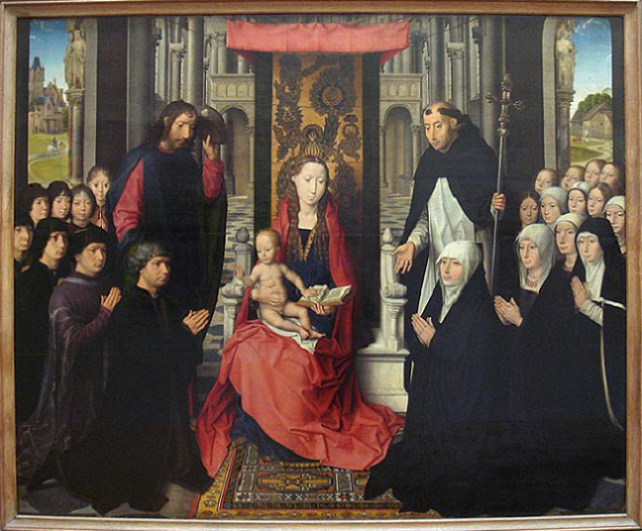
And so it is with this other Memling painting — and many others like it, by artists old and new:

Here we see the Virgin Mary and Christ child with Saints Dominic and James — there’s an eleven centuries gap right there, St Dominic lived from 1170 – 1221, more than a millennium after Christ — and Memling has St Dominic presenting his patron, the spice trader Jacques Floreins with his family to Christ, circa 1490. With everyone dressed in late 15th-century fashions…

Whitehead — co-author with Bertie Russell of Principia Mathematica — see how amazing this is? — could have been thinking of Memling: “the mere lapse of time through which any particular group of saints must travel to reach that meeting-place, makes very little difference”.

*

Coming up next: how this affects our understanding of story.

____________________________________________________________________________

For an understanding of the setup David Hockney uses for his multiple-video takes, see here and specifically this and this. For the setup used by Jeff Desom in his Rear Window remix, see here and specifically this.

Recommended Reading

Tuesday, April 10th, 2012

Top Billing! Global Guerrillas –Drones and Operational Maneuverability 

….Drones are currently in the process of being outfitted with insect mobility — bees to ants to fleas.  However, that mobility is of diminished use given the limitations on decision making complexity (beyond what’s required mobility).  

That decision making limitation will be fixed in the next decade, as inexpensive computing horsepower and bio-mimicry allows us to outfit drones with more complex mammalian behaviors (think rat).   

In fact, given that this decision making capacity will become merely a function of inexpensive hardware/software, it will become a throw away feature.  You can turn it up or down depending on need without any thought the expense involved.  

This implies a pretty efficient combo of dumbed down drones operating as part of a swarm, reacting to stigmergic signalling, and more rodent like behavior when operating as individuals. 

The Glittering Eye – Alien vs. Predator 

When I read this comment:

I don’t see it that way. I don’t think it’s about race, I think it’s about his status as a member of the Ivy League elite. He doesn’t understand “typical white people” but then neither does Mitt Romney.

my immediate reaction was “Yeah. 100% of blacks in America were raised by white people in Indonesia and Hawaii.”

Carl Prine –General Discontent


 The emails began circulating yesterday, all extolling the brilliance of retired U.S. Army LTG David Melcher as a good example of the “disruptive thinker,” his Ranger-honed brain sculpted by the best of the Army and unleashed now as a titan of entrepreneurship, his eyes burning as green as sawbucks in the jungle of Wall Street’s night.

Well, can you blame them?  I know I can’t.  Their applause for Melcher’s bio arrives at a historical moment, one that finds too many current and former soldiers intoxicated with a bit of maverick humbuggery championed by Lt. Benjamin Kohlmann on Small Wars Journal  – an argument so clumsy that he, no joke, suggests that the best way to shake up the stifling complacency of the military bureaucracies is to send junior officers to business school, most especially the one at Harvard. 

….To sell the innovative fusion that apparently occurs whenever we link – again, no joke – “cryogeneticists with F/A-18 pilots,” Kohlmann rambles on about fripperies as diverse as the iPhone, its godfather with deep pockets Steve Jobs, science fiction writer Orson Scott Card, dead USAF Col. John Boyd, the Myspace of living USN Adm. James Stavridis, three-named mediocrity Joshua Cooper Ramo, then some jumbled half-thoughts about crowdsourcing, terrorists and swarming drones all designed to answer a question he doesn’t really ask:   Why do it?  Who already benefits from today’s hidebound bureaucracy? 

Granted, I don’t think that even one of Kohlmann’s examples of Harvard’s entrepreneurial spirit ever attended HBS, but perhaps their accountants and personal wealth managers did. 

SWJ (Peter J. Munson) –Disruptive Thinkers: Defining the Problem


Benjamin Kohlmann’s essay, “The Military Needs More Disruptive Thinkers,” struck a chord like no other essay published recently in the Small Wars Journal.  In brutal honesty, I have to say that the many sniping comments struck exposed flesh.  While an ardent fan of Kohlmann’s essay, I have to agree that his argument was more akin to birdshot at maximum range than a mailed fist to the throat of the problem.  Perhaps a better analogy is that his was a marking round lobbed in the general vicinity of the problematic enemy fire.  Whatever it was, it was a wildly popular read.  For all the comments on the article, the one that rang truest with me came from commener “Null Hypothesis” and asked, “What problem are we trying to solve again?”  This was absolutely the right question.

Kohlmann called for disruptive thinkers, but the real question is why?  And what are we disrupting?  We cannot waste time with harassment and interdiction fires.  We must define what targets we are servicing….

Infinity Journal (Frank Hoffman)– The Myth of the Post-Power Projection Era

CTOvision (Alex Olesker) –Fighting Cyber Crime with Transparency 

Wilson Quarterly – Pakistan’s Most Dangerous Place 


Recommended Viewing:


Switch to our mobile site