zenpundit.com » 2012 » September

Archive for September, 2012

The symmetry: Charlie Hebdo

Saturday, September 22nd, 2012

[ by Charles Cameron — my apologies for an earlier incomplete draft, quickly withdrawn — first of two, on loose cannonry and mirror imagery — second will deal with recent events in Benghazi ]
.

.

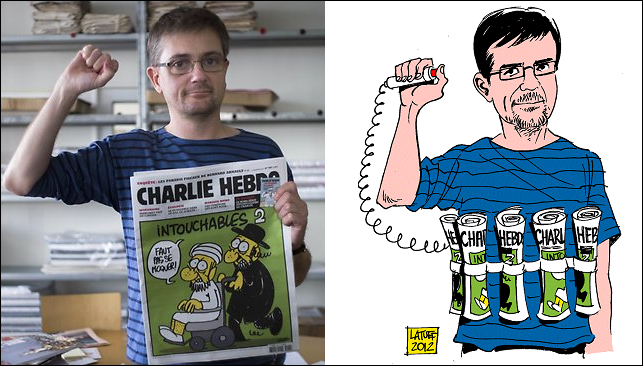
Charlie Hebdo recently published some cartoons featuring the prophet…

Okay, I’m always on about symmetry.

I posted a piece titled Messianic symmetries on ZP a while back, noting that both Ahmadinejad and Netanyahu can be viewed as exercising “leadership that makes decisions out of messianic feelings” — the quote comes from an unimpressed ex-Shin Beth director describing Bibi; Ahmadinejad makes the case for his own Mahdist leabings quite well himself.

Symmetry seems like an important analytic category to me, either because it’s there in the build of the world, or because it’s there in the build of the mind. Either way, I think we should take careful notice of symmetries.

Asymmetries I’ll talk about in my next post.

**

What about the cartoon above, right? It’s clearly based on the photo above, left, which shows Stéphane Charbonnier, the editor of Charlie Hebdo, holding his magazine with its offensive cartoons / vindication of free speech. And the suggestion is clear that he’s some kind of suicide bomber.

But who is he blowing up, exactly? Himself, and perhaps his staff and anyone else who happens to be within a few yards of his office at the time? France, Europe, the western world — the world itself? And how much irony should we read into the cartoon portrait?

They may have learned the technique from the Tamil Tigers, but these days, in the immediate wake of widespread rioting over the video clip and in the context of someone publishing cartoons that satirize the prophet, it’s clearly Islamist suicide bombers who provide the model for the cartoon of the cartoonist above.

Tit for tat? An eye for an eye? You’re just setting yourself up for a fatwa like Salman Rushdie?

**

Incendiary rhetoric on one side leads to incendiary behavior on the other, validating the incendiary rhetoric and making the escalation to incendiary behavior all the more probable.

Some of the incendiary rhetoric has its origin in holy books, which also preach peace.

There are Coptic Christians utterly blindsided by the virulence of the video, attributed to one of their number. There are Libyan Muslims utterly blindsided by the virulence of the attack on the US Embassy, attributed to some of their own.

**

I want to focus not on the specifics of the topic, but on the symmetry.

One writer, observing the partition of India and Pakistan, wrote:

The rioters brought the train to a stop. Those who belonged to the other religion were methodically picked out and slaughtered. After it was all over, those who remained were treated to a feast of milk, custard pies and fresh fruit.

Before the train moved off, the leader of the assassins made a small farewell speech: “Dear brothers and sisters, since we were not sure about the time of your train’s arrival, regretfully we were not able to offer you anything better than this most modest hospitality. We would have liked to have done more.”

Commenting on this paragraph, Ali Sethi wrote recently in the New Yorker:

That is all there is: murder—methodical and quick—followed by a feast and an ingratiating speech. Note the withholding of tags: we don’t know the location of the massacre or the religion of the killers. All we have is a spurt of base instincts.

The point here is that whenever you see a symmetry of opposites, it’s worth considering that symmetry in the abstract, as well as weighing the particular issues that drive your own side or the other.

That, I’d suggest, is one of the implications of that Paul van Riper remark I’m fond of quoting:

What we tend to do is look toward the enemy. We’re only looking one way: from us to them. But the good commanders take two other views. They mentally move forward and look back to themselves. They look from the enemy back to the friendly, and they try to imagine how the enemy might attack them. The third is to get a bird’s-eye view, a top-down view, where you take the whole scene in. The amateur looks one way; the professional looks at least three different ways.

**

I am concerned about hatred, simmering here, boiling over there. I am concerned about what sparks hatred, and what fans it. What I want to draw your attention to here, though, is the process by which one hatred fuels abother, the process of mirror imaging.

Mark Juergensmeyer, a terrific scholar of religion who has published on topics ranging from Gandhi‘s nonviolence to the violence of religionists who consider themselves sanctioned by the scriptures of various religions, makes the point in a recent Religion Dispatches post thus:

The US-based Islamophobes behind the insulting and amateurish video “The Innocence of Muslims,” and those behind the violent protests it allegedly caused around the Muslim world, are kindred hatemongers. Both are extremists with a political agenda, and both want to use this incident to discredit the legitimacy of the moderate governments in power in their respective countries. There is a symbiotic relationship between the strident protesters and the bigoted filmmakers; each needs the other.

We are in a hall of incendiary mirrors, with plenty of kindling: in my view, we should avoid playing with matches.

**

Thank God, there are also asymmetries.

In a companion post, I’ll take a look at recent, very promising events in Benghazi (h/t to Pundita for a pointer to this particular article), the not particularly unsurprising but unwelcome attitude of a Pakistani minister, and the imbalances that go along with the dangerous balances I’ve discussed in this post.

**

Oh, and let me digress…

I won the Divinity essay prize back in my schooldays at Wellington College, and received my chosen prize book, the Liber Usualis with its glorious collection of Gregorian Chants, from the then Minister of Defence, John Profumo, MP. Not long thereafter, it was discovered that he pillow talked with one Christine Keeler, a night lady of class, who also pillow talked with the Russian defence attaché. And the story was broken, week by glorious week, by the British satirical magazine, Private Eye.

Which I consequently have an affection for, after all these years. And I tell you this, because Charlie Hebdo, or Weekly Chuck as we might call it over here is, I’d suggest, a plausible latter-day French rough equivalent of Private Eye.

I don’t really like our guys posting inflammatory materials, you see, but I also have an affection for freedom of speech — and for magazines with a satirical bite, too…

So sue me, I contain multitudes.

Where in the world is Abu Musab al-Suri?

Thursday, September 20th, 2012

[ by Charles Cameron –on the whereabouts of the jihadist thinker, and the importance of careful reading ]
.

For those interested in the question of whether Abu Musab al-Suri has been released by the Syrians, where he is and how he’s doing, this tweet today from Mr. Orangetracker is probably the state of the art:

**

I sat up and took notice of this tweet today, both because I think al-Suri’s whereabouts is and should be a matter of considerable concern and interest — and also because it reminded me of a conversation a day or two back, which began (or at least, those parts that I can see from my own feed began) with a comment from Will McCants on the recently posted Institute for the Study of War report, Jihad in Syria, and led Jane’s analyst Charles Lister to comment that the report “Also concretely claims Al-Suri was released in Feb; that wasn’t confirmed, right?”

The exchange continues:

McCants: i haven’t seen anything credible. but Aaron tracks the story more closely
Aaron Zelin: Credible sources at the forums said al-Suri was released then, but no word on him since.
Raff Pantucci: I wonder if he was ever actually freed tho. maybe a scare story from Syrian intelligence?

I hadn’t particularly noticed the conversation up to this point, but here is where I noticed a tweet from Zelin to Pantucci:

Raff Pantucci is another student of these matters whom I follow. As the discussion continues, he agrees with Zelin’s assessment:

Pantucci: that would make sense. he certainly wouldn’t be on their side if they let him loose at home!
Yassin Musharbash: the thing is that we simply cannot know what kind of state – physically, psychologically and ideologically – he is in
Zelin: Agreed.

**

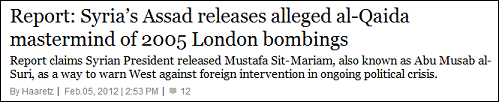
As a matter of fact, the report did indeed state [p. 15] that Abu Musab al-Suri has been released:

In early February 2012, the Syrian government released Mustafa bin Abdel Qadir Sitt Mariam Nassar, also known as Abu Musab al-Suri. Al-Suri is an important jihadist ideologue and a top al-Qaeda operative, with experience fighting against the Assad regime during the 1979—1982 Islamic Uprising. As the alleged mastermind of the July 2005 London Bombings, Al-Suri had been in Syrian custody since he was allegedly transported there by the CIA six years ago.

But here’s where it gets interesting. In connection with these sentences, the report carries this footnote [# 29]:

“Syria’s Assad releases alleged al-Qaida mastermind of 2005 London bombings,” Haaretz, February 5, 2012.

Significantly IMO, that footnote omits the first word of the Haaretz headline, which reads:

**

“Report claims Syrian President released” is simply not the same as “Syrian President released”.

On such tiny details are the webs and fogs of misunderstanding often based.

Nir Rosen Among the Alawites

Thursday, September 20th, 2012

Controversial journalist Nir Rosen is, by my standards, a left-wing extremist with carcinogenic political views. On the other hand, he is also a fearless and skillful war correspondent who goes places to report where few others dare; as a result, Rosen is usually worth reading, particularly as he seldom is treading a well-worn path:

London Review of Books: Among the Alawites -Nir Rosen reports from Syria 

….When Abu Laith took me to Rabia itself, news of our arrival spread quickly. Thousands of residents staged a seemingly spontaneous but clearly sincere demonstration in support of the regime in the centre of town, next to a statue of Hafez al-Assad holding an olive branch and a sword. The statue, paid for by locals, was erected after the uprising started. Behind it was a massive poster with a picture of Hafez and Bashar. On it was written ‘Rabia is the lion’s den,’ a play on the word assad, which means ‘lion’. I was dragged from house to house so people could speak of their dead and wounded relatives, and of Rabia’s 42 martyrs. I told one group of local men that when I visited opposition strongholds like Baba Amr in Homs I always heard similar stories about fathers or sons being martyred. ‘Our sons were just going to work,’ an army colonel whose nephew was killed in Idlib said in reply. ‘There is a difference between killing a man going to work for the state and killing an armed man taking up weapons against the state. Is it peaceful demonstrators who kill five officers at a checkpoint?’

For the past year Rabia’s Alawites have clashed with neighbouring Sunni villages. Last summer the town’s students couldn’t travel into the city of Hama to take their exams because the opposition had blocked the road. Around thirty Alawite families from one nearby majority Sunni village have settled in Rabia, feeling it was no longer safe to stay where they were. The displaced families were disappointed with the government’s response. ‘We didn’t have any weapons or we would have fought back,’ one man told me. ‘They should have sent in tanks but the opposition blocked the roads. We want the state to solve our problems and the army to return us to our land. The army has to enter the villages, but the army is busy in Hama. Why is the state taking its time?’ Abu Laith’s father, a retired soldier, agreed. ‘Only the army can solve this,’ he said. ‘If we respond ourselves it will be seen as sectarian violence and other villages will join them against us. They will outnumber us.’

From Rabia I headed north-west towards Aziziya, a remote Alawite village which has clashed with the neighbouring Sunni village of Tamana. As in most Alawite villages, the majority of its men work in security or the army. Its Sunni neighbours all support the opposition, and opposition militias have been operating in the area since last spring. Salhab, the nearest town of any size, contains hundreds of displaced Alawite mothers and children who have fled the village. The fight between Aziziya and Tamana showed no sign of abating and in the town I found several families in a near hysterical state. A woman who’d recently reached Salhab shouted at me: ‘We left under fire! Our dignity is precious! Our leader is honourable! They are traitors! Everything for Bashar!’

The Alawites and Syria’s Christian minorities are not going to fare well if Syria falls to the increasingly Salafist-tinged opposition. Their back is against the wall. The Druze and Kurds, with potential ethnic allies in neighboring states, may have greater leverage if the Baathist regime collapses.


Twenty-Nine Articles

Tuesday, September 18th, 2012

SWJ Blog has a new post up with an important and all too timely article on transition operations whose authors include an amigo of mine, Pete Turner, a veteran of Iraq and Afghanistan. Turner will also be one of the featured speakers at the Boyd & Beyond Conference in October at Quantico:

Transition Operations: A Discussion with 29 Articles by Richard LedetJeff Stewart and Pete Turner 

….What is Transition?

Currently, there is no accepted definition for Transition in US Doctrine.  For the purpose of this discussion, we will define Transition simply as the transfer of responsibility from Supporting Nations (SN) to the Host Nation (HN). 

How do we go from full-speed-ahead COIN operations where we call all of the shots to a fully functioning sovereign nation that provides security and services for its population?  Although we have concluded one Transition (Iraq) and are in the midst of another (Afghanistan), we are still literally feeling our way forward, one unit at a time, without a coherent strategy, doctrine, or national policy.  Battalion and Company Commanders want to know, “What comes after build?”

As previously stated, our doctrine is remarkably silent on Transition.  FM 3-24 Counterinsurgency acknowledges the requirement for Transition in the late stage of counterinsurgency:  

“The main goal for this stage is to transition responsibility for COIN operations to HN leadership.  In this stage, the multinational force works with the host nation in an increasingly supporting role, turning over responsibility wherever and whenever appropriate.  Quick reaction forces and fire support capabilities may still be needed in some areas, but more functions along all Logical Lines of Operations are performed by HN forces with the low-key assistance of multinational advisors.  As the security, governing, and economic capacity of the host nation increases, the need for foreign assistance is reduced.  At this stage, the host nation has established or reestablished the systems needed to provide effective and stable government that sustains the rule of law” (paragraph 5-6).

That is the sum total of the guidance given in our counterinsurgency manual.

Transition thus appears to be rather nebulous; it is something we desire and anticipate, but do not necessarily know how to achieve, or even understand.  It may occur quickly, or be drawn out over an extended period of time.  Like other operations in COIN, Transition will also occur differently in different locations, with various requirements and assorted timelines.  Our own relief in place/transfer of authority (RIP/TOA) process even affects Transition.  How do we maximize effects at this point, especially considering that the level of international effort is simultaneously in decline?  What are the requirements for Transition, and what is the glide path to a smooth successful hand-off to the host nation?  Is it a phase that comes after “Hold,” or is it part of the “Build” phase, both of which occur sequentially after “Clear?”  One might also argue that once “Transition” has begun, the COIN fight is over for SN forces and the responsibility shifts to the State Department or the UN.  Or does it?  

There is no simple way of answering these questions, or the others which are raised throughout this paper.  The answers may change with each particular case.  However, without a dialogue on the subject these questions will continue to go unanswered and operations are likely to proceed with uncertain or frustrating results. ….

Read the rest here.   I am a particular fan of points 3,4,5,6 and 9.

And now, we interrupt this post for a…….

Public Service Message:

If you enjoy discussions like this one and think that SWJ and SWJ Blog are an important forum for debate on key defense and strategic issues, they could really use your financial support:

Small Wars Foundation Annual Fundraising Campaign

The Small Wars Foundation / Journal / Council’s annual fundraising campaign is now underway and this is easily the most critical funding effort we have conducted since going hot in 2005. We originally envisioned quarterly campaigns but quickly realized that we were likely over-tapping the hard-core few who have kept our head above water all these years. Well, we are currently on life support in many aspects of our operations to include day to day operating costs, upgrades to the site, and providing at least a meager compensation to those who work 24/7 to keep our humble contribution to our Nation’s security and foreign policy alive and well.

There are many ways to support SWF/SWJ and they can be found here. But what we are most in need of right now is hard cash, the more the better. We have over 200 of our popular Small Wars Journal challenge coins remaining and will get one off to those who donate $50 or more or commit to a $25 a month recurring contribution. Donation options are available at the same link.

And for US contributors – your donation is tax deductible. Last year our goal was to raise approximately $20k but we fell far short of that. Our goal this year, and a very optimistic one at that, is $30k and we will keep you posted on our progress. Thanks in advance in helping keep this effort alive and well.

Of films, riots and hatred III: Scorsese and Verhoeven

Monday, September 17th, 2012

[ by Charles Cameron — The Last Temptation of Christ troubles, an early warning re the upcoming Jesus of Nazareth movie — the blood libel and more ]
.

American and European Christians, too, can react violently to films they perceive as blasphemous, and this too we should remember as we weigh our own responses to the rioting in Cairo and elsewhere.

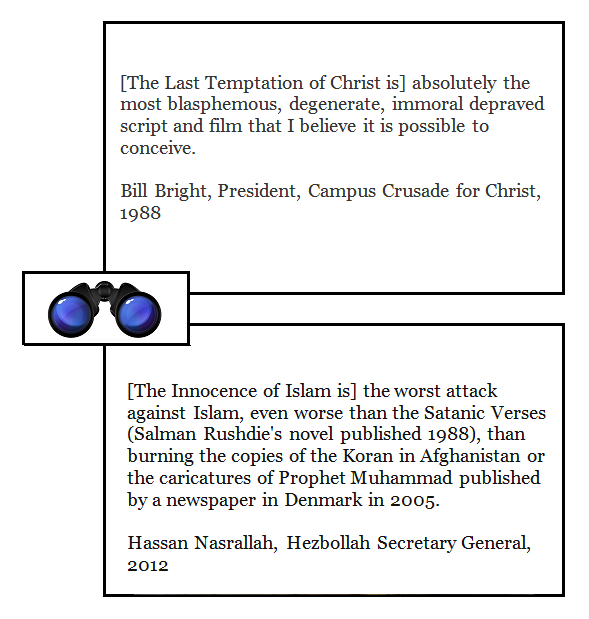
Martin Scorsese‘s Last Temptation of Christ gives us a sense of how modern American and European Christians can react to perceived blasphemy, while the forthcoming Paul Verhoeven movie of his own book Jesus of Nazareth will test the degree to which we’ve learned the lessons of a quarter century ago — and of this last week.


.

**

Martin Scorsese’s The Last Temptation of Christ: stirred strong feelings when it opened. I was in LA at the time, and was following the controversy fairly closely having attended an early screening, and having both literary and theological interests.

The short video clip below is a little choppy, it doesn’t make it particularly clear that the clips you see are from the film Martin Scorsese made of a novel — written by the Nobel laureate Nikos Kazantzakis — which makes no attempt nor pretense to be a historical or religiously orthodox portrayal of Christ. IMO, it is worth watching for the glimpse it gives of just how strong the undercurrents of emotion aroused by Scorsese’s film were at the time:

**

I’m bringing this subject up and attending to it in some detail because NBC World News mentioned Martin Scorsese’s movie on the 13th of this month, in an explanation as to Why films and cartoons of Muhammad spark violence, but without gwetting the picture quite right:

Director Martin Scorsese’s adaptation of a book by the same name showed Jesus struggling with lust, depression and doubt, and engaging in sex — in his imaginings — before snapping back to reality and dying on the cross. That movie was seen as blasphemy by some Christians, who — though not violent — were vocal enough to prevent the film from being shown in many parts of the United States.

There may have been no violence done to humans in the US — but there as certainly damage to property, and some vicious threats made, as The Encyclopedia of Religion and Film records:

At the Cineplex Odeon Showcase Theater in New York City, vandals slashed seats and spray-painted threats aimed at the chairman of MCA: “Lew Wasserman: If you release ‘The Last Temptation of Christ,’ we will wait years and decimate all Universal property. This message is for your insurance company.”

In parts of Europe, the violence was more intense:

Overseas, at the September 28 opening in Paris, demonstrators who had gathered for a prayer vigil threw tear gas canisters at the theater’s entrance. Catholic clergy led rock-throwing and fire-bombing assaults on theaters in many French municipalities. A thousand rioters in Athens trashed the Opera cinema, ripping apart the screen and destroying the projection equipment.

In Paris, specifically, the violence severely injured some human targets. From Wikipedia (with their footnotes removed — you can track the various quotes from the original page):

On October 22, 1988, a French Christian fundamentalist group launched Molotov cocktails inside the Parisian Saint Michel movie theater while it was showing the film. This attack injured thirteen people, four of whom were severely burned. The Saint Michel theater was heavily damaged, and reopened 3 years later after restoration. Following the attack, a representative of the film’s distributor, United International Pictures, said, “The opponents of the film have largely won. They have massacred the film’s success, and they have scared the public.” Jack Lang, France’s Minister of Culture, went to the St.-Michel theater after the fire, and said, “Freedom of speech is threatened, and we must not be intimidated by such acts.”

The Catholic response — from the Cardinal Archbishop of Paris among others — reproved both the blasphemy and the rioting:

The Archbishop of Paris, Jean-Marie Cardinal Lustiger, said “One doesn’t have the right to shock the sensibilities of millions of people for whom Jesus is more important than their father or mother.” After the fire he condemned the attack, saying, “You don’t behave as Christians but as enemies of Christ. From the Christian point of view, one doesn’t defend Christ with arms. Christ himself forbade it.” The leader of Christian Solidarity, a Roman Catholic group that had promised to stop the film from being shown, said, “We will not hesitate to go to prison if it is necessary.”

There was apparently a connection with French far-right politics, too:

The attack was subsequently blamed on a Christian fundamentalist group linked to Bernard Antony, a representative of the far-right National Front to the European Parliament in Strasbourg, and the excommunicated followers of Archbishop Marcel Lefebvre. Lefebvre had been excommunicated from the Catholic Church on July 2, 1988. Similar attacks against theatres included graffiti, setting off tear-gas canisters and stink bombs, and assaulting filmgoers.

There were legal proceedings following the Saint Michel incident, and it’s notable that Fr. Gérard Calvet OSB, founder and Prior of the Benedictine Abbaye Sainte-Madeleine du Barroux, testified at the tribunal on behalf of the convicted youths, describing their motives if not their mode of expression as “noble”. Would that term be equally applicable to protesters of blasphemies against other faiths? We now live in a dense-packed world where such comparisons are easily made.

Let’s pause for a minute over the twinned remarks of the late (and widely respected) Cardinal Lustiger concerning Last Temptation

Jean-Marie Cardinal Lustiger, said “One doesn’t have the right to shock the sensibilities of millions of people for whom Jesus is more important than their father or mother.” After the fire he condemned the attack, saying, “You don’t behave as Christians but as enemies of Christ. From the Christian point of view, one doesn’t defend Christ with arms. Christ himself forbade it.”

and compare the remarks of a similarly authoritative religious figure in Libya to the Innocence of Muslims video:

Libya’s Grand Mufti, Sheikh Sadeq Al-Ghariani, has issued a fatwa condemning Tuesday’s killing of US Ambassador Chris Stevens along with three other American diplomatic staff and a number of Libya security guards. He said those involved were criminals who were damned by their action.

He also condemned the production of any film, picture or article insulting the Prophet Mohammad or any of the prophets by “extreme fanatics” in the US or elsewhere. The Prophet Muhammad, Ghariani said, had specifically forbidden the killing of ambassadors and envoys.

**

Almost a quarter century has passed since Scorsese’s movie opened, but as I said above, we will soon have an opportunity to show what we have learned from those lamentable events in Paris and the more recent tragedies in Benghazi, Cairo and elsewhere.

Paul Verhoeven — the director of such blockbusters as RoboCop, the original Total Recall, and Basic Instinct — has raised the financing for his upcoming movie Jesus of Nazareth, based on his book of the same name, and scripted by Roger Avary, who shared an Oscar with Quentin Tarrentino for their Pulp Fiction screenplay.

Verhoeven, be it noted, is not only a writer and movie director, but also a member of the Jesus Seminar — a group of scholars which, as Wikipedia nicely puts it, “treats the canonical gospels as historical sources that represent Jesus’ actual words and deeds as well as elaborations of the early Christian community and of the gospel authors” and prepares color-coded editions of the gospels suggesting which sayings of Jesus should be considered original, and which are better understood as later additions.

Here, to give you an idea of what may be on the horizon, is an excerpt from a quick and informal take on the upcoming movie by an admirer of Verhoeven:

Deadline reports that the legendary Paul Verhoeven — a guy who, amazingly, only directed three movies in the past fifteen years — has received financing to adapt his own book, Jesus of Nazareth, which discounts every mythical story surrounding Christ and, instead, opts to present him as a simple human figure with a message powerful enough to radiate throughout time. Roger Avary (Tarantino‘s story partner on Pulp Fiction) will write the film, while Muse Productions are doing the proper backing.

Almost any work going against the long-held Biblical grain will get groups up in arms — no, I don’t even need to provide examples — but the claims of Nazareth are, even in this context, still mighty contentious. Most notable is the idea that Jesus is not the son of God, but was actually the product of Mary being raped by a Roman soldier; so, right off the bat, you’re discounting the entire foundation of his story.

I am pointing this out because right now would be a good time for the various churches to begin a general conversation about the film-maker’s right to hold an opinion, write a book and make a movie, the hurt that may be felt by believers, and the importance of responding without hatred or violence when offended.

**

In our concern with matters of Christian and Muslim issues, let us not lose sight of the fact that Jews too have movies made about them that may not only hurt feelings but also represent real threats against them, reminiscent of Nazi and earlier Russian antisemitic propaganda fabrications.

From the copious “blood libel” entry in Wikipedia:

In 2003 a private Syrian film company created a 29-part television series Ash-Shatat (“The Diaspora”). This series originally aired in Lebanon in late 2003 and was broadcast by Al-Manar, a satellite television network owned by Hezbollah. This TV series, based on the antisemitic forgery The Protocols of the Learned Elders of Zion, shows the Jewish people as engaging in a conspiracy to rule the world, and presents Jews as people who murder Christian children, drain their blood and use this blood to bake matzah.

MEMRI has a report with further details, and a MEMRI clip of the scene in which a Christian child is killed by Jews has been posted on YouTube, with the comment:

Al-Shatat: Jews Murder A Christian Child and Use His Blood for Passover Matzos. anti Semite Arab propaganda against Jews, Judaism and Israel.

The following is a scene from the Syrian-produced TV series Al-Shatat. Al-Shatat was first aired on Hizbullah’s Al-Manar TV during the month of Ramadan 2003, and then on two Iranian channels during Ramadan 2004. Al-Mamnou’ TV, a new Jordanian channel, is airing Al-Shatat during Ramadan 2005.

It is worth recalling, too, that Mel Gibson‘s film, The Passion of the Christ, was perceived by many Jews, Christians and others as anti-Semitic — and that nonetheless the Orthodox Jew and conservative movie critic Michael Medved wrote:

The possibility of anti-Jewish violence in response to the film has been irresponsibly emphasized and has become, self-fulfilling prophecy. In parts of Europe and the Islamic world, anti-Semitic vandalism and violence occur daily, and hardly need a film by a Hollywood superstar to encourage them. In this context, Jewish denunciations of the movie only increase the likelihood that those who hate us will seize on the movie as an excuse for more of hatred.

**

I trust it is not too late to wish our Jewish readers l’shana tova: may your apples be dipped in honey and all our days bathed in peace.


Switch to our mobile site