zenpundit.com » 2016

Archive for 2016

Orlando Tweets Two

Tuesday, June 14th, 2016

[ by Charles Cameron — on a variety of other perspectives ]
.

Once again, my point is that there’s a whole lot of going on going on, and it’s worth getting a wide-angle view.. which means multiple perspectives, including those not your own:

**

Politicking:

Joshua Green, Trump seems to regard Omar Mateen as “Afghan” in the same way Judge Curiel was “Mexican”: foreign/un-American, even though both born in US
Charlene Deveraturda, The Atlantic’s ISIS Expert Graeme Wood Slams Trump For “Hurt[ing] The Fight Against ISIS” With Anti-Muslim Rhetoric

Both Al-Jazeera‘s and Joshua Green‘s tweets offer us examples of DoubleQuotes thinking.

**

Guns:

Program on extremism, ‘Orlando Shooter Legally Bought Guns Despite Previous Flags by FBI’
Rob Crilly, Orlando shows arc again. Hate-filled young man with access to guns picks his victims and then selects poisonous ideology to add “meaning”
Bill Maher, #Orlando Conservatives:”Don’t say it has anything to do with guns!” Liberals:”Don’t say it has anything to do with Islam!”
Maajid Nawaz, Saying this has nothing to do with Islam (libs) is as ignorant as saying this has nothing to do with guns (cons).Both need reform
Piers Morgan, Obama’s about to make the same speech he’s made about guns 20 times in his presidency. Just more pointless rhetoric, sadly.
Steven Crowder, Orlando timeline: Anti-Gay Muslim commits mass terrorism. American gun-owners condemn it. Liberals try to take their guns

**

Islamic responses:

Shadi Hamid, Muslim organizations in the United States unequivocally condemned the Orlando assault
Usama Hasan, Does #Islam condemn #gays to death?

and in ISIS perspective:

Cole Bunzel, ISIS’s A’maq news agency claims Florida attack was “carried out by a soldier of the Islamic State”
Will McCants, ISIS uses term “fighter” for Orlando attacker rather than “soldier” (Paris/Brussels) or “supporter” (San Bernardino) for whatever it’s worth

**

And finally, barely mentioned in the welter of opinions about Orlando — the other shoe:

JM Berger, We may have narrowly escaped having two very similar massacres on the same day, apparently unconnected
JM Berger, The fact that one was prevented and one was not is largely a trick of fate. We need robust reporting on LA incident as well

Orlando Tweets One

Tuesday, June 14th, 2016

[ by Charles Cameron — on the variety of possible motives ]
.

On twitter alone, there’s far too much going on as we scramble to understand the Orlando massacre for anyone to make a useful summary, although I must say that Rukmini Callimachi‘s twitter feed since yesterday has been superb. My own first assortment of relevant tweets focuses on the question of motive, but even with that narrowed focus it’s too extensive to present visually tweet by tweet, so I’m mostly going to post relevant texts with links. First, though, I’ll let Jeffrey Goldberg set the overview:

**

Mental Illness:

Yaroslav Trofimov, Orlando killer’s ex-wife says he was a wife-beater with a short fuse who liked to work out and wasn’t religious.
CBSN, It is definitely mental illness…no one ever expected that he would do this.

Mental illness or mental instability may arguably be present in many or all cases of rampage shooting, suicide bombing, etc — it’s a judgment call, and one most properly made by psychiatric or psychological professionals who have observed and interacted with the subjects personally. Sadly, however, continued use of this explanation as the explanation for acts of this kind avoids recognition of other factors in what is inevitably a multifactorial situation — and also contributes to the popular misperception that “mental illness” is a shameful failure of character rather than a complex of medical conditions.

**

Susceptibility to violence:

Lilith, Was Orlando shooter’s domestic violence history a missed warning sign?

**

Islamism:

JM Berger, Orlando gunman tied to radical imam released from prison last year, say law enforcement sources
Program On Extremism, Omar Mateen pledged allegiance to ISIS, official says

**

Homophobia:

Mona Holland, His father says he wasn’t religious, but was furious abt 2 gay men kissing a week or so ago in public
Murtaza Hussain, “Ty Smith & Chris Callen recalled the eventual killer being escorted drunk from the Pulse bar on multiple occasions”
Matt Pearce, “Do you think he was gay?” The shooter’s ex-wife was silent for three seconds. “I don’t know.”
Frances Traynor, speaking from experience, the most virulently homophobic are the most deeply closeted

It seems to me we may have two different forms of enantiodromia to consider here — enantiodromia being the Jungian term for sudden psychological reversal, a pattern I’ve explored elsewhere. The two versions here, which in practice might well be one, but which we can distinguish for analytic purposes, would be (a) psychological, ie the sudden revulsion at forms of sexuality one previously found acceptable and (b) religious, as in a sudden, emotional conversion experience or repentance by which someone non-religious is precipitated into a religious enthusiast.

**

Anti-semitism:

Molly Crabapple, According to the Trump fans in my Twitter replies, somehow the homophobic Orlando murderer is the fault of Jews

**

And finally, Rebellion against Empire:

Excerpt:

An al Qaeda fighter made a point once in a debriefing. He said, all these movies that America makes, like Independence Day and Hunger Games and Star Wars, they’re all about a small scrappy band of rebels who will do anything in their power with the limited resources available to them to expel an outside, technologically advanced invader. And what you don’t realize, he said, is that to us, the rest of the world, you are The Empire, and we are Luke and Han. You are the aliens and we are Will Smith.

Central Standard Time

Monday, June 13th, 2016

[by Mark Safranski /”zen“]

I wanted to announce the debut of a Chicago-oriented culture e-zine, Central Standard Time, to which I will be one of the regular contributors. What is CST? In the words of the publisher, the Grammy nominated producer and professor of music, Joe Tortorici:

The intent of this site is to suggest more than a solitary blogger’s view of the world. Central Standard Time exists to be a catalyst for timely discussions and a showcase for contemporary arts. Impetus for this effort echoes the pivotal era of the Chicago Literary Renaissance.

Rising from the Great Fire of 1871, Chicago embraced the industrial revolution and the fundamental shift of American life from a rural to urban environment. In step with this cultural evolution came a wellspring of creativity spanning the intellectual and artistic spectrum that continued through the mid-twentieth century. It fostered the Literary Realism period in both fiction and non-fiction, and the ascendency of topical columnists writing for the myriad newspapers of the day. The Jazz Age was about to transform Chicago and the world. Art Nouveau gave way to Picasso and Duchamp; the Modern Age was born.

I stand in awe of the diversity during this period and how Chicago helped shape American literature. Henry Fuller and Theodore Dreiser wrote novels defining Midland Realism; prolific commentators and humorists George Ade and Eugene Field gave new stimulus to the daily read; Finley Dunne and his “Mr. Dooley” narrative spoke to social and political issues from a seat in his South Side Irish pub (of course); Nelson Algren, Saul Bellow, and the immortal Ben Hecht influenced generations of writers; poets Carl Sandberg, Harriet Monroe, and Gwendolyn Brooks bridged the racial divide; Upton Sinclair’s “The Jungle” remains required reading in every American Literature course; in our time, Studs Terkel, Mike Royko, and Jack Mabley sustained the gritty narrative of urban life while Erma Bombeck made us smile.

Within this multiplicity were common threads. Each of these intellectual giants created his own world by authoring plays, poetry, political commentary, neighborhood novels, and an enduring slang narrative. The age of compartmentalized sterility was more than a century in the future. Newspapers and periodicals served as incubators for numerous literary careers; The Chicago Tribune, Chicago Daily News, Chicago Post, Monroe’s Poetry, Chicago Journal, Chicago Sun, the South Side Writer’s Group, Chicago Sun Times, and Floyd Dell’s Friday Literary Review. The new millennium offers a unique method for sharing information. We would be remiss to not use this broad avenue for illumination and entertainment.

In this spirit, Central Standard Time hopes to carry on the task of publishing compelling stories, thoughtful opinions, visual and aural beauty, laughter, and everything else that makes us human.

Read the rest here.

Literary graces not being my strongest suit, I will continue to focus on natsec and strategy related pieces geared to a more general and less policy wonky, .mil, .gov oriented readership that visits here. My first post at CST dealt with the terror attacks in Orlando that unfolded Saturday:

It’s not Your Father’s War on Terror Any More

….While Americans quickly became politically divided on partisan lines over how to characterize Mateen’s terrorism as a problem of gun control, homophobia or Islamic radicalization, the security threat Americans now face with terrorism is different and potentially more socially disruptive that the kinds of state-sponsored terrorism of the 20th century or even that of non-state actors like al Qaida, whose September 11 attack launched the United States into fifteen years of war. The strategic targeting, the terrorist tactics, the ideological motivations and the kinds of people who become terrorists have shifted away from the model of Abu Nidal or Osama bin Laden to that of Omar Mateen or Syed Rizwan Farook and Tashfeen Malik. It’s not your father’s war on terror any more.

Previous iterations of terrorists have significant differences with the acts of Islamist terrorism seen in Orlando, San Bernardino or at Fort Hood in that some constraints on violence were imposed by the secretive nature and disciplined organizational structure of modern terrorist organizations and their often grandiose political aspirations. The 1970’s era terror groups such as the PLO, IRA or the Red Brigades enjoyed covert intelligence, training and funding from the Soviet bloc and radical states like Gaddafi’s Libya; while this gave these groups greater security and resources, it also gave their patrons a “veto” over any and all terror operations. Or more than a veto. Reputedly master Palestinian terrorist Abu Nidal met his end at the hands of Iraqi state security when he defied his chief supporter Saddam Hussein’s “requests” once too often. In short, it was not in the interest of terrorism sponsoring states to let terrorist groups off their short leash during the Cold War, lest they spark WWIII.

Read the rest here.

Sunday surprise: two small items for your contemplation

Monday, June 13th, 2016

[ by Charles Cameron — the heart speaks for itself; the recusant pyx to truth of a higher order ]
.

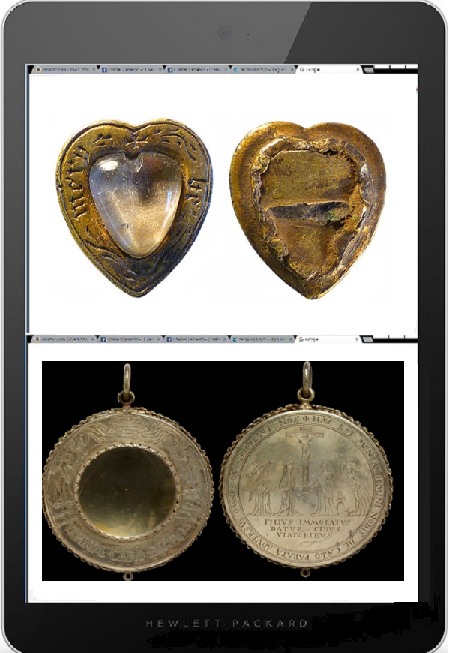
Two for your contemplation

**

It’s the second of these that really takes my breath away.

Recusants were the British subjects who remained Catholic in faith and practice at a time when the newfangled Protestantism made that behavior a heinous offence, punishable at times by death.

It has been the life and martyrdom of the Jesuit scholar and priest Edmund Campion in Elizabeth‘s reign and under her increasingly repressive laws — as Evelyn Waugh describes him in his book of that name — which engraved in me the heroic role of the recusants, and among them of their “massing priests” and the sacrament they brought to their faithful recusant remnant.

Michael Robinson notes in Newman’s Quest for the One True Church writes:

The Catholic majority did not submissively acquiesce to Elizabeth’s scheme. Much has been written of the fate of the priests, educated and ordained abroad, who were accused of treason, tortured, then hung, drawn and quartered; but as the Catholic Church went underground the laity also began to take enormous risks. Catholic gentry opened their stately homes up to the missionary priests. Escape routes were devised, with the diminutive Jesuit layman St. Nicholas Owen leading the way in ingenious acts of carpentry. He created hiding-holes for priests, their vestments and other liturgical items, that were so effective that centuries passed before some of them were discovered. In 1620 he died in the Tower of London under torture, taking his secrets with him.

Campion himself gets to the heart of the recusant matter, though, in the first salvo of his celebrated Brag — addressed before his capture to those who might capture him, the “Right Honourable, the Lords of Her Majestie’s Privy Council”:

I confesse that I am (albeit unworthie) a priest of ye Catholike Church, and through ye great mercie of God vowed now these viii years into the Religion of the Societie of Jhesus. Hereby I have taken upon me a special kind of warfare under the banner of obedience, and eke resigned all my interest or possibilitie of wealth, honour, pleasure, and other worldlie felicitie.

Waugh emphasizes, in turn, the significance of a priest as one who says Mass, ie whose sacramental act “in the person of Christ” continues the sacrifice of Christ on Calvary, turning the very bread and wine of the offering into the body and blood of Christ, while they retain their outward and physical form, following the words of Christ at the Last Supper:Take, eat; this is My body and Drink ye all of it; For this is my blood.

It was this transformation, this transubstantiation of bread into the very body, wine into the very blood of Christ, which so frightened and infuriated the Protestants. As Waugh notes:

Whatever the sectional differences between the various Anglican groups, they were united in their resolve to stamp out this vital practice of the old religion. They struck hard at all the ancient habits of spiritual life — the rosary, devotion to Our Lady and the Saints, pilgrimages, religious art, fasting, confession, penance and the great succession of traditional holidays — but the Mass was recognized as being both the distinguishing sign and main sustenance of their opponents

To be a priest, a Jesuit, and above all the great scholar Edmund Campion SJ, was to court death for treason. But the priest’s duty was to bring that sustenance, the blessed sacrament, to the faithful — and when they could not attend Mass, it could be carried to them in just such a silver box on a string as is illustrated above. This pyx, as it was called, would have carried the body of Christ to the needy, hidden on a chain under the shirt, and on pain of most painful and drawn out death.

It is for this reason that the recusant pyx, beautiful as it may be, means so much to me, and I hope to have conveyed something of that sense to you also: seldom if ever has a container carried a freight so exalted in service to a people so spiritually hungry, under so grave a threat.

**

But to relax a little…

The situation was fraught, and increasingly so, for those who remained loyal Catholics — and yet just as there were pockets of recusants still faithful to the old ways, there were pockets of allowance made for them in certain circumstances. Waugh puts it nicely:

In many places the priest would say Mass in his own house for the Catholics before proceeding to read Morning Prayer in the parish church; occasionally, it is said, he would even bring consecrated wafers and communicate his Catholic parishioners at thesame time as he distributed to the Protestants the bread blessed according to the new rite.

Thus also Queen Elizabeth I herself favored the composer William Byrd enough that he was able to compose not only works suited to the Protestants (Anglicans) such as his four Services, but also Masses for specifically Catholic use, in three, four, and five voices.

**

Byrd for Her Protestant Majesty, Queen Elizabeth:


The Nunc dimittis (Lord, now lettest thou thy servant depart in peace) from the Great Service

Byrd the faithful Catholic, for his fellow recusants:


The Agnus Dei from the Mass for five voices, Westminster Cathedral, Pope Benedict XVI celebrating

**

Sources:

  • Norfolk Heritage Explorer, June – Broken Heart
  • Annie Thwaite, Revelation and Concealment: Flipping the pyx
  • Pat Robertson & Orlando, just to be clear

    Sunday, June 12th, 2016

    [ by Charles Cameron — fict that aligns with expectation is more popular than fact that doesn’t, d’oh! ]
    .

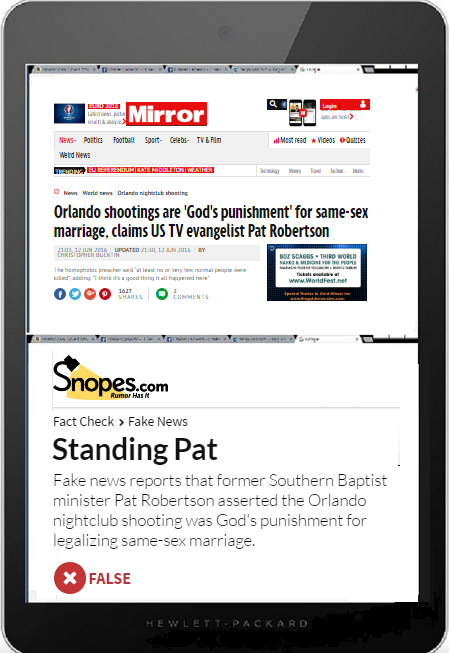
    Just so we’re clear about this, left, right, atheist, believer, whatever, let’s quash this rumor:

    DQ Robertson Snopes Orlando 600 75

    You may believe Pat Robertson said it, you may wish he had — but he didn’t, and I’m pretty sure Snopes knows better than the British tabloid The Mirror.

    Sources:

  • Mirror, Orlando shootings are ‘God’s punishment’ for same-sex marriage, claims .. Pat Robertson
  • Snopes, Standing Pat

  • Switch to our mobile site