[ by Charles Cameron — a matter of visual rhetoric, NYT’s Trump and Magritte ]
.
I’m intuiting that these two graphical representations somehow use the same visual logic to achieve their ends:
**
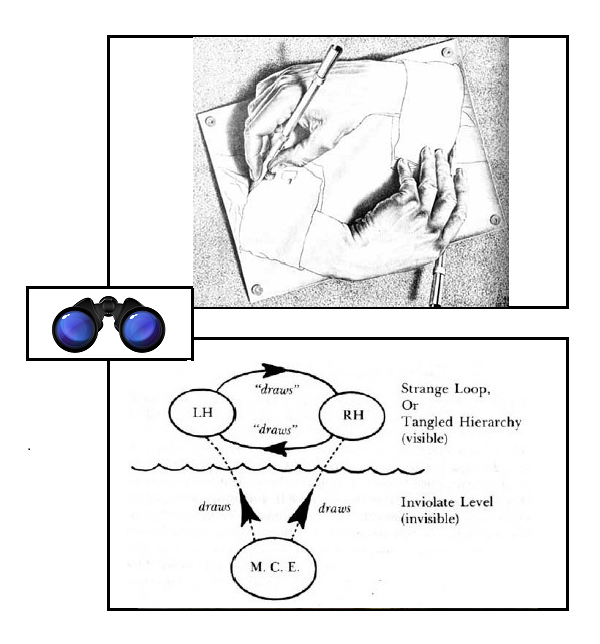
If I was more alert in some semi-defined sense, I’d be able to diagram them in a manner similar to that which Douglas Hofstadter uses to diagram the conceptual working of MC Escher‘s hands drawing hands —
— another brilliant ouroboros, for those who are keeping count!
**
How does “let not thy left hand know what thy right hand doeth:” fit into this (Escher) picture?
In 1942, 63% of public wanted to send interned Japanese nationals & Americans "back to Japan". 40% of public disapproved of Brown v Board. https://t.co/3XbW7vGFnG
Idiot wind, blowing like a circle around my skull,
From the Grand Coulee Dam to the Capitol.
**
The question interests me because there’s a back-level where the rhyme is in the concept, not the sound of the words as pronounced by poet or listener, reader — as with the rhyme womb / tomb, where before-birth and after-death meet both soncally and conceptually, making life freshly worthwhile as only the mechanics of poetry can.
Ginsberg explains:
Christopher Ricks, who has also penned books about T. S. Eliot and John Keats, argues that Dylan’s lyrics not only qualify as poetry, but that Dylan is among the finest poets of all time, on the same level as Milton, Keats, and Tennyson. He points to Dylan’s mastery of rhymes that are often startling and perfectly judged. For example, this pairing from “Idiot Wind,” released in 1975:
Idiot wind, blowing like a circle around my skull,
From the Grand Coulee Dam to the Capitol
The metaphorical relation between the head and the head of state, both of them two big domes, and the “idiot wind” blowing out of Washington, D.C., from the mouths of politicians, made this particular lyric the “great disillusioned national rhyme,” according to Allen Ginsberg.
Ginsberg’s tribute to that rhyme is one of the reasons he is here with Bob and Joan and the rest of the merry motley. It was, says Allen, “one of the little sparks of intelligence that passed between Bob and me and that led him to invite me on the tour.”
**
I caught the rolling thunder in Fort Collins:
**
Ah yes.
And If your memory serves you well is, as I recall via Google, Dylan’s top of the hat to Rimbaud‘s A Season in Hell, which opens with the words:
Jadis, si je me souviens bien, ma vie était un festin où s’ouvraient tous les cœurs, où tous les vins coulaient.
This Wheel’s On Fire, lyrics by that Nobel fellow, Rick Danko and the Band:
[ by Charles Cameron — witnessing the darkness, and the light shining in darkness ]
.
Curse and blessing, simultaneously, might be termed a mized blessing, ne?
Our understanding of Islam in relation to Christianity may be enhanced by a telling of the cursed, blest hehavior of Muslims in Mindanao, during the evacuation of the city of Marawi: curse and blessing are inextricably intertwined, the light shineth in darkness; and the darkness comprehended it not, the light shineth in darkness..
[ .. ] Islamist militants in black masks were stationed on bridges – the only way out of the besieged city of Marawi – looking for Christian hostages. A priest had already been kidnapped. Risking his own life, a local Muslim leader had hidden dozens of Christians in a rice mill.
“He was giving them an orientation,” said the city’s bishop, Edwin de la Peña. “How to respond to questions, to recite prayers, to wear their veils, how to say assalamu alaikum (peace be upon you).”
The plan worked, but others were not so fortunate, de la Peña said. “When they were asked if they were Christians, they said yes readily. So they were pulled out. And we just heard that they were killed and thrown down into a ravine.”
Residents of Marawi, on the Mindanao island of the Philippines, were fleeing a surprise takeover by fighters claiming to be Islamic State supporters. They left a burning cathedral and corpses in their wake.
Stories such as these of brutal sectarian bloodshed, but also selfless interfaith compassion, have rippled across the Philippines.
More than 160 civilians walked out of the besieged Philippines city of Marawi just after dawn on Saturday, deceiving Islamist fighters they encountered by hiding the identity of the many Christians among them. [ .. ]
“We saved ourselves,” said Norodin Alonto Lucman, a well-known former politician and traditional clan leader who sheltered 71 people, including more than 50 Christians, in his home during the battle that erupted on 23 May in the town of more than 200,000 on the southern island of Mindanao. “There’s this plan to bomb the whole city if Isis don’t agree to the demands of the government,” he said, referring to local and foreign fighters who have sworn allegiance to the ultra-radical Islamic State. [ .. ]
“We had a tip from the general commander that we should go out,” said Leny Paccon, who gave refuge to 54 people in her home, including 44 Christians. “When I got the text, immediately we go out … about 7 o’clock.”
By then, Lucman and his guests had begun their escape march from another area, holding white flags and moving briskly.
“As we walked, others joined us,” he told reporters. “We had to pass through a lot of snipers.”
Some of the civilians were stopped and asked if there were any Christians among them, said Jaime Daligdig, a Christian construction worker.
“We shouted ‘Allahu akbar’,” he told Reuters, adding that thanks to that Muslim rallying cry they were allowed to pass. [ .. ]
Christians have been killed and taken hostage by the militants, a mix of local fighters from the Maute Group and other Islamist outfits, as well as foreigners who joined the cause under the Islamic State banner. [ .. ]
Lucman said that many of those trapped were on the verge of starvation, which also gave them the courage to leave.
**
many of those trapped were on the verge of starvation, which also gave them the courage to leave.
There’s a close and provocative analogy there to the idea that darkness brings out the light, ne?
Zenpundit is a blog dedicated to exploring the intersections of foreign policy, history, military theory, national security,strategic thinking, futurism, cognition and a number of other esoteric pursuits.