zenpundit.com » 2017

Archive for 2017

Dank ponds and high places in the garden of forking paths

Sunday, April 16th, 2017

[ by Charles Cameron — Borges’ finest fiction, read with an eye to serpents within serpents ]
.

The pre-conscious mind, it seems to me, runs innumerable options before providing a single, first conscious selection, an initial thought, which we can then ourselves choose or dismiss, swaying away from whatever tendency we might dislike in that first choice, with alternatives then provided until we settle on a thought we can live with — whether because it suits our lust, our liking, our laughter, our love, or — simplest — love itself. The whole enterprise resembles, literarily speaking, Jorge Luis BorgesGarden of Forking Paths [link is to a deliciously annotated version, see more below].

But here’s the thing: my mind, at least, offers me quite a mixed bag of lascivious, laughing, light-hearted and level-headed options, all unbidden, and while the courteous Chinese gentleman in Borges’ fine short story would surely only have a selection of insights suitable for the Yellow Empereor among the branchings of his garden’s paths, and his maze of thoughts itself sums up to a transcendant mind, on the wider, non-literary world stage and usual human level there are some pretty dank pools of stagnant ideation to be found, and some skulls among the living that choose to harbor and indeed nourish those pools, hoping their poisonous atmosphere may prove contagious.

**

I am driven to these thoughts by a report from yesterday’s Sydney Morning Herald, Revealing the secrets of one of Australia’s worst online trolls.

Ordinarily I might have scanned this account of an online neo-Nazi and moved on, but it contains a built-in ourboros or snake biting its own tail, when the former pulp magazine editor who lost his job after being persecuted for his affinity with Nazi dolls, and who lived alone in a rooming house, self-published a novel featuring, and I quote, “a former pulp magazine editor who lost his job after being persecuted for his affinity with Nazi dolls, and who lived alone in a rooming house..”

Self-publishing is arguably a mildly neurotic ouroboric loop, but William Blake looped it, as did Martin Luther, Jane Austen, Emily Dickinson, Marcel Proust, and Edward Tufte, to name a few..

Self-publishing an autobiographical fiction, however, is more deeply loopy — for the ugly details, see the SMH piece.

Gloriously, Borges reaches as high as the neo-Nazi stoops low: some hope remains for humanity.

**

Annotation “o” in the annotated version of The Garden of Forking Paths mentioned above offers us a further — and specifically rhetorical — form of ouroboros to contemplate:

Linguists might classify the phrase “labyrinth of labyrinths” as an example of the genitive of gradation, as in the biblical “King of Kings,” from Daniel 2:37 (originally in Hebrew, “Melech ha-M’lachim”), I Timothy 4:14, and Revelations 17:14 and 19:16 (Curme, [6, p. 88]). Here the repetition of words conveys a sense of preeminence or superiority. A similar rhetorical device occurs earlier in line 30. But “centuries of centuries” might be more readily interpreted as a time span of hundreds of hundreds of years, constituting what is known as the partitive genitive, as in the “land of milk and honey.” Both usages are marvelously recursive, like “wheels within wheels,” and like the Thousand of One Nights, alluded to on line 230, which is a tale of a tale of a tale..

Wheels within wheels — indeed, tiny wheels in a footnote to a larger one — at which point we are back at Ezekiel and his vision of the dry bones, from which I derive my own username, hipbone.

**

Fscinatingly, certain equivalent pieces on opposing sides of xiangqi, the Chinese chess game of the sort Borges’ Ts’ui Pên would have played, have different names, though “pieces on the same row in the table below share the same move and ability”:

Their order of battle at the commencement of the game are as follows:
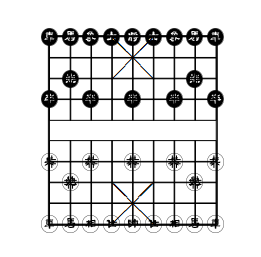
I’m grateful to Robert R. Snapp, Associate Professor of Computer Science at the University of Vermont, for his outstanding contribution to this (mostly) delightful romp through the forking gardens of ideas..

Happy Easter, with a Bach blessing

Sunday, April 16th, 2017

[ by Charles Cameron — from the heart, may it go to the heart, as Beethoven once said ]
.

Yesterday, Nicholas Kristof posed the question, President Carter, Am I a Christian? His subhead read, Christians celebrate Easter on Sunday. But wait — do we really think Jesus literally rose from the dead?

Here’s a taste:

NICHOLAS KRiSTOFF: How literally do you take the Bible, including miracles like the Resurrection?

PRESIDENT CARTER: Having a scientific background, I do not believe in a six-day creation of the world that occurred in 4004 B.C., stars falling on the earth, that kind of thing. I accept the overall message of the Bible as true, and also accept miracles described in the New Testament, including the virgin birth and the Resurrection.

KRiSTOFF: With Easter approaching, let me push you on the Resurrection. If you heard a report today from the Middle East of a man brought back to life after an execution, I doubt you’d believe it even if there were eyewitnesses. So why believe ancient accounts written years after the events?

CARTER: I would be skeptical of a report like you describe. My belief in the resurrection of Jesus comes from my Christian faith, and not from any need for scientific proof. I derive a great personal benefit from the totality of this belief, which comes naturally to me.

**

Et Resurrexit, from the Credo, Bach’s Mass in B Minor, performed by Akademie für Alte Musik Berlin under the baton of Daniel Reuss:

**

I guess I’m a reverse Bultmann: I don’t want to de-mythologize Christianity, I love to re-mythologize it.

If the Bible opened with the words, “Once upon a Time, God created the heavens and the earth..” and the Creed, “I make-beieve in One God, The Father Almighty..” we would still be in story, but no longer subject to the same kind of debate as to the historicity or dubiosity of the narrative’s claims. It’s a move that the literary critic Northrop Frye made on a more intimate scale when he called the Book of Revelation:

a fairy tale about a damsel in distress, a hero killing dragons, a wicked witch, and a wonderful city glittering with jewels”

I’m not interested in this move because it’s literary criticism; I’m interested in it because it rescues the great story corpus of our civilization from blind literalism on one side and blind debunking on the other.

**

Bach, I believe, in his towering Mass in B Minor — written by a fervent Lutheran to the Latin, hence Catholic, text of a rite he would have celebrated in Luther’s and his own native German — offers those who cannot believe the literal truth another avenue to experience the majesty of the ideation. This at least need not be disavowed by those leabving the faith, and may serve as a welcome portal to those entering it.

Wishing you a happy and blessed Easter, one and all..

Annunciation, framed

Monday, April 10th, 2017

[ by Charles Cameron — the war of content and context, Coptic / ISIS version ]
.

You are in a museum of the fine arts. You may recognize the painting is of the Annunciation.

You are in a church. The angel Gabriel announces to Mary that she will bear a son, and call his name Jesus:

He shall be great, and shall be called the Son of the Highest: and the Lord God shall give unto him the throne of his father David: And he shall reign over the house of Jacob for ever; and of his kingdom there shall be no end.

You are in a war zone: see, as much as you can see.

**

The photographer is in the war zone, catches a glimpse of the art, and takes the photo.

The returning devotee, I’d suggest, grieves the impact of war, pierces through and beyond it with his or her devotional gaze.

Mes Aynak, Afghanistan, the equation

Monday, April 10th, 2017

[ by Charles Cameron — a question of value ]
.

**

Footprints: Saving artefacts in Afghanistan

The Buddha rests quietly in a corner of the National Museum of Afghanistan.

While a group of Afghan restorers — with more than four decades of experience between them — work to restore similar artefacts, the Buddha, dating back to at least the second century BC, sits cross-legged, arms folded, awaiting its public debut in the city.

The statue, set to be unveiled to the public in the coming weeks, is a testament to the rich history of a nation that has seen various empires and conquerors pass through its land.

“There are artefacts in every corner of this country,” said Fahim Rahimi, the director of the National Museum of Afghanistan. However, even the layers of sand, silt and time have not been able to keep these artefacts safe from the forces of conflict and capitalism.

[ .. ]

The Buddha itself, discovered near the nation’s largest copper mine, is an embodiment of the duelling threats facing the physical remnants of Afghanistan’s cultural history. The statue, sitting in a reconstructed stupa, was found in 2012 in the Mes Aynak area of the eastern province of Logar. Mes Aynak, meaning literally “the little copper source,” is home to a 2,000-year-old Buddhist city filled with ancient statues, manuscripts, frescoes, shrines and stupas. It is also at the centre of a $3billion Chinese mining contract signed in 2007.

**

William Bruce My NameSake and presumed Clansman Cameron wrote “Not everything that can be counted counts, and not everything that counts can be counted.”

Equation implies equals. Here we have a tug of cash-and-peace.

Chag Pesach Sameach!

Monday, April 10th, 2017

[ by Charles Cameron — to all our Jewish readers, and thinking especially of Richard Landes in this season ]
.

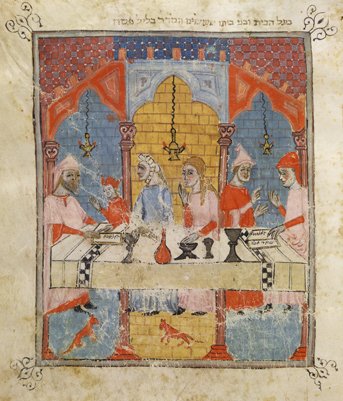
BL MS Oriental 2884 (early 14th-c Catalonia)

Wishing all a blessed Passover — with a hat-tip & illuminated greetings to Emily Steiner.


Switch to our mobile site