A Recommended Blog for Metacognition
A while back, I added Ribbonfarm to the blogroll, which is written by Dr. Venkat Rao, a corporate scientist type, after John Hagel featured in his twitterstream an old but amusing post by Rao analyzing sociopathology in corporate life via characters from The Office. Clever. I thought I would blogroll him and check in periodically.
Later, I noticed that Rao makes frequent references to Clausewitz in his posts and that he is writing Tempo, a book on decision making that will be of great personal and professional interest to many readers here. At this juncture, I’m intrigued.
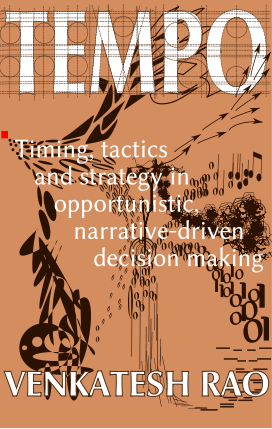
Then last week, Rao featured a lengthy post on metacognition where he made some excellent points. Here’s a few of them, but as I can only put up a small selection, you should go read the full post:
….To build mathematical models, you start by observing and brain-dumping everything you know about the problem, including key unknowns, onto paper. This brain-dump is basically an unstructured take on what’s going on. There’s a big word for it: phenomenology. When I do a phenomenology-dumping brainstorm, I use a mix of qualitative notes, quotes, questions, little pictures, mind maps, fragments of equations, fragments of pseudo-code, made-up graphs, and so forth.
You then sort out three types of model building blocks in the phenomenology: dynamics, constraints and boundary conditions (technically all three are varieties of constraints, but never mind that).
Dynamics refers to how things change, and the laws govern those changes. Dynamics are front and center in mathematical thought. Insights come relatively easily when you are thinking about dynamics, and sudden changes in dynamics are usually very visible. Dynamics is about things like the swinging behavior of pendulums.
Constraints are a little harder. It takes some practice and technical peripheral vision to learn to work elegantly with constraints. When constraints are created, destroyed, loosened or tightened, the changes are usually harder to notice, and the effects are often delayed or obscured. If I were to suddenly pinch the middle of the string of a swinging string-and-weight pendulum, it would start oscillating faster. But if you are paying attention only to the swinging dynamics, you may not notice that the actual noteworthy event is the introduction of a new constraint. You might start thinking, “there must be a new force that is pushing things along faster” and go hunting for that mysterious force.
This is a trivial example, but in more complex cases, you can waste a lot of time thinking unproductively about dynamics (even building whole separate dynamic models) when you should just be watching for changes in the pattern of constraints.
….Historians are a great example. The best historians tend to have an intuitive grasp of this approach to building models using these three building blocks. Here is how you can sort these three kinds of pieces out in your own thinking. It involves asking a set of questions when you begin to think about a complicated problem.
- What are the patterns of change here? What happens when I do various things? What’s the simplest explanation here? (dynamics)
- What can I not change, where are the limits? What can break if things get extreme? (constraints)
- What are the raw numbers and facts that I need to actually do some detective work to get at, and cannot simply infer from what I already know? (boundary conditions).
Besides historians, trend analysts and fashionistas also seem to think this way. Notice something? Most of the action is in the third question. That’s why historians spend so much time organizing their facts and numbers.
Nice. There’s a multitude of places here to jump off and generate further epistemic analysis, and I am sure that some of the admirers of Boyd, Polanyi, Wohlstetter, Feynman, Kahn and Clausewitz in the ZP readership might do so in the comments. Or my co-blogger Charles might weigh in from the imaginative/mythic/visual domain. We’ll see.
Regardless, I think if you are following blogs like Metamodern, Thomas P.M. Barnett, Open the Future, Global Guerrillas, John Hagel’s Edge Perspectives, Eide Neurolearning Blog or liked the old Kent’s Imperative (suddenly live again after being dormant for 2 years), you’ll want to consider adding Ribbonfarm to your RSS feed or blogroll.
ADDENDUM:
Ed at Project White Horse, another fine site for your blogroll, is also blogging on boundary conditions:
Stall, Spin, Crash, Burn and Die – Boundary Conditions for 2011
….You can’t fix things without some understanding, real understanding of the problem – nor can there be real leadership without actionable understanding. That’s where establishing boundary conditions as a vehicle to frame the problem – and therefore garner greater insight – become important.
Drilling for oil at a depth of 5000ft and in open ocean – Deepwater Horizon – should have been/should be seen as a “crisis” in waiting no matter the historical track record. Proper understanding would have meant that the National decision making level immediately recognized the high potential for the initial crisis migrating into a severely complex catastrophe after the explosion and acted, not waiting to see if BP’s response plans would work. Activities in “Blue Water”/open ocean are not a linear extrapolation from “inshore,” nor is 5000 ft a linear extrapolation from 200ft or 500ft. depths. BP’s plans might have been up to the problem, but the shear nature of the environment, if scrutinized in context of “unconventional” as described below, should have been a trigger to initiate intermediate action. Rather, the declaration of an Event of National Significance was 30+ days in coming??? A significant point, I believe, is the problem generated by not recognizing the nature or even acknowledging the existence of a different kind of problem, one potentially very complex or stochastic in nature – an “unconventional crisis.”



February 1st, 2011 at 6:29 pm
To be sure, Rao has the makings of a fine book. One common thread between Rao’s explanation and Ed’s is the commonality of "unknowns" in problem solving. Strictly speaking, the act of "knowing" there is a problem requires subject matter insight; and while this may seem apparent, it is not how many large organizations organize for problem solving. All too often, generalists rise to lead where someone more specialized might be more wise. The American nuclear submarine navy has wrestled with this issue for years; should command be split between an engineer who knows the propulsion plant and a guy who knows tactics (fights the ship) or should those responsibilities be vested in one person. The enormity of each role; nuclear engineer and master ship-handler-tactician is vested in a single person. I’ve watched a few of these guys up close and to a man they gravitate toward one discipline or the other (the familiar and comfortable have that affect); and this gravitation is a boundary condition of sorts, for intimacy with one means the exclusion of the other–call it a boundary of passionate interest/disinterest. Christ said man can’t serve two masters, and I’ve often wondered how this paradigm of leadership would play-out if we had to fight our submarines regularly. .It is no small feat successfully know and have the ability to deal with boundaries, as boundaries often have the nasty habit of having precipitous edges, which once passed changes completely and irrevocably the dynamics of the problem(s) (ref: Ed’s use of Deepwater Horizon). Hope sincerely others put an oar in the water on this thread, for there is much to explore.
February 2nd, 2011 at 4:51 am
Hi Scott,
.
"the commonality of "unknowns" in problem solving"
.
Yes. One reason for my admiration of theoretical physicists is the immense difficulty of the problems with which they wrestle – where *recognition* of the real significance of the phenomena may be as big an obstacle as comprehending it. Our brains are not wired from evolution to grasp the quantum and cosmic scales readily, we may not be framing the questions right for, say, string theory to reach a point where experimentalists can test.
.
Regarding generalists-specialists and two masters, I tend toward seeing positions/perspectives/methodologies as tools or lenses at the same time. There might be two or three "good" approaches to solving a problem and one "best" approach but it helps to look at a problem from many perspectives, even if they are tangential or not practically applicable. We should be ready, when stymied, to step back, abandon our cherished assumptions, and try something different or novel. Some problems are solved at a reasonable cost only by superceding the original problem set entirely.
February 2nd, 2011 at 4:06 pm
Hi Zen, It occurred to me last night that I "knew" what I was talking about in the post above, but didn’t explain (and I’m not sure I can). The distinction I was attempting to make above was that of a deep expert vs. a generalist. Experts are distinguished because they have the ability to detect nuance—the implication in the example of above is truly life or death. So from a metacognition perspective, what would be the boundary conditions of nuance, or the distinguishing characteristic of an expert vs non-expert? That may be a nutty question, but fascinates me only for the extremity of the view/the either/or, as it were. It is the short distance between "knowing" and not "knowing."