[ by Charles Cameron — this will surely encourage Comey to be forthcoming on Thursday ]
.
From Clapper‘s stunning speech at the Australian National Press Club:
Comaring Watergate with the current crisis:
I lived through Watergate. I was on active duty then in Air Force, I was a young officer. It was a scary time. It was against the backdrop of the post Vietnam trauma as well which seemed, at least in my memory, amplified as a backdrop, amplified the crisis in our system with Watergate. I have to say, though, I think you compare the two that Watergate pales really in my view compared to what we’re confronting now.
Sources of concern:
I am very concerned about the assault on our institutions coming from both an external source — read Russia — and an internal source, the President himself.
Paranoia and the dossier:
Clapper said he sensed “extreme paranoia” in Trump during his interactions with the new president, and lamented Trump’s stance toward the U.S. intelligence community in particular.
*
“Then President-elect Trump disparaged the intelligence community’s high-confidence assessment of the magnitude and diversity of this Russian interference that I just described by characterising us as Nazis,” he said.
“This was prompted, I found, I realised later, by his and his team’s extreme paranoia about and resentment of any doubt cast on the legitimacy of his election which, of course, our assessment did.”
*
Clapper claimed that when he called Trump to talk about intelligence, the president asked him to disavow the controversial intelligence dossier that claimed Russia had compromising material on Trump.
“I tried, naively as it turned out, to appeal to his higher instincts by pointing out that the US intelligence community that he was about to inherit is a national treasure in our country and that the people in it were committed to supporting him and making him successful. Ever-transactional, he simply asked me to publicly refute the infamous dossier which I couldn’t and wouldn’t do,” Clapper said.
Clapper said he sensed “extreme paranoia” in Trump during his interactions with the new president, and lamented Trump’s stance toward the U.S. intelligence community in particular. Clapper claimed that when he called Trump to talk about intelligence, the president asked him to disavow the controversial intelligence dossier that claimed Russia had compromising material on Trump.
“His subsequent actions, sharing sensitive intelligence with the Russians and compromising its source, reflect either ignorance or disrespect and either is very problematic.”
Firing Comey:
“Certainly the whole episode with the firing of Jim Comey, a distinguished public servant, apart from the egregious inexcusable manner in which it was conducted, reflect complete disregard for the independence and autonomy of the Federal Bureau of Investigation, our premiere law enforcement organisation.”
Trustworthy in the Administration:
He observed there were people in the administration who could be trusted – nominating Jim Mattis, the defence secretary, John Kelly, the homeland security chief, and HR McMaster, the national security adviser. “They have understanding and respect for our institutions,” he said.
Smoking gun:
“Is there a smoking gun with all the smoke? I don’t know the answer to that. I think it’s vital, though, we find that out.
Upcoming Comey testimony:
Mr Clapper pointed to the possibility of further damaging revelations when James Comey, the former FBI director sacked by Mr Trump, gives evidence on allegations of Russian interference in US politics before a congressional hearing Thursday, Washington time.
“I think it will be very significant to see both what he says and what he is asked about and doesn’t respond to,” said Mr Clapper.**
**
My sources and more:
It is to be regretted that neither a complete video nor a complete transcript of this major speech is readily available as yet, except perhaps in Australia. I have made this compilation as well as I coud, working from some of the following sources:
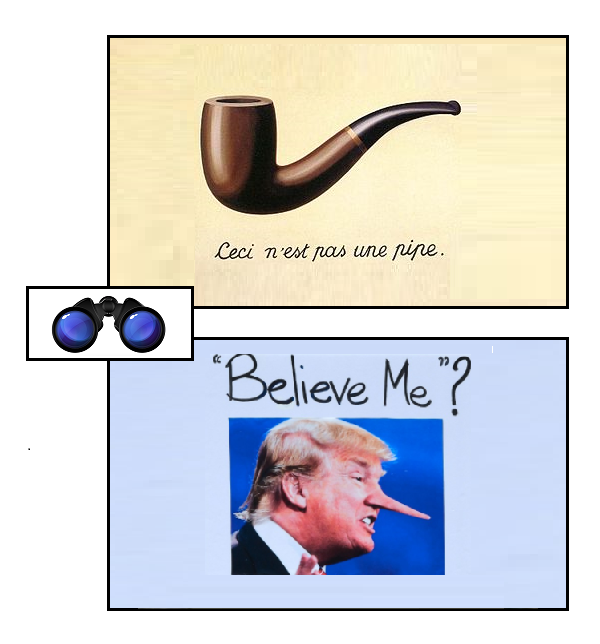
[ by Charles Cameron — a matter of visual rhetoric, NYT’s Trump and Magritte ]
.
I’m intuiting that these two graphical representations somehow use the same visual logic to achieve their ends:
**
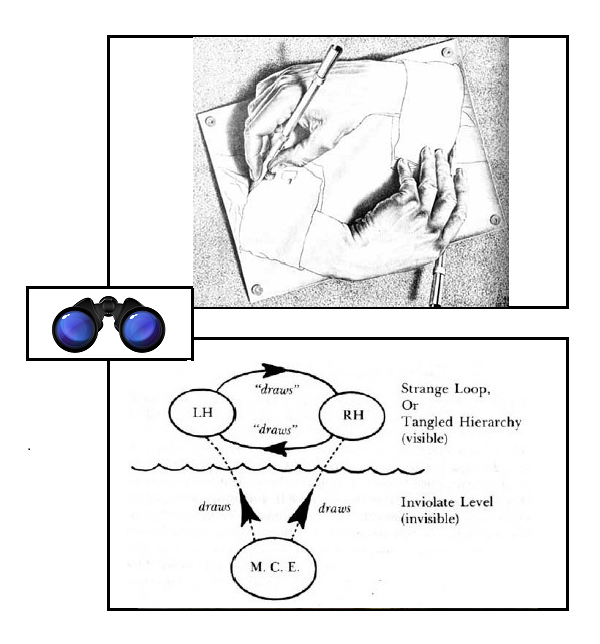
If I was more alert in some semi-defined sense, I’d be able to diagram them in a manner similar to that which Douglas Hofstadter uses to diagram the conceptual working of MC Escher‘s hands drawing hands —
— another brilliant ouroboros, for those who are keeping count!
**
How does “let not thy left hand know what thy right hand doeth:” fit into this (Escher) picture?
In 1942, 63% of public wanted to send interned Japanese nationals & Americans "back to Japan". 40% of public disapproved of Brown v Board. https://t.co/3XbW7vGFnG
Idiot wind, blowing like a circle around my skull,
From the Grand Coulee Dam to the Capitol.
**
The question interests me because there’s a back-level where the rhyme is in the concept, not the sound of the words as pronounced by poet or listener, reader — as with the rhyme womb / tomb, where before-birth and after-death meet both soncally and conceptually, making life freshly worthwhile as only the mechanics of poetry can.
Ginsberg explains:
Christopher Ricks, who has also penned books about T. S. Eliot and John Keats, argues that Dylan’s lyrics not only qualify as poetry, but that Dylan is among the finest poets of all time, on the same level as Milton, Keats, and Tennyson. He points to Dylan’s mastery of rhymes that are often startling and perfectly judged. For example, this pairing from “Idiot Wind,” released in 1975:
Idiot wind, blowing like a circle around my skull,
From the Grand Coulee Dam to the Capitol
The metaphorical relation between the head and the head of state, both of them two big domes, and the “idiot wind” blowing out of Washington, D.C., from the mouths of politicians, made this particular lyric the “great disillusioned national rhyme,” according to Allen Ginsberg.
Ginsberg’s tribute to that rhyme is one of the reasons he is here with Bob and Joan and the rest of the merry motley. It was, says Allen, “one of the little sparks of intelligence that passed between Bob and me and that led him to invite me on the tour.”
**
I caught the rolling thunder in Fort Collins:
**
Ah yes.
And If your memory serves you well is, as I recall via Google, Dylan’s top of the hat to Rimbaud‘s A Season in Hell, which opens with the words:
Jadis, si je me souviens bien, ma vie était un festin où s’ouvraient tous les cœurs, où tous les vins coulaient.
This Wheel’s On Fire, lyrics by that Nobel fellow, Rick Danko and the Band:
Zenpundit is a blog dedicated to exploring the intersections of foreign policy, history, military theory, national security,strategic thinking, futurism, cognition and a number of other esoteric pursuits.