zenpundit.com

Pilgrim visas, the Hajj, and MERS-CoV

June 11th, 2013

[ by Charles Cameron — it’s all a matter of concentric circles and the integration of the vertical — ibn Arabi ]
.


.

The concentric circles around the Kaaba ripple out across our world. This means we should be watchful at the intersection of three overlapping regions in a Venn diagram: pilgrim visas, MERS-CoV epidemiology, and pilgrim dispersal.

John Burgess of Crossroads Arabia is the only one I know focusing on the conjunction, see his Saudis Restrict Pilgrim Visas.

The point I’d like to be hinting at here is that whereas MERS-CoV epidemiology is a scientific monitoring and interpretive matter using Science Rules, and visa issues are mostly matters of bureaucracy, the Hajj itself is a matter of the most passionate devotional concern, and a “purely rational” understanding will hardly scratch its surface.

**

Those with a mixture of poetry and scholarship in their souls may wish to read Love Letters to the Ka’ba: a presentation of Ibn ‘Arabi’s Tâj al-Rasâ’il to glimpse the Kaaba as seen by the al-Sheikh al-Akbar, Muhyiddin ibn Arabi:

Charles-Andre Gilis has pointed out that in the Islamic tradition the Ka’ba symbolises the centre of every state of Being, as is demonstrated by the tradition recorded by Ibn ‘Abbas according to which there exists a Ka’ba, similar to the one belonging to our world, in each of the seven heavens and seven earths (cf. La Doctrine Initiatique du Pélerinage, Paris, 1982, pp. 45-6). In the introduction to the Tâj, Ibn ‘Arabi refers to the Visited House (al-bayt al-ma’mûr), situated in the seventh heaven, the celestial prototype of the Ka’ba (p. 557).

As Gilis also observes, the Ka’ba is perceived by Ibn ‘Arabi as a manifestation of the divine Essence (Tâjallî dhâtî). However, he situates it, due to its mineral nature, in the lowest level of Being. But it is precisely the inferior character of its external aspect that allows it to sustain the ladder of beings and to identify itself on each level. It is thus described as “celestial constitution, angelic reality, young girl with formed breasts, level of the perceptible realm, and Meccan dignity (at the same time this constitutes an excellent example of the assonances of his rhymed prose: nash’a falakiyya wa haqîqa malakiyya wa jâriya falkiyya wa martaba mulkiyya wa rutba makkiyya) (p. 555).” Ibn ‘Arabi himself is astonished at the number of contradictory aspects that this being is able to bring together: “Oh marvel: divine constitution, simil (mithliyya), angelic, human, superior and inferior in which we find validity and deficiency, multiplicity and scarcity.” (p. 556)

The devotional aspect of the Hajj is orthogonal to the realism of bureaucracies and epidemiology — but not on that account any the less powerful!
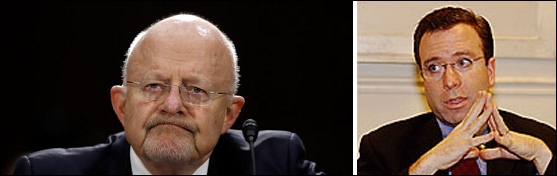
On, or Of?

June 11th, 2013

[ by Charles Cameron — always trying to read with care, not always succeeding — NSA ]
.

Dana Milbank in WaPo yesterday:

Sen. Ron Wyden (D-Ore.) asked Clapper at a Senate hearing in March, “Does the NSA collect any type of data at all on millions or hundreds of millions of Americans?”

“No, sir,” Clapper testified.

“It does not?” Wyden pressed.

“Not wittingly. There are cases where they could inadvertently, perhaps, collect, but not wittingly.”

We now know that Clapper was not telling the truth. The National Security Agency is quite wittingly collecting phone records of millions of Americans, and much more

Is there a signikficant distinction to be made between collecting data ON millions of Americans, and collecting phone records OF them?

Does OF mean pertaining to, and ON mean about?

Dateline, June 5th 2012

June 10th, 2013

[ by Charles Cameron — screengrabs from a very recently posted video, mostly Taliban with just a smidgeon of NSA ]

[edited to add: please see warning in comment below]
.

Scary, hunh? Yeah?

**

No, this is not from a NSA / Prism video — I’ll have just a little more on that topic later.

Nor is it from your local mafiosi

In fact, it’s from the Islamic Emirate of Afghanistan

i.e the Afghan Taliban.

And it’s addressed to Saakashvili and the people of Georgia (FSU), telling them:

and:

**

What interests me here is this: I tend to think of the Islamic Emirate as mainly Afghanistan-centric, so viewing this video I wondered whether they’ve announced similar intent to raid or attack other nations. Alex Strick van Linschoten responded to my query as to whether he’d seen this sort of message before:

He also pointed me to his book, An Enemy We Created: The Myth of the Taliban-Al Qaeda Merger in Afghanistan, where (p. 277 in my uncorrected proof) we read:

It was around this time that Dadullah started to make increasingly strident statements of support for a global jihad, one in which attacks in Europe and the United States were not to be ruled out.101 Dadullah was, in contrast to most other Talibs of his generation, a ‘true believer’ in this rhetoric. Some commentators have suggested this is pathological, but a possible explanation can be found in the time he spent with foreign jihadis both on the northern fronts during the 1990s as well as post-2001, when he was in South Waziristan. He was frequently used as a go-between for the Taliban in Pakistan and retained ties to the foreign al-Qaeda affiliates as well.

So this kind of thing is not entirely unknown, and indeed “revenge” strikes outside Afghan territory would fit the model Dadullah himself proposed for strikes within Afghanistan (pp. 273-73):

Our tactics now are hit and run; we attack certain locations, kill the enemies of Allah there, and retreat to safe bases in the mountains to preserve our mujahidin. This tactic disrupts and weakens the enemies of Allah and in the same time allows us to be on the offensive. We decide the time and place of our attacks; in this way the enemy is always guessing.

Mullah Dadullah died in 2007, but it seems his thinking still exerts some influence…

** ** **

And NSA — or Nonesuch as I was taught to call it, back in the day?

I stand by the idea I tweeted to JM Berger yesterday:

I’d only add that three days doesn’t seem long enough in this case, and that when the dust settles we may still find ourselves holding just a few loose ends of a multiply-tangled web…

The dervish and the gas mask

June 10th, 2013

[ by Charles Cameron — wall art, sufism and poetry in Istanbul ]
.


.

I wasn’t altogether sure, when Zeynep Tufekci tweeted a stenciled image of a whirling dervish (above, right) the other day, that the dervish was in fact wearing a gas mask. Just the fact that the dervish was showing up on a wall during the events in Turkey was interesting to me — and all the more so since Zeynep pointed out that the accompanying slogan Sen de GelCome, Come Whoever you are is from Jalaluddin Rumi, the great Sufi poet and founder of the Mevlevi order of whirling dervishes.

As the photo of a dervish whirling in the park (above, left) shows, however — and I only saw it today — the stencil is indeed the iconization — in protest art — of a dervish in gas mask in real-time Istanbul.

There’s insight to be had there.

**

The version of Rumi’s poetry that I first ran across lo these many years ago, and to which I return:

AJ Arberry, tr, Mystical Poems of Rumi 1
AJ Arberry, tr, Mystical Poems of Rumi 2

Rumi’s prose:

AJ Arberry, tr, Discourses of Rumi

Rumi’s poetry in the versions that have made this thirteenth century Afghan-born, Persian-speaking resident of Turkey “the best-selling poet in America”:

Coleman Barks, Rumi: The Big Red Book

Rumi’s life, as told within Sufi tradition:

Idries Shah, The Hundred Tales of Wisdom

Rumi’s life, teachings and poetry, in contemporary context:

Franklin D. Lewis, Rumi: Past and Present, East and West

Rumi explored with scholarship and depth:

Anne-Marie Schimmel, The Triumphant Sun
Anne-Marie Schimmel, Rumi’s World
William C Chittick, The Sufi Path of Love
Fatemeh Keshavarz, Reading Mystical Lyric

**

Come, Come Whoever you are

Recommended Reading

June 10th, 2013

Top Billing! The Guardian Glenn Greenwald – NSA collecting phone records of millions of Verizon customers daily , The National Security Agency: surveillance giant with eyes on AmericaNSA Prism program taps in to user data of Apple, Google and othersBoundless Informant: the NSA’s secret tool to track global surveillance dataEdward Snowden: the whistleblower behind the NSA surveillance revelations 

Have to say, I never in a million years expected to ever give Glenn Greenwald a “top billing”. I have often, for example, disagreed very strongly on how he has characterized (or, in my view, mischaracterized) the application of the laws of war about US actions toward al Qaida and the Taliban and I still do. It must be said however, that Greenwald has at least always been scrupulously consistent in his criticism when most other pundits were not; and secondly, with the NSA, Greenwald has broken one of the most important stories of the year.

Credit where credit is due.

Haft of the Spear  –140+ Ed Snowden Edition 1.0 

….His Insight. See comment about “context” above. Snowden is not a trained case officer or interceptor, or analyst. In being able to understand how what he had access to fit into the big scheme of things, he’s a lot more bottom-of-the-pyramid Manning than top of the pyramid Ellsberg.

T. Greer  – America 3.0 

It is unusual for me to read a book aimed at popular conservative audiences.  I am something of a disaffected conservative. Crony capitalism and government overreach have proved to be bipartisan endeavors, and I have long lost faith that the Republican party can ever be more than an organ of America’s governing elite. [1] Outside of the beltway the broader currents of mainstream conservatism are so full of angry sound and righteous fury (and nothing else) that I have long stopped paying close attention them. The movement is in desperate need of a clearer vision and more compelling purpose. 

 America 3.0 is the book to provide it. 

 James Bennet and Michael Lotus get everything right that all of the other popular commentators get wrong. In contrast to pundits incessantly focused on the character flaws of the opposition and controversies of the hour, these authors focus on the broad political principles and broad political context – “centuries into the past and decades into the future” (xxv).  Where most popular political creeds are shallow, filled more with hype and platitudes than meaningful evidence, America 3.0 is both respectful in tone and deeply researched (and none the less readable for it!). Few popular political works have any real historical grounding;  America 3.0 possesses this in spades. Even more impressively, the authors manage to convey both their sense of history and their firm belief in American exceptionalism without any of the reflexive chest-pounding sometimes mistaken as patriotism in conservative corners. (As they write in the introduction, “We are attempting to avoid setinmentalility in this book, and look at the record in a cold light. As we write things are not good in America. Being realistic is a matter of urgency (xxiv).”) Most impressive of all is the political platform they lay out. In age where conservatives are too often defined by what they are againstAmerica 3.0 paints a compelling picture of what they should be for.

All in all, a breath of fresh air. 

Nuclear Diner (Rofer) –What Makes a Whistleblower? 

….Daniel Ellsberg exemplefies the last kind of whistleblower. He shared the government’s documents on the Vietnam war that showed that the government’s public claims were lies. Combine that with the investigative journalism of Bob Woodward and Carl Bernstein on Watergate, and you have today’s high journalistic myth, that the press will out government wrongdoing with the help of whistleblowers. We now know that the person who took the chances to out Watergate was Mark Felt, whose identity was long hidden.

Both Ellsberg and Felt wanted to get the truth out. Ellsberg’s motives were honorable, to inform the public. Felt may have been motivated more by office politics. There are an enormous number of motives that someone may have for leaking information. What all the motives have in common is that hardly ever will the leaker be completely honest about his motives; he may not even be conscious of all his motives.

Edward Luttwak – Nukes: Why is Iran different?


Regime security for an ideological state

Abu Muqawama (Elkus) How Not to Argue about Women in Combat 

A brutal Fisking

SWJ – Political Violence Prevention: Profiling Domestic Terrorists  

It comes out a lot like you would expect

Dart Throwing Chimp –How Social Science Is Like Microbiology 

The Ecological paradigm

Duck of Minerva (Nexon) –New Podcast: Interview with Patrick James 

Middle-Earth in IR theory…..

Not the Singularity (Morris) Security expert Bruce Schneier on NSA and why we need whistleblowers

Austin Bay – Protests Change Turkey’s Political Landscape: A Report From Istanbul 

Victor Davis Hanson -Why Some Wars Are So Savage 

That’s it.


Switch to our mobile site

