— shows on the right, the Lovers of Valdaro — a matched pair of skeletons of which Time wrote in 2011:
For 6,000 years, two young lovers have been locked in an eternal embrace, hidden from the eyes of the world. This past weekend, the Lovers of Valdaro — named for the little village near Mantua, in northern Italy, where they were first discovered — were seen by the public for the first time.
On the left, you have an artist’s representation of how they might have been embraced in death.
**
All of which reminds me of Buddhist meditation on death, and of the dancing skeleton couple known collectively as Citipati:
Citipati is a protector deity or supernatural being in Tibetan Buddhism and Vajrayana Buddhism of India. It is formed of two skeletal deities, one male and the other female, both dancing wildly with their limbs intertwined inside a halo of flames representing change. The Citipati is said to be one of the seventy-five forms of Mahakala. Their symbol is meant to represent both the eternal dance of death as well as perfect awareness. They are invoked as ‘wrathful deities’, benevolent protectors or fierce beings of demonic appearance. The dance of the Citipati is commemorated twice annually in Tibet.
**
Considering two together as one is a recurring interest of mine, see also my posts on duel and duet — themselves a great pairing or dual — in Duel in slow time and more prosaically, Numbers by the numbers: two.
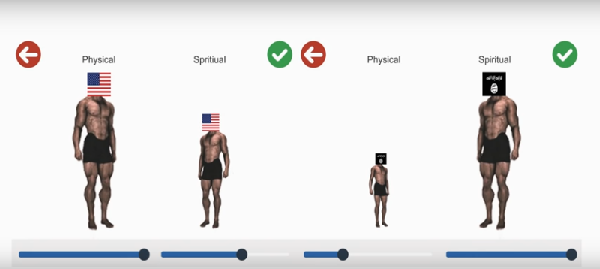
Our research with fighters shows that the US Government’s judgement is fairly mistaken about underestimating ISIS and overestimating the armies against it, because it denies th4e spiritual dimension of human conflict. Three critical factors are involved: sacred values and devotion to the groupz people are fused with; willing to sacrifice family for values; and perceived spiritual formidability. For example, among fighters on both sides in Iraq and Syria, they rate America’s physical force maximum but spiritual force minimum, and ISIS’ physical force minimum but spiritual force maximum. But – they also think material interests drive America but that spiritual commitment drives ISIS. The spiritual trumps physical force when all things are equal.
[ by Charles Cameron — tiger swats mechanical mosquito, also ontology and metaphor ]
.
I recently reported on eagles in training to take down drones in Next up — the anti-eagle drone — here’s video to go with that report..
and here’s video of tigers similarly employed to pair with that eagle video, making a fine YouTube DoubleQuote:
**
Thoreau describes the (newfangled) train in Walden, using an animal metaphor:
When I meet the engine with its train of cars moving off with planetary motion … with its steam cloud like a banner streaming behind in gold and silver wreaths … as if this traveling demigod, this cloud-compeller, would ere long take the sunset sky for the livery of his train? when I hear the iron horse make the hills echo with his snort like thunder, shaking the earth with his feet, and breathing fire and smoke from his nostrils, (what kind of winged horse or fiery dragon they will put into the new Mythology I don’t know), it seems as if the earth had got a race now worthy to inhabit it.
We have nature, and we have nurture — but new tech hardly fits in either category. When a new tech arises, initially, it’s readily assimilated to an animal, ie a form of nature — as in my equation of drone and mosquito in the header to this post.
And drone? What kind of name is that? As near as I can judge, the mechanical usage derives from the same term used to describe a male bee.
**
Okay, we might as well close with a quote from Thoreau’s friend Emerson, offering an intriguing ontology of means of transport, the natural and technological included — with an eagle this time on the receiving end of hunting..
Man moves in all modes, by legs of horses, by wings of winds, by steam, by gas of balloon, by electricity, and stands on tiptoe threatening to hunt the eagle in his own element.
[ by Charles Cameron — concerted: in which a single voice should be heard in contrast with others ]
.
Having said all that I did about bridge-building, and respectfully hearing and annotatimg both sides in a highly divisive environment, I have another issue, another question.
When is it time for the peace-maker to take a side?
Since the start of the Cold War some 70 years ago, Americans have been aware of a crazy thing about the holder of the Presidency. That person could blow up the world. The possibility of nuclear annihilation changed the institution by introducing new psychological facts to the relationship between the American people and the occupant of the White House. And, we should add, between the publics of other nations and the American President. For this was a terrible power to invest in one man.
And taking things a step further — is the world at serious risk of major nuclear war with Donald Trump in the Presidency? If so, should the peace-makers and bridge-makers take issue with him? And how? With what stratagems? And in what tone of voice?
[ by Charles Cameron — counterpoint: giving all voices a fair hearing. even when conflicting ]
.
I try to avoid taking political sides in American politics, partly because I’m a guest here and it seems only polite and wise to leave such matters to my hosts, and partly because bridge-building is the therapeutic method of choice in times of division and conflict. Keeping to a middle path may be something of a high-wire act, though, and is seldom popular wit those on either side.
**
I went looking for a quote that expresses the idea that this kind of middle way can get you killed, and my friends offered me a variety of possible items including Jim Hightower saying:
There’s nothing in the middle of the road but a yellow stripe and dead armadillos.
At the Liberation, he wrote (in Arthur Goldhammer’s translation):
Now that we have won the means to express ourselves, our responsibility to ourselves and to the country is paramount. . . . The task for each of us is to think carefully about what he wants to say and gradually to shape the spirit of his paper; it is to write carefully without ever losing sight of the urgent need to restore to the country its authoritative voice. If we see to it that that voice remains one of vigor, rather than hatred, of proud objectivity and not rhetoric, of humanity rather than mediocrity, then much will be saved from ruin.
Responsibility, care, gradualness, humanity—even at a time of jubilation, these are the typical words of Camus, and they were not the usual words of French political rhetoric. The enemy was not this side or that one; it was the abstraction of rhetoric itself. He wrote, “We have witnessed lying, humiliation, killing, deportation, and torture, and in each instance it was impossible to persuade the people who were doing these things not to do them, because they were sure of themselves, and because there is no way of persuading an abstraction.”
and the most scriptural from Scott McW, Revelation 3.14-16:
And unto the angel of the church of the Laodiceans write; These things saith the Amen, the faithful and true witness, the beginning of the creation of God; I know thy works, that thou art neither cold nor hot: I would thou wert cold or hot. So then because thou art lukewarm, and neither cold nor hot, I will spue thee out of my mouth.
John Messer catches the perspective I’m coming from when he comments:
One limitation perhaps is our framing of the challenge as a dichotomy rather than a 360 POV or perhaps a sphere of alternatives. In mediation one always looks for the unifying value that embraces all.
It seems harder and harder to present both sides of en ever-more-violently polarized situation without taking fire from each side — so I’d ask you to read what follows (and my posts on similar topics) as attempts at that unifying balance, rather than as statements of my own preferences.. which do exist, and no doubt can be glimpsed, but are not what I’m trying to propagate with my writings, at least thus far..
**
Consider these two opinions of Trump aide Sebastian Gorka — each the opinion of a valued friend:
It was F Scott Fitzgerald who said, “The test of a first-rate intelligence is the ability to hold two opposed ideas in the mind at the same time, and still retain the ability to function.”
Is there any room for a first-rate intelligence any more?
**
Or consider this juxtaposition as a DoubleQuote expression of a parallelism between Trump and Hitler:
The two phrases are indeed close parallels –n but obviously the Nazi analogy is one that (a) members of the never Trump faction feel a strong urge to explore, and (b) which is liable to close the ears of the pro Trump faction to any logic it might possess.
How do we hear both sides of so fraught an issue?
**
How do we retain awareness of that superbly humble and nuanced insight of Aleksandr Solzhenitsyn?
If only there were evil people somewhere insidiously committing evil deeds, and it were necessary only to separate them from the rest of us and destroy them. But the line dividing good and evil cuts through the heart of every human being. And who is willing to destroy a piece of his own heart?
.
During the life of any heart this line keeps changing place; sometimes it is squeezed one way by exuberant evil and sometimes it shifts to allow enough space for good to flourish. One and the same human being is, at various ages, under various circumstances, a totally different human being. At times he is close to being a devil, at times to sainthood. But his name doesn’t change, and to that name we ascribe the whole lot, good and evil.
Zenpundit is a blog dedicated to exploring the intersections of foreign policy, history, military theory, national security,strategic thinking, futurism, cognition and a number of other esoteric pursuits.
By Wonderlane – https://www.flickr.com/photos/wonderlane/3172647615/in/photostream/, CC BY 2.0, Link