[ by Charles Cameron — it’s what we won’t notice that can blindside us ]
.
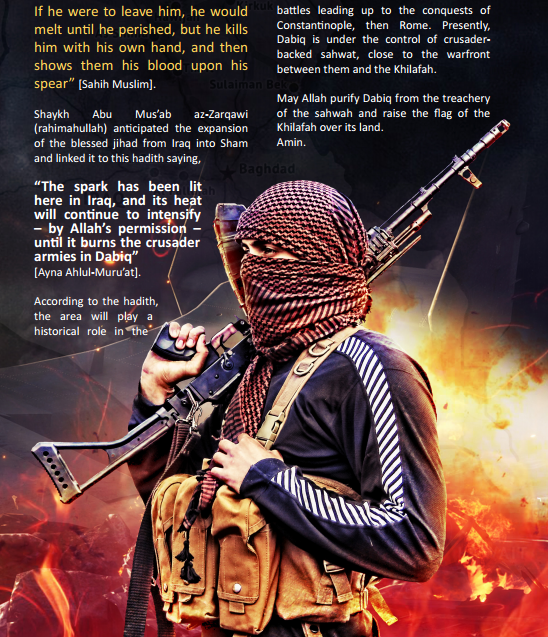
al-Malhamah al-Kubra, the great end-times battle
**
To recapitulate: in my previous post I suggested that “apocalyptic, end-of-days” movements are qualitatively different by virtue of the immediacy of their divine / transcendant mandate. Richard Landes sums the matter up nicely in his book Heaven on Earth: The Varieties of the Millennial Experience:
For people who have entered apocalyptic time, everything quickens, enlivens, coheres. They become semiotically aroused — everything has meaning, patterns. The smallest incident can have immense importance and open the way to an entirely new vision of the world, one in which forces unseen by other mortals operate. If the warrior lives with death at his shoulder, then apocalyptic warriors live with cosmic salvation before them, just beyond their grasp.
**
Here’s my concern, having lived a while in Malibu — and once watched on a friend’s TV in Santa Monica as a fire that had leapt the Ventura Freeway and swept down towards the Malibu Colony – rerouted by the fire service to go down the sparsely inhabited Corral Canyon, where as it happened I then lived..
Brush fires.
The human terrain is dry tinder, not yet ablaze – but a spark will ignite it, and the blaze then spread “like wildfire”.
The problem here is that we are far more disposed to read surfaces than undercurrents, news articles than the comments beneath them, what’s happening than what’s primed to happen, kinetic rather than potential energies. And so when potential goes kinetic, we are blindsided, caught off guard, faced with events we then characterize in retrospect as “unanticipated” — even though a little observation of what’s stirring below the surface would have allowed us to anticipate them…
What’s the equivalent, in contemporary Islamic terms, of dry underbrush of the sort that can suddenly ignite?
An expectation of the Mahdi’s coming – present enough in AQ some years back that AQ Central issued a caution against its people making premature claims concerning the Mahdi; present in IS but distanced by the possibility of a sequence of Caliphs preceding the Mahdist moment [cf McCants, Appendix 4]; and overall present to a considerable degree in the Islamic countries Pew polled in 2012:
The survey also asked respondents about the imminence of two events that, according to Islamic tradition, will presage the Day of Judgment: the return of the Mahdi (the Guided One who will initiate the final period before the day of resurrection and judgment) and the return of Jesus. .. In nine of the 23 nations where the question was asked, half or more of Muslim adults say they believe the return of the Mahdi will occur in their lifetime, including at least two-thirds who express this view in Afghanistan (83%), Iraq (72%), Turkey (68%) and Tunisia (67%).
A qualification is in order here. The British scholar Damian Thompson has shown in his remarkable study, Waiting for Antichrist, that it is possible for people to express expectation of a messianic “soon coming”– and still save for the college tuition of children who would presumably arrive at college age during the epoch of the “new heaven and new earth”. Expressing expectation, then, in a soon-coming Mahdi as much as a soon-coming Christ, does not necessarily imply “on the edge of one’s seat” expectation in real time. It is, however, suggestive…
Given dry conditions, then, to return to our analogy, what sort of spark can start a wildfire?
**
The Zipper metaphor.
In my simplistic way — and switching metaphors — I like to use the analogy of the zipper on a windbreaker. There are two elements that need to come together, in my view: some ancient prophetic utterance in scripture, and what appears to be a strong confirmatory event in contemporary affairs. Let me give you two examples:
The Chernobyl zipper
Nicolai Berdyaev, in his The Russian Idea, declared that “Russian people, in accordance with their metaphysical nature and vocation in the world, are a people of the end.”
Revelation 8. 10-11 reads in the English of the King James Version:
Then the third angel sounded: And a great star fell from heaven, burning like a torch, and it fell on a third of the rivers and on the springs of water. The name of the star is Wormwood. A third of the waters became wormwood, and many people died from the water, because it was made bitter.
Nothing especially marks this visionary verse as prophetic to Anglophone ears — but to our cousins in the Orthodox world, it suddenly attained significance on April 26, 1986, when the Chernobyl power plant blew up in a Level 7 nuclear event, showering Belarus, Ukraine and Russia with massive amounts of radiation – for as The Orthodox Study Bible notes:
Wormwood (in Slavonic, “Chernobyl”), an extremely bitter plant that would make water undrinkable, symbolizes the bitter fruits of idolatry…
Chernobyl had already been the site of an apocalyptic movement in the eighteenth century, when a group of Old Believers known as Chernobylites “preached the arrival of the Antichrist and the imminent end of the world.” I’m drawing here on my colleague Michael J. Christensen’s presentation, The Russian Idea Of Apocalypse: Nikolai Berdyaev’s Theory Of Russian Cultural Apocalyptic delivered at the Center for Millennial Studies conference in 1998. As you can see from his paper, the topic is a complex one, but the key comment for my purposes is this one, analogous to the Pew research referenced above:
According to a survey of 485 Belarusian citizens I commissioned in April 1996 (during the 10th anniversary of Chernobyl), nearly one third (31.2%) considered the Chernobyl nuclear disaster a prophecy specifically predicted in the Bible.
The Israel Zipper:
My other and perhaps more powerful example concerns Israel, and is a clincher that isn’t only notable to eastern Europeans. Tim LaHaye, in Charting the End Times, describes Israel as “God’s Super Sign of the End Times, writing:
The study of Bible prophecy is divided into three major areas: the nations (Gentiles), Israel, and the church. More detail is given prophetically concerning God’s future plans for His nation — Israel. When the church takes these prophecies that relate to Israel literally, as we do, then we see a great prophetic agenda that lies ahead for Israel as a people and nation. When the church spiritualizes these promises, as she has done too often in history, then Israel’s prophetic uniqueness is subsumed and merged unrealistically in the church. God has an amazing and blessed future for elect individual Jews and national Israel. Israel is God’s super sign of the end times.
Mark Hitchcock describes the connection between the founding of the State of Israel and prophecy in his 2003 book, The Second Coming of Babylon:
In the 1940s, who would ever have believed that the Jewish people would have a national homeland by 1948? The Jewish people were exiled from their homeland in AD 70. It had been almost 1900 years! It was unthinkable. But the Jews endured the horror of the Nazi death camps, and within a few years thousands of them were home. Over the past fifty years, millions of Jews have returned to Israel. About 37 per cent of the Jews in the world now live there. The current and continuing stream of Jews back to Israel is setting the stage for the Antichrist’s peace covenant with Israel that will trigger the seven-year Tribulation (see Daniel 9.27).
Once again, it’s a powerful “proof” – and once it’s accepted as validating the connection between prophecy and current affairs, it’s only too easy to fit the rest of current affairs, seductively if selectively, into the same overall pattern. The cover of Charles Dyer’s The Rise of Babylon all but screams at his 1991 readers:
Saddam Hussein is rebuilding the lost city of Babylon. The Bible says Babylon will be rebuilt in the last days. Could ours be the last generation?
But then we invaded Iraq, captured, tried, and executed Saddam.. and twenty-five years have passed since Dyer’s prophetic book was published..
In sum:
When there’s one single, strong (perceived) correlation between prophecy and news, in other words, the connection between them works like the zipper on a windbreaker – connect these two particular pieces together, and its fairly easy from then on to “see” current events in prophecy / prophecy in current events all over the place. The single strong case validates all sorts of other apparent correlations that would seem a lot less definite in its absence.
**
Next up: On the horrors of apocalyptic warfare, 3: Taiping and Falun Gong