zenpundit.com » doubletweets

Archive for the ‘doubletweets’ Category

A brief Trump policy statement & book-length question in response

Sunday, July 10th, 2016

[ by Charles Cameron — also a tweet asking for a DoubleQuote & getting one ]
.

As so often, Part I of this post is a somewhat playful teaser for Part II, which is where my real interest is to be found.

Part I, then, is about someone inquiring about two tweets Donald Trump made, asking in effect whether anyone had DoubleQuoted them:.

I like this question because it shows that DoubleQuoting — and indeed it’s subset, DoubleTweeting — is not some lonely idea of mine, but a more general form of inquiry that I’m aiming to fashion into a specigic and teachable tool for thinking.

**

As it happens, one Chris Taylor responded to Martyn’s question the next day, putting the two tweets in question together. Sadly for my purposes, he did this by screengrabbing the pair of them, thus making it impossible to click through to Trump’s two originals. I’ve therefore gone to Trump’s timeline, and present them here as they originally appeared there:

I see this juxtaposition as having some mild merit as political argument, but mainly as a sort of nit-picky point-scoring — so I’ll leave it at that.

For anyone who’s interested, here’s a storified compilation of Donald Trump’s tweets on Islam, Muslims and the Middle East — I haven’t verified its contents or up-to-date-ness, but ran across it in my rooting around, and thought it might be of use to some here.

**

Part II is where things get interesting.

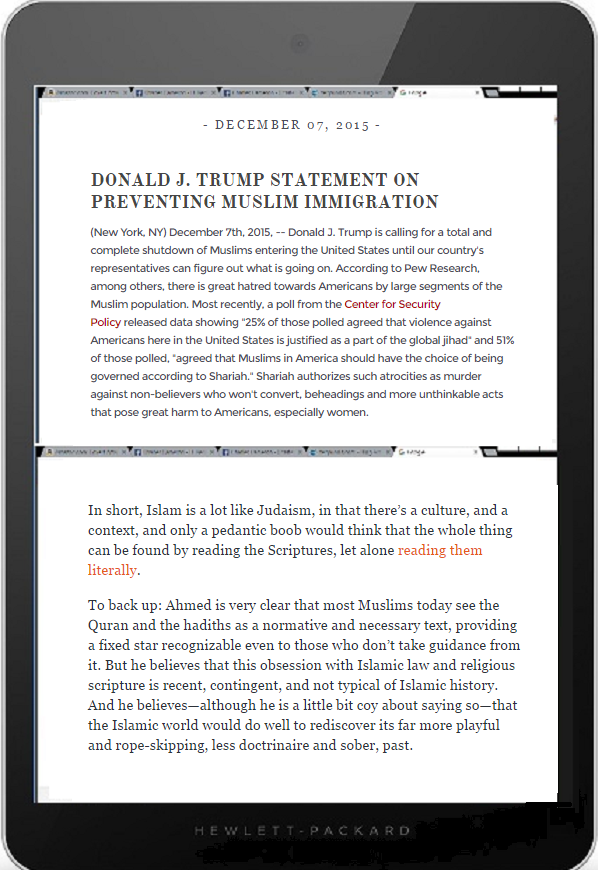
In the DoubleQuote below, I have posted excerpts from two documents — in the upper panel, Donald Trump’s news release on the prevention of Muslim immigration, and in the lower panel, a couple of paragraphs from the Tablet magazine review of the late Shahab Ahmad‘s extraordinary book, What is Islam, published this year by Princeton UP, and described in a blurb by Harvard Law’s Noah Feldman as “Not merely field changing, but the boldest and best thing I have read in any field in years.”
DQ tablet Trump Ahmed

Boiled down to it’s haiku-like essence, this twofer goes like this:

  • Trump: single page, single strand statement about banning Muslims
  • Ahmad: 550 page, multiple strand question as to how to define Muslims
  • **

    It’s inevitable that much of our popular — meaning “of the people, by the people, for the people” — discussion of Islam, brought on principally by the as yet but poorly understood connection between Al-Qaida and Islam, and exacerbated more recently by the equivalent link with the (so-called) Islamic (so-called) State — is framed in headlines and soundbites.

    Such single-stranded short-form messaging cannot hope to convey much at all of reality, and to get a deeper dive into what the words Islam and Muslim point to, one could hardly do better than The Study Quran for Islam’s central scripture, Jonathan Brown‘s Misquoting Muhammad for the history and interpretation of the corpus of hadith — and Ahmad’s What is Islam for the amazing richness of the Islamic traditions across continents and centuries.

    9780691164182

    Somewhere between the single words Muslim and Islam on the one hand, and the 550 pages of Ahmed’s erudition, aided and abetted by 44 pages of notes in small type and a substantial index on the other, there’s an awareness of rich complexity, perhaps sufficient for a 25-page essay or 125-page Oxford Very Short Introduction, that we could all benefit from applying to our political considerations of Islam in these fraught times.

    War & Peace, wounds and healing?

    Sunday, July 10th, 2016

    [ by Charles Cameron — hatred and hope? ]
    .

    and then again:

    **

    and:

    **

    My title — War & Peace, wounds and healing? — ends with a question mark. Are we, perhaps, beginning to see a shift here away from divisiveness, at least in the matter of the lives of both blue and black mattering? I don’t have the pulse of America, but am noting what may be early signs of a sea change, or just anecdotal outliers that don’t add up to anything.

    Sunday surprise the first — neat tweets from KarlreMarks

    Sunday, July 3rd, 2016

    [ by Charles Cameron — Brexit, graphical thinking, serpents — there’s never a dull moment with Karl Sharro on Twitter! ]
    .

    Karl Sharro is reMarkable and indeed reTweetable:

    **

    An hour or so before I saw that tweet from Sharro, I’d tweeted a quote from Suzanne Langer:

    I was quoting Langer’s Philosophy in a New Key — hat-tip: Steven H. Cullinane:

    Visual forms— lines, colors, proportions, etc.— are just as capable of articulation, i.e. of complex combination, as words. But the laws that govern this sort of articulation are altogether different from the laws of syntax that govern language. The most radical difference is that visual forms are not discursive. They do not present their constituents successively, but simultaneously, so the relations determining a visual structure are grasped in one act of vision.”

    I think that’s generally right, and goes some way to explaining why “reading” a HipBone Game is cognitively different, even when the game is played entirely in verbal moves, from an equivalent reading of the same “move” tests in sequence.

    I noted Sharro’s visual example — worth clicking all the way through to see it full scale — because although it’s a visual representation of a cluster of texts, it follows a timeline from left to right, and is thus simultaneously sequential and synchronic. A neat trick.

    BTW, Sharro is celebrated for an earlier diagram I’ve posted here — with glee, and with his amazing purely textual equivalent!

    **

    OK so now my focal length is just right for KarlreMarks Twitter feed, and I find this beauty — also about Brexit — too:

    What’s so neat here? Well, it appears to be a paradox of self-reference — ourobouros, a serpent biting its own tail if you like — and it’s very nicely done. The “large numbers of people” gathered in London, of course, aren’t the “large numbers of people” they say shouldn’t be heard, and if Sharro had tweeted —

    Large numbers of people gather in London to demand that large numbers of other people shouldn’t be heard”

    — the paradox would have been gone, the serpent biting its own tail morphed into a serpent biting another serpent — a far less interesting spectacle.

    Or would it? At the level of particular crowds, yes, the paradox would vanish, one crowd biting another, but at the level of implied principle, a crowd voicing the denial of the principle that the voices of crowds deserve a hearing would still be self-refuting in just the way Sharro plays on.

    So the paradox would be like Schrodinger’s cat, dead while alive — or even better, the Cheshire Cat, niow here now gone, perhaps?

    **

    Life, she is rich in paradox.

    Washington wording..

    Friday, July 1st, 2016

    [ by Charles Cameron — a DoubleQuote catches some WaPo weaseling with words ]
    .

    This is a day or two late, but I’ve been sick, so here you go:

    **

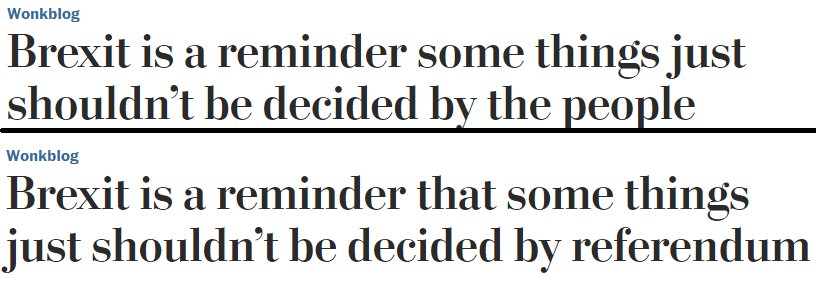
    It was David Auerbach who pointed out via Twitter that the Washington Post had changed its headline from an unseemly to a more seemly version:

    **

    DoubleQuote! — in fact, DoubleTweet! since WaPo still has its original tweet announcing its Wonkblog article, and also a revised version:

    and:

    **

    So what?

    Somehow, Washington the Post and We the People are not coterminous, although together they make for a nice alliteration. Government of the people, by the people, for the people is less convincing when some things just shouldn’t be decided by the people, ne?

    **

    I dunno. Because then again, there’s Andrew Sullivan, Democracies End When They Are Too Democratic, and Roslyn Fuller‘s response, America Needs More Democracy, Not Less.

    Forget Plato for a moment — what would Socrates say?

    Blowing in the wind, blowing in the mind

    Monday, June 27th, 2016

    [ by Charles Cameron — hair, Brexit, Trump, Apocalypse Now, and a forceful analysis of Brexit as lose-lose ]
    ,

    The DoubleQuote above is amusing, and falls into an interesting category along with the fan-rotor to helicopter-rotor transition at the start of Apocalypse Now. The real equivalence the juxtaposition is driving at remains unstated, while a superficial resemblance makes its case. In the case of Donald Trump and Boris Johnson, the wild hair in the wind is a stand-in for implied similarities between the BREXIT vote and the upcoming Presidential election US. In the case of Apocalypse Now, the rotors stand in for the frustration Capt. Willard feels stuck without a mission in a room in Saigon, and scooped out of there to be briefed on his mission up-river to Col. Kurtz in the very heart and horror of darkness.

    **

    Here’s a powerful comment by one Teebs at the Guardian, on the “no-win situation” the unfortunate Boris Johnson is now suffering:

    If Boris Johnson looked downbeat yesterday, that is because he realises that he has lost.

    Perhaps many Brexiters do not realise it yet, but they have actually lost, and it is all down to one man: David Cameron.

    With one fell swoop yesterday at 9:15 am, Cameron effectively annulled the referendum result, and simultaneously destroyed the political careers of Boris Johnson, Michael Gove and leading Brexiters who cost him so much anguish, not to mention his premiership.

    How?

    Throughout the campaign, Cameron had repeatedly said that a vote for leave would lead to triggering Article 50 straight away. Whether implicitly or explicitly, the image was clear: he would be giving that notice under Article 50 the morning after a vote to leave. Whether that was scaremongering or not is a bit moot now but, in the midst of the sentimental nautical references of his speech yesterday, he quietly abandoned that position and handed the responsibility over to his successor.

    And as the day wore on, the enormity of that step started to sink in: the markets, Sterling, Scotland, the Irish border, the Gibraltar border, the frontier at Calais, the need to continue compliance with all EU regulations for a free market, re-issuing passports, Brits abroad, EU citizens in Britain, the mountain of legistlation to be torn up and rewritten … the list grew and grew.
    The referendum result is not binding. It is advisory. Parliament is not bound to commit itself in that same direction.

    The Conservative party election that Cameron triggered will now have one question looming over it: will you, if elected as party leader, trigger the notice under Article 50?

    Who will want to have the responsibility of all those ramifications and consequences on his/her head and shoulders?

    Boris Johnson knew this yesterday, when he emerged subdued from his home and was even more subdued at the press conference. He has been out-maneouvered and check-mated.

    If he runs for leadership of the party, and then fails to follow through on triggering Article 50, then he is finished. If he does not run and effectively abandons the field, then he is finished. If he runs, wins and pulls the UK out of the EU, then it will all be over – Scotland will break away, there will be upheaval in Ireland, a recession … broken trade agreements. Then he is also finished. Boris Johnson knows all of this. When he acts like the dumb blond it is just that: an act.

    The Brexit leaders now have a result that they cannot use. For them, leadership of the Tory party has become a poison chalice.

    When Boris Johnson said there was no need to trigger Article 50 straight away, what he really meant to say was “never”. When Michael Gove went on and on about “informal negotiations” … why? why not the formal ones straight away? … he also meant not triggering the formal departure. They both know what a formal demarche would mean: an irreversible step that neither of them is prepared to take.

    All that remains is for someone to have the guts to stand up and say that Brexit is unachievable in reality without an enormous amount of pain and destruction, that cannot be borne. And David Cameron has put the onus of making that statement on the heads of the people who led the Brexit campaign.

    **

    Here, by the bye, is another tweet comparing situations in the UK (Brexit) and US (Presidential) votes:

    Here the comparison intended between US and UK is not implicit but explicit — and I have to say, I find it quite revealing. The answer, my friends, the answer is blowing in the mind.


    Switch to our mobile site
