zenpundit.com » trump

Archive for the ‘trump’ Category

U.S. Strategy Board – An Idea Whose Time Has Come?

Tuesday, January 10th, 2017

[Mark Safranski / “zen“]

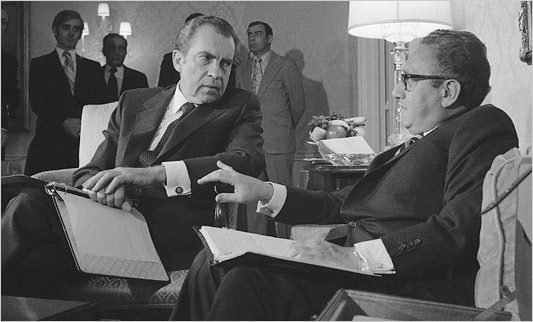
Image result for Nixon Kissinger the Team

Dr. Frank Hoffman has a piece up in Eurasiareview.com assessing the merits of an idea that in my humble opinion has some utility not merely for the incoming Trump administration but the institutional national security bureaucracy – a Strategy Board.

A Presidential Strategy Board: Enabling Strategic Competence – Analysis

The National Security Council (NSC) staff was once called the Keepers of the Keys, managers of the coordinating process that is central to an administration’s ability to plan and conduct a successful grand strategy.[1] The NSC has had an evolving role, as has its staff.[2] The NSC evolves to the strategic context that any administration faces, and it must also reflect the information processing and decision-making style of the president. The inbound Trump administration will soon face the challenge of integrating America’s diplomatic, military, and economic tools and applying them globally and coherently.

Many have offered advice on how to properly focus NSC staff as well as the “right size” of the group. NSC structures and processes are designed to fulfill the needs of the president and should support his policy and decision-making requirements. These may vary from president to president to fit information processing and decision-making styles as well as the character of an administration’s foreign policy. Lt. Gen. Michael T. Flynn, the president-elect’s National Security Advisor, will manage the evolution of the NSC team to best support Mr. Trump and establish processes and coordinating mechanisms to tee up presidential decisions and implement the foreign policy initiatives of our 45th President.

[….]

More importantly, we have misdiagnosed and mislabeled the problem. The White House’s real shortfall is strategy formulation, not planning. Strategy is not planning, but a good strategy enables proper planning.[20] Hence, I contend that the solution lies in creating a Strategy Board.

The Deputy National Security Advisor—President-elect Trump has tapped K.T. McFarland for the position—would chair the Strategy Board, and the board would not duplicate the existing system of Deputy and Principal’s committees. Its composition would include serving government officials below the existing committee structure from the Departments, NSC, and Office of Management and Budget (OMB) staff members as well as external members from outside government. Like Eisenhower’s board, this group would be charged with anticipating problems, generating solutions independent of Departmental preferences/inclinations, and proposing cost effective strategies. The planning details of approved strategic initiatives would be delegated to the respective Departments.

The board would conduct long-range strategic planning processes for presentation to the Deputy and Principal’s Committees at regular periods, including presidential strategy directives assigning priorities and resource allocations that would shape or inform Departmental budgets.[21] OMB representation would improve the connection between policy and budgets, enhancing long-term implementation and strategic coherence.

Read the whole thing here.

This is a good idea as strategic excellence has been a quality not greatly in evidence in American statecraft in the previous sixteen years and many have argued that we have been adrift since the end of the Cold War. The time horizons of the NSC and the IC are chronically driven by a sense of urgency toward the short term, to “reporting” over “analysis”, to tactics and political gestures over strategic perspectives – something a strategy board with some gravitas in its members would help counterbalance.

I had a related proposal five or six years ago that was more blue sky than Dr. Hoffman’s strategy board, focusing on the long to very long term American grand strategy:

Time for a Grand Strategy Board? 

….The President of the United States, of course has a number of bodies that could, should but do not always provide strategic advice. There’s the Defense Policy Advisory Board, an Intelligence Advisory Board,  the National Intelligence Council, the State Department’s Policy Planning Staff, the Office of Net Assessment and not least, the NSC itself and the Joint Chiefs of Staff, whose Chairman, by act of Congress, is the military advisor to the President and Secretary of Defense. While strategic thinking does percolate from these entities, many have very specific mandates or, conversely, wide ranging briefs on matters other than strategy. Some operate many levels below the Oval Office, are filled with superannuated politicians or have personnel who, while intellectually brilliant, are excessively political and untrained in matters of strategy. The Joint Chiefs, the professionals of strategy, are highly cognizant of the Constitutional deference they are required to give to civilian officials and are very leery of overstepping their bounds into the more political realms of policy and grand strategy.

What  the President could use is a high level group just focused on getting strategy right – or making sure we have one at all.

I’m envisioning a relatively small group composed of a core of pure strategists leavened with the most strategically oriented of our elder statesmen, flag officers, spooks and thinkers from cognate fields. A grand strategy board would be most active at the start of an administration and help in the crafting of the national strategy documents and return periodically when requested to give advice. Like the Spartan Gerousia, most of the members ( but not all) would be older and freer of the restraint of institutional imperatives and career ambitions. Like the Anglo-American joint chiefs and international conferences of WWII and the immediate postwar era, they would keep their eye on the panoramic view.

Read the rest here.

We have seen in many administrations and not least in the last two, a tendency toward insularity and groupthink, to politicized intelligence, to cutting subject matter experts out of the policy loop to better put forward much cherished but stridently evidence-free ideas and a general approach that eschews basic strategic thinking in favor of grasping for momentary tactical advantages to please domestic political factions. This lack of overarching strategy to tie together the strands of policy so that our bureaucracies pull in the direction of reality is why we lose wars and repeatedly get diplomatically outmaneuvered on the world stage by second and third rate powers.

A strategy board would not be a silver bullet. It won’t cure White House micromanagement by itself or keep the NSC from going rogue or make Defense, CIA or State produce workable options for the POTUS in a timely fashion. But a strategy board could well help clarify thinking at the inception and challenge the various players to pull together intellectually and operationally. It could makes things better.

And at the rate America has been going lately, we could hardly do worse.
Sunday surprise: Pokemon Go Go Go

Sunday, July 24th, 2016

[ by Charles Cameron — for Adam Elkus, John Robb & JM Berger among others ]
.

Three tweets:

*

*

**

I find that last one pretty interesting, and would like to juxtapose it with a para from Michael Moore‘s piece — almost certainly the only piece of his writings I’ve actually downloaded onto my hard drive — Five Reasons Why Donald Trump Will Win:

The fire alarm that should be going off [CC: for Hillary supporters] is that while the average Bernie backer will drag him/herself to the polls that day to somewhat reluctantly vote for Hillary, it will be what’s called a “depressed vote” – meaning the voter doesn’t bring five people to vote with her. He doesn’t volunteer 10 hours in the month leading up to the election. She never talks in an excited voice when asked why she’s voting for Hillary. A depressed voter. Because, when you’re young, you have zero tolerance for phonies and BS. Returning to the Clinton/Bush era for them is like suddenly having to pay for music, or using MySpace or carrying around one of those big-ass portable phones. They’re not going to vote for Trump; some will vote third party, but many will just stay home. Hillary Clinton is going to have to do something to give them a reason to support her — and picking a moderate, bland-o, middle of the road old white guy as her running mate is not the kind of edgy move that tells millenials that their vote is important to Hillary. Having two women on the ticket – that was an exciting idea. But then Hillary got scared and has decided to play it safe. This is just one example of how she is killing the youth vote.

Department of unintended consequences and black swans:

Who’d have thought a Japoanese telephone-based game might have an influence on the demographics of democracy in the US of A?

Benghazi, the election, and a look in the mirror

Saturday, July 23rd, 2016

[ by Charles Cameron — the current score seems to be bipolar 1, bipartisan 0 ]
.

You may believe:

You may believe:

Binocular vision on the Trump phenom

Tuesday, July 19th, 2016

[ by Charles Cameron — why the support, why the avoidance ]
.

I thought it would be interesting to juxtapose these two quotes about Donald Trump.

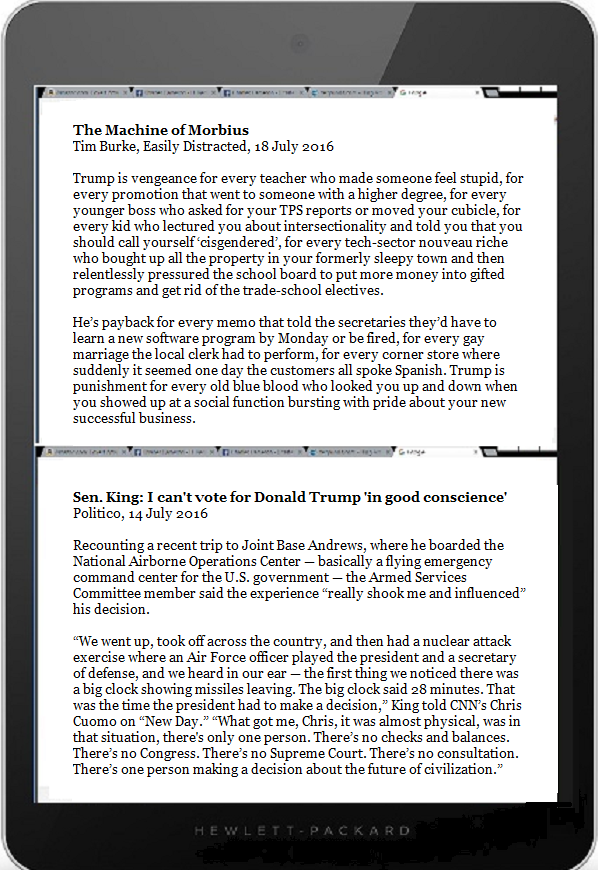
One comes from my friend Timothy Burke of Swarthmore and the Easily Distracted blog (upper panel, below) — Tim describes himself as holding generally left or progressive views, though he likes to think of himself as “dedicated to unpredictability”. Tim’s comment goes a long way towards explaining Trump’s appeal.

Tablet DQ Trump Burke & King

The other (lower panel, above) is from Independent Senator Angus King, who generally caucuses with the Democrats, and explains in all too vivid terms why he cannot support Donald Trump for President.

Between the two of them, they nicely illustrate the two poles of opinion around Trump. Tim gives voice to the personal frustrations carried by so many of Trump’s supporters — grievous frustrations which have gone too long unheeded by both parties. And Sen. King voices the agonizing uncertainty surrounding Trump’s reliability as a potential major player in the high-stakes game of geopolitics and nuclear alerts — for his contrast between Trump and Clinton in this regard, read his whole piece at the link below.

I am grateful to both for their succinct expressions of the two very real sides here.

**

Sources:

  • Timothy Burke, The Machine of Morbius
  • Sen. Angus King: I can’t vote for Donald Trump ‘in good conscience’
  • A brief Trump policy statement & book-length question in response

    Sunday, July 10th, 2016

    [ by Charles Cameron — also a tweet asking for a DoubleQuote & getting one ]
    .

    As so often, Part I of this post is a somewhat playful teaser for Part II, which is where my real interest is to be found.

    Part I, then, is about someone inquiring about two tweets Donald Trump made, asking in effect whether anyone had DoubleQuoted them:.

    I like this question because it shows that DoubleQuoting — and indeed it’s subset, DoubleTweeting — is not some lonely idea of mine, but a more general form of inquiry that I’m aiming to fashion into a specigic and teachable tool for thinking.

    **

    As it happens, one Chris Taylor responded to Martyn’s question the next day, putting the two tweets in question together. Sadly for my purposes, he did this by screengrabbing the pair of them, thus making it impossible to click through to Trump’s two originals. I’ve therefore gone to Trump’s timeline, and present them here as they originally appeared there:

    I see this juxtaposition as having some mild merit as political argument, but mainly as a sort of nit-picky point-scoring — so I’ll leave it at that.

    For anyone who’s interested, here’s a storified compilation of Donald Trump’s tweets on Islam, Muslims and the Middle East — I haven’t verified its contents or up-to-date-ness, but ran across it in my rooting around, and thought it might be of use to some here.

    **

    Part II is where things get interesting.

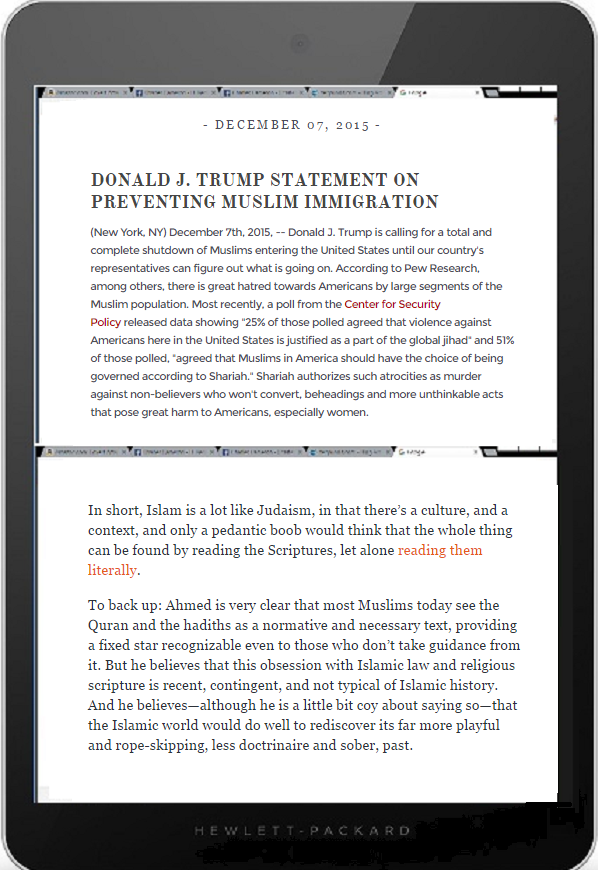
    In the DoubleQuote below, I have posted excerpts from two documents — in the upper panel, Donald Trump’s news release on the prevention of Muslim immigration, and in the lower panel, a couple of paragraphs from the Tablet magazine review of the late Shahab Ahmad‘s extraordinary book, What is Islam, published this year by Princeton UP, and described in a blurb by Harvard Law’s Noah Feldman as “Not merely field changing, but the boldest and best thing I have read in any field in years.”

    DQ tablet Trump Ahmed

    Boiled down to it’s haiku-like essence, this twofer goes like this:

  • Trump: single page, single strand statement about banning Muslims
  • Ahmad: 550 page, multiple strand question as to how to define Muslims
  • **

    It’s inevitable that much of our popular — meaning “of the people, by the people, for the people” — discussion of Islam, brought on principally by the as yet but poorly understood connection between Al-Qaida and Islam, and exacerbated more recently by the equivalent link with the (so-called) Islamic (so-called) State — is framed in headlines and soundbites.

    Such single-stranded short-form messaging cannot hope to convey much at all of reality, and to get a deeper dive into what the words Islam and Muslim point to, one could hardly do better than The Study Quran for Islam’s central scripture, Jonathan Brown‘s Misquoting Muhammad for the history and interpretation of the corpus of hadith — and Ahmad’s What is Islam for the amazing richness of the Islamic traditions across continents and centuries.

    9780691164182

    Somewhere between the single words Muslim and Islam on the one hand, and the 550 pages of Ahmed’s erudition, aided and abetted by 44 pages of notes in small type and a substantial index on the other, there’s an awareness of rich complexity, perhaps sufficient for a 25-page essay or 125-page Oxford Very Short Introduction, that we could all benefit from applying to our political considerations of Islam in these fraught times.


    Switch to our mobile site