zenpundit.com » small wars journal

Archive for the ‘small wars journal’ Category

An interesting peek into the PKK

Monday, November 12th, 2012

[ by Charles Cameron — the PKK and religion, my own ignorance and curiosity ]
.

Flag of the Iraqi Kurds, not a PKK flag -- but see below...

**

The PKK is important in a “first cousin once removed” kind of way, if I’m understanding Karen Kaya‘s piece in SWJ this past May correctly:

As Turkish military and government officials often say, the PKK is to Turkey what Al-Qaida is to the U.S., or that “the PKK is Turkey’s Al-Qaida.”

**

So I was trawling the web today, and the mention of religion in this paragraph from McClatchy caught my eye:

Volunteers who join the Kurdish insurgency against Turkey must abandon Islamic religious practice and must forego “emotional ties” to anyone outside the group, as well as swear words and sex, or face trial and prison, according to a Syrian-born Kurd who defected from the group to Turkey over the summer.

People who “defect” not uncommonly offer prejudiced accounts of the organizations they’ve left, so I read on to see how trustworthy this source might be:

The 21-year-old defector, who surrendered in June, brought with him not only a tale of life inside the Kurdistan Workers’ Party, known by its Kurdish initials as the PKK, but also detailed information about a planned attack inside Turkey that helped Turkish authorities beat back the PKK offensive.

McClatchy obtained a copy of a 19-page Turkish-language account of his debriefing, which was dated July 4 and was not marked classified. The debriefing contained his name, but McClatchy is identifying him only by his initials, R.S., to protect family members who might still be in territory held by the PKK’s Syrian affiliate.

It seems his military intelligence was quite accurate — so far so good. Next, my own curiosity naturally led me to wonder what the PKK’s religious stance, apart from being opposed to Islam, might be. After all, it’s called the the Kurdistan Workers’ Party and was founded on Marxist principles…

Okay, I skipped a few paragraphs, and found this:

R.S. portrayed the PKK as anti-Islamic. Performing daily prayers, fasting and reading the Quran are among the offenses that could land a recruit in prison, he told Turkish authorities. Instead, fighters were told that the religion of Kurds is Zoroastrianism, one of the world’s most ancient religions, and they should worship fire. There are said to be fewer than 200,000 Zoroastrians today, mostly in Iran and India.

Now that’s a fascinating glimpse behind the curtain.

**

For an alternate viewpoint, here’s the University of Utrecht grad student in Conflict Studies and Human Rights, Wladimir van Wilgenburg, writing for Rudaw in English and sounding knowledgeable, though his own or Rudaw’s potential biases are unknown to me:

The idea that Kurds are actually Zoroastrians is not something new. Kurdish nationalists such as the Bedirkhan brothers tried to revive Zoroastrianism and Yezidism as the original religion of the Kurds in the 1920s and 1930s. By this the Bedirkhans aimed to separate the Kurds from their Muslim neighbors and give them a glorious pre-Islamic history that had once boasted many empires.

They did not emphasize much on the Kurdish Islamic warrior Salahadin al-Ayyubi that rallied the Muslims against the crusaders in the twelfth century. Similarly, Turkish nationalists tried to promote Shamanism as the original religion of the Turks. But despite these efforts, Islam remained an important element among Kurdish nationalist movements.

It is unlikely that Yezidis are originally Zoroastrians. The Zoroastrian religion is a dualist religion (with good and evil constantly fighting each other), while the Yezidi faith revolves more around a single deity as the Satan.

Therefore it is possible that the Zoroastrians would regard the Yezidis as devil-worshippers, just as some Muslims do.

There are still many Kurds (especially in Europe) who think Kurds are originally Zoroastrians and wear Zoroastrian symbols, even though they are non-religious and do not have much knowledge about Zoroastrianism and its rituals.

The PKK was particularly influenced by the ideas of early Kurdish nationalists. Its media promoted the idea that Kurds are originally Zoroastrians. Other Kurdish political groups also came under the same influence.

But in 1991 the PKK took a positive approach about Islam and thus managed to win some sympathy. Some say the PKK tried to merge Kurdish nationalism and Islam for its own cause.

In recent years the PKK has also used Imams, Friday prayers and Islamic language as a means to compete with the ruling Justice and Development Party (AKP). In return, the Turkish government is said to have plans to recruit 1000 Kurdish Imams in its battle to win the hearts and minds of the Kurdish people.

**

That (Iraqi) Kurdistan National Flag at the top of this post has a golden sun with 21 rays as it’s central feature — but it’s from Iraq. The PKK has used a variety of flags, some of them reflecting the group’s Marxist origins, but one in particular appears to borrow from the Iraqi flag:

As noted on this Flags of the World page:

This seems to be a variant of the original PKK flag, since it has the star and the red background of the PKK original flag but also the sun disc of the Kurdish Regional Government in Iraq.

That, in brief, is why the symbolism of the Iraqi Kurdish flag may be significant in understanding symbolism associated with the PKK.

The Kurdistanica page on the Iraqi Kurdish flag is a little coy on the topic of the sun, noting:

The primary Kurdish characteristic of the flag is the golden sun emblem at the center. The sun emblem has a religious and cultural history among the Kurds, stretching into antiquity. The sun disk of the emblem has 21 rays, equal in size and shape. The number 21 holds a primary importance in the native Yazdani religious tradition of the Kurds.

The sun might also be associated with Zoroastrianism, and the number 21 with the 21 nasks of the original Zoroastrian scriptures — but the issue of Kurdish religious nationalism is another area I’m unfamiliar with…

**

The nice thing about knowing that one doesn’t know is that it makes leaping to conclusions so much more difficult.

The Shariah twins and other ads

Sunday, August 26th, 2012

[ by Charles Cameron — attempting the unbiased exploration of nuance in often low-nuance discourses ]
.

As usual, billboards, pamplets and ads on the sides of buses are worth watching. Let’s start with the Shariah twins:

The similarities are pretty obvious — what are the differences?

Well, the upper one was put up first, while the lower one was a response to it — that’s one difference, and it accounts for the similarities. Another difference has to do with the URLs each of them provides for further inquiry:

http://www.defendingreligiousfreedom.org
http://www.defendingreligiousfreedom.us

Again, the second is a response to the first and mimics its URL, although it switches automagically to http://freedomdefense.typepad.com/leave-islam/ when you click through. And “defending religious freedom” is clearly a double-sided coin…

The actual situation is neither that “Islam is a religion of Peace” nor that “Islam is a religion of War” — I would suggest it is that Islam is a religion that believes in opposing injustice in the name of peace, for the sake of eventual peace. In this regard, Islam is not unique.

Islam also has adherents who would like to see the entire world under Islam’s banner. In this again, Islam is not unique. Islam has given the world great poetry, history, architecture, philosophy, music, mathematics, science. Again, Islam is not unique in this. In one of my own fields of special interest, social entrepreneurship, Islam has given use Muhammad Yunnus and the Grameen Bank… The Islamic world also includes many religious leaders who espouse virulent anti-Semitism. In short…

Islam as expressed for better or worse in a vast diversity of human lives and situations neither renders each and every adherent an angel nor a beast. God may be perfect, but Muslims are only human. In this again, Muslims are not unique.

**

Let’s turn from religion to patriotism:

According to the lower image, the Tea Party is not the enemy. That’s fine by me — I have friends who are Tea Party stalwarts. According to the upper image, which was put up by a local Tea Party related organization using the Tea Party name, the sitting President of the US is the equivalent of Hitler and Stalin. And if they weren’t seen as enemies by the US, I don’t know what the Second World War and Cold War were all about…

So let’s just say that when Obama‘s death camps pass the five million mark in Jews, gypsies, homosexuals, poets, Christians or whoever killed, I will no longer think the comparison a trifle overheated. To put it mildly.

But hey, I have a question for the Oath Keepers among our readership.

If you are supposed to fire on the enemy, and the illustration in your ad specifically features British red-coats, but you’re not allowed to fire on American citizens, and Col. Kevin Benson, who wrote the disputed article in Small Wars Journal, is an American citizen whom you consider a “red-coat” — are you supposed to shoot him? Please note, I also have friends who are SWJ stalwarts.

What about droning Anwar al-Awlaki? I suppose these paradoxes of double identity all belong in the same category as Bertrand Russell‘s celebrated paradox of the Spanish barber:

There was once a barber. Some say that he lived in Seville. Wherever he lived, all of the men in this town either shaved themselves or were shaved by the barber. And the barber only shaved the men who did not shave themselves.

All of which is fine, until you begin to wonder, as Russell did, whether the barber shaves himself?

**

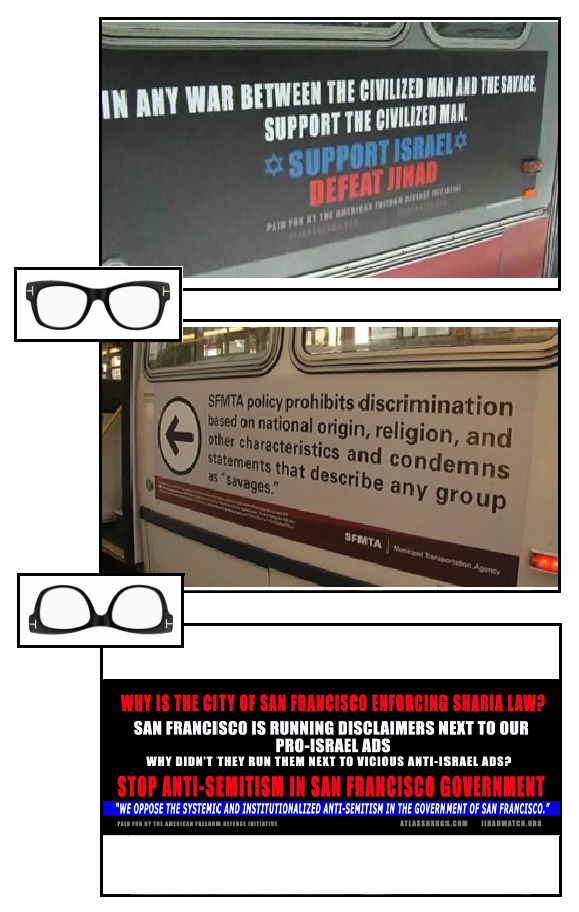
Back to religion (jihad) — or are we still on politics (Israel)? — for a quick look at the San Francisco Muni advertising discourse, which has now reached the point where I need to amend my usual two panel format:

Pamela Geller paid for the first ad, which encourages US support for Israel, okay, but also seems to call some group or other “savages” — we’re not quite sure who that group consists of since she doesn’t specify it — but she could plausibly be meaning all Palestinian suicide bombers, all Palestinians, all Arabs, all Muslims, even perhaps all those who support Israel… we just don’t know.

Given the amount of hatred floating around on the Israeli-Palestinian issue, I’d suggest the ad is indeed inflammatory, and that the Muni — who didn’t think they could refuse it under applicable US law — was acting appropriately if somewhat surprisingly in posting its own ad in response, seen here in the middle panel.

Now Geller has announced her intention to respond to the Muni’s ad with one of her own, seen here in the third panel — and all eyes will be on Muni if and when she does — to see if they will continue the back and forth.

**

The world is the cinema. There actually are people setting fires in several parts of the cinema, and others whose words could be the sparks that ignite yet more fires. Some of the fire-setters have names like Ajmal Kasab and Osama bin Laden, some like Timothy McVeigh or Anders Breivik, some like Vellupillai Prabhakaran. The theater is crowded, and some people are yelling “fire”…

Furthermore, there’s a difference between panic and precaution.

My early “close reading” of Nidal Hasan’s .ppt reposted

Monday, August 13th, 2012

[ by Charles Cameron — my original SWJ post featuring my attempt at interpreting Nidal Hasan’s powerpoint slide show when it was first published, plus more recent links ]
.


.

At Zen‘s suggestion, and since it’s no longer accessible on the revamped SWJ site, I’m posting here a link to my 2009 piece, The Hasan Slide Presentation: A Preliminary Commentary, as it originally appeared in .pdf in the Small Wars Journal.

My attempt then was to avoid, if possible, back-reading the facts of the Ft Hood shooting into the Hasan slide presentation — noting that at the time we lacked a clear sense of the verbal commentary with which Hasan had presented the slides.

Avoiding “projective hindsight” remains an interest of mine.

**

More recently, I raised a related question about Maj. Hasan here on Zenpundit, and received first rate answers from:

Daveed Gartenstein-Ross and Lauren Morgan, Nidal Hasan’s “Fairly Benign” Correspondence with Anwar al Awlaki
JM Berger, The Content and Context of Anwar Awlaki’s emails with Fort Hood Shooter Nidal Hasan

with indirect follow-ups from:

emptywheel, It’s Not Just Whether Nidal Hasan’s Emails Stuck Out, It’s Whether Abdulmutallab’s Did, and
Bernard Finel, Was Ft. Hood (or Aurora) Preventable?

**

I’m still in the relatively early throes of learning my new job at UrbIm, but hope to respond to these good folks once I’m a bit more settled in…

But I’ve noticed, I don’t always manage to get to everything… : (

A question re Hasan and Awlaki

Tuesday, July 24th, 2012

[ by Charles Cameron — revisiting the question of Maj. Nidal Hasan ]
.

... above: Daveed's tweet today, Awlaki's email from Intelwire

.

I was struck by one curious aspect to the question of what Maj. Nidal Hasan was up to at what point in his trajectory: the fact that as a psychiatrist, he was dealing with soldier patients returning from the wars in Iraq or Afghanistan who had doubts as to the religious legitimacy of killing fellow-Muslims in those wars.

On the face of it, that’s a topic a psychiatrist who didn’t feel himself expert in his religion (“am a novice at this and would like reassurance“) might wish to consult with clergy about, and the fact that “clergy” in this case was al-Awlaki shouldn’t be read back into the situation as confirming jihadist intent on Hasan’s part – Awlaki had been the imam of a Falls Church mosque where, according to one AP report:

Opinions varied on what kind of preacher al-Awlaki was when he served in Virginia. Most said they did not find him to be overtly political or radical.

As another report mentioned:

“Because the content of the communications was explainable by his research and nothing else derogatory was found, the [investigators] concluded that Major Hasan was not involved in terrorist activities or terrorist planning,” the FBI said in a statement issued days after the Ft. Hood shooting.

**

I mentioned this issue of Hasan’s (potentially) legitimate professional concern for his patients in my commentary on Hasan’s slide show in Small Wars Journal, but I haven’t been following news reports closely and have no access in any case to what’s known in restricted intel circles — so my issue may already have been addressed with clarity somewhere “open source”, in which case I’d welcome a pointer or pointers, and closure.

In the meantime, I do feel a little like someone going for a rollercoaster ride on a Moebius strip: as I read it, the same evidence that reads prospectively as suggesting a concern to be able to counsel patients in distress reads retrospectively as suggesting the conflict is in Hasan’s own mind – and that he has in effect already resolved it and is turning to Awlaki as someone he is sure will confirm his intent.

I understand that many of Hasan’s colleagues were dismayed at the time of his slide-point lecture and discussed their concerns that he was an extremist – but then there are not a few who imagine Huma Abedin is a closet Sayyid Qutb on far more slender grounds. Hasan was clearly discussing a potential clash between Islamic and military duties, and his final slide was undoubtedly phrased to be provocative – but I still don’t know what his comments on it were, and how much different members of his audience may have read into it.

It still seems plausible to me that the way Hasan’s mind turned involved three separable “colorations” of a developing line of thought, the first of them benign, the last fatal – from a concern with his patients, via a concern regarding his own position as a Muslim and a soldier, to his identification with Awlaki’s position and decision to take action resulting in the Ft Hood massacre.

And as you know, mapping, gaming or simulating mental processes at the level of thoughts, persuasions and decisions is a matter of keen interest to me.

**

My question — for Daveed Gartenstein-Ross, JM Berger and others who have a better sense of the timeline and documentation that I – is whether this remains a plausible understanding, or whether it has long been conclusively disproven by more recently available evidence.

SWJ: Manea interviews Fernando Lujan

Tuesday, July 24th, 2012

The latest in the series of COIN interviews by Octavian Manea:

COIN and Other Four-Letter Words: Interview with AfPak Hand Major Fernando Lujan 

OM:  In early 2009, I made a tour of a few DC think tanks.  At the time everybody was talking about COIN. Why did COIN become a dirty word, today? Why do you still believe in COIN doctrine?

FL:  Well, frankly I get a bit nervous whenever I hear the words “believe” and “doctrine” in the same sentence… the same way I get nervous when I hear people refer to the current counterinsurgency manual, FM 3-24, as “the good book.”  The counterinsurgency manual should never be dogma, never be seen as some sort of universal solution.  The manual was an attempt to change the culture of the Army at a time when we desperately needed it.  It was written by a group of very smart people who tried to include some lessons from Cold War-era insurgencies, but let’s not fool ourselves–it was written in extremis, for forces struggling through their rotations in Iraq from 2006-2010.  It did a pretty good job helping those units.. and it serves as a decent framework for one type of counterinsurgency effort–the resource intensive, ‘boots heavy’ sort that we saw in Iraq and Afghanistan.

 But we should not lose sight of the fact that this type of massive COIN effort is only one extreme of a long continuum of policy options, undertaken when the situation in both countries had already deteriorated so much that major reinforcement became the ‘least bad’ choice in the minds of our civilian leaders.  If we want to keep COIN from becoming a ‘dirty word,’ as you say, we need to make this distinction clear, and leave room for alternate, smaller footprint models.  The next version of the doctrine should not just pull lessons from Iraq and Afghanistan–but also from Colombia, the Philippines, El Salvador, the Sahel, and the myriad of other places we’ve been involved in over the past decades.  To the credit of the Army and Marines, Ft. Leavenworth is in the midst of rewriting the manual as we speak–but it remains to be seen what kind of message the final product will send.  Will we have a cookie cutter model with the five standard lines of effort, built around heavy resources and a 5,000-man brigade combat team or will we have a manual that offers a broad toolkit of different approaches–some civilian-led or embassy ‘country team’ based, some more heavily reliant on targeting and offshore training or 3rd party actors, et cetera.  Knowing what we know about land wars in Asia, I’d personally much rather see the latter…..

Read the rest here.


Switch to our mobile site