zenpundit.com » war

Archive for the ‘war’ Category

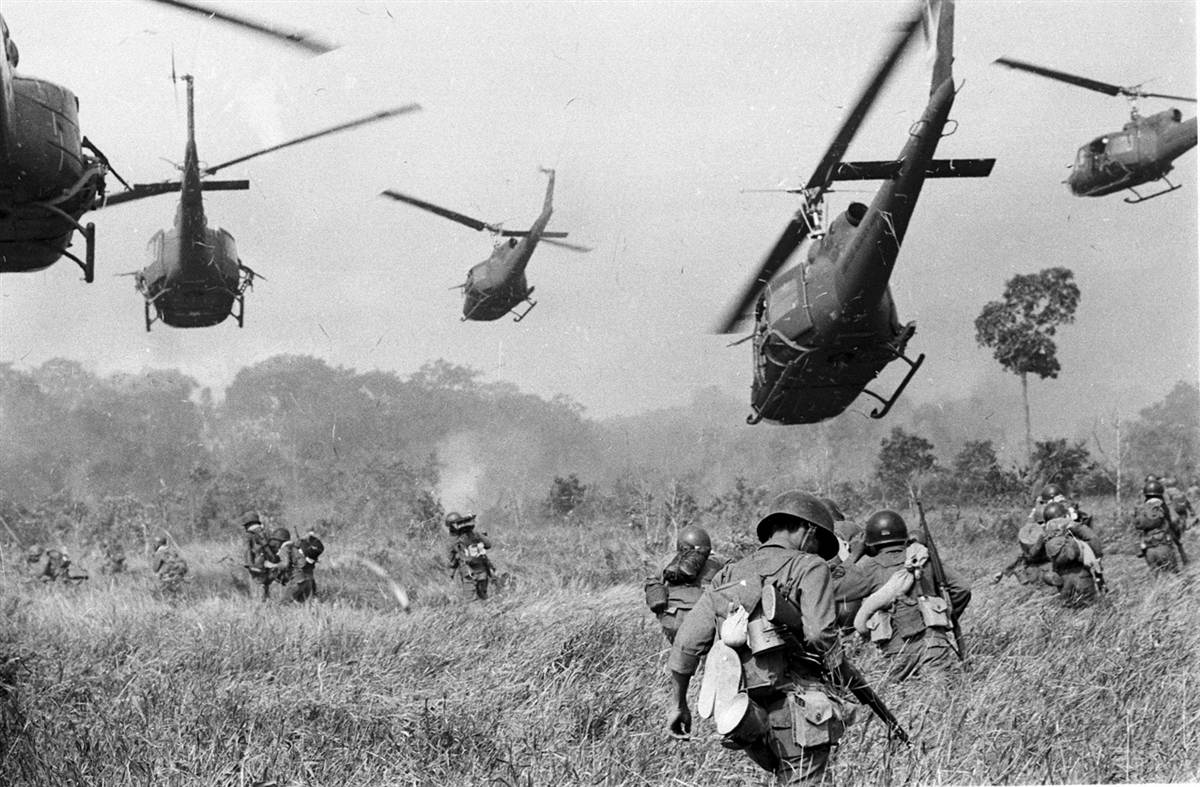
The Vietnam War at Fifty

Monday, November 11th, 2013

[by Mark Safranski, a.k.a. “zen“]

Today is Veteran’s Day. It is a day when Americans remember all of those who served, in peace or war.

Originally, this day was called Armistice Day in honor of the cease fire that came in ” the eleventh hour of the eleventh day of the eleventh month” and brought the horrific slaughter of  World War I to an end. This was fitting.  The First World War loomed large in the memories of our great grandparents and grandparents the way the Civil War did for earlier generations. It was an ominous touchstone of the nadir of which Mankind was capable until it was thoroughly eclipsed by the subsequent horrors of Nazi barbarism in a Second World War – a conflict that seemed a maturation of the first. In the postwar era, Armistice Day became a national tribute to the sacrifices of all veterans.

This year also marks the fiftieth anniversary of American entry into the Vietnam War.

Historians may quibble with this, as American involvement in Vietnam went back to WWII and OSS agents giving advice to Ho Chi Minh in the jungle war against Imperial Japan and Vichy French puppet colonialists, but 1963 is when “American boys” first went to South Vietnam in real numbers.  And many of them were indeed little more than boys. Fifty-eight thousand, two hundred and eighty six of them did not come home.

Those that did are now grown grey with the passage of time.

The Vietnam War caused deeper divisions in the American psyche than any other war except the one that began at Fort Sumter. The wounds have never really healed and they rest inflamed and sore just beneath the scabrous surface of American politics to this day. America has an unenviable historical track record of not treating its veterans very well and those who served in that unpopular war that ended in defeat received on their return home far more than their share of  disdain and abuse.

Even the attempt to build a memorial – the now famously cathartic Wall – roiled at the time in a controversy of unimaginable bitterness. The site eventually became a place of pilgrimage, alive with memory of the dead and compassion for the living. This was a good thing but in truth as a nation we could have done far, far better for the men who served in Vietnam than we did.

The best tribute to these veterans of Vietnam that we can make as a people would be to see that the veterans of Iraq and Afghanistan do not repeat the sad experience of their fathers.

Manea Interviews Colby on Air-Sea Battle

Friday, November 8th, 2013

[by Mark Safranski, a.k.a. “zen“]

Octavian Manea branches out from COIN to the realm of power projection:

The Role of an Air Sea Battle-Centric Posture in Strategic Reassurance: SWJ Interview with Elbridge Colby 

SWJ: In a time when the PLA is intensively investing in anti-access/area-denial (A2/AD) capabilities, how would you characterize the Chinese way of war? What are they preparing for?

EC: My understanding of what the Chinese are trying to accomplish is the ability to effectively counter a third party intervention. If you look at the strategic landscape in the Western Pacific, more or less starting from 1945, the US dominated the aerial and maritime spheres. Obviously, we had less success on the Eurasian landmass, but the whole system was predicated on the ability of the US fleet and airpower to dominate the Pacific.

The particular contingency for which this was most relevant was Taiwan. Now, the US continues to have a policy guided by the Taiwan Act which, at the very least, suggests that we might intervene militarily. This is something that the Chinese are not comfortable with. It [the claim to Taiwan] is a core element of their regime’s legitimacy. This issue became more salient after the Taiwan Strait crisis in 1995/1996. That was a wakeup call for the Chinese, and in its aftermath they decided to build up the ability to try to effectively push back the US military. The trajectory of Chinese military development has therefore been to build forces that would potentially enable them to prevent the US from operating effectively in the areas that we need to be able to dominate if we decide to defend Taiwan in the event of Chinese military attack or attempted coercion. In this context they have spent a lot of time and resources on more accurate ballistic and cruise missiles, aerial forces and naval forces, basically with the overarching idea of creating an A2/AD bubble in order to deny the US the ability to exercise its power in the Western Pacific. That challenge to our power projection ability has been compounded because of the centralization of the US military posture following the Cold War, becoming increasingly focused on Guam and a few other nodes in the Pacific region.

SWJ: What are the implications of China’s military build-up for the United States?

EC:  As we go forward and the Chinese economy likely continues to grow, they will presumably continue to put significant resources into these military capabilities. If we think about the basic military problem, the US is trying to project its power across the greatest expense of water on the globe, very far from our shores, using naval and airpower, all while the Chinese are operating from their mainland. The Chinese basically are trying to frustrate our ability to enter, while we are trying to get there and accomplish our objectives. As the Chinese military become more sophisticated, it will become a great problem for us.

SWJ: Are the Chinese A2/AD capabilities a long-term threat to the credibility of the deterrence capital that the US is providing to the region?

EC: Absolutely. We can see this in the case of Japan, where we see a lot more interest, focus, and essentially need for a stronger military posture. Publicly the Japanese are talking about North Korea, but what they are really worried about is China. The Senkaku Islands are the tip of the iceberg. A few months ago the Chinese state-affiliated press started to talk about the Chinese claims on the Ryukyu Islands, of which Okinawa is a part. It is a classic example of the downside of accommodation or appeasement in that the potential adversary can get hungrier rather than sated due to accommodation. And Taiwan’s closer relationship with mainland China is, in part, a result of the shifting regional military balance. More broadly, in these kinds of strategic competitions, perceptions of capability and resolve are crucial. If everyone thinks we are growing weaker, then they are likely to behave accordingly. 

A lengthy interview – read the rest here.

Heavy Metal: When Irregulars Go Armored

Saturday, November 2nd, 2013

[by Mark Safranski, a.k.a. “zen“]

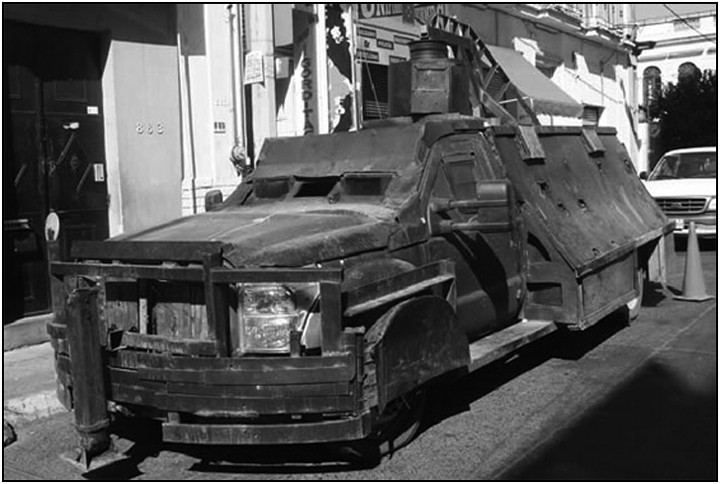
If the symbol of the 20th century insurgent was the AK-47 and a red banner, his 21st century counterpart may someday be recognized by the suicide belt and the “homemade tank”. Irregular fighters have always used light arms, civilian passenger vehicles and armor captured (or donated by) from conventional armies, but the ability to produce serviceable fighting armored cars is a new wrinkle. They could not stand up to an American or Russian tank company, of course, but they are not meant to do so.

Most prevalent and evolved in Mexico’s narco-insurgency where cartels use these “monsters” converted from SUVs and various types of light and heavy trucks to battle one another and as “troop carriers” but these DIY armored vehicles have also appeared in the recent Libyan and ongoing Syrian civil wars. Where heavy anti-tank weapons, air power and real tanks are scarce, these narco-tanks are useful additions to irregular combat power and convey an intimidating image to lightly armed police and the public.

Dr. Robert Bunker and Byron Ramirez, with the support of Small Wars Journal, Borderland Beat.com and the Foreign Military Studies Office at Fort Leavenworth, have a new scholarly compilation on the subject of irregular use of DIY armor in Mexico:

Narco Armor : Improvised Armored Fighting Vehicles in Mexico

….The wave of violence that has left thousands dead began in early 2005, when former Mexican
president Vicente Fox sent government troops to Tamaulipas to fight the cartels. For the past
seven years the government has ordered its military to fight the cartels directly, which, in turn,
has led drug cartels to improvise and develop their own methods of warfare to combat both
government troops and other competing cartels.

The extreme rivalry among various Mexican drug cartels for regional control of the drug trade
market has yielded an arms race. The following collection of articles and images addresses a
segment of the military technology utilized by violent non-state actors during this period: “narco armor” or, more accurately, improvised armored fighting vehicles (IAFV).

….Mexican cartel use of IAFVs and armored sport utility vehicles (ASUV) may yield some
important lessons for military counter-criminal insurgency efforts. Still, many unanswered
questions exist concerning the fielding of narco armor in Mexico. Reports of these vehicles
being fielded span roughly from mid-2010 to the beginning of 2012, with a spike in activity 5
surrounding them taking place around mid-2011. These vehicles had predominantly been utilized

in the Mexican state of Tamaulipas in engagements between the Zetas and Gulf cartels and in a
few other locales (see Map Locations). While it has been said that the Mexican government has
seized well over one hundred of these vehicles, only about two dozen photographic examples
exist per our research (see Picture Gallery).

….Given the apparent cessation of the fielding of narco armor since early 2012, quite possibly these vehicles have reached an evolutionary dead end, with more emphasis once again placed by the cartels on fielding more stealth-masked armored vehicles, such as armored SUVs, that better blend in with civilian cars and trucks so as to eluded identification and targeting by Mexican federal forces. Still, given the ever changing conflict waging in Mexico among the cartels and against the Mexican government, future resumption of IAFV employment will always remain a potential. 

Read the rest here.

During the Russian civil war (1917-1922), armored trains complete with heavy machine guns and artillery were used by both Bolshevik and White armies across the vast expanse of the Eurasian steppe and the armored train subsequently made spotty appearances in civil wars in China and Spain before fading away. This less likely to happen with homemade armor which is smaller and infinitely more mobile and can be created in a sufficiently large garage with time, elbow grease and a supply of scrap metal.

New Article up at Pragati: Lethal Ideas & Insurgent Memories – Review of The Violent Image

Friday, October 25th, 2013

[by Mark Safranski, a.k.a. “zen“]


The Violent Image by Neville Bolt 

I have a new book review up at Pragati this morning:

Lethal ideas and insurgent memory 

….One expert who does acknowledge a paradigmatic shift and posits a powerful explanatory model for the behavior of what he terms “the new revolutionaries” is Dr Neville Bolt of the War Studies Department of King’s College, London and author of The Violent Image: Insurgent Propaganda and the New Revolutionaries. Taking a constructivist view of irregular military conflict as the means by which insurgents weave an enduring political narrative of mythic power and shape historical memory, Bolt eschews some cherished strategic tenets of realists and Clausewitzians. The ecology of social media, powered by decentralised, instant communication platforms and the breakdown of formerly autarkic or regulated polities under the corrosive effects of capitalist market expansion, have been, in Bolt’s view, strategic game changers “creating room to maneuver” in a new “cognitive battlespace” for “complex insurgencies”.  Violent “Propaganda of the Deed”, once the nihilistic signature of 19th century Anarchist-terrorist groups like the People’s Will, has reemerged in the 21stcentury’s continuous media attention environment as a critical tool for insurgents to compress time and space through “…a dramatic crisis that must be provoked”.

As a book The Violent Image sits at the very verge of war and politics where ideas become weapons and serve as a catalyst for turning grievance into physical aggression and violence. Running two hundred and sixty-nine heavily footnoted pages and an extensive bibliography that demonstrates Bolt’s impressive depth of research. While Bolt at times slips into academic style, for the most part his prose is clear, forceful and therefore useful and accessible to the practitioner or policy maker. Particularly for the latter, are Bolt’s investigations into violent action by modern terrorists as a metaphor impacting time (thus, decision cycles) across a multiplicity of audiences.  This capacity for harvesting strategic effect from terrorist events was something lacking in the 19th and early 20thcentury followers of Bakunin and Lenin (in his dalliances with terrorism); or in Bolt’s view, the anarchists “failed to evoke a coherent understanding in the population” or a “sustained message”.

Read the rest here.


Now, about taklif, and about parawar?

Tuesday, October 15th, 2013

[ by Charles Cameron — two learnings about Hezbollah, in process and with one question each ]
.


.

The trouble with this internet thing is that it offers nonstop opportunities for learning.

I hope my readers here at Zenpundit know by now that I’m an amateur (a lover) of the topics that I write about, learning as I go. I have long thought fard ‘ayn or individual obligation was the key phrase in religious recruitment to the jihad, conveying as it does divine sanction for the deeds properly committed under that license. I believe I first encountered the phrase in the context of Muhammad Abd al-Salam Faraj and his book, The Neglected Duty. It’s my (strictly amateur) hunch that the neglected (pun intended) Faraj should be the object of as much of our study as the far better known Sayyid Qutb.

**

Just yesterday Phillip Smyth posted an extended piece on the Brown Moses blog, Hizballah Executing Syrian Prisoners? – Analyzing the Video, which in turn introduced me to the concept of taklif al-sharii. The key paras read:

In a June USA Today article which covered Hizballah’s involvement in Syria, a Hizballah fighter noted, “Everyone who is sent to fight in Syria has received a ‘Taklif Sharii'”. USA Today added the taklif sharii is “a religious command that means he will go to heaven if killed.” Nevertheless, the taklif sharii is more than just a religious edict which guarantees a martyred fighter’s spot in heavenly paradise. It is a religious obligation put forth by a cleric and must be followed. In fact, it is a form of religious ruling which underpins the Khomeinist ideology guiding Iran, Hizballah, and all of the main Iraqi Shia organizations sending militiamen to Syria.

Augustus Richard Norton noted that Hizballah’s adherence to taklif sharii is a theological legal ruling, “as though commanded by Allah”. According to Mohammed Sherri, an Al-Manar (Hizballah’s official TV channel) commentator, “once a taklif is issued, violating it is similar to any sin, like murder or adultery, or not praying or fasting.” In traditional Shi’ism, the taklif sharii was rarely issued and normally did not deal with political issues. The concept was actually revived as an important Shia idea by the father of Iran’s Revolution, Grand Ayatollah Khomeini and as an important support for his form of clerical rule, Wilayat al-Faqih (in Persian it’s known as Velayat e-Faqih). In effect, the issuing of a taklif sharii by a high ranking Shia cleric, in this case Iranian Supreme Leader Ayatollah Khamenei—The “Spiritual leader” of Hizballah and the other Iraqi Shia groups, is a direct order coming from Allah.

So — here are my amateur — still learning — questions: does taklif sharii serve the same function among Shia jihadists as fard ‘ayn does among Sunnis? Are both terms used in both communities? The parallel between the two terms, and the differences between the kinds of authorities who control Sunni and Shiite discourses in matters such as these, would make for an interesting exploration I think.

Okay, that’s the “About taklif” section of this post.

**

As you might imagine, though, Smyth’s post set me reading Augustus Richard Norton‘s piece, and there I discovered another interesting snippet, on another topic entirely:

From the Israeli withdrawal of May 2000 until the eruption of war in July 2006, there was aggressive patrolling, heated rhetoric and periodic episodes of violence by both sides. Most of the armed attacks were in the disputed Shebaa farms. By historical standards, however, this was a relatively quiet period. In general, clashes respected “rules of the game”, which had been codified in writing in 1996 and specified that Israel would not attack civilians in Lebanon and Hezbollah would not attack Israel. As Daniel Sobelman notes, the rules were so well established that officials were sometimes quoted as saying that such and such skirmish was ‘‘within the rules’’.

The Sobelman reference points us to:

Sobelman, D. New Rules of the Game: Israel and Hizballah after the Withdrawal from Lebanon. Tel Aviv: Jaffee Center for Strategic Studies, Tel Aviv University, 2004, pp. 67–82.

Okay, here’s second my question, the one about “parawar”. What’s the Clausewitzian term for something of this kind, far beyond politics, “within the rules” yet still not quite war — parawar? The duel comes to mind, too.

So: is there a word for such things?


Switch to our mobile site