zenpundit.com » war

Archive for the ‘war’ Category

Splitting the second

Saturday, July 14th, 2012

[ by Charles Cameron — on war, life and death, IEDs, Carl Prine, prayer ]
.

People in general — Americans, British, Israelis, Iranians, Japanese, people from all over — don’t much like the idea of having an atom split right in their faces. But the problem isn’t necessarily so much the splitting of the atom, a technical feat which can be accomplished safely in, say, the heart of the sun — it’s the splitting of life from body, the work of a split second.

Which can also be accomplished by IED.

**
**

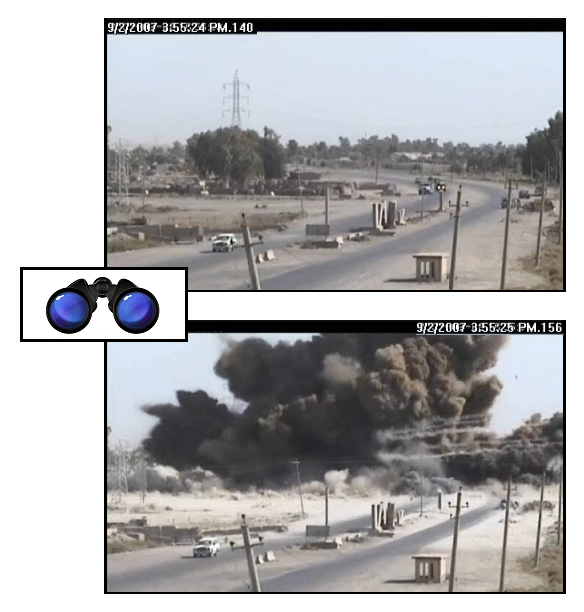
I’ve split these two images, both drawn from the same video one second apart, to give myself the fraying edges of a visceral sense of what that separation of life from body might be about.

See how little the car, bottom left, has advanced between the first image and the second.

The video the two images come from is embedded in Michael Yon‘s tribute to Carl Prine. I’d have embedded the video here myself if I could, but it’s in Vimeo rather than YouTube, and either because I’m incompetent or because Vimeo isn’t set up that way, I couldn’t figure out how to do the embed.

The Marine who sent Yon the video wrote:

This is the type of explosion that our troops are dealing with, not the puny kind we see on television or in the movies. Pass this on… so Americans will now understand what an IED truly is… and what our war veterans are dealing with.

Click on the link in red above if you haven’t already seen the movie nor lived through the event, and get that edge of a visceral sense — like a second-cousin-once-removed of the real thing.

My thoughts and prayers are with Carl Prine and all those battle-scarred in body, mind and soul.

**

One second passes between the first screen-grab and the second: time enough to sneeze, but not time enough to respond, “God Bless you”.

Life and death: a snapshot, a split second.

Numbers by the numbers: two

Thursday, July 12th, 2012

[ by Charles Cameron — numbers as analytic categories, two, the duel and the duet ]
.

Charles Darwin once said of his fellow species biologists:

Those who make many species are the “splitters,” and those who make few are the “lumpers”.

**

The diagram above represents a card-game I’ve played on occasion in my mind, asking myself the question: what is the opposite of one?

Two is the usual answer — and it’s interesting, you can get there from one two ways: by adding, or by dividing.

**

The human mind very often thinks in binaries, we talk about us and them, friend and foe, the Allies and the Axis Powers, and even an eye for an eye and a tooth for a tooth – our ideas of warfare, contest and justice alike are predicated on the number two.

As I said in my intro post, one is a single data point, perhaps an anomaly: two is a duel or a duet, an opposition or a trend.

So we don’t always have to think of us and them — we could also think about me and mine, you and yours, two heads are better than one…

And what if you can “turn” your enemy? Then the duel turns into a duet.

**

The duel is all about two competing, contending, fighting, agonizing to see who shall be the one. It is arguably the most basic form of combat, the simplest, and possibly the most profound. It can be close to symmetric — “they were perfectly matched” — or the very essence of asymmetric — David and Goliath.

The duet is about two collaborating, counterpointing, harmonizing — seeing how, together, they are one…

War-fighting and music-making, war and peace, regiment and free form, the march and the dance…

*****

I am eager to know what sorts of insights you can derive from or find echoed in this series of posts.

SWJ: Casebooks on Insurgency

Tuesday, July 10th, 2012

This looks to be an invaluable resource. From SWJ:

Casebooks on Insurgency and Revolutionary Warfare 

US Army Special Operations Command and Johns Hopkins University/Applied Physics Laboratory National Security Analysis Department have put together a useful reference for small wars students and practitioners entitled “Casebook on Insurgency and Revolutionary Warfare Volume II:  1962-2009.”  The resource is available for download in PDF format here.  If you are wondering where Volume I is, that government document covers post-World War I insurgencies and revolutions up to 1962 and can be downloaded in PDF here.  The original was published by the Special Operations Research Office at The American University in 1962.

Volume II is broken down by conceptual categories as can be seen by the table of contents….

Read the rest here.


Book Review: Thucydides:The Reinvention of History by Donald Kagan

Thursday, July 5th, 2012

Thucydides: The Reinvention of History by Donald Kagan 

Donald Kagan, who has been a professor of history and classics at Yale University almost as long as I have been alive has written a provocative book about Thucydides that challenges both conventional scholarly wisdom regarding the man who shares the title of “The Father of History” and the purpose of the book Thucydides meant to be “a possession forever”, The Peloponnesian War. In Kagan’s interpretation, Thucydides is the father of historical revisionism whose careful methodology furthered a political agenda: to defend the record of the Periclean state in Athens, where democracy was moderated by the wise statesmanship of the old aristocratic elite; and lay the blame for the downfall of Athens at Spartan hands on the vulgar hubris of radical democracy of mob and demagogue.

Thucydides is tightly focused argument about Thucydidean omissions, juxtapositions and treatment of sources and bias in his analytical rendering of military events and debates in the Assembly, not a comprehensive examination of  The Peloponnesian War. Specifically, the treatment of Pericles and Nicias (whom Kagan argues Thucydides favors and whom Kagan blames for failures of strategy and execution, especially the latter) vs. that he meted out to Cleon, Alcibiades and Demosthenes. Kagan criticizes Thucydides for the deliberate omission of speeches of Periclean opponents in debates where he  had been present and purporting to know the thoughts of actors where definitely had been absent, in exile; of faulty military analysis of the situation of the Spartan garrison besieged on Sphacteria due to personal enmity with Cleon and of the original expedition to Syracuse, because of favortism toward Nicias.

On Nicias in particular, a fellow aristocrat in favor of strategic restraint whom Kagan ascribes blame for the disaster in Sicily, did Thucydides seek a radical revision of the contemporary Athenian opinion. It was Thucydides belief that the post-Periclean democracy was a reckless, superstitious and greedy mob that led him, Kagan argues, to craft his narrative as an apologia for the inept statesmanship and incompetent generalship of Nicias that brought Athens to utter ruin in Sicily. Kagan’s accusations of bias on Thucydides part are more persuasive than his contention that the original expedition to Syracuse of sixty ships was a justifiable and sensible endeavor.

Kagan’s charges against Thucydides indirectly raise the larger question of politics in postwar Athens. A democracy shorn of it’s empire, long walls and fleet, defeated in external war but triumphant in brutal civil strife over it’s internal oligarchic enemies, was in all likelihood a dangerous place. Xenophon felt as a follower of Socrates, who had been associated with the reviled Alcibiades and Critias, that it was politic to leave Athens for his march upcountry under the banner of Cyrus. Socrates was unjustly put to death by the democratic faction. Writing from retirement in the luxury of a distant estate was a wiser option for a man of Thucydides’ opinions in that era than a return to the political fray in Athens and in part, would explain his supposed “revisionism”.

Strongly recommended.

Infinity Journal: The Foundation of Strategic Thinking

Tuesday, July 3rd, 2012

I first heard Lieutenant General Paul Van Riper speak at the Boyd ’07 Conference at Quantico and came away impressed. General Van Riper has a new article posted at Infinity Journal (registration required but always free….):

The Foundation of Strategic Thinking 

….While Clausewitz alludes to this nonlinearity through much of his opus On War, he speaks to it directly in Book One, Chapter 1, Section 28. This section, which hardly takes up half a page, summarizes many of the essentials of Clausewitz’s theory of war. He begins the section noting: “War is more than a true chameleon that slightly adapts its characteristics to the given case.”[vii] His use of a biological metaphor indicates war is not mechanistic and therefore not a controllable or predictable phenomenon. He then lays out the dominant tendencies of that phenomenon, which strategists often sum up as passion, probability, and reason. He mentions that most often the three tendencies are the concern of the people, army, and government.[viii] Continuing, Clausewitz makes a strong claim: “A theory that ignores anyone of them or seeks to fix an arbitrary relationship between them would conflict with reality to such an extent that for this reason alone it would be totally useless.”[ix]

In other words, to be valid any theory of war must incorporate war’s intrinsic dynamism. He goes on to say: “Our task therefore is to develop a theory that maintains a balance between these three tendencies like an object suspended between three magnets.” This analogy points to a cutting-edge scientific experiment of his era, that demonstrates the nonlinearity of any system where there is freedom of movement among three or more elements.[x] The virtual impossibility of duplicating the path of a pendulum as it moves among three equally spaced magnets tells us that despite our desire to balance passion, probability, and reason—the three central tendencies of war—it is simply not possible.[xi] War is a nonlinear phenomenon.

As with all nonlinear phenomena, we can only study war as a complete system, not as individual parts. Clausewitz is clear in this regard claiming that, “. . . in war more than in any other subject we must begin by looking at the nature of the whole; for here more than elsewhere the part and the whole must always be thought of together.”[xii] This advice runs counter to Americans’ preference for using an engineering approach to solve all problems. Reductionism tends to be part of the national character. We persist in using linear methods even when the evidence shows their limitations.

John Lewis Gaddis described the difficulties this approach has caused the U.S. national security community in a ground-breaking article questioning why political scientists failed to forecast the end of the Cold War.[xiii] His convincing conclusion is that while members of the physical and natural sciences were incorporating the tools of nonlinear science into their various disciplines those in political science were adopting classical linear practices, which blinded them to the dynamics that led to the Soviet Union’s demise. In the end, we confront the reality that as with war, international relations is nonlinear. Indeed, so also are most things that flow from it, including strategies and strategic thinking. […]

Read the rest here.

I particularly liked Van Riper’s later comment as going to some of what ails us:

….Good strategists know how nonlinear systems such as nation-states, non-state actors, international relations, politics, economics, wars, campaigns, and a host of others work in the real world. More importantly, they use this knowledge of a nonlinear world when they ponder strategic questions or recommend strategies. Good strategists don’t depend on analytical tools to uncover the future security environment or potential enemies. Rather, they look to history and economic and demographic trends to inform their judgments of what might happen in a nonlinear world.

If you look at the biographies of the men who were “present at the creation” or made the transition from World War to Cold War – Stimson, Acheson, Harriman, Marshall, Bohlen, Kennan, McCloy, Forrestal, Nitze, Eisenhower, Dulles, Lovett – they had overlaps of background in international business, diplomacy, banking, law and war. While this did not mean policy harmony – for example Acheson, Kennan, Bohlen, Harriman and Nitze had disagreements among themselves in regards to the Soviets  – they possessed a shared understanding of strategy and the historical context in which they operated.

Today, high level discussions of strategy between the military, policy and political worlds are too often exactly that – communications between different planets rather than a dialogue within one small world.


Switch to our mobile site

