zenpundit.com » politics

Archive for the ‘politics’ Category

Does Culture Trump Strategy?

Thursday, November 1st, 2012
The always interesting John Hagel tweeted a link recently to an old post at  Mill’s-Scofield Innovanomics, a blog run by a business strategist and consultant with a science background, Deb Mills-Scofield.

Summer’s Trump Cards 

….Culture Trumps Strategy: The best made plans are worthless if they’re not aligned with the culture. Sometimes the strategy can help transform the culture (for good or bad), but if the culture doesn’t support it, it won’t happen.  Perhaps that’s why I think CEOs need to be CCS’s – Chief Culture Stewards.

Challenge:  Start to check the health of your culture – really, be brutally honest -before the end of August.

This was interesting to me.

Obviously, Mills-Scofield was concerned here with “business strategy” and organizational theory and not strategy in the classical sense of war and statecraft. As Dr. Chet Richards has pointed out, unlike a military leader in war, businessmen are not trying to destroy their customers, their employees or even their competition, but while not the same kind of “strategy”, the underlying cognitive action, the “strategic thinking”,  is similar. Perhaps the same.

So, shifting the question back to the original context of war and statecraft, does culture trump strategy?

On twitter, I had a brief twitter discussion on this with Marc Danziger who was sympathetic to the proposition of cultural supremacy. I am not so sure, though I think the relationship between culture and strategy is an iterative one, the degree to which culture matters in strategy is highly contextual and is determined by how broadly you define cultural values as being directly operative in driving the scenario. Some disjointed comments:

  • Your own cultural-societal worldview shapes politics, policy and politik. So indirectly, culture will be a determining factor in conceiving “Ends” worth spilling blood and dying for – particularly in wars of choice. When war, especially existential conflict is forced upon a state by an enemy attack, some of the initiative and room for constructing artful or limited “Ends” has been lost and becomes secondary to survival. Even Stalin’s normally overweening and murderous ideological preferences mattered somewhat less in Soviet policy and strategy the day after Operation Barbarossa began than the day before.
  • If the Ends in view imply forcing a political settlement upon the enemy – “compelling him to do our will” – than the enemy’s culture matters a great deal. All the moreso, if the war entails COIN, military governance of an enemy population and reconstructing an enemy state to our liking. The enemy culture is part of the operational environment because our use of military force (destruction) is going hand in glove with substantial political activity (construction) – mere physical control of the population is not enough, though it is a precondition for success. MacArthur’s role as SCAP in post-war Japan demonstrated an exceptionally shrewd blend of coercion and concession to traditional Japanese cultural touchstones.
  • If our Ends are much more limited – degrading enemy operational capacity and/or simple, spasmodic, punitive expeditions to impose costs on an enemy state or entity in retaliation for aggression; or, if we intend to stand off-shore and strike with air and naval superiority – than the enemy culture matters far less. Force is being used to “bargain” at a very primitive level that does not require much cultural nuance to understand and the message of “we will hit back” . Likewise, if the war is an unlimited one of extermination and Carthaginian peace, enemy culture matters far less than your military capacity to execute your strategy.
  • Your cultural worldview shapes your grand strategy or statecraft because great and lesser powers are not coldly playing chess for material interests alone when they engage in geopolitical conflict and warfare but are establishing, evolving and protecting a national identity on the world stage. What Thucydides called “Honor”, the British “Paramountcy”, Richard Nixon “Credibility” and Joseph Nye “Soft Power” may all have been intangible expressions, difficult to quantify, but are very much part of the strategic calculus of war and peace.
  • Finally, it is important to note that strategic employment of brute force has a large role in setting the parameters of where and when cultural nuance and interpretation matter and exercise political leverage during war. Extreme violence disrupts and warps the cultural norms of belligerents, usually for the worse. It was the wars of the French Revolution and Napoleon that awoke the romantic pan-German nationalism of the 19th century that eventually united Germany and transformed it into the terror of the world in the 20th. The First World War ushered in a century of ideological monstrosities and revolutionary state terrorism on an epochal scale of murder unequaled even by the butchery of the Romans or Mongols. War is often the Abyss that looks into you.

Thoughts?

Cool theological footnotes to a heated political argument.

Saturday, October 27th, 2012

[ by Charles Cameron — Christian theology on two-fold logic, and its crucial importance in understanding the role of evil and the question of theodicy, with an aside concerning Islamic theology on the breath of life in utero, hence also abortion ]
.

As I shall say more than once, my own interest here is not in discussing the merits or demerits of a recent political debate, but to add a couple of theological nuances for our consideration.
.

Richard Moursock is reported to have said:

I struggled with it myself for a long time, but I came to realize life is that gift from God, and I think even when life begins in that horrible situation of rape, that it is something that God intended to happen.

Joe Donnelly is reported to have responded:

The God I believe in and the God I know most Hoosiers believe in, does not intend for rape to happen — ever. What Mr. Mourdock said is shocking, and it is stunning that he would be so disrespectful to survivors of rape.

Mourdock then apparently responded:

What I said was, in answering the question form my position of faith, I said I believe that God creates life. I believe that as wholly and as fully as I can believe it. That God creates life. Are you trying to suggest that somehow I think that God pre-ordained rape? No, I don’t think that. That’s sick. Twisted. That’s not even close to what I said. What I said is that God creates life.

Similarly, Rick Santorum is reported to have said:

I think the right approach is to accept this horribly created — in the sense of rape — but nevertheless a gift in a very broken way, the gift of human life, and accept what God has given to you. We have to make the best of a bad situation.

**

My sole intention here is to add in a note or two about theology — I explicitly do not address the moral, political, legal and gender ramifications of this issue.

We are accustomed to think in terms of what I’d call “single-track” logic: the logic of Aristotle’s excluded middle. Christianity however, in its gospel-based forms, on occasion uses a “two-track” logic, in which something can be both timeless and temporal, or both the will of God and a clear defiance of that will.

An example of the first can be found in Christ saying of himself, “Before Abraham was, I am.” (John 8.58).

On the face of it, that’s ridiculous – Christ appears to be claiming to have preceded Abraham, who is commonly called “our father Abraham” (Avraham Avinu, Rab in Yoma 28b cf. Genesis 26.3, cf. also Abeena Ibraheem in the Qur’an, 22.78). If single-track logic obtains, that’s a fair and reasonable critique.

The clashing tenses of the two verbs, however, gives us the clue that a two-track logic is at work: that Christ is claiming to be in eternal presence, in a manner that logically “precedes” Abraham’s admittedly prior place when considered in terms of a purely temporal sequence.

**

That piece of two-track logic doesn’t have any direct bearing on the politics of abortion in today’s USA, although it was a scandalous enough paradox to the Jews Jesus was addressing that the next verse states:

Then took they up stones to cast at him: but Jesus hid himself, and went out of the temple, going through the midst of them, and so passed by…

I have quoted it first to make the point that two-track logic is at work in the sayings of Christ in the New Testament – but the key reference point illuminating what Moursock and those of like mind might say concerning an act both being in flagrant defiance of God’s will and also in some way partaking of it would be the betrayal of Christ, resulting directly in his arrest and crucifixion – the hideously cruel form of capital punishment used in that time and place.

Matthew 26.24 indicates that the betrayal and death of Jesus are the means by which a sacrifice is made, in fulfillment of prophecy, and then goes on to point up a double moral:

The Son of man goeth as it is written of him: but woe unto that man by whom the Son of man is betrayed! it had been good for that man if he had not been born.

Reading that, it’s clear that within Christian two-track logic, an outcome (in our contemporary case, fertilization) can fall within the will of God, while there is “woe unto that man by whom” that outcome was brought willfully and sinfully effect.

Thus considering a child born of rape a blessing in its own right may — from a strictly theological standpoint — coexist with the idea that the rape should be abhorred and the rapist subject to whatever punishment the law may provide.

**

I should briefly note here two other pieces that address parts of the same issue:

  • Sarah Sentilles, Rape and Richard Mourdock’s Semi-Omnipotent God, posted at Religion Dispatches
  • G. Jeffrey MacDonald, Richard Mourdock: the theology behind his rape comments, posted at the Christian Science Monitor
  • Obviously, I am not impressed with Christian theological commentaries that miss the “twofold logic” at work wherever evil is encountered in a good creation.

    The case of the betrayal of Christ is the clearest possible indication that God can will the outcome of an act which is in flagrant opposition to his will. The gospels state and Christians believe that Christ’s betrayal itself, not just the consequential salvation of the world by virtue of his sacrifice, was foretold in prophecy: in this sense, even the betrayal was part of the divine will, though as we have seen, that in no way excuses Judas from his complicity in deicide.

    To be perfectly clear: it is my opinion that only the twofold logic I have pointed to satisfactorily approaches the age-long question of theodicy or the problem of evil, which I hope to return to in an upcoming post.

    **

    It is perhaps worth also noting here that the Qur’an suggests that life enters the developing body of a child in the middle of the second trimester, 120 days after conception — although we should also remember that “40 days” can mean “quite a while” in Semitic cultures, if Hebrew figurative usage us anything to go by.

    Thus we read in the Qur’an, 5.12-14:

    And verily We did create man from a quintessence (of clay). Then We placed him (as a drop of sperm) in a place of rest, firmly fixed. Then We made the sperm into a clot of congealed blood. Then of that clot We made a (foetus) lump. Then We made out of that lump bones and clothed the bones with flesh. Then We developed out of it another creature (by breathing life into it). So blessed be Allah, the most marvellous Creator.

    Expanding on this, in the premier hadith collection, Sahih al-Bukhari (# 3036), we read:

    Sayyiduna Abd Allah ibn Mas’ud (Allah be pleased with him) narrates that the Messenger of Allah (Allah bless him & give him peace) said:

    Each one of you is constituted in the womb of the mother for forty days, and then he becomes a clot of thick blood for a similar period, and then a piece of flesh for a similar period. Then Allah sends an angel who is ordered to write four things. He is ordered to write down his deeds, his livelihood, his (date of) death, and whether he will be blessed or wretched (in religion). Then the soul is breathed into him…

    I am indebted to commenters on Juan Cole‘s post Mourdock, Rape as a Gift of God, and Islamic Sharia on his informed Comment blog for the impetus to research the question of life in utero from an Islamic perspective.

    Wisdom traditions may differ across centuries and cultures…

    **

    In closing, let me repeat: this posts presents footnotes on points in theologies, and is not intended to make a statement or give any indication of a political opinion.

    My personal keen interest is in how our valuation of our human situation would change if more of us had an acute sense of two-track logic as it applies to “eternity within the temporal” and its corollary, the mutual interdependence of all that is.

    Speaking of Pundita….

    Wednesday, October 24th, 2012

    She has a post up that skillfully weaves the case of Colonel Tunnell into a much larger, demoralizing, political and policy context:

    On the perversion of nonviolence and religious tolerance in service of politics and war 

    Two recently published essays, one by Belmont Club’s Richard Fernandez, one by Zenpundit’s Mark Safranski, when taken together reveal a portrait of human evil so horrific that young people and the severely depressed should not be allowed to see it. The rest of us need to contemplate what we have wrought by looking the other way as NATO military commands ordered soldiers in Afghanistan to act like saints in the face of ruthless armed militias and democratic governments promoted the lie that nonviolent resistance could topple dictators.  

    In The Limits of Myth, Richard Fernandez amplifies on the theme I presented in On the Taliban shooting of Malala Yousafza: Pakistani human rights activists need to step believing in American fairy tales:

    Pundita argues the notion of bloodless resistance has been oversold by the advocates of Mahatma Gandhi and Martin Luther King. It was a convenient alternative narrative to that perennial problem-solving algorithm, war.  By skipping over the War of Independence and the Civil War and emphasizing the Salt March and Selma, Alabama they gave the mistaken impression that resistance was all about speeches and heroic poses.
    […]
    But nonviolence is a useful myth she argues, because it gives diplomats an excuse not to act. It makes a virtue of doing nothing by characterizing it as actively breaking the cycle of violence and counseling that eventually the tyrant will die of shame. But not before you die of a bullet.
    […]
    The truth is that every resistance movement — even largely nonviolent ones — carries with it the implicit threat of force. The police and army of the regime often switch sides when they see that the cost of dealing with impending storm of popular violence exceeds the cost of turning on the tyrant. They fear force and therefore decline to exercise it.

    The idea of consequences was once deeply rooted in the public consciousness. Yahweh thundered. And even Christ came to save us from the fires of hell. But hell there was. The opportunity for nonviolent change was always understood to be the ‘last chance’ prelude to violent consequences.  …  This kind of reasoning is now out of fashion…..

    Read the rest here.

    Apocalypse Revisited, not for the last time

    Tuesday, October 9th, 2012

    [ by Charles Cameron — Tim Tebow and 666, Charlie Fuqua and stoning disobedient children — addenda to two recent posts ]
    .

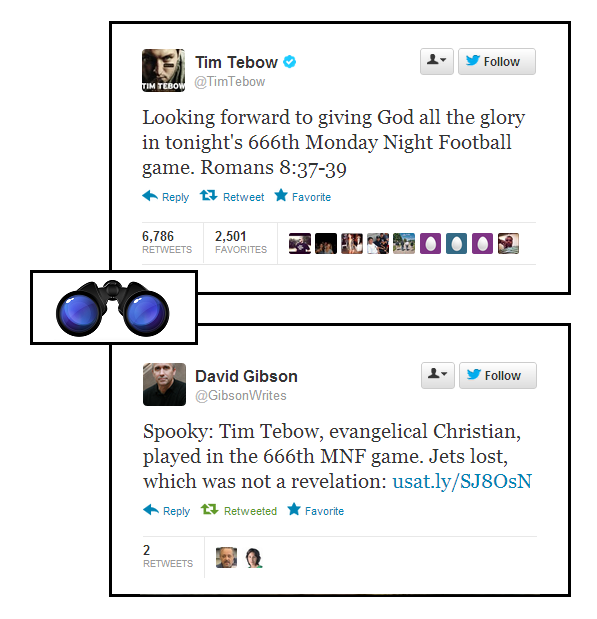
    First, the more lighthearted news. Yesterday I featured three footballers prayingTim Tebow was one of them. Today: when prophecy fails on Twitter:

    Just look at the retweets for Tebow: his tweet may have been half-tweet, half prediction, half-prayer, all in one forty characters, and his fans were behind it — yet the Jets lost.

    At the time of writing, Tebow hasn’t tweeted for 24 hrs.

    Permit me an aside, by way of clarification — as someone raised in the UK, I don’t know what “the Jets lost” means, to be honest. My Welsh ex once understood American Football while she was watching a game on hospital TV during a delivery — until the epidural wore off, at which point it went back to being incomprehensible. So that’s as close as I’ve come to understanding it myself — although I played both soccer and rugby in my schooldays.

    **

    Now onto more serious things. In a comment on another recent post, I mentioned Charlie Fuqua, a Republican candidate for the Arkansas House. I am beginning to think we should have a category to put after the names of such people, as in “candidate Charlie Fuqua (R-Ex)”, to indicate that many on their own team disavow their more extreme pronouncements.

    In a post on his Running Chicken blog headed Today in inexplicable religious zealotry, Prof. Ari Kohen quotes the Arkansas Times on Charlie Fuqua, a Republican-side candidate for the Arkansas legislature:

    Here’s the key passage from Fuqua’s 2012 book, “God’s Law: The Only Political Solution“:

    The maintenance of civil order in society rests on the foundation of family discipline. Therefore, a child who disrespects his parents must be permanently removed from society in a way that gives an example to all other children of the importance of respect for parents. The death penalty for rebellious children is not something to be taken lightly. The guidelines for administering the death penalty to rebellious children are given in Deut 21:18-21:

    Deuteronomy 21.18-21 reads:

    If a man have a stubborn and rebellious son, which will not obey the voice of his father, or the voice of his mother, and that, when they have chastened him, will not hearken unto them: Then shall his father and his mother lay hold on him, and bring him out unto the elders of his city, and unto the gate of his place; And they shall say unto the elders of his city, This our son is stubborn and rebellious, he will not obey our voice; he is a glutton, and a drunkard. And all the men of his city shall stone him with stones, that he die: so shalt thou put evil away from among you; and all Israel shall hear, and fear.

    The Arkansas Times continues:

    Fuqua helpfully notes that “This passage does not give parents blanket authority to kill their children.” Rather, parents would have to “follow the proper procedure in order to have the death penalty executed against their children.” Fuqua assures the reader that, in his view, the procedure would “rarely be used.” The threat of death would, however, “be a tremendous incentive for children to give proper respect to their parents.”

    **

    Here’s where Prof. Kohen, Schlesinger Associate Professor of Political Science and Director of the Forsythe Family Program on Human Rights and Humanitarian Affairs at the University of Nebraska—Lincoln, adds his own informed scholarly input:

    The trouble for Fuqua — and anyone else who thinks the Hebrew Bible provides a good template to follow in cases like these — is that he doesn’t actually have any idea what Jewish scholars and religious authorities have been thinking and writing about this particular passage for centuries:

    In defining the extent and limitations of the laws of the ben sorer u-moreh, the Talmud (Sanhedrin 71a) states that the child is not considered liable until he has stolen his father’s property in order to acquire a tartimar of meat to eat, and a log of Italian wine to drink. The Halakha places further restrictions upon the ben sorer u-moreh so as to make the application of the law extremely unlikely, if not impossible. The rules only apply with the first three months after the child has reached halakhic manhood; both parents must be living and willing to press charges; neither parent can be deaf, lame, nor missing a limb; they must speak with the same voice and have the same appearance; the boy must steal the meat and wine from his father’s house, yet consume them elsewhere in the company of worthless individuals, in order for him to be convicted. According to the Tosefta Negaim, this law is not in effect in Yerushalayim. (The Meshekh Chokhma suggests that this is due to the continuous eating of so many sacrifices and offerings, as well as ma’aser sheni – the second tithe – within Jerusalem; consumption within the city, since it is performed for mitzva purposes, cannot be considered gluttony.) These are only a few of the numerous restrictions and limitations that apply before a boy can be judged as a ben sorer u-moreh, ensuring that the actual application of the law was extremely rare.

    Several Talmudic opinions (Sanhedrin 71), having studied the above limitations, conclude that the case of the ben sorer u-moreh “never occurred and never will occur.” According to them, the sole purpose of having this section in the Torah is to learn the laws and provide a reward for those who do so.

    So, in brief, here is my plea to people like Charlie Fuqua:

    Stop cherry-picking the Torah to justify all of the terrible things you want people to do to one another; Jews don’t believe that things like this are mandated by the Torah and it’s our book.

    **

    I very much appreciate Prof. Kohen’s comments, which open a lively window not only on Judaic scripture, interpretation and practice, but also on how scriptures, their literal interpretations by outsiders, and the more skillful and adaptive interpretations of scholars within the traditions can function in the actual shaping of human lives…

    When considering the scriptures of any religious tradition, we should bear such examples strongly in mind.

    **

    Indeed, I have only one qualification to make regarding Prof. Kohen’s post, and offer it as a small gift of thanks.

    The one thing I can say that Fuqua is very likely not doing is cherry picking.

    It is far more likely that he is a follower of the late RJ Rushdoony, whose massive work The Institutes of Christian Law advocates for the application of what he terms Biblical Law – in its entirety — to American society, and whose Chalcedon Institute published an article in its January 1999 issue on precisely this topic: Rev. William Einwechter‘s Stoning Disobedient Children?:

    Deuteronomy 21:18-21 contains what is, perhaps, the most vilified law of the Old Testament. It is widely believed that this law authorizes the stoning of children who disobey their parents. … When this case law, which applies the moral law of the Fifth Commandment to a specific circumstance, is understood it will prove to be “holy, just, and good,” a delight to the heart of God’s true people (Rom. 7:12, 22).

    This piece created a bit of a stir, and it was followed shortly thereafter by another Einwechter piece: Stoning Disobedient Children? Revisited.

    Both articles seem to have proven unpopular enough that they have been removed from their respective original sites, so I am grateful that the Archive still has them as linked above. I recommend an acquaintance with Rushdoony’s work, and with essays such as these, to anyone interested in the influence of “Biblical Law” on contemporary politics.

    **

    By way of comparison, the Qur’an, like the Torah, stresses the importance of honoring one’s parents in close conjunction with that of having no god but God. Thus Qur’an 17:23 in the Shakir translation reads:

    And your Lord has commanded that you shall not serve (any) but Him, and goodness to your parents. If either or both of them reach old age with you, say not to them (so much as) “Ugh” nor chide them, and speak to them a generous word.

    — compare Exodus 20.3-5, 12 — while the hadith reported in Sahih Bukhari, Bk 48, Witness, #822 tells us:

    Narrated Abu Bakra:

    The Prophet said thrice, “Should I inform you out the greatest of the great sins?” They said, “Yes, O Allah’s Apostle!” He said, “To join others in worship with Allah and to be undutiful to one’s parents.” The Prophet then sat up after he had been reclining (on a pillow) and said, “And I warn you against giving a false witness, and he kept on saying that warning till we thought he would not stop.

    To my knowledge, no specific (hudud) punishment for disobedient children is prescribed in the Qur’an.

    Haaretz on the Temple Mount, pt II: axis mundi

    Sunday, October 7th, 2012

    [ by Charles Cameron — Jerusalem, and the Temple Mount in particular, as the still point in the turning world — Midrash, Haaretz, a map from 1581, M Eliade, TS Eliot, Navaho Night Way ]
    .

    There is tremendous poetic force to the notion of the axis mundi, the mythic center around which all else revolves.


    .

    In an earlier post, I quoted this saying, which exemplifies the power of the “center of the world” motif as applied to Israel and the Temple Mount:

    As the navel is set in the centre of the human body,
    so is the land of Israel the navel of the world…
    situated in the centre of the world,
    and Jerusalem in the centre of the land of Israel,
    and the sanctuary in the centre of Jerusalem,
    and the holy place in the centre of the sanctuary,
    and the ark in the centre of the holy place,
    and the foundation stone before the holy place,
    because from it the world was founded.

    – Midrash Tanchuma, Qedoshim.

    **

    Let’s give that room to breathe.

    **

    There are those who will dismiss all such images and words as irrelevant, impractical, foolish, irrational — Jerusalem is not the center of the earth any more than the earth is the center of the solar system — but to a poet they are words in a familiar language, not of fact but of imagination and love. They are poetry.

    Sadly, in my view, the members of the various movements to rebuild the Jerusalem Temple on or near the sites of the Al-Aqsa Mosque and Dome of the Rock on the Noble Sanctuary / Temple Mount take the poetry of the Mount as axis mundi literally and all too politically — as happens not infrequently with authentic poetry.

    Phrased as political prose, the idea just isn’t the same, as these words from Shany Littman‘s Haaretz article addressed in the prequel to this post will demonstrate:

    Rivka reminded us that over and above the sheer experience and the historical tales, the visit had a purpose: to understand the essence of the Jewish home through the Temple, as the visit revolved around a bride on her wedding day. Holding up a page containing what looks like a satellite image of planet Earth, she showed how, from a certain angle, the Land of Israel and Jerusalem appear to be at the center of the world, in its innermost circle. “I give lessons to women about modesty,” she said. “I show them this image and replace the word ‘modesty’ with the word ‘inwardness.’ The innermost circle, the most hidden, is the Land of Israel, Jerusalem, the Temple, the Holy of Holies. What is modesty, what is a modest, inward place? It is hidden, the place least visible to the eye.”

    But the bride was contentious: “You could take that photograph from a different angle and then Jerusalem will not be in the center.” “True,” Rivka replied, “but here we see that the State of Israel is at the heart of the world. If the world knew how much it would gain from us building the Temple, they would heap good stones on us, because they will profit from it. The most prosperous countries in the world are the Western ones; China, Africa and Asia are poor.”

    A questioning eyebrow was raised. “Don’t look at the industry,” Rivka said. “Look at the miserable people, who are not allowed to have more than one child and don’t have proper housing and suffer from tsunamis and earthquakes. Look at the suffering they are undergoing. And why? Because the Jewish people resides close to the Temple, the world on this side gains; where we do not reside [i.e., the East] the world loses. This is the place that coordinates and pinpoints all the prayers and the connection with the Master of the Universe. If we are not here, they lose. And we lose, too.”

    and, in the words of Prof. Weiss from the same article:

    I want to take the movements to a place that is more sensible: a Temple-based state, where the state’s entire content revolves around the Temple.”

    **

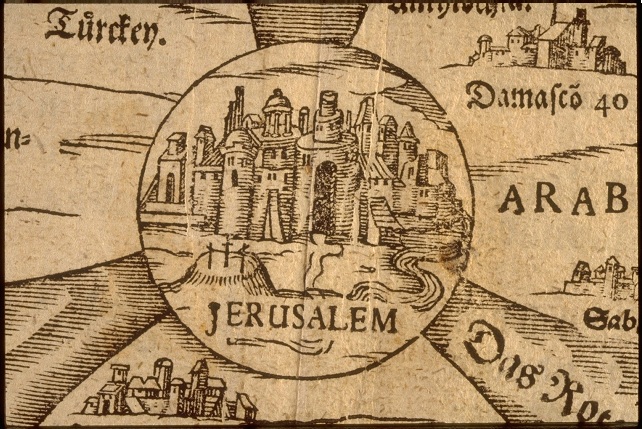
    Map (above) by Heinrich Bunting from a copy of Itinerarium Sacrae Scripturae (1581) in the Jerusalem as the center of the world exhibition at the University of Southern Maine’s Osher Map Library, detail below:

    **

    For more on the symbolism of the axis mundi, see Mircea Eliade‘s essay Symbolism of the Centre in his book Images and Symbols — or consider these lines from TS Eliot‘s poem-series, Four Quartets:

    At the still point of the turning world. Neither flesh nor fleshless;
    Neither from nor towards; at the still point, there the dance is,
    But neither arrest nor movement. And do not call it fixity,
    Where past and future are gathered. Neither movement from nor towards,
    Neither ascent nor decline. Except for the point, the still point,
    There would be no dance, and there is only the dance.
    I can only say, there we have been: but I cannot say where.
    And I cannot say, how long, for that is to place it in time.
    The inner freedom from the practical desire,
    The release from action and suffering, release from the inner
    And the outer compulsion, yet surrounded
    By a grace of sense, a white light still and moving…

    **

    In many ways, both Eliot’s words and those of the Midrash remind me of the beauty found in the prayers of the Navaho Night Chant:

    In beauty may I walk.
    All day long may I walk.
    Through the returning seasons may I walk.
    On the trail marked with pollen may I walk.
    With grasshoppers about my feet may I walk.
    With dew about my feet may I walk.
    With beauty may I walk.
    With beauty before me, may I walk.
    With beauty behind me, may I walk.
    With beauty above me, may I walk.
    With beauty below me, may I walk.
    With beauty all around me, may I walk.
    In old age wandering on a trail of beauty, lively, may I walk.
    In old age wandering on a trail of beauty, living again, may I walk.
    It is finished in beauty.
    It is finished in beauty.

    To my reading eye as a poet, these are all expressions of the same kind — invocations of the human spirit by rhythm and imagery — true poems, visions. They offer us a form of nourishment and insight not easily found today — nourishment and insight which shrivel and die when reduced to politics or prose.

    **

    For more on the Navaho chantways, and the balance called “sa’a naghai bik’e hózhó” which this prayer embodies, see John Farella, The Main Stalk: A Synthesis of Navajo Philosophy.


    Switch to our mobile site