zenpundit.com » recommended reading

Archive for the ‘recommended reading’ Category

Recommended Reading – Cinco De Mayo Edition

Monday, May 6th, 2013

Top Billing! T. GreerWhat Happens When Wall Street Goes Up Against the CIA? 

….I would like to focus on one sentence hidden in the body of the report. Shortly after the implementation of the Merida Initiative in 2008, the Mexican intelligence agency CISEN discovered that various cartels were employing American trained, ex-special forces. Understandably alarmed, American intelligence agencies floated a proposal to cut the power of the cartels:

“Anxious to counterattack, the CIA proposed electronically emptying the bank accounts of drug kingpins, but was turned down by the Treasury Department and the White House, which feared unleashing chaos in the banking system.”This one sentence betrays Washington’s distorted foreign policy priorities.  The CIA proposal had several clear benefits: drug lords forced to pull their investments would have less incentive to stay in the game,  cartels would be robbed of operating funds, and most importantly of all, the proposal could be implemented with minimal American involvement. [2] There would be no need for more boots on the ground. The drawbacks were also clear: folks on Wall Street would lose money. The White House took Wall Street’s side in the debate, and favored a policy designed to kill or capture the “high value targets” whose bank accounts were not to be touched.  (Readers curious about the cost of these operations — in terms of man-power as well as money — will find plenty of details in the last few pages of the Washington Post report.) 

SWJ El Centro – Friction Rises as Mexico Curbs U.S Role in Drug Fight and Mexican Cartel Strategic Note No. 14: Narcocantante (Narco-singer) Assassinated in Mission, Texas 

….If the investigation determines that Quintanilla was killed because of his narcocorridos it would be the first known assassination of a narcocantante (narco-singer) in the United States.  This would be a significant shift in targeting and the U.S. would be firmly in the operational zone of targeted killings to shape the ‘narcosphere’ or ‘drug war zone.’  

Quintanilla was identified with the CDG: Cartel del Golfo (Gulf Cartel) and had dedicated songs to Tony Tormenta (Antonio Ezequiel Cárdenas Guillén)[6] the CDG capo who died in a battle with Los Zetas in November 2010.[7]  One of his songs, “Estamos En Guerra (Los Zetas Vs. CDG),”chronicled the battles following the Gulf-Zeta split.[8],[9]

It is possible that Quintanilla became a target of one or both of those cartels as a result of his characterization of their activities in the current conflict in Tamaulipas.  Certainly both cartels have a presence in Texas and could operate there as seen in recent reports of narcobloqueos (narco-blockades) in Texas.[10]  It is also possible that he crossed other criminal enterprises (such as U.S. gangs) or was targeted for more mundane criminal reasons.  Nevertheless, the modus operandi or tactics, techniques, and procedures (TTPs) involved in his death are consistent with those of narco-assassinations. 

Southern Pulse –Cleaning up after Operation Limpieza 

….Prosecutions of government corruption initiated under the Calderon administration are falling apart in the early months of the Peña Nieto administration, leading to accusations among Mexico’s political elite. On one side, PRI officials say the Calderon government abused its authority, relied on untrustworthy witnesses, and targeted politically convenient officials. On the other side of the debate are concerns that the PRI is allowing impunity for corruption and harming relations with US agencies that provided evidence and want corrupt officials out of government. Regardless of whether the officials named were or were not working with transnational criminal organizations, the Mexican government’s failure to successfully investigate and prosecute high-level corruption should be a source of concern. Rumors of high level corruption have only increased since ex-President Felipe Calderon declared a war on violent drug trafficking organizations in Mexico upon taking office in December 2006. 

SWJ Blog –Cyberwar in the Underworld: Anonymous versus Los Zetas in Mexico

WIREDDon’t Panic, But Mexico’s Zetas Cartel Wants to Recruit Your Kids 

FOXnews Latino –Mexico’s Blog De Narco Author Gives First Major Interview 

Washington Post – Obama’s trip to Mexico hints at new balance of power and What did we learn about Obama’s thinking in Mexico?

OTHER TOPICS:

TIME C. Christine Fair –Can This Alliance Be Saved? Salvaging the US-Pakistan Relationship

J.M. Berger –FORECASTING TERRORIST ATTACKS WITH BIG DATA AND THE WISDOM OF CROWDS… OR NOT

Steven Pressfield Online (Shawn Coyne) –Getting Screwed is a Compliment 

Global Guerrillas-The Flaw that May Bring Down Bitcoin or Change it Forever 

 Information Dissemination (Robert Farley) Book Review: China’s Search for Security 

Col. Pat Lang –“Israeli attacks inside Syria risks widening war” CSM 

RECOMMENDED VIEWING:

A harbinger that we are in grave danger of becoming a nation of autistic mimes 😉

Jottings 3: Espionage on the chess board

Friday, May 3rd, 2013

[ by Charles Cameron — playing the two great games, from Caxton to Le Carré ]
.

.

Karla, the Russian spymaster in John Le Carré‘s Smiley novels, is represented as the white queen in the 2011 Tomas Alfredson / Gary Oldman film of Tinker Tailor Soldier Spy (lower panel, above).

In chess terms, that’s quite a step up for spies — pawn promoted to queen.

**

Before the digital age, in the early years of printing, way back in 1474, Thomas Caxton‘s press issued the second book ever printed in England — his Game and Playe of the Chesse — and things were subtly different. The eight pawns, for instance, differed one from another, each representing a different human type or craft, and named accordingly: “Labourer, Smith, Clerk, Merchant, Physician, Taverner, Guard and Ribald.”

It’s the Ribald (in the upper panel, above) who interests us here — for he’s the spy on the chessboard, as surely as Joshua the son of Nun and Caleb the son of Jephunneh were spies in the land of milk and honey. Caxton describes the Ribald, stationing him in front of the Rook, thus:

The rybaulders, players of dyse and of messagers and corrours ought to be sette to fore the rook/ For hit apperteyneth to the rook whiche is vicayre & lieutenant of the kynge to haue men couenable for to renne here and there for tenquyre & espie the place and cytees that myght be contrarye to the kynge/ And thys pawn that representeth thys peple ought to be formed in this maner/ he must haue the forme of a man that hath longe heeris and black and holdeth in his ryght hand a lityll monoye And in his lyfte hande thre Dyse And aboute hym a corde in stede of a gyrdell/ and ought to haue a boxe full o lettres

And what should be the appearance of such a one?

And thys pawn that representeth thys peple ought to be formed in this maner/ he must haue the forme of a man that hath longe heeris and black and holdeth in his ryght hand a lityll monoye And in his lyfte hande thre Dyse And aboute hym a corde in stede of a gyrdell/ and ought to haue a boxe full o lettres

Let’s go over that first part one more time, and make sure we understand it:

It pertains to the Rook, which is vicar and lieutenant of the King, to have men available to run hither and yon to make inquiries and spy out the place and cities that might be contrary to the King.

**

And isn’t that precisely what Moses sent Joshua and Caleb out to do, when he instructed them in Numbers 13.17-20:

Get you up this way southward, and go up into the mountain: And see the land, what it is, and the people that dwelleth therein, whether they be strong or weak, few or many; And what the land is that they dwell in, whether it be good or bad; and what cities they be that they dwell in, whether in tents, or in strong holds; And what the land is, whether it be fat or lean, whether there be wood therein, or not. And be ye of good courage, and bring of the fruit of the land.

**

Espionage has been around longer than chess: some things never change — and some things have changed significantly.

Today, you can’t tell one pawn from the next…

A second comment on Hegghammer & Lacroix

Sunday, April 28th, 2013

[ by Charles Cameron — because the Bene Gesserit understand the power of Mahdism and jihad ]
.

Further reading:

  • Frank Herbert, Appendix II: The Religion of Dune
  • Peter Tarchin, The ‘Dune Hypothesis’
  • Peter Tarchin, Psychohistory and Cliodynamics
  • Peter Tarchin, Science on Screen: DUNE
  • Peter Tarchin, How to Overthrow an Empire – and Replace It with Your Own
  • Ibn Khaldun, The Muqaddimah: An Introduction to History
  • Doris Lessing, Canopus in Argos: Archives
  • **

    As T Greer, friend of this blog, notes in a comment to that last Tarchin post, his explorations would fit in nicely with the work at Grand Blog Tarkin

    A Question for Hegghammer & Lacroix

    Sunday, April 28th, 2013

    [ by Charles Cameron — a single word in a very small book, and the world that hangs in the balance ]
    .

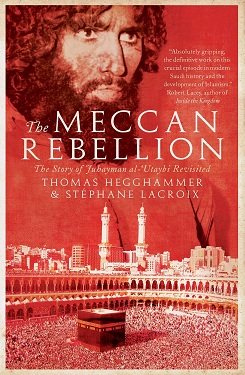
    I’ve just read Hegghammer & Lacroix on The Meccan Rebellion. At 78 pages and 5.3 x 8.3 inches, it’s a tiny book in hardback and quite a delight to hold — the electricity in my city block went out for a while the other day, and I took pleasure in reading it out under the sun — and it contains, in essence, the two authors’ paper, Rejectionist Islamism in Saudi Arabia (Int. J. Middle East Stud. 39 (2007), 103–122) and a companion piece by Lacroix titled Between Revolution and Apoliticism: Nasir al-Din al-Albanai and his Impact on the Shaping of Contemporary Salafism.

    Blog posts tend to present a point of view – whether to preach to the choir, promote it to unbelievers, stir up trouble, or simply add detail or a fresh angle to an existing narrative. Seldom do they ask questions.

    My own instincts — in line with Madhyamaka as I briefly encountered it in the teachings of Elizabeth Mattis-Namgyel — lead me to leave some kinds of questions open: I use my DoubleQuotes format to set the juices flowing, by providing nudges to thought rather than outright statements – but on this occasion I have a question to ask, and as it’s too long for Twitter I’ll post it here.

    **

    Here’s my question. Juhayman al-Utaybi believed one of his companions, Muhammad al-Qahtani, was the Mahdi, the awaited Coming One of Islam — and that, in our authors’ words, “consecrating him [al-Qahtani] in Mecca on the turn of the hijra century” would ”precipitate the end of the world”.

    In my view, a great deal rests on that simple word, “precipitate”. Would “usher in” do as well? Or “mark the beginning of” perhaps? Or is the idea of forcing the hand of God present, as it is in Reuven Paz’ phrase, “hot-wiring the apocalypse”?

    There’s a lot riding on that issue: whether or not it is possible to force the hand of God, to accelerate destiny, to hasten apocalypse.

    **

    Okay, let’s go light-footed into this issue. In The Question in the DC Comics universe, we have a character described thus:

    During service in Vietnam Jeremiah Hatch got insane, he began to hear the voice that urged him to do the will of the Lord by serving the Devil. He thought that his mission was “to hasten the corruption, to nurture the foulness until the almighty has no choice but to rain down fire and brimstone and overthrow the cities and the plain and all the inhabitants of cities and all that grows on the ground…”

    **

    Hastening the apocalypse — it’s an idea you can find in the world of DC Comics, but it was Israeli analyst Dr Reuven Paz who presented it to us in canonical “national security” form in his paper, Hot-wiring the Apocalypse, where his actual words are:

    The Jihadi and nationalist insurgency in Iraq, which feeds the motivations and enthusiasm of growing number of Islamist youth to search for Jihad, look for the “culture of death and sacrifice,” and self-radicalize themselves, is another factor in the growing sense of Jihadi pride, which also hotwires the sense of the apocalypse.

    That’s a faily imprecise form of words (‘The sense of apocalypse”) from a careful scholar, and Paz applies the concept in a specifically Sunni context. This, however, doesn’t prevent a popular Christian writer such as Joel Rosenberg from applying the same idea to the Shi’ite rulers of Iran:

    Only when we understand the eschatology currently driving Iranian foreign policy, can we truly begin to understand how dangerous the regime in Tehran is. Only then can we fully appreciate how events like the revolution underway in Egypt only encourages Twelvers like Khamenei to take still further provocative and perilous actions to hasten the coming of the Twelfth Imam.

    So the idea is afloat that both Sunni jihadists in Iraq and the Shi’ite state of Iran ay be about the “hastening” business.

    **

    Blog-friend Dr. Timothy Furnish, as I’ve noted here before, rebuts the application of Paz’ concept by Rosenberg, Glenn Beck and others to the situation in Iran, saying of it:

    It posits that there is a strain of Islamic eschatological thought which hopes to force Allah’s hand in sending the Mahdi, as it were, via sparking a major conflagration (nuclear, or otherwise) with the West (either the U.S. or Israel). This may be true of some of the Sunni jihadits with an apocalyptic bent, but there is very little evidence that such an idea is operative in the upper echelons of the Islamic Republic of Iran. The ayatollahs may be cut-throat, anti-Israeli and anti-American-but they are not stupid. They know full well that any nuclear attack on Israel of the U.S. would be met with a crushing retaliation. (Besides, what good would it do for the Mahdi to come and establish his global caliphate over smoking radioactive ruins?)”

    **

    And if I might ask a follow-up question — is the first of the Juhayman Letters, which is devoted to the theme of the coming of the Mahdi, available in English?

    Recommended Reading

    Wednesday, April 24th, 2013

    Top Billing! HNN Dr.Tim FurnishThe Ideology Behind the Boston Marathon Bombing 

    …..Much of the world, including the twittering class, woke up to the relevance — if not existence — of Chechnya this past week. (The Tsarnaev brothers’ parents were Chechen, but Dzokhar was born in Kyrgyzstan and Tamerlan in Russia proper; both had also lived in Dagestan.) Still a part of Russia, despite violent efforts at independence, this small region is home to about 1.3 million people, mostly Sunni Muslims, and is located between the Black and Caspian Seas. Islamic militancy has been part of this Caucasus Muslim culture for at least two centuries, until recently mostly in the guise of the various Sufi jihads waged against their Orthodox Christian (or Marxist) Russian overlords — exemplified by that of Imam Shamil (d. 1859). (The Sufis are the mystics of Islam, usually peaceful but never pacifist.) Throughout the twentieth century the Sufis in Chechnya, Dagestan and environs — predominantly two orders known as the Naqshbandis and Qadiris — increasingly eschewed jihad and, in recent decades, their Islamic militancy mantle has been taken on by Muslims (both indigenous Chechen and foreigners, such as Arabs) of the more Wahhabi/Salafi tendency (who have even killed Sufi leaders there). Salafis are Sunnis who believe in emulating the salaf, “pious ancestors” of Muhammad’s time — think Primitive Baptists, but wielding swords. Wahhabis are a specifically Saudi Arabian type of Salafi, intellectual heirs of the Sunni fundamentalist Ibn Abd al-Wahhab (d. 1792) who had resurrected and repopularized the strict Sunni teachings of Ibn Taymiyya (d. 1328) which, inter alia, included a dislike of Sufis (for their love of saint veneration, seen as shirk, “idolatry”) and the duty to fight jihad against any rulers deemed insufficiently Islamic as well as, a fortiori, non-Muslims.

    This was the Chechen Islamic context which incubated both Tamerlan and Dzhokhar Tsarnaev before they came to the U.S. as young men and, after over a decade here, seemingly assimilated. However, Internet sleuthing by various outlets indicates that the elder Tsarnaev, at least, was being pulled back into strict Islamic norms: he was a purveyor of the online sermons of one Feiz Mohammed, whose views were so Islamically “extremist” they might have made Ibn Taymiyya blanch; he may, as well, have become enamored with the ideas of a Pan-Islamic Caucaus Emirate and may have received training from jihadists of that self-styled polity; finally, perhaps most tellingly, Tamerlan was influenced by Islamic eschatological teachings about the coming of the Mahdi.   

    Foreign Policy J.M. Berger –Boston”s Jihadist Past 

    ….It will take time to discover whether there was a militant connection and, if there was, to what extent it is pertinent to the Tsarnaevs’ decision to bomb the marathon.

    But if the lead pans out, it won’t be Boston’s first brush with that faraway war. During the 1980s and into the 1990s, Islamist foreign fighters operated robust recruiting and financing networks that supported Chechen jihadists from the United States, and Boston was home to one of the most significant centers: a branch of the Al Kifah Center based in Brooklyn, which would later be rechristened CARE International.

    Al Kifah sprang from the military jihad against the Soviets in Afghanistan. Through the end of the occupation, a network of centers in the United States helped support the efforts of Afghan and Arab mujahedeen, soliciting donations and recruiting fighters, including at least four from Boston who died in action (one of them a former Dunkin Donuts employee). When the war ended, those networks did not disappear; they refocused on other activities.

    In Brooklyn, that network turned against the United States. The center’s leaders and many of its members helped facilitate the 1993 World Trade Center bombing, and they actively planned and attempted to execute a subsequent plot that summer to blow up the Lincoln and Holland Tunnels in New York, which would have killed thousands.

    When the FBI thwarted the tunnels plot, the Brooklyn Al Kifah office and most of the other satellite locations were shuttered. But in Boston, the work continued under a new name and with a new focus: supporting foreign-fighter efforts in Bosnia and Chechnya. 

    Dr. Chet Richards –Is 4GW dead? 

    ….The 9/11 attacks, by a transnational guerrilla movement, seemed to confirm 4GW in both of its forms. In the last few years, however, everything has gone quiet. Transnational insurgencies, “global guerrillas” as John Robb terms them, have not become a significant factor in geopolitics. “Continuing irritation” might best describe them, whose primary function seems to be upholding national security budgets in frightened western democracies. The state system has not noticeably weakened. So it might be fair at this point to conclude that although 4GW was a legitimate theory, well supported by logic and data, the world simply didn’t develop along the lines it proposed.

    ….The conditions for insurgency, as described by Boyd in Patterns of Conflict, had been defused by reforms in the early 20th century. Within the last 25 years or so, these conditions have returned. The austerity measures in southern Europe, the decline in living standards and economic polarization in the United States, and the enormous increase in firepower available to the general citizenry (at least in the US) will combine to produce abrupt changes in political organization. So long as the democratic process remains uncorrupted, these changes will be largely peaceful. In non-democratic states, and in those democracies where the beneficiaries of highly-skewed income and wealth distributions attempt to hang on to their gains by whatever means they deem necessary, we should expect higher levels of violence.

    Social Evolution Forum – How to Overthrow an Empire and Replace it with your Own

    Registan.net –Contextualizing Media Claims in BostonAbout the Central Asian Link to those Boston BombersFreedom and Fear in Central Asia: How the Security Assistance Debate is Asking the Wrong Questions

    Haft of the Spear -Explaining Computer Security Through the Lens of Boston 

    Global Guerrillas –OPEN SOURCE WARFARE never goes away 

    Marine Corps Gazette Blog – Marine Corps End Strength: 100k and End Strength 100k: Fixed-Wing Air 

    Hmmm…America wants more than a tiny Marine Corps

    Dr. David Ronfeldt –Further points about “tribes” (T) — plus a new proposition about TIMN as a whole

    WPR Dr. Steven Metz –Strategic Horizons: U.S. Professional Military Education on the Chopping Block 

    Campaign Reboot – Kill Chain 

    SWJ El Centro – How to Win the Mexican Drug War 

    Jamestown Foundation  – Shattering the al Qaida-Chechen Myth 

    Nick Carr – Augmentor and Augmentee 

    Presentation Zen –Should we be suspicious of stories?

    That’s it!


    Switch to our mobile site