zenpundit.com » recommended reading

Archive for the ‘recommended reading’ Category

Scenario planning and prophecy

Friday, October 14th, 2011

[ by Charles Cameron — futurism, prediction, Christian and Islamic apocalyptic traditions, fiction ]
.
clancy-rosenberg.jpg

Two new thrillers.  And what caught my eye — fascinated as I am by the whole business of prophecy and prediction, scenario planning and science fiction — was Wolf Blitzer‘s pronouncement about Tom Clancy on his CNN blog today:

Sometimes nonfiction seems to follow fiction, especially, it seems, in the case of Tom Clancy and his spy novels.

Here’s Blitzer’s supporting evidence:

In 1994, he wrote a thriller called “Debt of Honor.” Long before the terrorist attacks of 9/11, Clancy had a character fly a Boeing 747 into the U.S. Capitol. Clancy’s “The Teeth of the Tiger,” published in 2003, features a man named Mohammed who has a network of Colombian drug cartel thugs who plot evil deeds against the U.S. His newest book is entitled “Against All Enemies.” A major plot line has Taliban terrorists joining hands with Mexican drug cartel killers to launch attacks in the United States. A friend who’s read all the Clancy books alerted me to this when he heard of the Obama administration’s accusations that Iran plotted to have members of a Mexican drug cartel kill Saudi Arabia’s ambassador to the United States, Adel al-Jubeir. “Seems like terrorists are big Clancy fans,” my friend suggested…

Not so fast, Wolf and Wolf’s friend. They might equally well have been reading Joel Rosenberg (also, or instead).

Clancy does this sort of stuff because he’s a scenario planner turned novelist — Rosenberg does it because he’s a student of prophecy turned novelist.  Come to that, I rather like the idea that prophecy and scenario planning might be related.

Here’s an excerpt from Wikipedia’s current article about Rosenberg:

Nine months before the September 11th attacks, Rosenberg wrote a novel with a kamikaze plane attack on an American city. Five months before the 2003 invasion of Iraq, he wrote a novel about war with Saddam Hussein, the death of Yasser Arafat eight months before it occurred, a story with Russia, Iran, and Libya forming a military alliance against Israel occurring the date of publishing, the rebuilding of the city of Babylon, Iran vowing to have Israel “wiped off the face of the map forever” five months before Iranian President Ahmadinejad used similar language, and the discovery of huge amounts of oil and natural gas in Israel (a major gas discovery occurred in January 2009).

Neat, hunh?

Or of course, they could just all be playing Steve Jackson‘s 1995 Illuminati card game

illuminaticardgametowers.jpg

I suppose we should add role-playing and card-reading to our list of prognostic activities…

*

In any case…

I enjoy Joel Rosenberg’s books.  His thrillers are full of Christian and Islamic apocalyptic elements, of course, which are of continuing interest to me — especially when they cross over into each others’ territories.  I’ve been meaning to write up my review of the first book in his current series for months now — my copy must have a hundred or so little colored flags in it, marking passage of interest, plot points and so on.

And there are things Rosenberg gets seriously wrong that are important. It’s dangerous when someone who influences thousands through his Epicenter conferences and his appearances with Glenn Beck is unable to distinguish the Hojjatiyeh Society (a small group that may not even exist at this point) from Twelver (ie orthodox Shi’ite) Islam.

But it’s because I think:

  • that Islamic apocalyptic is important and all too often overlooked,
  • that he thinks so, too,
  • that his tying it in with policy proposals carries some weight,
  • that the brisk pace of his novels reaches readers who have not much other access to ideas about the Mullahs, the Twelfth Imam or Mahdi, and the issue of the Iranian nuclear program, and
  • that there are scholars in a position to clarify and correct some of his mistakes and misconceptions,

that I still hope to review the first book in the current series, The Twelfth Imam, and his new book, The Tehran Initiative, right alongside it.

Heck, I’d be more than happy to review the new Clancy, too.

Recommended Reading

Monday, October 10th, 2011

To Billing! Peter J. Munson – The Black Hole of Real Thinking

…Nor are we particularly attuned to operate in complexity.  I do not believe that the complexity of today’s operating environment is really dramatically different than that of days gone by.  Some argue that today’s problems are “complex,” and thus different and more difficult from the simply “complicated” problems of yesterday.  Direct causality can be determined in complicated problems, according to this analysis anyway, while complex problems have so many interconnected variables that causal linkages between action and outcome cannot be determined.  Perhaps the defeat of the Germans and Japanese was simply a complicated problem.  Then so too was that of the Iraqi army and the Afghan Taliban regime.  Under the complex/complicated dichotomy, though, how could the reconstruction of Germany and Japan, the establishment of the “Marshall Plan,” and indeed the creation of a new postwar world order, be anything but complex?  How were those problems any less complex than those of post-2003 Iraq?  While two retired colonels writing in Armed Forces Journal (Kevin Benson and Steven Rotkoff) argue that “decision-making in the 21st century will take place under conditions of ambiguity and hyperspeed in information” (whatever that means), I’d argue that the only differences between today and yesterday are that yesterday’s ambiguity due to incomplete information and imperfect communications means has become today’s ambiguity due to incomplete but cacophonously copious information.

Fabius Maximus- Cyberwar: a Whole New Quagmire – When the Drones Come To Roost

WIRED Magazine reports that the US drone fleet’s command-and-control systems at Creech Air Force Base are compromised by a piece of malware that appears to be logging keystrokes and otherwise, “We think it’s benign.” If  having a keylogger on a weapons system’s command-and-control console is “benign” we don’t want to know what “malicious” is – though perhaps the operators of the Iranian reactor at Beshehr could share some of their experiences. There is, simply put, no way that malware should be able to get onto competently built control systems. There are plenty of ways it could get onto incompetently built control systems, starting with….

Thomas P.M. Barnett-My best explanation of Wikistrat yet

….So how would I describe Wikistrat as we embark on our midstage effort?

….It thus proved, to a pleasantly surprising degree (for me, at least) the viability of a phrase I had started using last spring after Joel and Daniel confronted me with their idea of the competition: we are building the world’s first MMOC, as in, a massively multiplayer online consultancy.  So, it’s not just the community (Facebook of strategists) and it’s not just the environment (Wikipedia/GLOMOD), it’s the MMOC that combines the two into a product-offering machine.I had written about this back in “Blueprint for Action” (2005) in my concluding bit called, “Headlines from the Future” (last entry for the 2020 timeframe)

SWJ – How Corruption Affects National Security of the United States

While there isn’t evidence of intense and cruel violence carried out by Mexican TCNs on the U.S. side of the border, such as we see on the Mexican side, some media information would suggest that sophisticated and non-traditional forms of corruption are increasing.[xiv] As explained above, in the present document we refer to this as sophisticated forms of corruption in order to highlight that these situations do not consist of traditional bribery carried through monetary exchange. In fact, it has been stated that recruitment procedures carried out by Los Zetas include those observed in official espionage agencies, applied to achieve long-term agreements

HG’s WorldA Promise to Remember a Life Lived

Yesterday October 8th, marked the 44th anniversary of the death of Specialist 4th Class Scott Christofferson, in Vietnam. I did not know Scott, and only became aware of him when a co-worker and nephew of Scott’s sent out a small email message to the staff commenting on the anniversary of his uncle’s passing and bringing attention to a little book that was published from a collection of his letters home. I first wrote about Scott two years ago and in pausing to remember a fellow soldier I am reprinting it in full.

Something happened today to bring memories flooding back of a time that I mostly try and keep locked away only to be visited in the company of those who have also held the lance. This morning, a young man sent out an email to all the employees where he worked, asking them to take a moment and remember his uncle Scott, whom had been killed in action on this date, October 8, 1967 while serving with the United States Army in Vietnam. He asked that those who got the email to visit the a youtube link to view a tribute to his uncle….

Dr. Von -Mathematics – Both Discovered and Invented

An interesting thought experiment presented in the Livio article goes like this: If the intelligence of the world resided in a jellyfish that lives deep in the ocean, where it is generally isolated, would the concept of numbers exist? If there is nothing to count, and nothing discrete about the environment in which one lives, do numbers make any sense at all? So does this mean numbers are a natural concept of Nature, or that numbers are an invented entity because humans have a need to count things? Perhaps the jellyfish thought experiment leads to a conclusion that numbers are an invented concept

That’s it!

Rhythm in Ecclesiastes and CJ Chivers

Friday, October 7th, 2011

[ by Charles Cameron — wars and seasons of wars ]

.

quo-cjchivers.gif

Read the CJ Chivers piece first, for verbal and visual background, then read the New York Times article he mentions, Cease-Fire for Harvests Offers Respite in Afghanistan, which is now online — and quite a read it is, too.

Recommended Reading

Sunday, October 2nd, 2011

Top Billing! Bruno Behrend –So This Is How Democracy Dies

How is this for a headline?

“Key Democrats call for Ending Democracy”

Some people subscribe to the idea that politicians are stupid. They shoot from the hip until reined in by their consultants during election season. There is probably a great deal of truth to that. On the other hand, the use of the “trial balloon” is a well-tested technique for gauging public reaction to an idea.

With that in mind, I submit today’s WSJ’s “Notable and Quotable” into evidence to let the jury decide.

“Most Americans complain that government is unresponsive to their wishes. But not everyone feels that way. In the space of two days, two prominent Democrats have called for less responsive government that ignores public input.

One of them, former White House Budget Director Peter Orszag, penned a piece this week in the New Republic arguing, as the title says, “Why we need less democracy.” Orszag wrote that “the country’s political polarization was growing worse-harming Washington’s ability to do the basic, necessary work of governing.” His solution? “[W]e need to minimize the harm from legislative inertia by relying more on automatic policies and depoliticized commissions for certain policy decisions. In other words, radical as it sounds, we need to counter the gridlock of our political institutions by making them a bit less democratic.” . . .

[S]imilar comments by Gov. Bev Perdue, D-N.C., are far more troubling. “I think we ought to suspend, perhaps, elections for Congress for two years and just tell them we won’t hold it against them, whatever decisions they make, to just let them help this country recover,” Perdue told a Rotary Club gathering in suburban Raleigh this week. “I really hope that someone can agree with me on that.”

Gaffe or Trial Balloon?

I’m in the trial balloon camp. I think the “Ruling Elite” (aptly described by Codevilla) wants to literally cut governance from “the consent of the governed.”

Democrat or Republican, inside government or outside, these rulers are in the process of turning most important decisions over to “depoliticized commissions,” and they simply don’t want any pesky citizens or constitutional barriers in their way. This class of people has a simple goal – to turn America’s “government of laws, not men,” on its head. They want to govern by edicts issued by commissions. I may be wrong, and I don’t want to appear overwrought, but I think this is (or should be) a big deal.

I am with Bruno. This generation of elite, which have shown themselves to be remarkably less competent and far more corrupt than their Cold War or WWII predecessors, are wistful for a velvet-gloved authoritarianism to help insulate themselves from democratic or legal accountability or even from hearing contrary opinions and criticism. It is amazing how our very best universities – Harvard, Yale and Princeton – produced so many alumni, in so short a period of time, who are disdainful of democracy and hold their fellow citizens in contempt.  Do the spirits of Carl Schmitt and Antonio Gramsci hold sway over undergrad education there or what?

Rethinking Security –Spectrum of Intervention and the Indirect Approach

In each step of the ratchet, actions proposed as cheap and risk-free end up pulling—through dynamics of public pressure and commitment—the political leader deeper and deeper into a military operation her or she did not originally intend to carry out. The process is similar to the famous microeconomic concept of the “dollar auction“—in which players bidding cents to get a dollar end up overbidding because they refuse to see the total sum of their sequential investments (which are deceptively cheap) as a sunk cost. The danger of the R2P spectrum, thus, is that even small investments in prevention can morph into commitment.

Why does prevention often fail? Clausewitz’s injunction about the necessity of defeating the enemy’s main army often applies here. CvC was perfectly fine with using influence to defeat an enemy without fighting—however, his reading of military history suggested that this was very rare and required an exceptional ability to know and manipulate opponents (and an unhealthy amount of luck). Strategic bombing and the idea of systems targeting is an attempt to bypass the enemy’s main army and target a state’s parts in detail, hoping to cause a cascading collapse. I have already dealt with indirect approaches and strategic paralysis here.

I welcome Adam’s keen intellect to the R2P arena.

Joseph Fouche-Attrition on the Cheap

In a recent post, I speculated that zombie military doctrines like the “revolution in military affairs”, “effects based operations”, or “network centric warfare” could bloom afresh in the debris left by the ravages of policy doctrines like “responsibility to protect”. I deliberately refrained from framing the negative consequences of such resurrections as solely a bad retread of past schools of military thought that advocated what author James Kiras called “strategic paralysis”.Military doctrines in the strategic paralysis tradition advocate winning quick, cheap, and easy victories by targeting the enemies critical centers of gravity. Fellow FHI blogger Adam Elkus pointed out in his recent Small Wars Journal article on The Rise and Decline of Strategic Paralysis that the embryonic 20th century version this military doctrine first formulated by the occultist J.F.C. Fuller in his Plan 1919 were based on a crude analogy to the human body. No wonder they required a special type of magick.


If indirect approaches are strategic magick then R2P is akin to the atavistic ritual of a witch doctor.

That’s it.
 

Ali Soufan: AQ, Khorasan and the Black Banners

Saturday, September 17th, 2011

[ by Charles Cameron — yet more black banners, Khorasan, Jerusalem and Armageddon, with the usual strategic implications ]
.
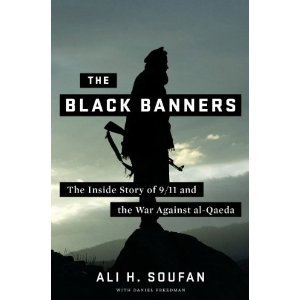
soufan-book-cover.jpg
.

It’s beginning to be embarrassing how obvious the Khorasan / black banner / Mahdism meme is getting these days.  Earlier this week I pointed it out as the basic through-line of Syed Saleem Shahzad‘s Inside Al-Qaeda and the Taliban: Beyond bin Laden and 9/11. Today it’s Ali Soufan‘s turn.

In his book, The Black Banners: The Inside Story of 9/11 and the War Against Al-Qaeda — which I hope to review here — Soufan too makes the apocalyptic significance of AQ’s jihad painfully apparent. Take his title, for instance

Black banners, eh?

Those would presumably be the ones mentioned to Soufan by Abu Jandal, who began to quote the hadith:

If you see the black banners coming from Khurasan, join that army, even if you have to crawl over ice; no power will be able to stop them —

at which point Soufan broke in and completed the hadith for him:

— and they will finally read Baitul Maqdis [Jerusalem], where they will erect their flags.

And in case you missed it, that’s an explicitly end-times, Mahdist hadith, as you can see from (eg) this Hizb-ut-Tahrir-associated site:

Messenger of Allah said: “If you see the Black Banners coming from Khurasan go to them immediately, even if you must crawl over ice, because indeed amongst them is the Caliph, Al Mahdi.” [Narrated on authority of Ibn Majah, Al-Hakim, Ahmad]

Soufan goes on to say:

I was to hear that reputed hadith from many al-Qaeda members I interrogated. It was one of al-Qaeda’s favorites.

Khurasan is a term for a historical region spanning northeastern and eastern Iran and parts of Turkmenistan, Uzbekistan, Tajikistan, Afghanistan, and northwestern Pakistan. Because of the hadith, jihadists believe that this is the region from which they will inflict a major defeat against their enemies — in the Islamic version of Armageddon. Bin Laden’s 1996 declaration of war against the United States – a main text for al-Qaeda members – ends with the dateline “Friday, August 23, 1996, in the Hindu Kush, Afghanistan.” It’s not a coincidence that bin Laden made al-Qaeda’s flag black; he also regularly cited the hadith and referenced Khurasan when recruiting, motivating, and fundraising. Al-Qaeda operatives I interrogated were often convinced that, by joining al-Qaeda, they were fulfilling the words of the Prophet.

It is an indication of how imperfectly we know our enemy that to most people in the West, and even among supposed al-Qaeda experts, the image of the black banners means little…

I could go on, but that’s surely enough.

*

And by the way, who is that man on the cover, anyway?

banners-mafa-juxtaposed.png


Switch to our mobile site