zenpundit.com » al qaida

Archive for the ‘al qaida’ Category

Jottings 6: How the network works, it seems

Sunday, May 5th, 2013

[ by Charles Cameron — often puzzled & shocked at the way some algorithms behave in public ]
.

I was on Silobreaker this evening, looking at a page called Dead Terrorist Tamerlan Tsarnaev Channeled Islamic Videos, and what I found curious was this little network diagram, presumably algorithmically-generated from the Silobreaker database:

I have to tell you, I like network diagrams — but what are we supposed to infer from that?

Do you see the same diagram when you visit the site — or is this display just for me, knowing what books I buy, what movies I see, what friends I have — and tailored to sell me something, or get my vote?

Jottings 2: Dr Fadl book announcement

Friday, May 3rd, 2013

[ by Charles Cameron — I got the announcement via Cole Bunzel, and Kévin Jackson kindly informed me that Dr Fadl is currently free ]

.

Dr Fadl‘s announcement, in Arabic, is here — I had to use Google Translate, which wouldn’t pass a Turing test. However…

**

A while back, I made a post here titled Will Dr Fadl retract his Retractions? in which I wrote:

Sayyid Imam al-Sharif, popularly known as Dr Fadl, wrote two of the key works of jihadist ideology, The Essential Guide for Preparation and the thousand-page Compendium of the Pursuit of Divine Knowledge, in the late 1980s — thereby providing his friend from student days, Ayman al-Zawahiri, with powerful scholarly backing for the doctrines of militant jihad and takfirism. Lawrence Wright refers to Fadl as an “Al-Qaeda mastermind” in a detailed 2008 New Yorker analysis.

Dr Fadl was imprisoned without trial in the Yemen shortly after 9/11, but it was after he had been transferred to an Egyptian prison in 2004 that he wrote Rationalizing Jihad, the first volume of his “retractions” — a work so powerful in its attack on his own earlier jihadist doctrine that al-Zawahiri felt obliged to respond with a two-hundred page letter of rebuttal. A second volume from Dr. Fadl followed more recently.

If Dr Fadl regains his liberty, the question arises whether he will claim his critiques of jihadist dictrine were obtained by force, and effectively retract his retractions – or whether he will stand by them, as I somehow expect he might — still declaring, this time as a free man, that “There is nothing that invokes the anger of God and His wrath like the unwarranted spilling of blood and wrecking of property,” and “There is nothing in the Sharia about killing Jews and the Nazarenes, referred to by some as the Crusaders. They are the neighbors of the Muslims … and being kind to one’s neighbors is a religious duty.”

**

As late as October 2012, I was noting an Atlantic piece by Daveed Gartenstein-Ross and Aaron Zelin on How the Arab Spring’s Prisoner Releases Have Helped the Jihadi Cause, and asking whether Dr Fadl had been released in my post Quick update / pointer: GR & AZ on prisoner release — but now we know.

In response to an inquiry I tweeted after seeing Bunzel‘s tweet above — asking whether Dr Fadl was still imprisoned, albeit more comfortably than most — Kévin Jackson replied:

I’m no Arabist, but I’d guess we can take it that Sayyed Imam Al-Sharif aka Dr Fadl is talking freely in this book, which he says will cover both his experience of the history of AQ “from the womb (the Afghan jihad against communism) … to the end” in detail, with dates and names, and “all this with the background of the study of Islamic jurisprudence that distinguish between right and wrong, and this is a jurisprudential historical book.”

**

Tricky that, the need to rely on Google Translate. Once again I regret my lack of umpteen languages.

Inscription on the flag of the Mahdi’s army?

Tuesday, April 30th, 2013

[ by Charles Cameron — how to tell an authentic Mahdist “black banner” — from a false flag, perhaps? ]
.

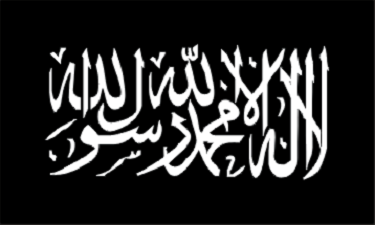
There has been considerable talk about black flags featuring the Shahada:

This is the creed of Islam, and reads, “There is not God but God, and Muhammad is the Prophet of Allah.”

And more recently, of black flags featuring the seal of Muhammad:

Will McCants wrote of this:

When the ISI adopted the flag, it issued a statement in 2007 explaining its design. In the statement, the group relates oral traditions portraying Mohammad’s battle flag as either black or white (other traditions say yellow) with the words “No god but God, Mohammad is the messenger of God” written on it. The ISI chose black for its flag because most accounts say the Prophet’s flag was black, and chose the Muslim testimony of faith because many accounts said it was written on the Prophet’s flag.

For the second half of the testimony of faith, “Mohammad is the messenger of God,” the ISI reproduces the Prophet’s seal. They contend that the seal’s design is preserved in Ottoman manuscripts and its three-lined text, “God/Messenger/Mohammad,” is mentioned in oral traditions about the Prophet. They have added this seal to their flag, they explain, because some Muslim scholars say that it appeared on the Prophet’s flag.

**

I therefore thought it worth noting that al-Islam.org — which presents Islam “with particular emphasis on Twelver Shia Islamic school of thought” — has a section on The Slogan on the Flag of the Uprising in Chapter 7, The Uprising of the Imam of the Time (‘atfs) of Najmuddin Tabasi‘s An Overview of the Mahdi’s (‘atfs) Government, which reads:

Every government has a flag by which it can be recognized, and uprisings and revolutions also have particular flags whose logos bespeak of the objectives of their leaders. The global revolution of Hadrat al-Mahdi (‘a) has also a specific flag on which a slogan has been inscribed. Of course, although there are differences with respect to the slogan on his flag, there is a common point in all the statements and that is: It invites the people to obey him (‘a).

Now, it would suffice to mention some pertinent instances:

It has been recorded in a hadith: “It is thus written on the flag of Hadrat al-Mahdi (‘atfs): ‘Listen and obey him’.”

Elsewhere, we read: “The slogan of al-Mahdi’s (‘atfs) flag is al-bay‘atu lillah (the allegiance for the sake of Allah).”

**

Just a little different, eh?

Well, that’s it — just a footnote to ponder.

Two tales from the outsider jihad

Sunday, April 28th, 2013

[ by Charles Cameron — wanna know the very latest on those black banners from Khorasan? ]
.

Here’s the scene that greeted four British recruits to the jihad on their arrival at a training camp in Pakistan in August 2011:

This wasn’t like the training camps of propaganda videos, with the black flag of al-Qaeda flying free in the wind. There were no racks of weapons waiting for recruits. And all the trainers had left for the religious festival of Eid.

They came home to the UK, where their families “berated” them, they were arrested, tried, found guilty and sentenced to 40 month terms in prison.

With jihad, as with so much else, you can’t always count on truth in advertising.

**

And then there’s Omar Hammami.

Even Rusty Shackleford from My Pet Jawa — “a weblog comparing Muslims to Jawas and containing criticism and satire of Islamic traditions and beliefs” — can’t help but like Omar Hammami, aka Abu Mansoor Al-Amriki, the American jihadist from Alabama who, as Wired puts it, “shoots the breeze” on Twitter “with the people whose job it is to study and even hunt people like him.” He does it with verve, even when ridiculing al-Shabab, the group he was put on the the FBI’s Most Wanted Terrorist List with a $5 million bounty for joining:

Shackleford commented, “I’ve actually become kinda fond of the guy — if that’s possible”.

Al-Shabab, however, appears to dislike him enough to have tried to assassinate him a couple of days ago, following up their failure with a major attack, results as yet unknown.

With jihad in foreign lands, apparently, you can’t even trust your fellow mujahidin to treat you better than your avowed enemies.

Of Omar Hammami — and dying more than once?

Friday, April 26th, 2013

[ by Charles Cameron — dying more than once in hadith, in press reports, in Rumi and John of the Cross ]
.

The American mujahid in Somalia, Omar Hammami [see his Wikipedia bio], who has been tweeting back and forth with various “U.S. national security professionals” [see this Wired piece], reported yesterday that he had been shot in the neck “by Shabab assassin” [see this piece by Clint Watts at Selected Wisdom]. JM Berger, who has been in close correspondence with him, tweeted:
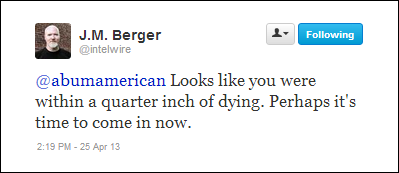
Omar has indeed been in dispute with Shabab, the group he originally joined [see this LWJ post], and his own most recent tweets, sent eighteen hours ago as I write this, were these:
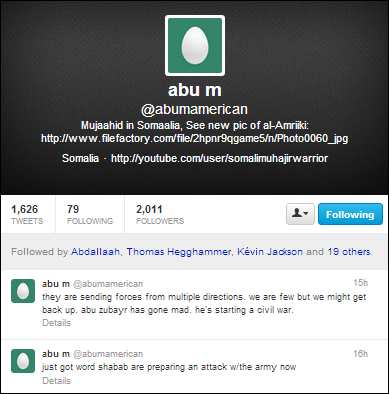
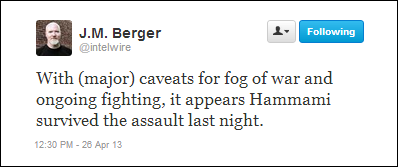
Omar Hammami may or may not still be among us, although recent reports suggest with caveats that he survived the attack…
That’s the background.

**

From my point of view, the most interesting discussion anyone had with Hammami in the last day or two was this exchange between Hammami and Jeremy Scahill, whose book Dirty Wars has just hit the stands:
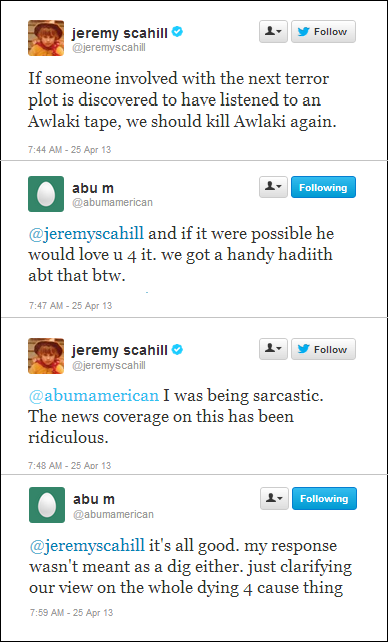
Characteristically, Omar has a light tone — yet speaks to the issue in the context of his theology…

**

There are, it seems to me, basically three ways that one might imagine dying more than once. The first — and it’s the one Hammami himself was referring to — is found in the hadith in Bukhari [Volume 4, Book 52, Number 54]:

Narrated Abu Huraira:

The Prophet said, “… By Him in Whose Hands my life is! I would love to be martyred in Allah’s Cause and then get resurrected and then get martyred, and then get resurrected again and then get martyred and then get resurrected again and then get martyred.

Let the intensity of that hadith — and Hammami’s reference to it, a little earlier [?] on the same day he was shot — sink in.

**

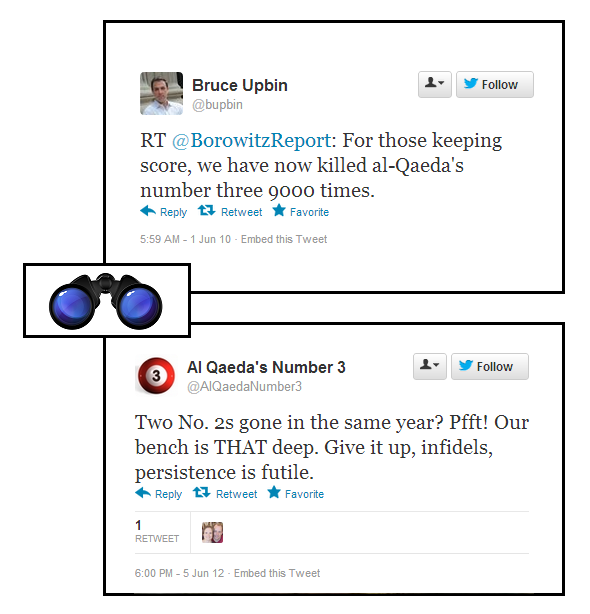
The second, “secular” way to have “died” more than once is through faulty intelligence and / or journalism — and that’s what JM Berger is on about when he tweets:

Indeed, such reports led to the 2011 release of a nasheed in his name, though he may not have sung it himself:

Now Hammami has apparently resurfaced, with two new a cappella songs that appeared on the web earlier this week. In “Send Me A Cruise,” Hammami begs to be plastered by a tank shell, a drone attack or a cruise missile, so that he can martyred like some of the heroes he names, including Al Qaeda leaders Abu Musab al-Zarqawi and Abu Laith al-Libi. In his trademark tuneless drone, he claims “an amazing martyrdom” is what he “strive(s) for and adore(s).” “Send me a cruise like Maa’lam Adam al Ansari/ And send me a couple of tons like Zarqawi,” chants Hammami. “Send me four and send me more, that’s what I implore.”

More generally, false reports of AQ leaders dying hither and yon have become so common that I posted a DoubleQuote about it last year:
**

Here’s where it get’s most interesting…

For a third view of dying more than once, we can turn to the mystical tradition. Thus the Prophet Muhammad is credited with the hadith “Die before death” by Jalaluddin Rumi, who in his Mathnawi, VI, 3837-38 writes:

The mystery of “Die before death” is this, that the prizes come after dying (and not before).
Except dying, no other skill avails with God, O artful schemer.

The death before death here is the death of the nafs, the “self” — the true martyrdom of the greater jihad. As Peter Lamborn Wilson puts it in his Introduction to the Sufi Path:

Man’s authentic existence is in the Divine; he has a higher Self, which is true; he can attain felicity, even before death (“Die before you die,” said the Prophet). The call comes: to flight, migration, a journey beyond the limitations of world and self.

Of course, St John of the Cross wrote in much the same vein:

This life I live in vital strength
Is loss of life unless I win You:
And thus to die I shall continue
Until in You I live at length.
Listen (my God!) my life is in You.
This life I do not want, for I
Am dying that I do not die.



Switch to our mobile site