zenpundit.com » islamist

Archive for the ‘islamist’ Category

Love, Death, and Jihad by Pen and Sword

Wednesday, May 29th, 2013

[ by Charles Cameron — with Wagner and Abu Dujana as examples, the cognitive sting here is in the tail — the power of a double image to engage both emotion and insight ]
.

Love and death.

**

The human mind thinks in parallelisms and oppositions.

My lords, if you would hear a high tale of love and of death, here is that of Tristan and Queen Iseult; how to their full joy, but to their sorrow also, they loved each other, and how at last they died of that love together upon one day; she by him and he by her.

Thus begins Bédier‘s version of The Romance of Tristan & Iseult as Hilaire Belloc presents it in its classic English form. The parallel there, between love and death, is found also in Freud’s binary opposition of Eros and Thanatos, which he suggests in Civilization and Its Discontents:

The name libido can again be used to denote the manifestations of the power of Eros in contradistinction to the energy of the death instinct.

and in Wagner’s Liebestod — by way of returning to Tristan and Iseult:

**

Likewise, there’s a parallelism between jihad by pen (jihad bil qalam) and by sword (jihad bil saif) — shown in Abu Dujana al-Khurasani‘s move from writing on the forums to martyrdom in Khost — which al-Awlaki phrases in terms of ink and blood in eulogizing Sayyid Qutb in Constants on the Path of Jihad:

We see that in our contemporary times with people like Syed Qutb. He wrote with ink and his own blood. People like Shaykh Abdullah Azzam and Shaykh Yusuf al ‘Uyayree. They wrote amazing books, and after they died it was as if Allah made their soul enter their words to make it alive; it gives their words a new life

and which appears, contrariwise, in the hadith — considered weak by some and cherished by others:

The ink of the scholar is more sacred than the blood of a martyr

**

Which brings me to my own parallelism of the day — a parallelism between two uses of graphical similarities, to convey powerful messages:

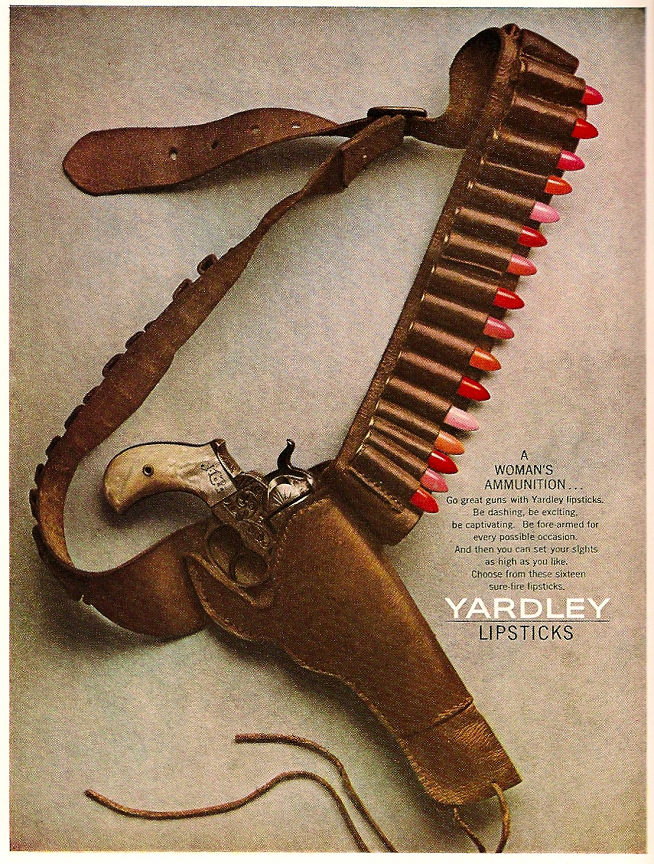
The upper panel shows a Yardley‘s lipstick ad that I must have seen forty years ago on the London Underground — it stunned me then, and it stuns me today to have rediscovered it on the net — which I have long thought of as a brilliant illustration of “rhyme” in images.

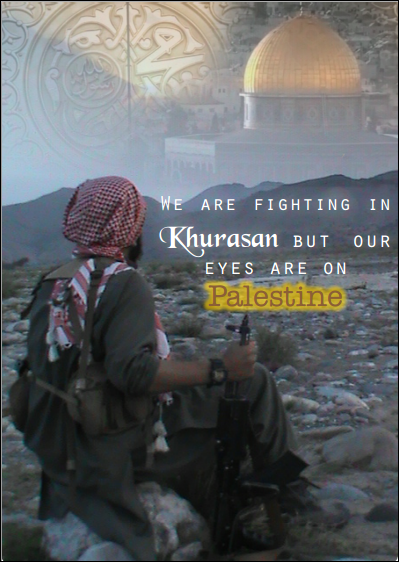
And the lower panel? It’s the parallelism between jihad bil qalam with jihad bil saif, extended into the cyber realm. Again, a powerful image, because when two items “rhyme” in some way that’a apparent to us, there’s an instinctive summoning of all that they mean to us close to the surface of consciousness, and other aspects of their relatedness can then become clear to us in a flash of insight.

**

Here’s the full Yardley’s ad, still very much as I remember it from so long ago:

Sura 9 invoked: correction regarding the Woolwich transcript

Thursday, May 23rd, 2013

[ by Charles Cameron — update to follow ]
.

I’m sorry to have to inflict this on you, but I have yet to see an accurate transcript of the Woolwich attacker’s televised explanation published.

So far, we have two transcripts, both found in a piece by Max Fisher in the Washington Post. The first goes like this:

We swear by Almighty Allah we will never stop fighting you. The only reasons we have done this is because Muslims are dying every day. This British soldier is an eye for an eye a tooth for tooth. We apologise that women had to see this today but in our lands our women have to see the same. You people will never be safe. Remove your government. They don’t care about you.

Then there’s an update to Fisher’s piece, which say the WP’s Anthony Faiola “listened to the ITV video very carefully and came away with a different quote than the one circulating in British media … Here’s the quote as heard by Faiola”:

There are many, many ayah throughout the Koran [referring to religious verses] that says we must fight them as they fight us, an eye for an eye and a tooth for a tooth. I apologize that women had to witness this today but in our land women have to see the same. You people will never be safe. Remove your government, they don’t care about you.

That’s definitely an improvement, and yet…

**

I must apologize for the fact that I cannot read or write Arabic, and therefore no doubt mix up different transliteration schemes at times like this — but I think this is one off those cases where a little religious knowledge helps ones ability to make out what’s being said by someone offering religious justification for their acts. The clip begins in mid-sentence with a clear reference to a Sura from the Quran — Sura 9, at-Taubah, The Repentance — and then continues with a reference to ayat , the plural of ayah, the term for a Qur’anic verse.

Here’s what I hear:

… Sura at-Taubah — many, many ayat throughout the Koran that, we must fight them as they fight us, an eye for eye and a tooth for a tooth. We, I apologize that women had to witness this today, but in our lands, our women have to see the same. You people will never be safe. Remove your government, they don’t care about you.

The other notable divergence between my text and Faiola’s is that I hear “our lands” where he hears “our land”. But listen to the video — without the ITV reporter’s voice over obscuring part of the text — on this Guardian page.

**

It is worth noting that Sura 9 is the only sura in the Quran which does not begin with the Bismillah, “In the Name of God”.

One commentator, referencing Ali ibn Abi Talib, notes:

It should also be mentioned that this surah does not start with ‘Bismillah’ as do all other surahs in the Qur’an, because ‘Bismillah’ is an assurance of protection and mercy and as per report of Ali (RAA) this surah was revealed with a sword in its hand, and thus could not have the assurance of peace and mercy for the disbelievers.

This presumably ties in with the fact that this is the sura which contains the “verse of the sword” — Sura 9.5, given here in the Arberry version:

Then, when the sacred months are drawn away, slay the idolaters wherever you find them, and take them, and confine them, and lie in wait for them at every place of ambush. But if they repent, and perform the prayer, and pay the alms, then let them go their way; God is All-forgiving, All-compassionate.

**

I do not believe it serves justice, let alone mercy, for us to leap to the conclusion — rush to the judgment — that “Islam” is a monolithic entity, all of whose members are by definition disposed to violence.

I do think it is important, once again, for us to understand that the speech here is religious speech.

Putting it very mildly, and with deep sadness in my heart, today’s event in Woolwich was barbaric.

Words, words — what’s a bunch of Wordsworth?

Sunday, May 19th, 2013

[ by Charles Cameron — bemused again, “jihad” (the word) in the news, “big data” too, plus Google expecting Mahdi ]
.

I suppose I should be glad — or should I? — that the word jihad is now in the news.

It’s about time. Jihad (the word, the concept, the interpretations) should have been in the news at least since 9/11, don’t you think? or since the World Trade Center bombing in February 26, 1993, perhaps? or at least since Osama bin Laden’s Declaration of Jihad Against the Americans Occupying the Land of the Two Holy Mosques of September 2, 1996?

In any case, the word finally seems to have arrived, if the entry from the National Geographic site last month (upper panel, above) can be trusted:

And Big Data (lower panel)?

President Obama launched his Big Data Initiative on March 29, 2012, but I’m not sure how long the term has been in active use. I’m told there’s no “big data” listing in the 2009 Oxford English Dictionary on CD-ROM, I have the sense that three days ago’s Foreign Policy is far more up to date than last month’s National Geographic in any case — and just a month or two ago the CTO of CIA, Ira “Gus” Hunt, situated Big Data somewhere between “the cloud” and right now, telling his audience at GigaOM:

Big Data was so last year, right, all those breathless articles and all the front page covers — I was expecting BD to be Time’s Man of the Year, right. This year what we’re really talking about is how do we get value out of the stuff?

That quote, of course, is so “two months ago”…

**

So what does National Geographic tell us about jihad?

The Boston marathon bombing has focused attention on the word “jihad.”

Vice President Biden characterized the alleged bombers as knockoff jihadis.” The Associated Press reported that the elder brother had “vaguely discussed jihad” with his mother over the phone in 2011.

Origins

“Jihad” is derived from the Arabic word juhd (meaning effort, exertion, or power) and literally translates to “struggle” or “resistance” for the sake of a goal. Used 30 times and in multiple contexts in the Koran, jihad most often denotes a struggle against external enemies, the devil, or one’s self. One example from the Koran (49.15) is: “The believers are those who believe in Allah and His Messenger … and jahadu (do jihad) with their properties and selves in the way of Allah.”

Mark Wilks, an early 19th-century British author, introduced jihad into the English lexicon, defining it as a Muslim “holy war,” in his Historical Sketches of the South of India. It’s retained that meaning in English; the Oxford English Dictionary defines jihad as “a religious war of Muslims against unbelievers.”

History

Because of its roots and context in the Koran, jihad has a positive meaning to Muslims. Whatever form jihad may take, the struggle is always noble. When the term is evoked against external enemies, it can be used only during just or defensive wars.

I’m sorry, but that last para beginning “Because of its roots and context in the Koran, jihad has a positive meaning to Muslims” isn’t terribly clear. When al-Zawahiri talks about jihad, for instance, does the writer imagine all Muslim readers imagine he’s talking about something noble? I fear there are some subtleties being missed her that not everyone who reads National Geographic may understand.

**

And what does Foreign Policy want to tell us about Big Data?

The promoters of big data would like us to believe that behind the lines of code and vast databases lie objective and universal insights into patterns of human behavior, be it consumer spending, criminal or terrorist acts, healthy habits, or employee productivity. But many big-data evangelists avoid taking a hard look at the weaknesses. Numbers can’t speak for themselves, and data sets — no matter their scale — are still objects of human design. The tools of big-data science, such as the Apache Hadoop software framework, do not immunize us from skews, gaps, and faulty assumptions. Those factors are particularly significant when big data tries to reflect the social world we live in, yet we can often be fooled into thinking that the results are somehow more objective than human opinions. Biases and blind spots exist in big data as much as they do in individual perceptions and experiences. Yet there is a problematic belief that bigger data is always better data and that correlation is as good as causation.

**

Mr Orange had something to say about the word “jihad” in his War Tracker blog the other day, under the title What’s in the names of terrorist groups (1): Jabhah al-Nusrah li-Ahl al-Shâm min Mujâhidî al-Shâm fi Sahât al Jihâd:

… they still use a religious term in their name: One that is quite negatively understood in the West but not so in the Arab and Muslim world namely Jihâd.

They are Mujâhidîn – those who do Jihâd (religious struggle – in this case fighting) – on the fields of Jihâd. Mujâhidîn has a positive, religiously legitimizing ring to it – see here is someone who struggles for the religion – and is furthermore including. Whether you are with the FSA (even one of the rather secular parts of that group mind you) or with an independent Islamist group or with Jabhah al-Nusrah all do use the term Mujâhîd and all may be identified by that term (Granted there was a time when Thuwâr (revolutionaries) was en vogue but no longer so).

That, IMO, gets us a lot closer to understanding a term that has a range of meanings, a range of users, and a range of audiences — from something along the lines of divinely obligated warfare to something akin to conscience (or what Rilke calls “being defeated, decisively, by constantly greater beings”) , and from those who use it for glorious self-identification to those for whom it is a euphemism for terrorist (irhabi), and from those itching for a fight to those longing, praying and working devotedly for peace…

**

So — since we’re talking big data and jihad, here’s a tiny snippet of jihad-related skew from Google, one of the giants of big data…

I came across it via SelfScholar, who posted a very interesting response re the Iranian nuclear fatwa issue here a few days ago, in a post titled Google Translate’s Khomeini Problem.

It appears that Google Translate has a distinctly unsecular view when it comes to major figures in Shi’ite theology — specifically, it adds religious honorifics to their names when translating from English into Farsi. As you might imagine, I wanted to know how they dealt with the Mahdi — and behold, my prayer was answered:

So Google awaits his blessed return?

It seems pretty clear that SelfScholar would be skeptical about that. He ends his blog post, in fact, with an indication that he neither awaits nor expects it — choosing for his final example “to highlight the inanity of it all, just one for the road…”:

**

Prof. Dr. Muhammad-Reza Fakhr-Rohani has an interesting piece titled Rendering Islamic Politeness Markers into English, which he concludes thus:

There remain some Desiderata to be dealt with. First, the Arabic pre-nominal honorifics as well as post-nominal honorific-cum-optative sentences must be re-translated with a view to remove the items which make the language sound odd, and perhaps ungrammatical. Secondly, appropriate abbreviations must be devised for them. Finally, they must find their ways into English dictionaries, hence registered as part of the language.


Sisyphus on the treadmill of memes

Thursday, May 9th, 2013

[ by Charles Cameron — Khorasan, black banners, the Ghazwa-e-Hind — when will the updating ever stop? ]
.

**

It looks as though I first realized that “the black banners of Khorasan” was a meme I should be “eyes out” for was in July 2007, when John Robb pointed us to a piece by Syed Saleem Shahzad on events at the Red Mosque

For the al-Qaeda leadership sitting in the tribal areas, the situation is fast evolving into the promised battle of Khorasan. This includes parts of Iran, Pakistan, Afghanistan and Tajikistan from where the Prophet Mohammed promised the “end of time” battle would start.

That reference to Khorasan in turn led me back to a slightly earlier Washington Post piece where the Khorasan / black banners motif was clearly set forth, along with a pointed comment from Andrew Black, co-founder of Thistle Intelligence Group:

The battles today, like those against the Soviet occupiers, are also fought with religious verve. The Taliban and al-Qaida fight under a black flag connoting the participation of Islam’s prophet in their battle for Khorasan, the ancient name for the region centered around Afghanistan.

Khorasan increasingly features in the militants’ videos and the name was taped to the leg of a suicide bomber who killed 24 people in Pakistan’s Northwest Province this spring.

“One should not underestimate the theological importance of Khorasan to aspiring mujahedeen; particularly those who are only able to initially view the conflict through the Internet,” said Black.

Hamid Gul was in Shahzad’s piece too, talking about the Red Mosque and the Red Fort — and here, too, I likely made my first acquaintance with the motif of the Ghazwa-e-Hind, symbolized by the wish to plant Pakistan’s flag on Delhi’s Red Fort:

It is a pity that our army was preparing youths to seize Lal Qala [the Red Fort of Delhi] and they ended up seizing the Lal Masjid,” Gul said.

Both these memes have been around longer than I have, but back then they didn’t seem to be attracting much attention in the west.

Now they’re cropping up all over — and I’m (to switch metaphors in mid-stream) paddling hard to keep up.

**

The black flags are alive and well this week, as shown in this video of the graduation of a new batch of the Free Army fighters in Syria:

Khorasan too, as seen in the image from the new magazine Azan at the top of this post — but where does Azan itself come from?

B Raman writes:

It is not yet clear who has started “Azan”. One suspect is the Tehrik-e-Taliban Pakistan (TTP), which is the Pakistani Taliban. The other suspect is Al Qaeda headquarters in the South Waziristan area of Pakistan.

I’m interested in this question, because Azan had an overview of the various fronts of contemporary jihad, and an image that invokes both Khorasan and Jerusalem isn’t exactly “local” in focus. And that brings me to that other meme of interest here — the Ghazwa-e-Hind — which as I pointed out recently ius also mentioned in Azan, though not a huge focus there.

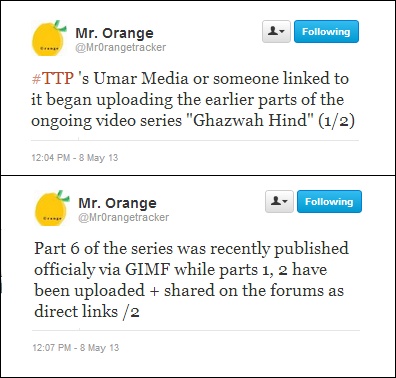
But if Azan is indeed a TTP product, then this info from Mr Orange:

would indicate they find the Ghazwa of more than passing interest…

If I could slip a couple of quotes into the water supply

Thursday, May 9th, 2013

[ by Charles Cameron — pretty much just thinking out loud about mental processes ]
.

The thing is, changing minds is a delicate business, pushing too hard can be counter-productive, and all the more so when the conclusion you want to bring about is clean contrary to the ethos of those you would far rather see thinking — and acting — very differently.

**

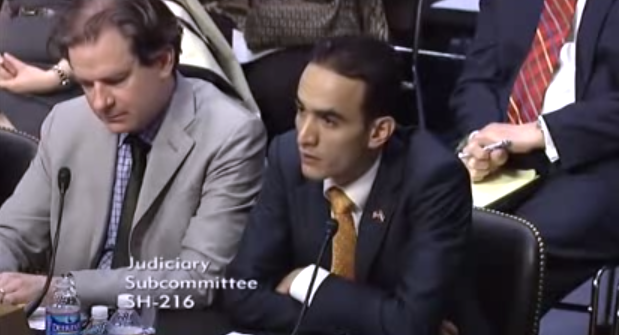
My first example doesn’t actually need to be dropped into the water supply, it’s there already, in the public discourse. It is taken from Farea Al-Muslimi‘s testimony on Drone Wars: The Constitutional and Counterterrorism Implications of Targeted Killing, April 23, 2013:

Had the United States built a school or hospital, it would have instantly changed the lives of my fellow villagers for the better and been the most effective counterterrorism tool. Instead of first experiencing America through a school or a hospital, most people in Wessab first experienced America through the terror of a drone strike. What radicals had previously failed to achieve in my village, one drone strike accomplished in an instant: there is now an intense anger and growing hatred of America.

If that can quietly penetrate thinking in Washington DC, it might alert us to our tendency to act with thought only for direct consequences, never for unanticipated second and second plus order effects…

And diminish hatred. And thereby also diminish radicalization and recruitment.

**

Knowing what words might best counteract pro-jihadist sentiments among potential recruits for purposes of CVE is a far trickier business, and I don’t think it’s my job or the job of government to attempt to influence anyone’s religious belief directly — as I said above, it all too easily backfires.

Nevertheless, I think that getting a clear picture of how the jihadist mind typically works is a useful exercise, and I’ve suggested before now that accepting the concept of jihad as individual obligation — fard ‘ayn — marks a decisive turning point. That’s why Abd al-Salam Faraj made it a “sixth pillar” of Islam and the centerpiece of his tract The Neglected Duty — see also this article on Faraj in Islamopedia.

Having said that, these words of bin Laden to Sheikh `Atiyya should at the very least give pause to any who have, like Faisal Shahzad, obtained US citizenship under oath:

You have perhaps followed the media trial of brother Faisal Shahzad, may God release him, during which the brother was asked to explain his attack [against the United States] in view of having taken an oath [not to harm it] when he was awarded his American citizenship. He responded that he lied [when he took the oath]. It does not escape you [Shaykh `Atiyya] that [Shahzad’s lie] amounts to betrayal (ghadr) and does not fall under permissible lying to [evade] the enemy [during times of war]…please request from our Pakistani Taliban brothers to redress this matter…also draw their attention to the fact that brother Faisal Shahzad appeared in a photograph alongside Commander Mahsud. I would like to verify whether Mahsud knew that when a person acquires an American citizenship, this involves taking an oath, swearing not to harm America. If he is unaware of this matter, he should be informed of it. Unless this matter is addressed, its negative consequences are known to you. [We must therefore act swiftly] to remove the suspicion that jihadis violate their oath and engage in ghadr.

That’s from Letters from Abbottabad: Bin Ladin Sidelined? by Nelly Lahoud et al, Harmony Program, the Combating Terrorism Center at West Point, 3 May 2012, p. 36.

For convenience — and here you see the compulsive editor in me helplessly at work — I’d leave out the names and bracketed explanatory phrases, and give the essence of his remarks thus:

When a person acquires an American citizenship, this involves taking an oath, swearing not to harm America. … The brother was asked to explain his attack in view of having taken an oath when he was awarded his American citizenship. He responded that he lied. It does not escape you that amounts to betrayal (ghadr) and does not fall under permissible lying to the enemy …

**

Obviously, that single quote doesn’t accomplish total de-radicalization — but what it might do is give some wannabes pause for further reflection, And as JM Berger has pointed out recently:

there are hundreds of thousands to millions of people in the world who are radicalized, and only a handful take up violence

My point here is that if bin Laden himself counseled forms of restraint which young jihadi wannabes acted in ignorance of — how much more would an aspirant need to exercise caution, knowing that divine sanction depends on an accurate theological understanding of what is halal and what haram?

Because once an individual becomes convinced that jihad is an individual obligation, the fear of being an irhabi terrorist rather than a mujahid fi sabil Allah is about the only restraint left — and that theological distinction, which at the moment of death separates Jannah from Jahannam, paradise from hell, is way above the wannabee’s theological level of competence.

Something that bears thinking about, no?


Switch to our mobile site