zenpundit.com » terrorism

Archive for the ‘terrorism’ Category

A Boston DoubleQuote, via Jim Friedrich

Saturday, April 20th, 2013

[ by Charles Cameron — the subject of interest is in the details ]
.

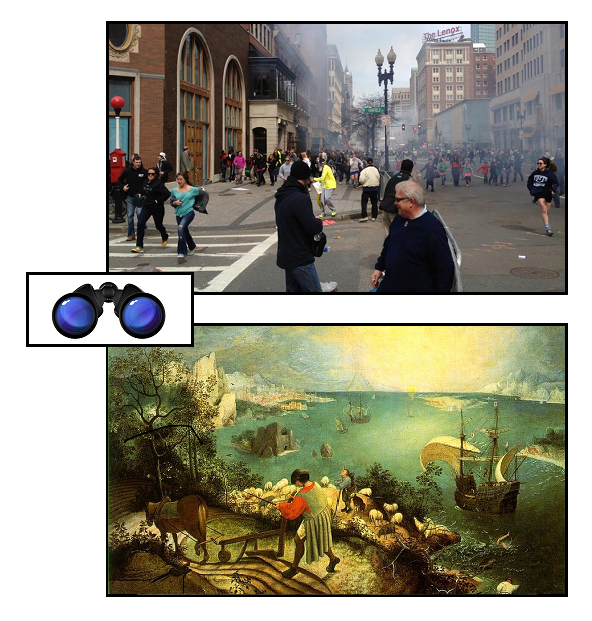
My friend Jim Friedrich, an Episcopalian priest and artist, posted a thought-provoking juxtaposition of images on FaceBook yesterday, which I have resized and cropped to fit my own DoubleQuotes format:

Fr Friedrich’s comment:

This photo snapped Monday in Boston is like Brueghel’s “Fall of Icarus.” The critical subject in each is, from the viewer’s position, just a small detail practically lost in the totality of the scene. Very strange to look at, and to think about – ethically, existentially, theologically…

**

Also worth recalling in this context is WH Auden’s poem, Musee des Beaux Arts:

About suffering they were never wrong,
The old Masters: how well they understood
Its human position: how it takes place
While someone else is eating or opening a window or just walking dully along;
How, when the aged are reverently, passionately waiting
For the miraculous birth, there always must be
Children who did not specially want it to happen, skating
On a pond at the edge of the wood:
They never forgot
That even the dreadful martyrdom must run its course
Anyhow in a corner, some untidy spot
Where the dogs go on with their doggy life and the torturer’s horse
Scratches its innocent behind on a tree.

In Breughel’s Icarus, for instance: how everything turns away
Quite leisurely from the disaster; the ploughman may
Have heard the splash, the forsaken cry,
But for him it was not an important failure; the sun shone
As it had to on the white legs disappearing into the green
Water, and the expensive delicate ship that must have seen
Something amazing, a boy falling out of the sky,
Had somewhere to get to and sailed calmly on.

**

I hope to post something tomorrow on the Mahdist video that Tamerlan Tsarnaev “liked” on FaceBook and added to his “Islam” folder. In its own way, that’s a minor — yet significant — detail, too.

Aftermath: Caitlin Fitz Gerald

Friday, April 19th, 2013

[ Charles Cameron, introducing Caitlin Fitz Gerald ]
.

I was among those deeply moved by Caitlin Fitz Gerald‘s post, Boston’s Best Day, which I quoted from two days ago, and today she posted a series of tweets which again struck me. Knowing Caitlin’s love of visual expression, I invited her to take those tweets and make a guest post of them here, with an illustration should she so choose.

Her post, both text and its illumination, follows:

**
 
 
Turns out I hate the theater of this. I don’t want to hear politicians talk about what happened, or about how strong we are, or anything. I just want the professionals to do what they do, find the people who did this, and along the way to keep us as informed as they can without compromising what they’re doing. I want people to grieve in their way, I don’t want this to be a political speech opportunity. Let our local religious leaders offer comfort and our community leaders direction. I’m sure others feel differently, and if it offers comfort to others, that’s wonderful, but I’ve been surprised how very much I don’t want to hear speeches from, e.g. the President on this. And if focus is on anyone, it should be on the medics and doctors and nurses and cops and firefighters and regular old people who helped each other. People keep calling them heroes, which is nice but almost undercuts the absolute gobsmacking amazingness of what they actually are: regular, good people whose instinct in a crisis was to help other people. Isn’t that more incredible than needing some superlative hero in a time like this? Isn’t it more amazing that what looks like heroism is really just what people are? How remarkable, that we all have that capacity in us. It’s not extraordinary, it’s miraculously ordinary.


Caitlin Fitz Gerald, Aftermath

Boston: of motives and munitions

Tuesday, April 16th, 2013

[ by Charles Cameron — the prayer response at least is wordless and direct ]
.

**

The most deeply felt post about the Boston Marathon massacre I’ve seen was Caitlin Fitz Gerald‘s Boston’s best Day:

If you’ve never been to Boston on Patriots’ Day, you might not know this, but it’s the best day of the year in Boston. It’s a state holiday, spring is hitting, the Red Sox play a morning game, and thousands of runners and hundreds of thousands of people come from all over the world for the Boston Marathon. The marathon is a 26-mile party. Every runner hears cheers from every person the whole way down the route. It is a gorgeously international event, with runners and spectators coming from all corners of the earth, filling the city and lining the marathon route. In the ultimate Patriots’ Day experience, you can go to Fenway to see the Sox, then walk out to Kenmore Square to watch the runners come through. They are tired then, they are in their last mile, but people line the route 10 and 15 deep hooting and cheering and clapping to help them through to the end. It’s amazing to watch the elite runners fly through the toughest course in the world, and just as amazing to watch the regular runners, most of them raising money for charity, people who have trained months and years to do this superhuman thing.

This didn’t just hit close to home, it hit my home.

Caitlin is also responsible for the elegant Clausewitz for Kids.

**

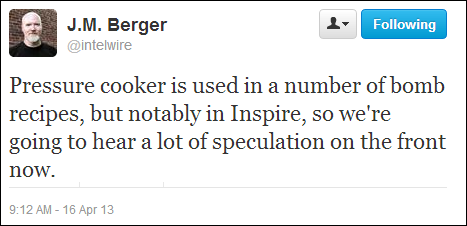
The most sensible response to the various premature speculations as to who’s to blame is JM Berger‘s tweet:

The speculations themselves ranged from dangerous incitement (Muslims or North Koreans, kill em all) to dangerous incitement (d’oh, it’s the Mossad)

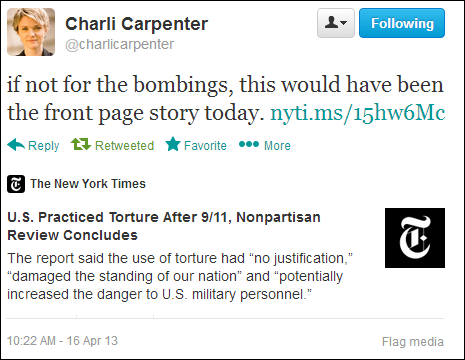
The least expected insight came from Charli Carpenter:

**

Pressure cookers:

For background, here’s a DHS release on pressure cookers from 2010.

It’s beginning to seem likely that the bomb or bombs were made with a pressure cooker or pressure cookers — normally unsuspicious items that can be found in many homes, or easily purchased online.

JM Berger would be my resource for ongoing analysis of the Boston event, but Betsy Ross sees to be the one to follow for information about pressure cookers as weaponry. Their history goes back at least as far as the Croatian nationalist hijacking of TWA flight 355 in September 1976, although the “pressure cooker bomb” in that case was a threatening fake rather than the real thing. Max Fisher tells us their use in bomb-making is mentioned in the Anarchist’s Cookbook — I’m not about to spend money on something that would only tell me how to maim people in any case — but Berger pointed out (first in my feed) that AQAP’s Inspire magazine featured them:

The Inspire mention appears in their first issue, in a piece by “AQ Chef” titled Make a bomb in the kitchen of your mom.

**

But you know what most interested me in that article?

It’s not the recipe, no sireee, I have no interest in how to blow things — much less, people — up. It’s the warning that the writer attached. Explosive devices can easily — all too often and all too literally — blow up in the faces of those who are trying to make or set them.

Bomb making is a hazardous occupation — and that’s why the order and emphasis with which the AQ Chef [promotes his three dafety precautions interests me so much:

The following are a few safety precautions:

1. Put you trust in Allah and pray for the success of your operation. This is the most important rule.
2. Wear gloves throughout the preparation of the explosive to avoid leaving behind fingerprints.
3. This is an explosive device so take care during preparation and handling.

Did you get that? The most important advice is to trust in God and pray for success — taking care during preparation and handling comes a distant third.

That’s piety, people — piety before practicality.

And — as if to prove the point — three Palestinian would-be suicide bombers were killed by their own devices back in 1999, because they refused to comply when Israel announced a “premature switch from daylight savings time to accommodate a week of pre-sunrise prayers“.

So much irony, so much stupidity, so much sorrow.

**

A few other pages to note:

Bruce Schneier, The Boston Marathon Bombing: Keep Calm and Carry On
Jeff Stein, How They Will Investigate the Boston Bombing

Andy Kroll, Question Everything You Hear About the Boston Marathon Bombing
Dana Liebelson and Tim Murphy, 6 False Things You Heard About the Boston Bombing
Adam Serwer, Terror Attacks on Sporting Events, Especially Marathons, Are Surprisingly Rare

Mike Adams via Alex Jones, Boston marathon bombing happened on same day as ‘controlled explosion’ drill by Boston bomb squad — conspiracist, reminiscent of Ruppert on 9/11

XKCD, Pressure cooker: the worst thing? — see graphic above

Zoketsu Norman Fischer, In Times of Trouble — a Zen view from just post 9/11.

Boston 4/15/13

Tuesday, April 16th, 2013

The Boston Marathon was bombed today near the finish line with allegations of multiple other unexploded devices:

CBS Boston station WBZ-TV reports one of the three who died from the attack was an 8-year-old boy.

 Two bombs exploded near the crowded finish line of the Boston Marathon on Monday, killing three people and injuring more than 125 others in a terrifying scene of broken glass, smoke and severed limbs, authorities said.

Police reportedly set off at least one other explosive device with a water cannon. On Monday night, a federal law enforcement source told CBS News correspondent Bob Orr that an earlier report was incorrect that authorities had found one other device that was intact and had not been detonated. Orr reports that authorities are not in possession of such a device.

 CBS News senior correspondent John Miller reports that a Saudi national is being questioned by authorities. He was seen “acting suspiciously” running from the explosion, and a civilian chased him down and tackled him. He was turned over to Boston police and is being questioned by the FBI. He is being cooperative and denies any involvement.

 “This could mean a lot, or this could mean very little,” Miller said. “It’s too soon to call him a suspect.”

 Miller reported earlier that authorities are also reviewing surveillance video that shows a man from behind carrying two backpacks near the site of the explosions. Authorities are not sure whether the subject in the video is linked to the blasts.

Boston police say no suspect has been taken into custody. 

There is much speculation and misinformation at the present time and a rush to analytic judgement is premature when crucial physical evidence is in the early stages of being found, identified and tested by expert investigators. White House officials have classified the attack – which featured a second blast to harm first responders and bystanders – “terrorism”.

Terrorism would appear to be accurate. Whether this is by a group or a “lone wolf” is not yet determined. The presence of multiple, coordinated bombs would be very difficult for one person acting alone to plant without detection but not impossible, a small cell is more likely. A high failure rate of bombs may indicate a determined amateur rather than a professional bomb-builder from a group like the IRA, Hezbollah or Lashkar-e- Taiba, all of which are noted for their skill with explosives. Nor can a foreign state security agency be definitively ruled out at this time, though that is much less likely a possibility ( Pointlessly bomb the Boston Marathon and get yourself a 2 carrier group aerial “regime decapitation” campaign).

Before jumping to conclusions about the possible identity of the Boston Bomber, recall first guesses are frequently wrong and as with the “Anthrax Letters”, we may never know for certain. Or the FBI may run down the culprits in the next 48 hours. People using this attack to score cheap partisan political points right now in the media or on social network sites  are supreme asshats

Tyrannicide and the Lost Republic

Tuesday, March 19th, 2013

“Beware the Ides of March”

T. Greer gave me a rousing recommendation that I read the following post on the death of Julius Caesar by Burt Likko of The League of Ordinary Gentlemen blog. Greer was correct, it was outstanding. You should read the post in it’s entirety:

Rue the Ides

….One of my big observations about Julius Caesar is that he took great care in his career to do nothing that he could not credibly claim that a political or military leader had not done before him. Scipio Africanus used his huge prestige from winning a massive war for Rome to monopolize all political power within his own family. The Gracchi disregarded informal controls in the cursus honorum in favor of pursuing needed reform. Pompey used extraordinary and open-ended military powers to wage a war of conquest for Rome and got personally rich doing it. Catalina had been a blue-blooded populist who thumbed his nose at the consuls in power. Both Marius and Sulla had marched on Rome; Marius was consul six times in a row and Sulla was a dictator for longer than the traditional six months and used attainders to purge the ranks of the elites of his enemies.

So all along, when people protested to Caesar that he was making himself into a king, he could point to precedent and say he was doing nothing new, and nothing that the republic hadn’t been through before without losing its republican character. This seemed a transparent fiction to his critics. But for a legal culture steeped in and heavily reliant on precedent, it mattered a lot. Not for nothing did Caesar spend the first chapter of both his books chronicling his own military conquests on offering political justifications for what he had done.

After all nearly two centuries of history that preceded Caesar’s rise to power demonstrated that in order for the government of Rome to be effective, it took a blue-blooded strongman brushing aside the niceties of the anti-autocratic but ossified constitution to actually do something. And that same history demonstrated to him that the public admired success much more than it did formal adherence to the law – which had grown too complex, too much a creation of the elite, and too distant from the realities of daily life and popular culture, to matter all that much to the average Roman on the street. The formalities of government were for the elites to worry about, not the common man functionally unaffected by them; justice was obtained through informal means and not through the courts.

By the end of the civil war against Pompey and the remnants of the Scipio Africanus family’s control group, every tribune, every judge, every junior official, and every decision-maker of consequence was a client of Gaius Julius Caesar. Caesar himself held a consulship, a censorship, and a dictatorship and was quite clear that he would never let those things go – he clearly intended to hold on to all of that prestige and power and immunity from criticism until his death, and he would brook no serious opposition. [….]

Read the rest here.

There is much to agree with here.

First, I think Likko understood the limitations, frustrated ambitions and political immaturity of the anti-Caesarian and Optimate conspirators very well. Tyrannicide in classical antiquity was not mere political assassination, but a noble act, usually accompanied by martyrdom, which further sanctified it. This was true of the Athenians who had put up statutes of  Harmodius and Aristogeiton who slew the tryrant Hipparchus and Lucius Junius Brutus, the ancestor of the assassin Brutus, was revered for his leadership in the overthrow of the Roman monarchy of the Tarquins.

That the conspirators expected that the participation of Brutus in the murder of his patron Caesar would resonate symbolically as an intended gesture of patriotism with the Roman people was reasonable; the romantic hope the assassination itself would prove politically transformative was not.  Likko was correct, Rome had changed since the second century BC – and not just from the abusive political intrigues of the Patrician elite but by the Social Wars that brought the bulk of Rome’s Italian allies into their political community as Roman citizens. The “People of Rome” had changed and the mob of landless poor – whom Populares like Caesar wished to aid with reforms over optimate objections – had grown much larger and dangerous.

This goes to Likko’s larger point that, as revered as the Republican traditional virtues and outward forms may have been in terms of lip service, in substantive practice as the first century AD progressed, they were increasingly ignored when convenient to powerbrokers, the wealthier classes or the mob.  Sulla’s attempt to “re-set” the Roman political system along traditionalist lines by blood purge and Cincinnatus-like personal example failed within a generation.  Other than the terrifying example of the proscriptions to inculcate political restraint, which lasted only so long as Sulla lived, nothing else was introduced to tamp down the subversive dynamic of unrestrained and aggressive aristocratic political competition for imperium and glory by the ambitious among Rome’s elite.

Where Likko errs, somewhat, in my opinion, is here:

The liberators did not think about institutions. They did not think about culture. They did not think about logistics. They did not think about government. They did not think about the contradiction inherent in a lawless act done in the name of preserving the law. They did not think about the immediate political aftermath. 

Some of this is right – the conspirators did not think clearly about politics, given the large numbers of patricians and rich “new men” alike who had fallen under Caesar’s spell or grudgingly accomodated themselves to his personal rule after the failure of Pompey and Cato. That they expected the sort of popular sympathy Cato received -really more public respect for his incorruptibility and intrangisent virtue than any widespread desire to emulate Cato’s antiquated Roman mores or reactionary politics – is itself evidence f how out of touch they were. That said, thinking in terms of institutions would have been nigh impossible for them.  As an aristocratic Republic, Rome’s institutions that composed what we might call “the state”  were very few in number and skeletal in form. This was because the expectation was that patrician leadership, informally exercised through their extensive clientelas, their public benefactions and donations, expressions of charismatic auctoritas even when not in power, would always provide the muscle to make things happen. These in turn would be regulated by age-old custom, tribunican vetoes, the signs of the augurs, the weight of Senatorial opinion and what formal laws existed.

When custom began to be lightly disregarded in pursuit of political vendettas and even the legions did not possess an “institutional” existence yet, there was little to stop aristocracy from transmogrifying into oligarchy and autocracy. Conceiving of institutions in the modern sense of an independent, self-regulating,  corporate body in the late 1st century BC would have been a radical innovation to say the least. Even Octavian’s assumption of imperial power was done under the mantle of amalgamating republican offices in his own person that took many lifetimes to crystallize “princeps” into an institutionalized, tyrannical, office of  “emperor” as understood later in the time of the Dominate.  Brutus, the wayward follower of Cato, could no more have conceived of institutionally-based constitutional reform to renovate Roman government than he could have invented an airplane

This however, is a mere quibble about a minor point in an excellent post.

Switch to our mobile site