zenpundit.com » 20th century

Archive for the ‘20th century’ Category

Cantigny Museum

Wednesday, July 22nd, 2009

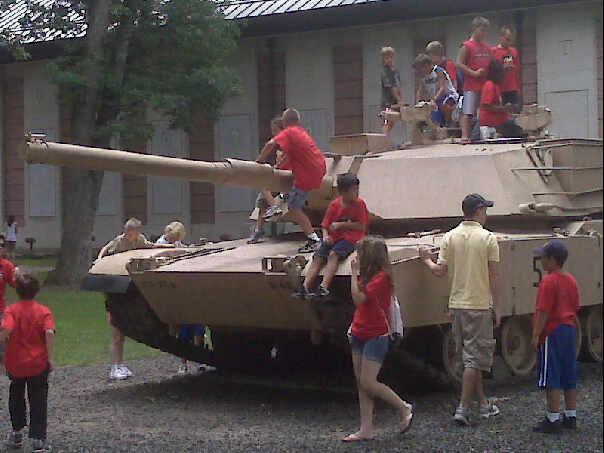
tank.jpg

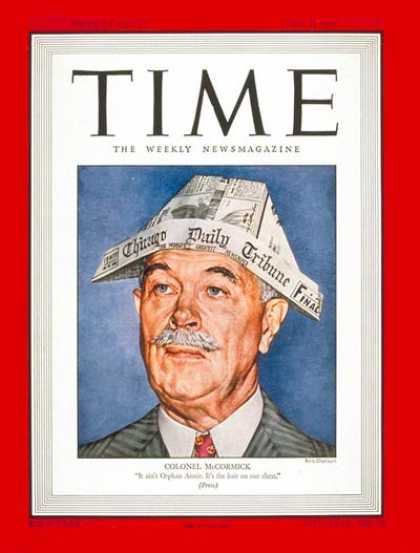
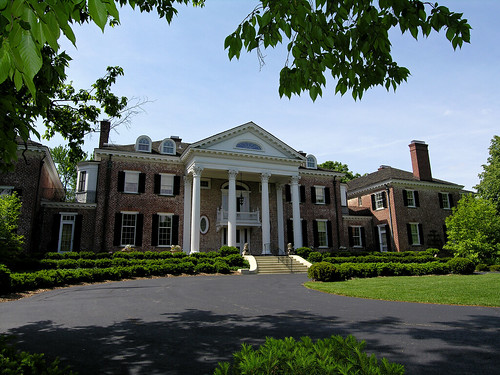
Spent a pleasant afternoon at Cantigny, the estate of legendary Chicago Tribune publisher, broadcast pioneer and ardent isolationist,  Colonel Robert McCormick. After his death in 1955, McCormick had willed that the 500 acre grounds located in Wheaton, Illinois,  be turned into a memorial to the 1st Infantry Division of the US Army, in which he had served ( McCormick was a veteran of the Mexican Expedition and the Great War). Operated by the McCormick Foundation, a charitable and educational trust with an endowment that rivals that of Yale or Harvard universities, Cantigny now is home to an opulent garden, golf course, mansion museum, several restaurants, a greenhouse, a tank and artillery park, a children’s playground, visitor’s center and the Museum of the First Division.

The grounds contain an array of armor on display for the tank aficianado, including the Sheridan, Sherman and variations of the Patton series up to the M-1 Abrams, including several “experimental” models plus a selection or artillery pieces going back well before WWI. Just added was a fully restored D-Day landing craft (still being unloaded from the trailer).  Aside from children’s tours and families present, I saw not a few veterans today, some very elderly and in wheelchairs, reminiscing together quietly by particular tanks or displays.

The museum has a collection of artifacts that run the gamut from the Revolutionary War to the Iraq War but the major sections are concerned with the two World Wars and the Vietnam War. Museum staff are friendly and helpful but unobtrusive and the basement contains a military library and archive that is open to the public for research.

The grounds are very extensive and the landscaped garden, which covers many acres,  is a world class feature in itself. The fee for admission is a mere $ 5 to park – the amenities and facilities (except the golf course and restaurants) are all free of charge.

Operation Overlord, 6 June 1944

Sunday, June 7th, 2009

D’Este on Churchill at HNN

Saturday, January 31st, 2009

Military historian Carlo D’Este had an inspiring piece up at HNN last week on Sir Winston Churchill, drawn from his book Warlord: A Life of Winston Churchill at War, 1874-1945:

The Power of Oratory: Why Churchill is Still Relevant

….From the time he became prime minister, until December 1941, when Pearl Harbor brought the United States into the war, Churchill’s strongest weapon was oratory. As a young army officer stationed in India in 1897 he wrote that: “Of all the talents bestowed upon men, none is so precious as the gift of oratory.”

His speeches of 1940 become legendary, not only for their magnetism but more importantly for their effect on public morale. To counter both the disastrous news in France and to put to rest any notion that Britain might capitulate, Churchill delivered one of his many patriotic speeches to Parliament on June 18 that was also broadcast by the BBC. He made no effort to sugarcoat the extent of the dire situation Britain faced. The struggle that lay ahead from the air and likely from invasion would be met with every means and would be rebuffed. Of Hitler and the nations now under the Nazi jackboot, he said, “If we can stand up to him, all Europe may be free . . . But if we fail, then the whole world, including the United States . . . will sink into the abyss of a new Dark Age … Let us therefore brace ourselves to our duties, and so bear ourselves that, if the British Empire and Commonwealth last for a thousand years, men will say, ‘This was their finest hour.’

Read the rest here.

Churchill was an inordinately creative military leader, deeply interested in all facets of warfare from intelligence to technological innovations in armaments ( famously a proponent of the development of the tank in WWI) to military tactics. The amphibious landing at Gallipoli was a disaster but Normandy a generation later, despite Churchill’s misgivings, was a providential success. When in political disgrace – mostly undeserved – as a result of Gallipoli, Churchill did not retire to the shadows but donned a uniform and went to the Western Front ! Moreover he demonstrated there exemplary bravery under fire.

Can anyone imagine a politician doing that today? Or the public expecting him to do so ?

In the Second World War, in 1940 -1941, Churchill was the  indomitible rock upon which Western civilization rested. A lesser man as Prime Minister would have taken easy terms from Hitler and made Great Britain a satellite empire of the Greater German Reich, akin to the Phonecians’ relationship to ancient Persia. Few people alive today realize how dire the situation was in the Spring of 1941 and how close liberal democracy came to vanishing from history. 

Thanks to Churchill and the bravery of the RAF, the West had a chance to catch it’s breath.

Red Flag Rising

Friday, November 14th, 2008

Shane Deichman had a superb post on Soviet Admiral of the Fleet and C-in-C of the Red Navy, Sergei Georgyevich Gorshkov over at Antilibrary. The admiral was the father of Soviet blue water power projection. Shane is reviewing Gorshkov’s The Sea Power of the State:

Gorshkov’s “The Sea Power of the State”

In this book, Admiral of the Fleet Gorshkov not only offers a vision of the relevance of the “World Ocean” to any nation’s well-being – he also provides a compelling rationale for “joint operations” a full ten years before our own nation’s Goldwater-Nichols Act forced jointness onto a reluctant American defense establishment, and underscores the importance of the littoral in a navy’s ability to influencing events ashore nearly two decades before “… From the Sea”.

The Sea Power of the State is rich in dichotomy: a land-rich nation with few accessible ports preaching the relevance of sea power, an atheist totalitarian regime describing the social and cultural significance of the “World Ocean”, a nation besmirched for its negative impact on the environment bemoaning pollutants and the need for “union with the environment”, and a foundational tome for effective naval force planning from a nation that just this month claimed the lives of nearly two dozen civilians in a submarine accident. Such is Gorshkov’s compelling style – scholarly and impeccably researched, with steadfast devotion to the tenets of Marxism, decrying the “imperialist aggression” of the Capitalist powers who exploit sea power to “hold in check other states.”

….Most impressive about Gorshkov is the breadth of his perspective.  Alongside the typical Communist demagoguery (e.g., “Imperialist power exploit sea power to preserve their monopoly …”) are lucid arguments for balanced force structure planning (inclusive of creating large merchant fleets), diminished pollutants, and even maritime law (with an appeal to demilitarize the World Ocean beyond the 12 mile territorial waters).  Curiously, he never once expresses disdain at the limited blue water access of the Soviet Union – and was convincing enough in his vision that the Kremlin subsidized his development of a fleet that nearly reached parity with the dominant sea powers of the west

Read the whole review here

I am not an expert in maritime matters but I am relatively conversant on Soviet affairs. Shane’s right, by Soviet standards, where bureaucratic conservatism and enforced conformity to CPSU doctrine served to weed out independent thinkers before they could ascend the first rungs of the nomenklatura ladder, Gorshakov was making a daring, even a startingly bold argument. The Sea Power of the State could have easily been a career-ender had the ideological winds taken a wrong turn; Gorshakov’s argument has very little to do with Marxism or Soviet military doctrine. Instead, it draws upon the Petrine tradition of modernization and securing the “window to the west” that Peter the Great sought in building St. Petersburg and the warm water ports after which subsequent Tsars lusted.

Fortunately for Gorshakov, his ideas coincided with the noontide of Brezhnev’s faction, which was rooted in military heavy industry, the Dnepropetrovsk mafia and a national security axis of the power ministries – Defense, Foreign Ministry and the KGB which were controlled by Brezhnev’s then allies and proteges, Ustinov, Gromyko and Andropov. Gorshakov’s vision of expanding Soviet reach abroad also had appeal to party hardliners like Mikhail Suslov and Boris Ponomarev who were deeply interested in supporting radical third world regimes and adding the Ethiopias, Angolas and Nicaragua’s to the “Socialist camp”

Mao ZeDong and 4GW

Wednesday, June 18th, 2008

A part of a comment from Jay@Soob:

“This was likely compounded by the chronological assignment (that Mao was the first to conceptualize 4GW is an assertion that Ethan Allen might have something to swear and swing fists about)”

The frequent and casual association of Chairman Mao with 4GW is something that has always puzzled me as well ( though, if memory serves, William Lind was always careful to explain that 4GW isn’t simply guerilla warfare). I think it can be attributed to the likelihood that most people who are somewhat familiar with 4GW theory tend to think first of guerillas and Mao is regarded as a great innovator there. However, is there merit in placing Mao in the “4GW pantheon” (if there is such a thing)?

In the ” yes” column I’d offer the following observations:

Mao, whose actual positive leadership contribution to Communist victory in the civil war was primarily political and strategic rather than operational and tactical ( his military command decisions were often the cause of disaster, retreat and defeat for Communist armies) had a perfect genius – I think that word would be an accurate description here – for operating at the mental and moral levels of warfare.  Partly this was skillful playing of a weak hand on Mao’s part; the Communists were not a match on the battlefield for the better Nationalist divisions until the last year or so of the long civil war but Mao regularly outclassed Chiang Kai-shek in propaganda and diplomacy – turning military defeats at Chiang’s hands into moral victories and portraying Communist inaction in the face of Japanese invasion as revolutionary heroism. Yenan might have be a weird, totalitarian, nightmare fiefdom but Mao made certain that foreign journalists, emissaries and intelligence liasons reported fairy tales to the rest of the world.

In the “maybe” column:

Regardless of one’s opinion of Mao ZeDong, China’s civil war, running from the collapse of the Q’ing dynasty in 1911 to the proclamation of the People’s Republic in 1949, is a historical laboratory for 4GW and COIN theory.  The complexity of China in this era was akin to that of Lebanon’s worst years in the 1980’s but it lasted for decades. In a given province of China ( many of which were as large or larger than major European nations) then there might have been operating simultaneously: several warlord armies, Communist guerillas,  Nationalist armies, the Green Gang syndicate, White Russian mercenaries, Mongol Bannermen, rival Kuomintang factions, common bandit groups and military forces of European states, Japan and the United States. Disorder and ever-shifting alliances and fighting was the norm and Mao was the ultimate victor in this era.

In the “no ” column:

Mao ZeDong, whatever his contributions to the art of guerilla warfare, intended, quite firmly, to build a strong state in China, albeit a Communist one in his own image. He was never interested in carving out a sphere of influence or an autonomous zone in China except as a stepping stone to final victory. Moreover, the Red Army’s lack of conventional fighting ability for most of the civil war related to a lack of means, not motive on Mao’s part. When material was available, particularly after 1945, when Stalin turned over equipment from the defeated  Kwangtung army and began supplying a more generous amount of Soviet military aid to the Chinese Communists, Mao tried to shift to conventional warfare. When in power, he sent the PLA’s 5-6 crack divisions into the Korean War to face American troops in 2GW-style attrition warfare, not guerilla infiltrators behind MacArthur’s lines. 

Finally, Mao’s personal political philosophy of governance, taken from Marxism-Leninism and Qin dynasty Legalism, are about as radically hierarchical and alien to 4GW thinking as it is possible to be.

In sum, Mao is and should be regarded as a major figure in the  history of the 20th century and that century’s military history but he isn’t the grandfather of fourth generation warfare.

ADDENDUM:

Congratulations to 4GW theorist and blogger Fabius Maximus for being picked up by the BBC.

Switch to our mobile site