zenpundit.com » Communism

Archive for the ‘Communism’ Category

A Remarkable Disconnect From Context and Causation

Sunday, November 25th, 2007

I was surfing over at the always engaging, Left of center blog, The Newshoggers, when I saw a post by Cernig discussing a NYT op-ed by Martin Walker giving the lion’s share of the credit for the end of the Cold War to Mikhail Gorbachev, a position Cernig strongly endorsed, expounding upon the” Reagan won Mythtique”.  A key section from the Walker op-ed:

“According to both Schell and Rhodes, the cold war ended not because Reagan stood firm at Reykjavik but because Gorbachev and his supporters had already decided to stop waging it, or as Gorbachev’s adviser Giorgy Arbatov once put it to this reviewer in Moscow, “to take your enemy away.” Gorbachev understood that the arms race was ruining his country. And then he learned that the radiation fallout from Chernobyl was the equivalent of a single 12-megaton bomb.It was a wondrous accident of history that saw Gorbachev, the determined reformer of a sclerotic Soviet system, coincide with Reagan, the anti-Communist conservative who nonetheless dreamed of a world without nuclear weapons. After Reagan came the first president Bush, whose initial caution about Gorbachev gave way to such enthusiasm that he unilaterally scrapped America’s vast arsenal of land- and sea-based tactical nuclear weapons. Between them, the three men put an end to the first nuclear age.”

The first paragraph begs the question of “Why?” – particularly when Gorbachev’s recent predecessor as General-Secretary and longtime political godfather, Yuri Andropov, had such a drastically different reaction to nearly identical circumstances, despite being perhaps the best informed Soviet leader to ever rule the Kremlin. Walker ( leaning heavily on the writings of Jonathan Schell and Richard Rhodes) credits the Chernobyl disaster causing a Paul on the road to Damascus political conversion in the highest reaches of the Soviet nomenklatura. I find that such a thesis strains credulity, to put it mildly.

Walker would have us believe that a totalitarian system that weathered: approximately 20 to 25 million war dead in WWII, plus; another 20 to 30 million Soviet citizens who vanished into the Gulag under Stalin; that went to the brink of nuclear war with the U.S. under Khrushchev and with China under Brezhnev; that was, at the time, accepting tens of thousands of casualties annually in Afghanistan under Gorbachev; was suddenly undone morally and spiritually by a comparative handful of dead in an industrial accident at a nuclear plant and subsequent bad Western P.R. This is not history but wishful fantasy of an adolescent kind.

Let us be clear, Mikhail Gorbachev deserves significant credit for his share in bringing the Cold War to a sane and relatively soft landing.  He exercised intelligent restraint at a number of critical junctures where an ideologue would have provoked a civil war – something the coup plotters who toppled Gorbachev almost did. Gorbachev also understood that the Soviet system was fundamentally incompatible with the emergence of a globalized and highly technological information economy and that if his country did not adapt quickly, it would be left behind. At no time in power, however, did Gorbachev intend to destroy the Soviet Union or abandon “socialism” ( though what socialism was to be in the future, became increasingly vague in Gorbachev’s pronouncements) – these were the unintended consequences of trying to square a circle and make the USSR into a “normal” state via perestroika. A herculean task that exceeded even Gorbachev’s considerable political talents.

The facts are that Gorbachev and the USSR lost the Cold War and then sued for peace out of necessity, not from moral superiority or anti-nuclear altruism. It is a further truth that Ronald Reagan was substantially more correct than most of his contemporaries, Left and Right, on the proper American stance toward the Soviets; and that without his tough but flexible policies, the USSR might have limped along on life support for some time longer, as has North Korea.  Possibly, without the challenge of Reagan in the first place, the Soviet politburo might have opted for yet another ailing octogenarian to warm Lenin’s seat after Chernenko died and the “youthful” Gorbachev might have idled as a second tier leader for another decade.

No, Ronald Reagan did not win the Cold War by himself but he contributed to that victory and all attempts to spin Mikhail Gorbachev, a tough-minded and daring apparatchik who wanted to save the Soviet Union, into the grand savior of humanity are just that – empty spin.
Saturday, August 4th, 2007

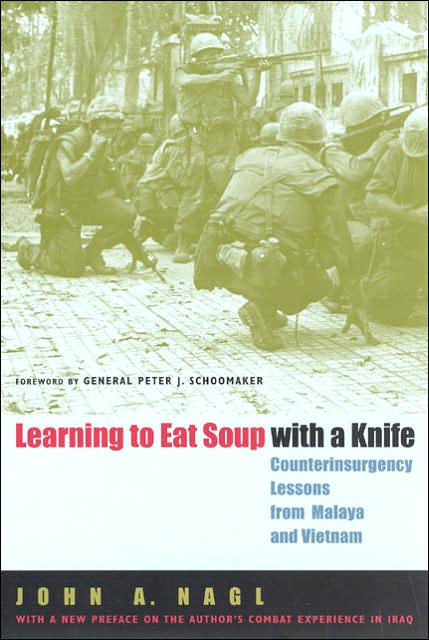
REVIEWING LEARNING TO EAT SOUP WITH A KNIFE

Learning to Eat Soup With A Knife -Book Review” is now up at Chicago Boyz.

Friday, August 3rd, 2007

SOLZHENITSYN AND HIS BATTLE FOR RUSSIA’S SOUL

Der Spiegel recently had an interview with Aleksandr Solzhenitsyn ( hat tip to M. Gemmill). At 88, Solzhenitsyn has lost neither his mental acuity nor his uncompromising vision of Russia that made him the most feared of dissidents by Soviet leaders, until his expulsion from the USSR in 1974, four years after being awarded the Nobel Prize. Some excerpts of Solzhenitsyn’s answers from the interview:

“The prize in 1990 was proposed not by Gorbachev, but by the Council of Ministers of the Russian Soviet Federative Socialist Republic, then a part of the USSR. The prize was to be for “The Gulag Archipelago.” I declined the proposal, since I could not accept an award for a book written in the blood of millions.

…I have grown used to the fact that, throughout the world, public repentance is the most unacceptable option for the modern politician.

….Vladimir Putin — yes, he was an officer of the intelligence services, but he was not a KGB investigator, nor was he the head of a camp in the gulag. As for service in foreign intelligence, that is not a negative in any country — sometimes it even draws praise.

….Only an extraordinary person can turn opportunity into reality. Lenin and Trotsky were exceptionally nimble and vigorous politicians who managed in a short period of time to use the weakness of Kerensky’s government. But allow me to correct you: the “October Revolution” is a myth generated by the winners, the Bolsheviks, and swallowed whole by progressive circles in the West.

….However, when you say “there is nearly no opposition,” you probably mean the democratic parties of the 1990s. But if you take an unbiased look at the situation: there was a rapid decline of living standards in the 1990s, which affected three quarters of Russian families, and all under the “democratic banner.” Small wonder, then, that the population does not rally to this banner anymore. And now the leaders of these parties cannot even agree on how to share portfolios in an illusory shadow government.”

Solzhenitsyn has never been a voice of liberalism or even Russian nationalism in the traditional pan-Slavic, imperial and chauvinistic sense the term is usually meant. Rather he has propagated Russophilism, even to the extent of using archaic Russian words without modern foreign antecedents, when possible, in his writings. Solzhenitsyn’s emphasis on the unique cultural and spiritual traditions of old Russia is one that excludes other peoples – including those like Jews and Ukrainians- who have been deeply intertwined with or innately part of Russian history.

Part of Solzhenitsyn’s thunderous moral denunciation of the monstrosities of the Soviet system were because of the ruin of the old Russian patrimony under the profoundly alien doctrines of Communism, a Western import. I would not be surprised if Solzhenitsyn traced the origin of Russia’s sad history to Peter the Great as much as to Vladimir Lenin.

Sunday, July 29th, 2007

MOUNTAINRUNNER ON KENNAN’S LESSONS

Matt at MountainRunner has a fine post on lessons that can be drawn from George Kennan’sLong Telegram“.

For those who frame the modern conflict in Cold War images, it might be useful to remember the real designs and purposes of early Cold War policies. For those who think public diplomacy is simply a beauty contest to hopefully “win hearts”, should go back to the aggressive “five-dollar, five syllable” foundation of public diplomacy as a psychological struggle for minds and wills against an enemy who understood perception management.”

Kennan’s two volume memoirs make for some interesting reading, as does his work Russia and the West Under Lenin and Stalin, though it helps to have some of the period’s diplomatic historiography under your belt to better read between the lines of Kennan’s prose. If we have any George Kennan equivalents today, they are probably employed by the Defense Department or have been, which says a great deal about the intellectual and political decline of the State Department since Kennan’s time.

KENNAN ADDENDUM:

America and the Russian Future (1951)” by George F. Kennan

More reflections on George Kennan” by Dave Schuler

LET HISTORY JUDGE THE FATHER OF CONTAINMENT ” – Zenpundit

George Kennan Speaks to the War on Terror” and “Tipping Points” by CKR

Sunday, March 25th, 2007

THE STRONG MEN OF ASIA

Having spent a great deal of time considering creativity and insight, I’m generally convinced that we benefit cognitively and on an emotive-psychological level from novelty, even if that novelty is to a small degree. Sort of like garnering measurable aerobic benefits from modest daily walking, every little bit helps. You don’t have to go from a microbiology lab one day to spelunking the next in order to give your brain some stimulus.

Therefore, I decided to shift my usual reading attention from matters of Western history and military affairs to read in succession, the biographies of three seminal 20th century dictators, all of whom ruled Asian nations but impacted the history of the world. It is a good shifting of gears for me, as the last heavy fare of reading Asian history and politics was back in the early nineties.

First up, is Chiang Kai-Shek: China’s Generalissimo and the Nation He Lost by Jonathan Fenby, who gives a critical reappraisal. While we are all accustomed to the standard scholarly historical criticism of Chiang Kai-Shek and the Kuomintang which is heavily influenced by the politics of academic Marxism, Fenby, a British journalist who is a longtime writer and editor for The Economist magazine and The Observer, (so far as I have read) gives a hard-eyed, pragmatic, thoroughly detailed, flavor that Alan Schom gave to his masterful deconstruction of Napoleon Bonaparte.

Number two will be the critically acclaimed The Unknown Story of Mao by Jung Chang and Jon Halliday, which like the Fenby book is an act of idol-smashing. All the moreso since Mao ZeDong, unlike his rival Chiang, retains an aging cadre of Leftist admirers both at home and in the West.

I intend to finish with the highly regarded Ho Chi Minh: A Life by former diplomat and Penn State historian William J. Duiker.Duiker himself, served in the American embassy in Saigon during the Vietnam war, which adds a poignant edge to his historical research.

Anyone out there who has read any or all of these books, feel free to chime in.


Switch to our mobile site

