zenpundit.com » IC

Archive for the ‘IC’ Category

What could have stopped Snowden

Thursday, June 13th, 2013

[ by Charles Cameron — mini-rant on importance of humans, human errors, and insight ]
.

OK, I watch TV & this screencap is from *Lie to Me* - this is about more than that


.

One proficient judge of human character with a good combo of micro-observation skills and / or gut instinct present at a Booz Allen job interview might very well have made a substantial difference, no?

**

I see this as a case to consider in terms of the human intelligence : number crunching ratio, or HUMINT : SIGINT balance.

Or rich data : Big Data or mind : machine question.

Or am I missing something?

**

Just one piece of the puzzle:

Microexpressions, from Wikipedia:

A microexpression is a brief, involuntary facial expression shown on the face of humans according to emotions experienced. They usually occur in high-stakes situations, where people have something to lose or gain. Microexpressions occur when a person is consciously trying to conceal all signs of how he or she is feeling, or when a person does not consciously know how he or she is feeling. Unlike regular facial expressions, it is difficult to hide microexpression reactions. Microexpressions express the seven universal emotions: disgust, anger, fear, sadness, happiness, surprise, and contempt. Nevertheless, in the 1990s, Paul Ekman expanded his list of basic emotions, including a range of positive and negative emotions not all of which are encoded in facial muscles. These emotions are amusement, contempt, embarrassment, excitement, guilt, pride, relief, satisfaction, pleasure, and shame. They are very brief in duration, lasting only 1/25 to 1/15 of a second.

Microwizards, from Wikipedia — which may not be quite the same as the ability to detect microexpressions:

O’Sullivan and Ekman identified only 50 people as Truth Wizards after testing 20,000 (~0.25%) from all walks of life, including the Secret Service, FBI, sheriffs, police, attorneys, arbitrators, psychologists, students, and many others. Surprisingly, while psychiatrists and law enforcement personnel showed no more aptitude than college freshmen, Secret Service agents were the most skilled.

**

That’s all, folks. It’s a beginning — what say you all?

On, or Of?

Tuesday, June 11th, 2013

[ by Charles Cameron — always trying to read with care, not always succeeding — NSA ]
.

Dana Milbank in WaPo yesterday:

Sen. Ron Wyden (D-Ore.) asked Clapper at a Senate hearing in March, “Does the NSA collect any type of data at all on millions or hundreds of millions of Americans?”

“No, sir,” Clapper testified.

“It does not?” Wyden pressed.

“Not wittingly. There are cases where they could inadvertently, perhaps, collect, but not wittingly.”

We now know that Clapper was not telling the truth. The National Security Agency is quite wittingly collecting phone records of millions of Americans, and much more

Is there a signikficant distinction to be made between collecting data ON millions of Americans, and collecting phone records OF them?

Does OF mean pertaining to, and ON mean about?

Dateline, June 5th 2012

Monday, June 10th, 2013

[ by Charles Cameron — screengrabs from a very recently posted video, mostly Taliban with just a smidgeon of NSA ]

[edited to add: please see warning in comment below]
.

Scary, hunh? Yeah?

**

No, this is not from a NSA / Prism video — I’ll have just a little more on that topic later.

Nor is it from your local mafiosi

In fact, it’s from the Islamic Emirate of Afghanistan

i.e the Afghan Taliban.

And it’s addressed to Saakashvili and the people of Georgia (FSU), telling them:

and:

**

What interests me here is this: I tend to think of the Islamic Emirate as mainly Afghanistan-centric, so viewing this video I wondered whether they’ve announced similar intent to raid or attack other nations. Alex Strick van Linschoten responded to my query as to whether he’d seen this sort of message before:

He also pointed me to his book, An Enemy We Created: The Myth of the Taliban-Al Qaeda Merger in Afghanistan, where (p. 277 in my uncorrected proof) we read:

It was around this time that Dadullah started to make increasingly strident statements of support for a global jihad, one in which attacks in Europe and the United States were not to be ruled out.101 Dadullah was, in contrast to most other Talibs of his generation, a ‘true believer’ in this rhetoric. Some commentators have suggested this is pathological, but a possible explanation can be found in the time he spent with foreign jihadis both on the northern fronts during the 1990s as well as post-2001, when he was in South Waziristan. He was frequently used as a go-between for the Taliban in Pakistan and retained ties to the foreign al-Qaeda affiliates as well.

So this kind of thing is not entirely unknown, and indeed “revenge” strikes outside Afghan territory would fit the model Dadullah himself proposed for strikes within Afghanistan (pp. 273-73):

Our tactics now are hit and run; we attack certain locations, kill the enemies of Allah there, and retreat to safe bases in the mountains to preserve our mujahidin. This tactic disrupts and weakens the enemies of Allah and in the same time allows us to be on the offensive. We decide the time and place of our attacks; in this way the enemy is always guessing.

Mullah Dadullah died in 2007, but it seems his thinking still exerts some influence…

** ** **

And NSA — or Nonesuch as I was taught to call it, back in the day?

I stand by the idea I tweeted to JM Berger yesterday:

I’d only add that three days doesn’t seem long enough in this case, and that when the dust settles we may still find ourselves holding just a few loose ends of a multiply-tangled web…

Manhunt: Radicalization, & comprehending the full impact of dreams

Saturday, June 8th, 2013

[ by Charles Cameron — how do you intercept messages that come via dreams? I’m thinking of al-Balawi ]
.

My little graphic (below) may be kidding — but what of reality?

**

In the bin Laden documentary, Manhunt, which I mentioned before seeing it here, and discussed briefly here, another passage (at 1.22.31) that is missing from the CNN transcript concerns the dream which radicalized Humam al-Balawi, the Khost bomber. Balawi speaks, the subtitles translate for us:

God blessed me to have this dream. I dreamed I saw Zarqawi. He was in my house. His face was like a full moon. He was busy. Preparing an attack. I wishes I could fight with him. Be killed with him. I am your humble brother from Jordan. I am 32 years old and a medical doctor.

I’m not suggesting there was no prior fertilization of Balawi’s mind and heart, nor that he was influenced by no other drivers: I just wonder what the impact of such a dream would be, given that intense smuggling goes on between our waking and dream lives, of a kind that no intercepts can capture for analysis.

**

How powerful can influence can a dream exert?

Consider this example, taken from Marie-Lousie von Franz, On Dreams & Death: A Jungian Interpretation, p. 64:

She sees a candle lit on the window sill of the hospital room and finds that the candle suddenly goes out. Fear and anxiety ensue as the darkness envelops her. Fear and anxiety ensue as the darkness envelops her. Then, the candle re-lights on the other side of the window and she awakens. She died the same day.

**

If I may borrow a bit from some unpublished writings of mine…

Dreams as early indicators:

The western secular paradigm considers dreams to be of little or no significance, and it is therefore entirely possible that intelligence gleaned from the recounting of dreams will seem of little interest to western analysts. In the Islamic view, however, certain dreams are of considered to be of real significance, their importance being indicated by the hadith reported by Bukhari:

Narrated Ibn ‘Umar: Allah’s Apostle said, “The worst lie is that a person claims to have seen a dream which he has not seen.”

— Sahih Bukhari, book 87: Interpretation of Dreams, #167.

One early indicator of a Mahdist tendency in a given population, therefore, would be the presence of dreams about the Mahdi in a given discourse — in jihadist chat rooms, for instance — while the frequency of such mentions would be a useful heuristic measure of the development of such a movement. Thus Yaroslav Trofimov reports [Siege of Mecca, hb. p.50.] that in the run-up to the 1979 siege of the Grand Mosque and Ka’aba in Mecca, many followers of Juhayman al-Otaibi, the leader of the raid, dreamed dreams:

Then, one after another, hundreds of Juhayman’s supporters experienced detailed, vivid dreams. Mohammed Abdullah’s sister appears to have been the first, quickly followed by others. In their sleep, they all had the same vision: Mohammed Abdullah standing by the sacred Kaaba in Mecca’s Grand Mosque, accepting allegiance as the blessed Mahdi amid multitudes of believers. Militants from as far away as Lebanon who never encountered Mohammed Abdullah in person claimed to have had the same dream.

It is worth noting here that while, as Trofimov suggests, much of the dreaming “must have been caused by self-suggestion” this in no way invalidates their significance as indicators. Indeed, Reuven Paz writes of the mediaeval scholar Ibn Sirrin‘s still-popular Interpretation of Dreams that “high selling rates of this book can provide us an indicator for rising apocalyptic notions”. Paz also notes a “sizable number” of jihadis publishing their dreams and visions on Jihadist forums on the web [p.4..

Dream narration of this sort certainly corresponds to hikayat as discussed by Michael Vlahos in his essay Terror’s Mask: Insurgency Within Islam — still one of the most necessary pieces I have read on al-Qaeda..

**

Closer to home, in one sense, than the siege of the Grand Mosque, is the 9/11 attack on the Twin Towers and Pentagon. This too had its dream precursors, as we can tell from the video transcript of bin Laden‘s taped meeting of mid-November 2001:

UBL: He [Abu-Al-Hasan Al-Masri] told me a year ago: “I saw in a dream, we were playing a soccer game against the Americans. When our team showed up in the field, they were all pilots!” He said: “So I wondered if that was a soccer game or a pilot game? Our players were pilots.” He didn’t know anything about the operation until he heard it on the radio. He said the game went on and we defeated them. That was a good omen for us.

Shaykh: May Allah be blessed.

Unidentified Man: Abd Al Rahman Al-Ghamri said he saw a vision, before the operation, a plane crashed into a tall building. He knew nothing about it.

Shaykh: May Allah be blessed!

and notably:

UBL: We were at a camp of one of the brother’s guards in Qandahar. This brother belonged to the majority of the group. He came close and told me that he saw, in a dream, a tall building in America, and in the same dream he saw Mukhtar teaching them how to play karate. At that point, I was worried that maybe the secret would be revealed if everyone starts seeing it in their dream. So I closed the subject. I told him if he sees another dream, not to tell anybody, because people will be upset with him.

(Another person’s voice can be heard recounting his dream about two planes hitting a big building).

For your in-depth reading pleasure, see Iain R. Edgar, The Inspirational Night Dream in the Motivation and Justification of Jihad if you can get past the paywall…

**

Vlahos quotes Albert Hourani, A History of the Arab Peoples, on this point — I’ll present my own version of that quote here, because it describes a mindset that, mutatis mutandis, many of our opponents share to this day:

It was commonly held, in all cultures before the modern age, that dreams and visions could open a door into a world other than that of senses. They might bring messages from God; they might disclose a hidden dimension of a person’s own soul; they might come from jinns or devils. The desire to unravel the meaning of dreams must have been widespread, and was generally regarded as legitimate; dreams told us something which it was important to know.

Dreams are “outside the box” of waking reality — and we need to learn to appreciate the force of dream logic, if we want to think outside our own western prejudices, and inside our adversaries’ heads…

A feast of form in my twitter-stream today

Sunday, June 2nd, 2013

[ by Charles Cameron — forms & patterns, pattern recognition & creative leaps, creative leaps & connecting dots, connecting dots & node-and-edge mapping — node-and-edge mapping, link charts and Sembl-HipBone games ]
.
.

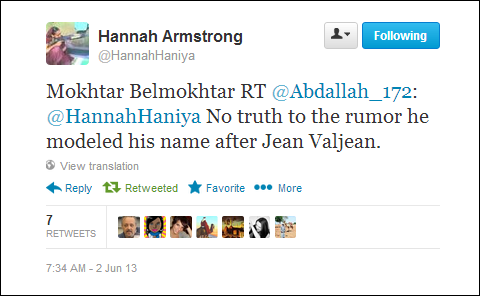
There’s no “actionable intelligence” in that tweet, but it recognizes a pattern, it makes a fine creative leap. And given the chance, that’s something bright minds do naturally, and enjoy doing, and is away more important than we think.

Yestedrday I was watching Manhunt pretty closely for an upcoming Zenpundit review, and noticed that some of the most significant quotes in the film were absent from CNN’s transcript. One gap I noticed had to do with the descriptions of the analytic process, and in particular some of the things Cindy Storer said. I’ll quote this one, which goes to the heart of the matter, but there’s plenty more left for me to chew over with you later. Here she goes:

Even in the analytical community there’s a relatively smaller percentage of people who are really good at making sense of information that doesn’t appear to be connected. So that’s what we call pattern analysis, trying to figure out what things look like. And those people, you really need those people to work on an issue like terrorism, counternarcotic, international arms trafficking, because you’ve got bits and pieces of scattered information from all over the place, and you have to try to make some sense of it. … That takes this talent, which is also a skill, and people would refer to it as magic — not the analysts doing it, but other people who didn’t have that talent referred to it as magic.

That’s a pretty exact description of what the Sembl game will eventually teach people, once it comes out of the museum prototype and onto the web — but let’s back it up with a quick quote from Wittgenstein:

A surveyable representation produces precisely that kind of understanding which consists in ‘seeing connections’ [Zusammenhänge sehen]. Hence the importance of finding and inventing connecting links. Hence the importance of finding and inventing intermediate links.

That’s from Philosophical Investigations, 122, and it’s a higher altitude / more abstract view — but it’s also the very heart of network thinking, seeing processes not just in terms of isolated nodes but of the connections between them.

**

Seeing connections — connecting the dots — happens in lines and leaps. That is to say, it can happen according to the usual linear way of thinking, the dogged 99% of perspiration that people talk about — or according to the far less common lateral move or creative leap, which moves by analogy, which is to say by pattern recognition, by the perception of similarities of form.

That’s the 1% we call inspiration. That’s the magic.

**

So a whole lot of patterning was going on in my twitter-stream today, and I thought I’d show you.

First, there was the parallel between the names Mokhtar Belmokhtar and Jean Valjean (above). If you’re hunting either fellow, the parallelism isn’t going to yield a useful clue — but the mode of recognition is what matters, and the reason its such a rare mode is precisely because it’s playful. It plays with forms — in this case, the forms of the two names — without regard for practicality.

And yet this playful spirit is what brought us Weil‘s conjecture and Pierre Deligne‘s Abel Prize, and the Taniyama-Shimura conjecture and Wiles‘ proof of Fermat’s Last Theorem.

Serious playfulness is key… to serious, magical breakthroughs. In any and all domains.

*

With that in mind, here are the rest of the patterns I recognized in todays feed.

Let’s start with self-reference, which can hardly get more succinct than the hackers hacked:

There’s also a self-referential paradox at work in the question of a defendant appearing in his own defense — something that gives judges pause, because they see how tightly the serpent is chasing its own tail. Defendant defends self, From Raff Pantucci:
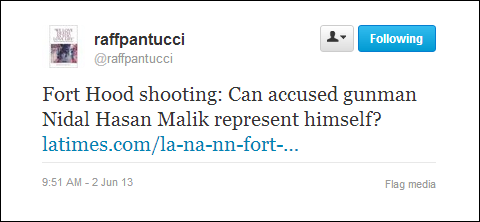
The saddest self-reference of the morning’s tweets was this one, which could be encapsulated as storm-chaser chased by storm:
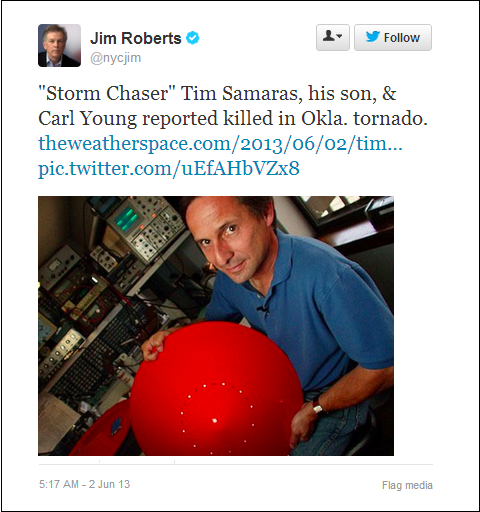
Even tragedy can take self-referential form.

**

But lets move on to Turkey, which provided a rich dividend:

There was this problem:
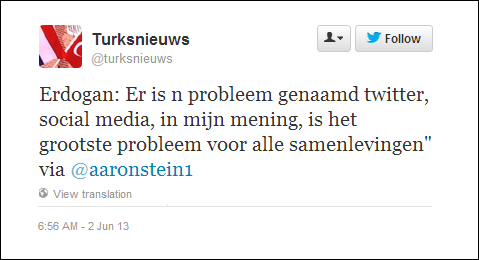
Turkish I couldn’t read, Dutch I can more or less make out — but for an English tweet making the same point let’s go to Zeynep Tufekci, who has expertise in both matters Turkish and matters Internet, and tweets about Erdogan disapproving of tweeting:

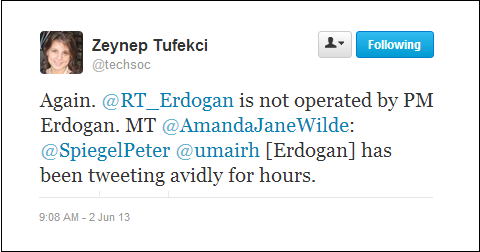
Tufekci again, this time catching an even neater self-reference which doesn’t quite pan out — because, as she says, PM Erdogan is not the same as @RT_Erdogan:
**

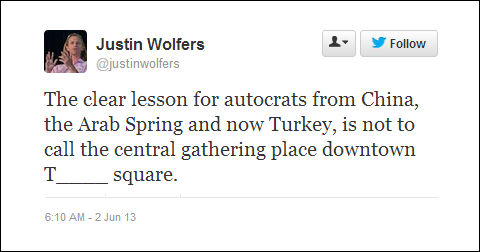
While we’re on Turkey, this tweet about Tienanmen, Tahrir and Taksim Squares gave us another example of a bright mind catching a hint of pattern…
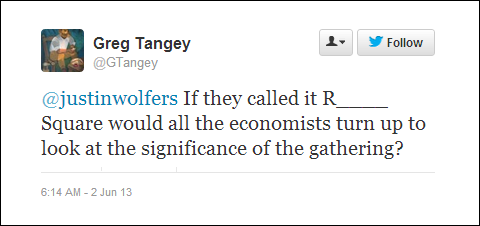
And what a neat rejoinder!
All of the above is quite useless, entirely playful — and of deep interest if creativity and insight matter

**

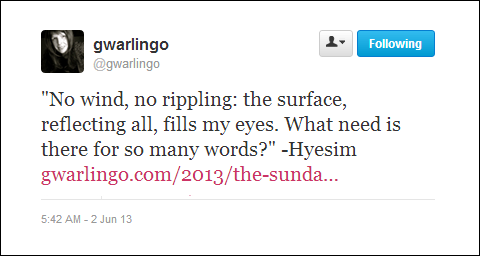
Finally, I’d like to go someplace quiet and bathe in peace. This tweet, featuring a poem by a Korean zen master, does the trick nicely:
AN appreciative bow to Gwarlingo for that one…

Switch to our mobile site