zenpundit.com » john boyd

Archive for the ‘john boyd’ Category

A Recommended Blog for Metacognition

Sunday, January 30th, 2011

A while back, I added Ribbonfarm to the blogroll, which is written by Dr. Venkat Rao, a corporate scientist typeafter John Hagel featured in his twitterstream an old but amusing post by Rao analyzing sociopathology in corporate life via characters from The Office. Clever. I thought I would blogroll him and check in periodically.

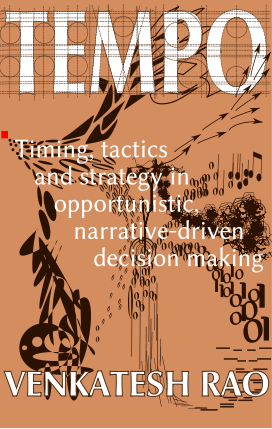
Later, I noticed that Rao makes frequent references to Clausewitz in his posts and that he is writing Tempo, a book on decision making that will be of great personal and professional interest to many readers here. At this juncture, I’m intrigued.
Then last week, Rao featured a lengthy post on metacognition where he made some excellent points. Here’s a few of them, but as I can only put up a small selection, you should go read the full post:

Boundary Condition Thinking:

 ….To build mathematical models, you start by observing and brain-dumping everything you know about the problem, including key unknowns, onto paper.  This brain-dump is basically an unstructured take on what’s going on. There’s a big word for it: phenomenology. When I do a phenomenology-dumping brainstorm, I use a mix of qualitative notes, quotes, questions, little pictures, mind maps, fragments of equations, fragments of pseudo-code, made-up graphs, and so forth.

You then sort out three types of model building blocks in the phenomenology: dynamics, constraints and boundary conditions (technically all three are varieties of constraints, but never mind that).

Dynamics refers to how things change, and the laws govern those changes. Dynamics are front and center in mathematical thought. Insights come relatively easily when you are thinking about dynamics, and sudden changes in dynamics are usually very visible.  Dynamics is about things like the swinging behavior of pendulums.

Constraints are a little harder. It takes some practice and technical peripheral vision to learn to work elegantly with constraints. When constraints are created, destroyed, loosened or tightened, the changes are usually harder to notice, and the effects are often delayed or obscured. If I were to suddenly pinch the middle of the string of a swinging string-and-weight pendulum, it would start oscillating faster. But if you are paying attention only to the swinging dynamics, you may not notice that the actual noteworthy event is the introduction of a new constraint. You might start thinking, “there must be a new force that is pushing things along faster” and go hunting for that mysterious force.

This is a trivial example, but in more complex cases, you can waste a lot of time thinking unproductively about dynamics (even building whole separate dynamic models) when you should just be watching for changes in the pattern of constraints.

….Historians are a great example. The best historians tend to have an intuitive grasp of this approach to building models using these three building blocks.  Here is how you can sort these three kinds of pieces out in your own thinking. It involves asking a set of questions when you begin to think about a complicated problem.

  1. What are the patterns of change here? What happens when I do various things? What’s the simplest explanation here? (dynamics)
  2. What can I not change, where are the limits? What can break if things get extreme? (constraints)
  3. What are the raw numbers and facts that I need to actually do some detective work to get at, and cannot simply infer from what I already know? (boundary conditions).

Besides historians, trend analysts and fashionistas also seem to think this way. Notice something? Most of the action is in the third question. That’s why historians spend so much time organizing their facts and numbers.

Nice. There’s a multitude of places here to jump off and generate further epistemic analysis, and I am sure that some of the admirers of Boyd, Polanyi, Wohlstetter, Feynman, Kahn and Clausewitz in the ZP readership might do so in the comments. Or my co-blogger Charles might weigh in from the imaginative/mythic/visual domain. We’ll see.

Regardless, I think if you are following blogs like Metamodern, Thomas P.M. Barnett,  Open the Future, Global Guerrillas, John Hagel’s Edge Perspectives, Eide Neurolearning Blog or liked the old Kent’s Imperative (suddenly live again after being dormant for 2 years), you’ll want to consider adding Ribbonfarm to your RSS feed or blogroll.

ADDENDUM:

Ed at Project White Horse, another fine site for your blogroll, is also blogging on boundary conditions:

Stall, Spin, Crash, Burn and Die – Boundary Conditions for 2011

….You can’t fix things without some understanding, real understanding of the problem – nor can there be real leadership without actionable understanding. That’s where establishing boundary conditions as a vehicle to frame the problem – and therefore garner greater insight – become important.

Drilling for oil at a depth of 5000ft and in open ocean – Deepwater Horizon – should have been/should be seen as a “crisis” in waiting no matter the historical track record. Proper understanding would have meant that the National decision making level immediately recognized the high potential for the initial crisis migrating into a severely complex catastrophe after the explosion and acted, not waiting to see if BP’s response plans would work. Activities in “Blue Water”/open ocean are not a linear extrapolation from “inshore,” nor is 5000 ft a linear extrapolation from 200ft or 500ft. depths.  BP’s plans might have been up to the problem, but the shear nature of the environment, if scrutinized in context of “unconventional” as described below, should have been a trigger to initiate intermediate action.  Rather, the declaration of an Event of National Significance was 30+ days in coming??? A significant point, I believe, is the problem generated by not recognizing the nature or even acknowledging the existence of a different kind of  problem, one potentially very complex or stochastic in nature – an “unconventional crisis.”
Grand Strategy as Co-Evolution: Being and Becoming

Tuesday, December 21st, 2010

“Our form of government does not enter into rivalry with the institutions of others. Our government does not copy our neighbors’, but is an example to them. It is true that we are called a democracy, for the administration is in the hands of the many and not of the few. But while there exists equal justice to all and alike in their private disputes, the claim of excellence is also recognized; and when a citizen is in any way distinguished, he is preferred to the public service, not as a matter of privilege, but as the reward of merit.” – Pericles, The Funeral Oration

“The President of the United States of America and the Prime Minister, Mr. Churchill, representing His Majesty’s Government in the United Kingdom, being met together, deem it right to make known certain common principles in the national policies of their respective countries on which they base their hopes for a better future for the world.”

– The Atlantic Charter, 1941

Adam Elkus, at Rethinking Security, makes an important point about grand strategy not requiring a great enemy:

Building a Strategy for Chaos?

….The short answer is that grand strategy isn’t something that requires an clear and equal enemy to create. But since grand strategy is something that involves a long time line, a substantially more broad subject area than war strategy, and the utilization of resources in peacetime, it makes more sense to visualize it less as an explicit plan than a collection of practices sustained over a long period of time. The policy of “offshore balancing” which Churchill mentions in this speech is one of those sets of practices. 

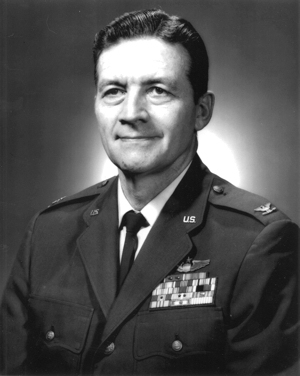
Boyd is commonly misunderstood as a tactically obsessed jet pilot whose insights mainly relate to cycling through a decision cycle faster than the opponent. But the importance of his writings to grand strategy is undeniable. His stress on the importance of forming organizations creative and efficient enough to “destroy and create” perceptions of the external environment, increase our own connectivity and degrade that of our opponents, and the importance of establishing a “pattern for vitality and growth” all point to aspects of strategic design that focus less on marshalling resources against a specific opponent than developing a basic strategic template that can remixed for various situations under a process of “plug and play.”  
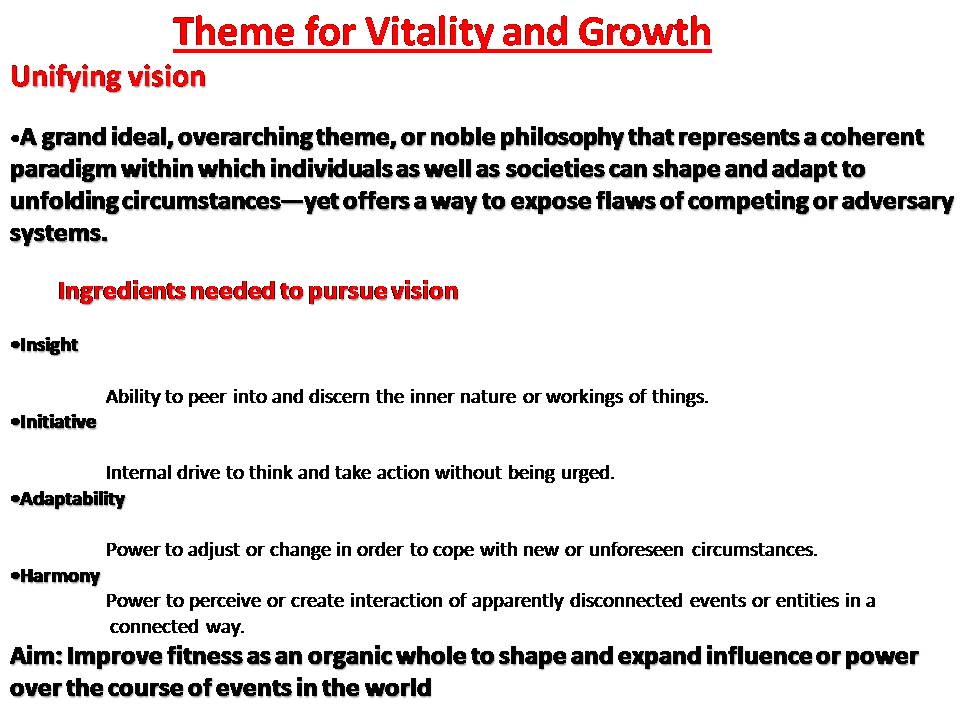
In his post, Adam references Colonel John Boyd’s “Theme for Vitality and Growth” from his brief, Patterns of Conflict:

themeforvitality.jpg

Adam went on to make an insightful observation:

The problem is that as societies grow both more structurally and interactively complex, this process grows much more difficult. That is what The Collapse of Complex Societies is about–how, if we view civilizations as computing mechanisms, how growth makes it more difficult to carry out the basic process of response to changing external conditions that is an essential part of data-processing. Moreover, even in eras of relative simplicity, the ability to aggregate enough information together to form a grand strategic design was exceedingly rare for individuals and more difficult for governments than success stories such as 19th century Prussia might indicate

Read the rest here.

I would like to extrapolate Adam’s argument about the difficulty imposed by complexity several steps further.

In considering grand strategy, historically, except for the Romans during their golden age, state actors, even vast empires like the Soviet Union or Great Britain, never approximated a closed system that could operate without reference to rivals who could potentially present an existential threat, singly or in combination. While the Pax Romana represents the rare outcome of a successful grand strategy, most great powers wrestled with imposing their will on both their rivals – but also on the geopolitical environment or “system” in which they operated.

What do I mean by the “system”? The explicit and implicit cultural and diplomatic rule-sets; the “rules of the game” by which powers interacted; the geoeconomic structures and patterns that were larger than any particular political entity and imposed constraints upon them, even the chance-based variables of natural resources and technological level which had a determining effect upon formulation of policy and strategy. The relationship between the architect of a grand strategy, his rivals and the world in which all were forced to operate consisted of a multiple variable feedback loop, not a diktat with a binary set of possible results.

I woud now like to make two points. 

First, to use an analogy from the biological sciences, grand strategy enunciated by a great power is a process of geopolitical co-evolution. There is an effort in grand strategy to impose over time one’s political will upon others to shape the “battlespace”, the sphere of influence, the hegemonic dominion to a state of affairs favorable to the state actor. Often, this is done by military force in times of crisis but over the long term, economic and diplomatic factors, all of DIME really, weigh heavily on the outcome. The process is never a one way street, even for actors who are considered to be largely triumphant. It is coevolutionary. If you gaze into the abyss, the abyss will gaze into you.

The early Roman republicans, much less Cato the Younger, would have been viscerally appalled by the Empire of Late Antiquity with its’ Teutonic Masters of the Horse in place of citizen- Praetors and Imperators. The Founding Fathers would be amazed by the condign dominance of the United States as a global titan but dismayed by the truckling servility, the lack of economic independence and the sheepish passivity of Americans whose citizenship is largely nominal. Ancient Chinese sages might feel much the same about hybrid capitalist-communist China of 2010.

Secondly, sustaining the national or group identity is a critical component of grand strategy that makes it a different, more expressly political/cultural  exercise than crafting strategy as Clausewitzians use the term as being driven by policy. Grand strategy should guide policy formulation because it is not just a set of concrete structural ends, or a laundry list of “vital interests” but a constructive, values-laden, attractive, motivating, civilizational narrative. An ideal or cultural identity for which men and societies are willing to go to war, to stand, fight and die. As Thomas P.M. Barnett once put it, for a “Future worth creating“. Grand strategy is a defiant clarion call of civilizational supremacy, marshalling those who will fight for that which is not, but could be.

But if you gain the whole world, while losing oneself, have you won? Or lost?

A victorious grand strategy shapes others while preserving – or expanding the reach of – the core identity of cultural-political community engaged in the struggle for autonomy for itself  and dominion over the environment. Some changes though are inevitable despite the best of intentions. Exercising power carries with it a price and the piper must be paid.

Following Boyd, the more attractive our vision, the “noble philosophy” we offer up to others and the more consistently we practice that which we preach, the greater our reach while remaining true to ourselves – thus demoralizing our adversaries. The more we trade on our souls, compromise our principles, turn away from threats and contradict our professed ideals, the less we have. Power is useful but it is transient. The exercise sweet, but the cost dear.

Power runs through our fingers like water. What did we give for it? What did we gain? Who are we now?

That is grand strategy.

Guest Post: Beakley on Boyd, Aerial Combat and the OODA Loop

Thursday, December 2nd, 2010

Ed Beakley is the Director and guiding spirit of Project White Horse and is student of the strategic thinking of John Boyd. Ed requested space to respond to criticism directed at the OODA Loop by Col. Jim Storr in The Human Face of War and assumptions made regarding the influence of aerial combat on John Boyd’s strategic thought.

Boyd, Aerial Combat and the OODA Loop

by Ed Beakley

While I’m sure most have read the basic story, it seems it might be worth recalling the details abit.  Boyd first characterized OODA, looking to understand and explain the differential in air-air kills between U.S. and North Korean pilots and realized that with the significantly better visibility from the F-86 bubble canopy than that from the MiG 15, the USAF pilot was more likely to see a MiG approaching from the rear quarter tan the other way around. (The Vietnam era MiG 17 and 21 had similar designs – narrow canopies extending straight back into the fuselage.  I can attest to this having flown a MiG 21 simulator in an air engagement with a German Col in an F-4 at Ling Tempco Vought some years ago).  This ability to see the fight early is critical and coupled with the F-86 significant advantage in roll rate meant rolling and turning into the MiG, then reverse rolling would eventually set up a misalignment in a/c attitude which the F-86 could exploit. Seeing led to the ability to exercise a  fast transient.

Boyd’s example of the F-86 and MiG 15 allowed him to address the four pieces and their impact and of having the ability to change state quicker than one’s opponent.  The fact that time wise the observation and action are nearly stacked on top of each other,  does not mean that “orientation” and decision” did not or do not occur.  One must realize that almost all engagements of aerial combat last only seconds. Data from the air war over Vietnam show that in most instances the shot down pilot never saw the shooter. Snoopy jousting with the Red Baron is a colorful idea but dogfights happen mostly only in training. Indeed, with certainly no disrespect meant, “Forty Second Boyd” is a characterization that could only come out of the training world. Forty seconds is multiple life times in actual air-air engagements.

So how then does OODA occur? Two things, one closely relating to martial arts – individuals must be completely immersed in their art. There exists no better representation of this than the fighter pilot. Any fighter pilot who wouldn’t claim he could kick your ass in forty seconds is not worthy of the name, and he trains hard to be able to back that up.  And there’s nothing worse than a guy who can back that up. (Frank ‘Whip’ Ault, the Navy Captain, fighter pilot whose report led to TOPGUN was no Ace but his call sign was well earned).  This leads to the second, that attitude, training AND being immersed with similar extremely competitive arrogant bastards, means he takes all the elements of orientation with him when he crosses the Yalu or the Red River Valley.  His observation of the enemy aircraft brings the only missing piece of the “orientation” into play – physical situational awareness and allows the quickness of decision and action. “Decision” also follows out of that training (think about the “ribbon” drawings in Boyd’s Aerial Attack Study that were and are studied and practiced).  He’s been there done that so many times, it’s truly Gary Klein’s recognition primed, but all parts of OODA are still in play. 

Indeed, if the mission and performance of the aircraft differ substantially, the OODA process may actually stretch out and be more easily discerned. By way of example would be an A-7 on a Sam suppression “Ironhand” mission attacked from below by a MiG 21.  The A-7’s performance is significantly less than that of the MiG. This is not the quick conversion to a kill of Boyd’s example where O-O-D-A are essentially stacked on top of each other time wise, rather survival of the A-7 pilot and completion of his mission to protect the strike group (i.e., survival of a number of planes), turns into a more spread out O-O-D-A process, in which working to gain proper orientation is crucial to the necessary timing of the decision and action to execute a “bug-out.”

This rolling reversal maneuver is extremely violent, involves applying negative G’s and can be disorienting to the executing pilot.  Done correctly, it creates the same misalignment of aircraft with the MiG nose high, the A-7 nose low gaining separation and running out to the MiG’s six o’clock.  The trick though is that you wanted to run toward the water.  Even with separation and 180 degrees out of phase, it’s no longer just guns, the MiG had Atol missiles.  Water meant possibility of pick-up if you had to eject.  And on top of all that, if the Ironhand a/c bugged out, the strike group was now more susceptible to Surface to Air Missile attacks.  Will anyone argue this is not a discernable example of observe, Orient, decide act?

As to Boyd’s stature and competence to analyze the air-air world in regard to a true Ace (5 confirmed kills):

1.      World War II was unique in air-air combat in light of the technical capability, the number of aircraft in the air and in a fight at the same time.  Many kills came without one pilot seeing the other.  Kills were achieved by pulling the trigger at the right time as planes crossed your nose chasing someone else.  To be sure there were some great deeds of derring-do and some great pilots and certainly intuitive actions played a significant part. Does Col Storr’s interviews with Aces indicating the falsity of the OODA in air-air combat counter Boyd’s analysis?  Hardly.  Boyd was not trying to expound a theory on OODA and Air-Air Combat, he used an example he knew well, which is appropriate in many instances, but certainly not all.  He simply intended to show that if you could move through the OODA flow at a better tempo than your enemy, you could create a mismatch that could be exploited.

2.      Was not being a true Ace important?  No matter how good the pilot, luck and mission assignment plays a huge part.  Ask any fighter pilot, anywhere this one.  Some of the best never even get a look.  True story ( I was in the same area earlier and it wasn’t nice) – one of the senior F-4 Commanders who’d been involved with all the early TOPGUN stuff, was so frustrated because he, unlike some of that group, did not have a MiG, hoping a MiG would come up, went “trolling” along the DMZ, the very last day of the war and got shot down and lost.  Good pilot? Former commanding officer of the Blue Angels.  Boyd’s work as an ACM instructor and developer/writer of the Aerial Attack Study at Nellis tells you all you need to know.  One of his best students was Ev Raspberry, one of General Robin Olds’ MiG killers who credited his success over Route Pack Six to John Boyd for what he taught him at Nellis.

One final note, Seydlitz questions anything following from Boyd, if the original thinking is flawed.  As noted above, the view of an Ace doesn’t necessarily contradict Boyd’s analysis.  This is an extremely situationally dependent context.  Would he dismiss my own experience in combat?  The first time I read Boyd’s analysis, it made perfect sense.  The fact that the flow can be almost unobservable due to speed of process is irrelevant.  If Boyd’s OODA is to be discarded, then one must dismiss a whole process and body of work coming out of the Naval Electronic Systems Command in the eighties stemming from Dr. Joel Lawson’s research and writing on command and control.  Boyd’s work  seems to fall prey to “if it’s not perfect for all situations then it’s all bad”????

As to Storr, I turn the question, how can one now trust his writing, given his pretty obvious shoddy research on Boyd.  One must go no further than page 12 and the critique of Boyd’s loop.  Poor form no matter what he thinks of Bill Lind and 4GW.

Dogma

Tuesday, November 30th, 2010

Strategic dogma, that is. Thoughts by Joseph Fouche at The Committee of Public Safety.

Heh. Regarding the crappy and buggy formatting performance of the comment field here that JF terms “the worst on the internet”, I’ll be happy to take suggestions for a new, no-hassle, plug-in that works well with wordpress. There were trade-off issues involved with what was available at the time of the last site redesign and I rejected options that were actually, if it is to be believed, worse.  I would like to do some post holiday tweaking of the site and if there are better things out there, I’ll see if they can be used to replace the current plug-in.

How to Run a War Room

Sunday, October 31st, 2010

Hint: You need to know your Boyd.

British political consultant James Frayne at Campaign War Room explains:

Creating an effective war room

….War rooms are therefore places which can pull in relevant information, which can process it effectively by working out what is most important at a given moment, and which can make timely decisions as a result of processing this information. They must become expert in Boyd’s OODA loop – Observe, Orient, Decide, Act (although I appreciate some prefer to think of this the other way round – you inevitably act first, and observe after).

War rooms should have the following characteristics:

  • They must have clear objectives. In electoral politics, the objective is clear: win the election. In permanent campaigns or in business, objectives are usually less clear. Is the war room there to act as a rapid rebuttal machine, for example, to defend a business’ reputation (Wal-Mart set one of these up back in 2005)? Or is it to help re-organise a business? War room staff must know exactly why they are there.
  • They should have a small staff and clear lines of authority. War rooms are often created because prior decision-making structures failed, perhaps because there were too many people involved in discussions, or because no one knew where authority lay. These were reasons why the most famous political war room of all – Clinton’s in 1992 – was created. They need be tight so that people don’t get bogged down by endless people given their opinions, and they need to have clear lines of authority so that everyone knows who can make what decision.
  • They must have executive authority. It sounds like an obvious point and in many ways it is, but I remember one campaign where we worked in the campaign office but ultimate authority for decisions lay off-site. It was a debacle as you can imagine. War rooms must contain those people who can actually make decisions.

Read the rest here.


Switch to our mobile site

