zenpundit.com » 21st century

Archive for the ‘21st century’ Category

Towards Computational Strategy (Part I)

Sunday, December 8th, 2013

(by Adam Elkus)

As Zenpundit readers may know from my previous entry, I am a PhD student in Computational Social Science at George Mason University. Though I am learning the technical craft of computer modeling of social processes, I have had a longstanding interest in future war and technology. I grew up in California, and in an environment very much shaped by the technology industry. This was diluted by the fact that I grew up in Southern California and also have had a mostly liberal arts education heavy on arts, (military and strategic) history, and social science. My own struggle these days is — having spent so long developing the humanities side of myself — to think more like an engineer in developing computational and quantitative approaches to studying social science.  You can see some of my notes on this process at my own personal research journal.

My term project for my CSS 600 class is a very, very crude and simple agent-based model of military mobilization. I’m also working on an equally crude model of strategic learning and a very crude simulation of strategic effectiveness in alliances. I don’t like them, and am on the fence about whether I’ll want to post them on Github after all — though I am definitely going to post the alliance effectiveness model (which relies on an interesting optimization algorithm) to a larger audience.

That is OK. Though I began practicing Python and NetLogo all the way back in early spring, learning to program from scratch takes time and effort. Through my classes, tutoring, and plenty of sleepless nights I bootstrapped my way to being able to make computational models in Python, NetLogo, and Java. And this winter I will be practicing Java and Lisp in preparation for spring classes. I could probably, with more time and less distractions (readers who know me in person will know that I unfortunately have had to devote a lot more attention this semester to resolving some logistical problems outside of academics) have done better than the models I’m making for my classes. So I chose easier and simpler for my first models. However, I have grander ambitions in the long term.

This post is the first of a series that I am constructing from notes I have scribbled throughout this semester, my first at GMU. I have, over the last year, relentlessly explored and narrowed down my idea of my research agenda. Aaron Frank, Jay Ulfelder, Mark Safranski, A.E. Stahl, David Masad, Russell Thomas, Lynn Rees, Dan tdaxp, Daniel Trombly, Joshua Foust, Trey Causey, Alex Hanna, Sina K., Anton Strezhnez, Nick Prime, Daniel Bilar, Sam Liles, W.K. Winecoff, H. Lucien Gauthier III, Dave Lyle, Daniel Solomon, Jon Jeckell, Alex Olesker, Brett Fujioka, Robert Caruso, the mysterious Dr. Kypt3ia, and many others too numerous to mention have served as sounding boards for a successive array of both promising ideas and also half and even quarter-baked “dry holes.”

I have a gigantic array of TextEdit files, Moleskine journals, and even theories scribbled in pseudocode in my Sublime Text 2 text editor. So as I turn them into coherent posts, I will space them out individually. This series concerns the concept of “computational strategy,” which I am shaping my own studies around. For example, I will be taking a survey artificial intelligence class next semester — one of two survey courses that computer science majors (which I am not  — I will have the same relationship with CS that political science has with probability and statistics in that I’ll try to borrow as much as I can but also will never be as good as an actual CS student) must take to survey breadth and depth of AI. I will also be taking a course on cognitive programming for computer models.

It will consist of the following posts:

(I) My own journey as a PhD student up to this point

(II) Contrasting generative social science with theoretical computer science — and their deficits when applied to strategy

(III) From “killer robots” to “robot historian” and computation as a universal language

(IV) Towards a preliminary research agenda for computational approaches for studying strategic theory

We begin with (I):

Between A Dead Prussian And Kenneth Waltz

Since my friend Aaron Frank convinced me to switch from International Relations to my current PhD program in Computational Social Science, I have experienced something of an identity crisis. Though I have an BA in Diplomacy in World Affairs, and two semesters’ of graduate coursework in International Relations, my largest substantive base of expertise is in military-strategic theory and history and War Studies. I am both self-taught in this subject (endless library hours in my BA) and have a MA in Security Studies from Georgetown with a concentration in Military Operations. Unfortunately, this has ensured that for most of my time in higher education I have been caught between various disciplinary boxes. International Relations and Political Science has been a home for strategic thinkers like Richard BettsMichael Horowitz, and Eliot Cohen. But on the whole, International Relations and Strategy have diverged since the high point of the 1960s nuclear theorists (Brodie, Schelling, and others).

As A.E. Stahl wrote, IR’s interest usually stops (with few exceptions) once the war begins. This is actually mirrored by the state of military history itself, which increasingly shies away from the study of strategy, battle, and tactics. Comparative politics, ironically, has picked up the slack. Quantitative comparative politics has some of the most valuable research on sub-state violence and civil war, but it is not connected to the larger strategic picture. The danger in studying one part of warfare in isolation from the whole of war and strategy is that it is easy to begin to think that your field has rules somehow distinct from the larger picture. Counterinsurgency, as Colin Gray wrote, has different particulars but on the whole does not have a separate logic from war as a whole.

To make matters worse, there is also a disciplinary disconnect in the study of strategy between a number of different camps. Game theorists — from the classical variety to more exotic subtypes like algorithmic game theory and evolutionary game theory — explore strategic interaction with mathematical models. Business strategists explore strategy and innovation from an organizational standpoint. And military strategists examine topics from a qualitative-historical mindset derived from Carl von Clausewitz’s philosophy of “critical analysis.” Though all of these perspectives have value, few attempt to bring them together (and of those who do, few are successful). This does not have to be the case. Mid 20th century strategists like Thomas SchellingJohn Boyd, and J.C. Wylie combined a set of eclectic influences. Lawrence Freedman’s new book, as I’ve been told (haven’t got a chance to read) — also takes an holistic view of strategy that manages to also throw in the Marxist social movement strategic thinking of foundational radicals (Lenin and Gramsci to Hardt/Negri). And applications of complexity science to the study of strategy have been congruent with classical strategic theory.

Strategic Schizophrenia 

Given the problems I have had finding places where I could study strategy freely, I could have aimed to do my PhD in War Studies, like my friend Nick Prime. However, the PhD program he is in is best suited to those with a very concrete and well-formed plan of study. I did not have one when I was applying for my PhD. And I also am both a product of the American political science tradition and the classical strategy school. I thought I could combine the two in my PhD at an International Relations department.

After I switched to Computational Social Science, I briefly abandoned the thought of doing something on strategy and decided I was going to look at risk and complexity. This coincided with my own sense of uncertainty over what I would do after graduation. I had always thought I was getting my PhD so I could teach at a military institution or work in military research. But with sequestration devastating many places I wanted to work, I began to radically hedge. I thought to myself, “maybe I would be happy selling widgets with computer models and writing about strategy on the side.” But as I went through intensively pushing myself through remedial mathematics, programming, and computer science I began to fear going down a million complexity-theoretic rabbit roles without a strong anchor that would guide me at least through my PhD program.

Mathematics, code, and programs are after all only just formal languages. One must first know what they seek to say before they start talking. And I also simply could not get past the basic fact that I had devoted 7 years of my life (BA up until now) to studying war and strategy. I could either use my existing base of expertise as a source of research questions and subject matter knowledge, or force myself to develop entirely new bases of social science expertise. To reduce my own sense of schizophrenia, drift, and confusion I began to think about how I could make my new studies fit my interests.

To be continued.

Ayatollah Khameini: Crony Capitalist and Slumlord

Wednesday, November 13th, 2013

[by Mark Safranski, a.k.a. “zen“]

Reuters has begun a remarkable series on the economic dealings of Iran’s Supreme Leader, Ayatollah Khameini who controls a staggering fortune of $ 95 billion dollars through a secretive fund Setad that expropriates the property of poor Iranians and religious minorities. This would put the venerable theocrat in the same superclass as Bill Gates, Carlos Slim, Warren Buffet and the Sultan of Brunei .

Up until now, former Iranian president Rafsanjani has always been the face of financial corruption in Iran’s clerical hierarchy, but to paraphrase John D. Rockefeller’s comment about J.P. Morgan, compared to Khameini ” he’s not even a rich man”:

Khamenei controls massive financial empire built on property seizures 

The 82-year-old Iranian woman keeps the documents that upended her life in an old suitcase near her bed. She removes them carefully and peers at the tiny Persian script.

There’s the court order authorizing the takeover of her children’s three Tehran apartments in a multi-story building the family had owned for years. There’s the letter announcing the sale of one of the units. And there’s the notice demanding she pay rent on her own apartment on the top floor.

Pari Vahdat-e-Hagh ultimately lost her property. It was taken by an organization that is controlled by the most powerful man in Iran: Supreme LeaderAyatollah Ali Khamenei. She now lives alone in a cramped, three-room apartment in Europe, thousands of miles from Tehran.

….But Setad has empowered him. Through Setad,Khamenei has at his disposal financial resources whose value rivals the holdings of the shah, the Western-backed monarch who was overthrown in 1979.

How Setad came into those assets also mirrors how the deposed monarchy obtained much of its fortune – by confiscating real estate. A six-month Reuters investigation has found that Setad built its empire on the systematic seizure of thousands of properties belonging to ordinary Iranians: members of religious minorities like Vahdat-e-Hagh, who is Baha’i, as well as Shi’ite Muslims, business people and Iranians living abroad.

Setad has amassed a giant portfolio of real estate by claiming in Iranian courts, sometimes falsely, that the properties are abandoned. The organization now holds a court-ordered monopoly on taking property in the name of the supreme leader, and regularly sells the seized properties at auction or seeks to extract payments from the original owners.

The supreme leader also oversaw the creation of a body of legal rulings and executive orders that enabled and safeguarded Setad’s asset acquisitions. “No supervisory organization can question its property,” said Naghi Mahmoudi, an Iranian lawyer who left Iran in 2010 and now lives in Germany.

The Persian name of the organization that hounded her for years is “Setad Ejraiye Farmane Hazrate Emam” – Headquarters for Executing the Order of the Imam. The name refers to an edict signed by the Islamic Republic’s first leader, Ayatollah Ruhollah Khomeini, shortly before his death in 1989. His order spawned a new entity to manage and sell properties abandoned in the chaotic years after the 1979 Islamic Revolution.

It used to be said back in the 70’s by Western intellectuals of the tweedy, social democratic, Left variety that the future would be a merging of Communism and Capitalism into a “Third Way”, perhaps, it was optimistically suggested, of the gentle Scandinavian variety with, democracy, universal free child care and quaint, bicycle-riding, constitutional monarchs. I doubt anyone thinks that today. If there is any emerging universal model at all it is that of nasty authoritarian governments being run, sometimes under a facade of elections, by a bareknuckle, crony capitalist Oligarchy that hollowed out the state.

Sometimes,the crony capitalists are merely the junior partners to the mandarins, siloviki and mullahs and at other times you could look “….from pig to man, and from man to pig, and from pig to man again” and be hard pressed to tell the difference.

Khamenei’s conglomerate thrived as sanctions squeezed Iran 

….The ayatollah’s organization would go on to acquire stakes in a major bank by 2007 and in Iran’s largest telecommunications company in 2009. Among dozens of other investments, it took over a giant holding company in 2010.

An organizational chart labeled “SETAD at a Glance,” prepared in 2010 by one of Setad’s companies and seen by Reuters, illustrates how big it had grown. The document shows holdings in major banks, a brokerage, an insurance company, power plants, energy and construction firms, a refinery, a cement company and soft drinks manufacturing.

Today, Setad’s vast operations provide an independent source of revenue and patronage for Supreme Leader Khamenei, even as the West squeezes the Iranian economy harder with sanctions in an attempt to end the nuclear-development program he controls.

“He has a huge sum at his disposal that he can spend,” says Mohsen Sazegara, a co-founder of the powerful Islamic Revolutionary Guard Corps military force, who is now living in exile in the United States. “When you have this much money, that’s power itself.” 

Indeed. It insulates Khameini’s core supporters from external financial pressure and allows Khameini to have an arsenal of carrots, not just sticks in dealing with other members of the Iranian ruling elite.

It is often overlooked how frequently dictators, even those who were known for ruling through terror like Hitler, Stalin and Mao, could be lavishly generous with gifts and financial rewards or indulged the blatant corruption of powerful subordinates like Goering, Abukumov or Kang Sheng. Every Grand Ayatollah and Marja in Shia Islam maintains a charitable trust to which their pious followers donate. I would be extremely surprised if Khameini, whose scholarly credentials share similarities with Leonid Brezhnev’s military decorations, had not made arrangements for substantial contributions over the years from Setad to the trusts of Iran’s most respected senior clerics.

Baksheesh is an older faith in Iran than is Islam.

The Vietnam War at Fifty

Monday, November 11th, 2013

[by Mark Safranski, a.k.a. “zen“]

Today is Veteran’s Day. It is a day when Americans remember all of those who served, in peace or war.

Originally, this day was called Armistice Day in honor of the cease fire that came in ” the eleventh hour of the eleventh day of the eleventh month” and brought the horrific slaughter of  World War I to an end. This was fitting.  The First World War loomed large in the memories of our great grandparents and grandparents the way the Civil War did for earlier generations. It was an ominous touchstone of the nadir of which Mankind was capable until it was thoroughly eclipsed by the subsequent horrors of Nazi barbarism in a Second World War – a conflict that seemed a maturation of the first. In the postwar era, Armistice Day became a national tribute to the sacrifices of all veterans.

This year also marks the fiftieth anniversary of American entry into the Vietnam War.

Historians may quibble with this, as American involvement in Vietnam went back to WWII and OSS agents giving advice to Ho Chi Minh in the jungle war against Imperial Japan and Vichy French puppet colonialists, but 1963 is when “American boys” first went to South Vietnam in real numbers.  And many of them were indeed little more than boys. Fifty-eight thousand, two hundred and eighty six of them did not come home.

Those that did are now grown grey with the passage of time.

The Vietnam War caused deeper divisions in the American psyche than any other war except the one that began at Fort Sumter. The wounds have never really healed and they rest inflamed and sore just beneath the scabrous surface of American politics to this day. America has an unenviable historical track record of not treating its veterans very well and those who served in that unpopular war that ended in defeat received on their return home far more than their share of  disdain and abuse.

Even the attempt to build a memorial – the now famously cathartic Wall – roiled at the time in a controversy of unimaginable bitterness. The site eventually became a place of pilgrimage, alive with memory of the dead and compassion for the living. This was a good thing but in truth as a nation we could have done far, far better for the men who served in Vietnam than we did.

The best tribute to these veterans of Vietnam that we can make as a people would be to see that the veterans of Iraq and Afghanistan do not repeat the sad experience of their fathers.

Heavy Metal: When Irregulars Go Armored

Saturday, November 2nd, 2013

[by Mark Safranski, a.k.a. “zen“]

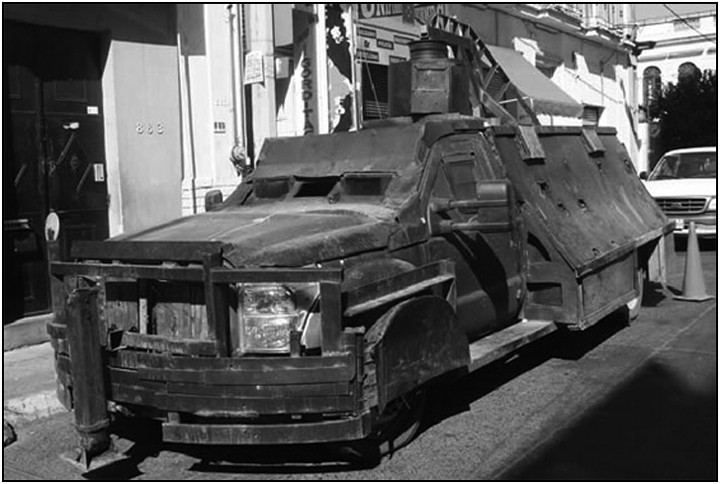
If the symbol of the 20th century insurgent was the AK-47 and a red banner, his 21st century counterpart may someday be recognized by the suicide belt and the “homemade tank”. Irregular fighters have always used light arms, civilian passenger vehicles and armor captured (or donated by) from conventional armies, but the ability to produce serviceable fighting armored cars is a new wrinkle. They could not stand up to an American or Russian tank company, of course, but they are not meant to do so.

Most prevalent and evolved in Mexico’s narco-insurgency where cartels use these “monsters” converted from SUVs and various types of light and heavy trucks to battle one another and as “troop carriers” but these DIY armored vehicles have also appeared in the recent Libyan and ongoing Syrian civil wars. Where heavy anti-tank weapons, air power and real tanks are scarce, these narco-tanks are useful additions to irregular combat power and convey an intimidating image to lightly armed police and the public.

Dr. Robert Bunker and Byron Ramirez, with the support of Small Wars Journal, Borderland Beat.com and the Foreign Military Studies Office at Fort Leavenworth, have a new scholarly compilation on the subject of irregular use of DIY armor in Mexico:

Narco Armor : Improvised Armored Fighting Vehicles in Mexico

….The wave of violence that has left thousands dead began in early 2005, when former Mexican
president Vicente Fox sent government troops to Tamaulipas to fight the cartels. For the past
seven years the government has ordered its military to fight the cartels directly, which, in turn,
has led drug cartels to improvise and develop their own methods of warfare to combat both
government troops and other competing cartels.

The extreme rivalry among various Mexican drug cartels for regional control of the drug trade
market has yielded an arms race. The following collection of articles and images addresses a
segment of the military technology utilized by violent non-state actors during this period: “narco armor” or, more accurately, improvised armored fighting vehicles (IAFV).

….Mexican cartel use of IAFVs and armored sport utility vehicles (ASUV) may yield some
important lessons for military counter-criminal insurgency efforts. Still, many unanswered
questions exist concerning the fielding of narco armor in Mexico. Reports of these vehicles
being fielded span roughly from mid-2010 to the beginning of 2012, with a spike in activity 5
surrounding them taking place around mid-2011. These vehicles had predominantly been utilized

in the Mexican state of Tamaulipas in engagements between the Zetas and Gulf cartels and in a
few other locales (see Map Locations). While it has been said that the Mexican government has
seized well over one hundred of these vehicles, only about two dozen photographic examples
exist per our research (see Picture Gallery).

….Given the apparent cessation of the fielding of narco armor since early 2012, quite possibly these vehicles have reached an evolutionary dead end, with more emphasis once again placed by the cartels on fielding more stealth-masked armored vehicles, such as armored SUVs, that better blend in with civilian cars and trucks so as to eluded identification and targeting by Mexican federal forces. Still, given the ever changing conflict waging in Mexico among the cartels and against the Mexican government, future resumption of IAFV employment will always remain a potential. 

Read the rest here.

During the Russian civil war (1917-1922), armored trains complete with heavy machine guns and artillery were used by both Bolshevik and White armies across the vast expanse of the Eurasian steppe and the armored train subsequently made spotty appearances in civil wars in China and Spain before fading away. This less likely to happen with homemade armor which is smaller and infinitely more mobile and can be created in a sufficiently large garage with time, elbow grease and a supply of scrap metal.

Celebrating Orwell Day on ZP

Tuesday, October 29th, 2013

[ by Charles Cameron1984 comes to Venezuela? ]
.

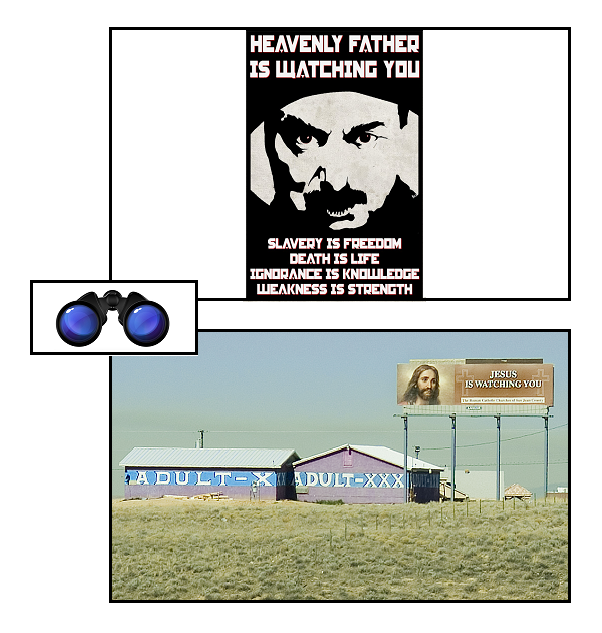
I had just finished posting the somewhat Orwellian DoubleQuote above and a set of quotes from Biblical and Qur’anic sources in my welcoming comments on Adam Elkus‘s inaugural post here, which itself drew on Orwellian dystopia for its imagery, when a friend pointed me to an article about the recent institution of a Vice-Ministry for Supreme Happiness by Venezuelan President Nicolás Maduro.

**

Bingo, Orwell again! Responses on Twitter were quick to invoke 1984:

In Orwell’s 1984, four ministries control Oceania:

  • Minitrue is the Ministry of Truth, which controls literature and oversees propaganda
  • Minipax, the Ministry of Peace, oversees warfare
  • Miniplenty, the Ministry of Plenty, controls rationing of food and other goods, and
  • Miniluv, the Ministry of Love, deals appropriately with heretics and dissidents
  • I disclaim any deep knowledge of Venezuelan politics, although Ahmadinejad‘s claim that Chávez would be resurrected to accompany the Mahdi and Christ when they return certainly caught my attention… but these literary references impress me.

    Specifically, the Venezuelan tweeters above suggest that Orwell “predicted” the Venezuelan Vice-Ministry, and that it will be followed next by Venezuelan versiuons of Minitrue and Miniluv.

    **

    George Orwell, the man of the hour / day / year / century / millennium… ?


    Switch to our mobile site