zenpundit.com » America

Archive for the ‘America’ Category

Mourning the loss of Monte Cassino

Friday, January 18th, 2013

[ by Charles Cameron — destruction of sacred spaces ]
.
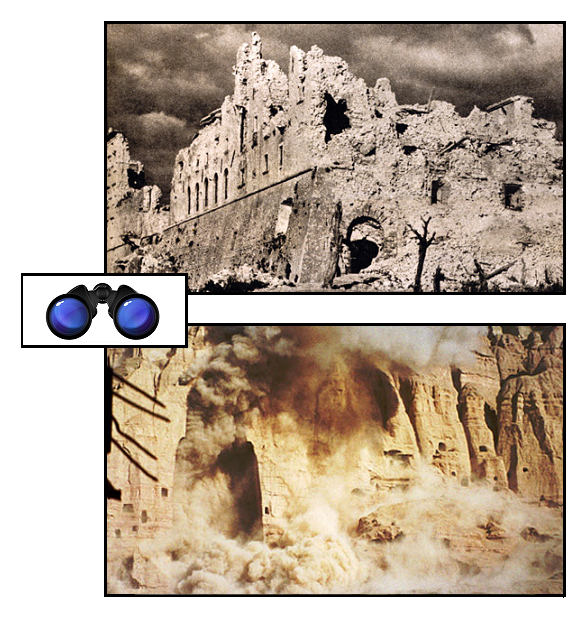
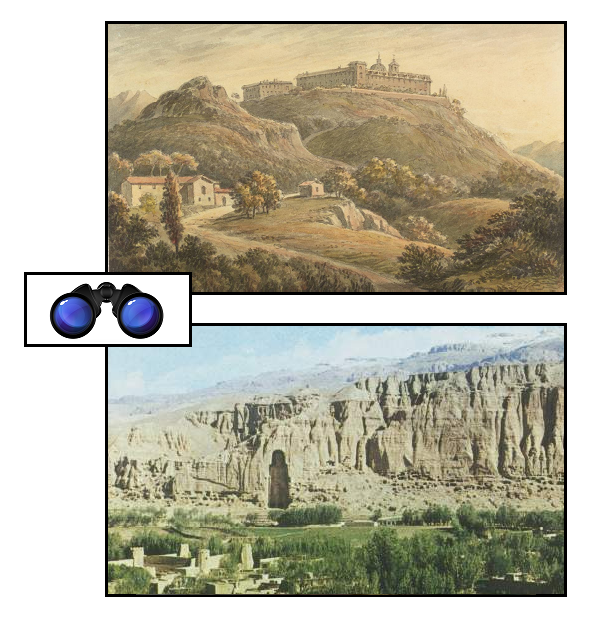
Do we grieve the destruction of the Abbey of Monte Cassino as we grieve the destruction of the Bamiyan Buddhas?
**

With playful and appropriate scholarly tongue-in-cheek, Umberto Eco describes the importance of monasteries — and of the Benedictine Order specifically — in preserving culture, literacy, the arts and sciences through dark ages in his novel, The Name of the Rose:

“Monasterium sine libris,” the abbot recited, pensively, “est sicut civitas sine opibus, castrum sine numeris, coquina sine suppellectili, mensa sine cibis, hortus sine herbis, pratum sine floribus, arbor sine foliis. … And our order, growing up under the double command of work and prayer, was light to the whole known world, depository of knowledge, salvation of an ancient learning that threatened to disappear in fires, sacks, earthquakes, forge of new writing and increase of the ancient. … Mundus senescit. If God has now given our order a mission, it is to oppose this race to the abyss, by preserving, repeating, and defending the treasure of wisdom our fathers entrusted to us.

Monte Cassino is the spiritual home of the Benedictine monastic order. It was here that Saint Benedict of Subiaco built a retreat in 529 CE, here that he wrote his Regula Monachorum or monastic Rule, the central text of western monasticism, and though the monastery had been previously sacked by the Lombards in 585, the Saracens in 884, and the Normans in 1046, it was devastated anew during the Battle of Monte Cassino 1944, an American artillery commander telling his men:

I don’t give a damn about the monastery. I have Catholic gunners in this battery and they’ve already asked me for permission to fire on it…

Harold Bond, in his book Return to Cassino A Memoir of the Fight for Rome, describes the scene as 256 American heavy bombers began dropping 576 tons of munitions on the abbey in waves, in words echoes by the video below:

There was no anti-aircraft fire from the Germans, either, just the drone of the big planes. They were very close now, and the first formation flew in over the abbey, releasing the bombs. We could see them fall, looking at this distance like little black stones, and then the ground all around us shook with gigantic shocks as they exploded. Another formation flew in, and then another, each followed by thunderous detonations. Now where the abbey had been there was only a huge cloud of smoke and dust which concealed the entire hilltop.

**

The bombing appears to have been authorized on the basis of a mistranslation. An intelligence intercept of the question “Ist Abt in Kloster?” — “is the Abbot in the Monastery” — was translated by the US as though Abt was short for Abteil, “Is the HQ in the Abbey?” The recorder answer “Ja” then led to the bombing.

Three days after the bombing, the Abbot was interviewed in person by the commander of XIV Panzer Corps, himself a lay brother of the Benedictine order, and reported:

Until the moment of the destruction of the Monte Cassino abbey there was within the area … neither a German soldier, nor any German weapon, nor any German military installation.

Thankfully, the abbey was restored and reconsecrated in 1964 by Pope Paul VI and remains to this day the mother house of the Order of St. Benedict.

**

I hope to review relevant portions of Peter Caddick-AdamsMonte Cassino: Ten Armies in Hell, available in the UK and due to be released in the US in April 2013, later this year. A review copy has been my source for details of the Battle of Monte Cassino described above.

Image sources, upper pair:

Destruction of the taller Bamiyan Buddha, CNN via Wikipedia
Montecassion destroyed, from Monte Cassino Tour

Image sources, lower pair:

Bamiyan Buddhas, from Random Walks
Monte Cassino by John `Warwick’ Smith, from the Tate
Thomas Hegghammer on Morten Storm

Tuesday, January 15th, 2013

[ by Charles Cameron — in case you missed TH’s tweets on Storm today ]
.


.

Here’s a quick overview of Morton Storm, the complex figure who is reported to have brought Anwar al-Awlaqi a bride from Europe — and thus betrayed Awlaqi’s whereabouts to the Agency:

After converting to Islam, a former member of a Danish motorcycle gang travels to Yemen to study the Quran and soon comes in contact with radical preachers waging holy war against the West.

On the verge of becoming a jihadist, he abruptly abandons his faith and embarks on a dangerous undercover mission to help Western intelligence agencies capture or kill terrorists.

Morten Storm, 37, claims he worked for six years as an informant for the CIA, Britain’s MI5 and MI6 and Denmark’s security service, PET. All declined to comment for this article.

“Could they just say `he never worked for us’? Sometimes silence is also information,” Storm told AP in Copenhagen. “I know this is true, I know what I have done.”

Storm’s unlikely story, told in a new book and an interview with The Associated Press, has the drama and intrigue of a “Homeland” episode. But the burly, red-bearded Dane insists his tale isn’t fiction.

Storm said he decided to reveal his secret-agent life to the media – he first spoke to a Danish newspaper in October – because he felt betrayed by his agent runners.

In particular, he was upset that he wasn’t given credit for the airstrike that killed Anwar al-Awlaki, a senior al-Qaida figure, in Yemen in 2011.

**

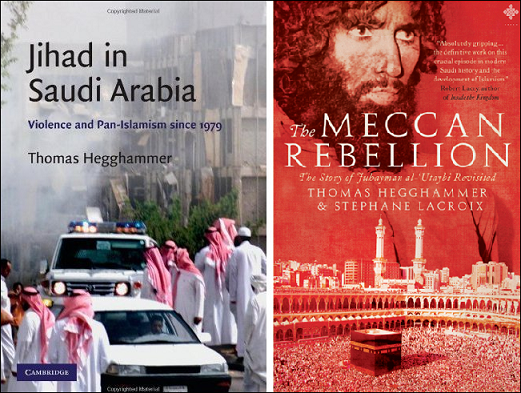
Thomas Hegghammer, author of the two books depicted above, and a highly respected academic specialist in terrorism and poliical violence, tweeted:

Enjoying new book on Danish ex-jihadi Morten Storm. Some highlights:

1) Regents pk mosque da’i sends Storm to Muqbil in Yemen in 97

2) Storm travels from Sanaa to Dammaj with “Rashid”, aging Afro-American Korea vet. They join 3000 Salafists in “gigantic boy scout camp”

3) in 98, after 8 months wMuqbil, Storm goes to Sana’a to find wife. Connects with jihad vets from Bosnia, Afgh. Weds, divorces Djbouti girl

4) Back to UK, Denmark; marries in Morocco; to Yemen again in 2001; almost goes to pre 9/11 Afgh; preaches jihad in Ta’iz (2001-2) instead.

5) Returns to DK in 2002 with wife and son Osama. Joins radicals in Vollsmose. “Jihad training” (obstacle course and paintball) in Odense

6) Moves to Luton in 2003; meets Omar Bakri, Taymour Abdelwahhab; demonstrates and jihad trains (in Barton Hills) with al-Muhajiroun

7) Thought 7/7 bombings were “cool”; found Bakri and Choudhry too soft; went to Yemen again in Jan 2006 but found no jihadis to join

8) Prepared to fight in Somalia in late 2006, but trip called off. Annoyed, he starts to doubt; turns completely after 2 weeks of googling

9) becomes PET informant in Jan 2007; sent to Tripoli, Lebanon in April to report on Raed Hlayhel, Omar Bakri, Fath al-Islam.

10) Meets w/MI6 and CIA (Jennifer Matthews) in spring of 2007; sent to UK for spy training; then travels between DK, UK, Kenya and Yemen.

11) Storm had taken classes with Awlaqi in 2006; Awlaqi helped Storm find a wife. Storm back in Sana in Aug 2008, they reconnect.

12) Aug: 2008: Awlaqi visits Storm’s flat; Awlaqi impressed by Dane’s Shabaab contacts. Awlaqi and Warsame speak on Storm’s mobile

13) next meeting in Sep 2009 in al-Hawta (Shabwa); Awlaqi mentions plots in West; wants fridge to store explosives, and help finding wife

14) Late 2009: Storm helps US-led operation against Saleh Nabhan in Somalia. Storm stays in touch w Awlaqi by email in 2009-2010

15) late Nov 2009: random female Awlaqi fan from Croatia contacts Storm via FB fanpage. Storm vets her and puts her in touch wAA.

16) Storm meets “Aminah” in Vienna in March 2010; shows her video from AA and records one of her for AA; gives her CIA-bugged suitcase.

17) On 2 June 2010 Aminah flies to Yemen. On arrival, cautious AA aides discard her suitcase. Storm still gets $250k cash from CIA.

18) New plan in spring 2011: go to Yemen, send AA a tracked USB. In Sanaa, Storm connects wAA, shops ladies items for Aminah on his request.

19) early Sep 2011: AA courier picks up tracked USB from Storm. AA killed on 30 Sep. Storm, back in DK, expects recognition as key agent

20) Storm, outraged at lack of recognition and reward, plots revenge. He secretly records next CIA meeting, then contacts press. THE END

Then:

PS: E-book version of the Morten Storm biography (Danish only) available here: http://tiny.cc/2wfxqw Sorry for overposting – I’ll shut up now

**

I’d asked Hegghammer’s impression of the book’s (and Storm’s) credibility, while Aaron Zelin had commented on TH’s #7 above:

Right before the jailbreak in Feb ’06.

To which Hegghammer responded:

Exactly. It’s details like this (plus pics, receipts, recording etc) that makes it very credible

Will McCants has the last word…

also, his last name gives him superhero status

**

The brief account of Morton Storm at the top of this post is from Huffington Post. Name links are to twitter feeds, all are recommended. Hegghammer’s books are available on Amazon.

“Sustaining” your Way to Serfdom as a Grand Strategy

Monday, January 14th, 2013

Friend of the blog, commenter L.C. Rees, likes to point out that one of the most important part of a grand strategy, particularly one that is maintained despite evidence of being a geopolitical failure, are the domestic political effects that work to the advantage of the faction supporting it.  In my view, grand strategy usually has a political or cultural evolutionary component and, human nature being unchanging, Rees’s cynical observation has merit.

Last year, a couple of JCS aides/field grade officers wrote a grossly overpraised paper that was pushed by Anne-Marie Slaughter, Thomas Friedman and assorted worthies, that purported to be about a new grand strategy with which America could navigate the world. Mostly it centered on a preference for an America being run by a vaguely EU-like, technocratic, regime under the rubric of “sustainment”, in which the authors wisely folded in a number of  shibboleths popular with the corporate-liberal upper class who write large donation checks to think tanks or make their living in public policy and academia.

The talk of this nature died down when the election cycle began, but the themes were recently revived by the New America Foundation’s Grand Strategy Project whose director had an op-ed in Foreign Policy to reintroduce this agenda to the chattering classes now that the pesky voters are out of the way until 2014:

A New U.S. Grand Strategy 

….Walkable communities: The first pool of demand is homegrown. American tastes have changed from the splendid isolation of the suburbs to what advocates are calling the “five-minute lifestyle” — work, school, transit, doctors, dining, playgrounds, entertainment all within a five-minute walk of the front door. From 2014 to 2029, baby boomers and their children, the millennial generation, will converge in the housing marketplace — seeking smaller homes in walkable, service-rich, transit-oriented communities. Already, 56 percent of Americans seek this lifestyle in their next housing purchase. That’s roughly three times the demand for such housing after World War II.
If only Bismarck had included some “walkable communities” for Prussia, Europe might have avoided the tragedy of World War I.
.
Incidentally, all of this argument from assertion is unsupported rubbish keyed to a preexisting anti-suburban agenda the Obama administration brought with them into office in 2009. As Joel Kotkin explained:

….Whenever possible, the Clintons expressed empathy with suburban and small-town voters. In contrast, the Obama administration seems almost willfully city-centric. Few top appointees have come from either red states or suburbs; the top echelons of the administration draw almost completely on big city urbanites—most notably from Chicago, New York, Los Angeles, and San Francisco. They sometimes don’t even seem to understand why people move to suburbs.

Many Obama appointees—such as at the Departments of Transportation and of Housing and Urban Development (HUD) and at the Environmental Protection Agency (EPA)—favor a policy agenda that would drive more Americans to live in central cities. And the president himself seems to embrace this approach, declaring in February that “the days of building sprawl” were, in his words, “over.”

Not surprisingly, belief in “smart growth,” a policy that seeks to force densification of communities and returning people to core cities, animates many top administration officials. This includes both HUD Secretary Shaun Donovan and Undersecretary Ron Sims, Transportation undersecretary for policy Roy Kienitz, and the EPA’s John Frece.

Transportation Secretary Ray LaHood revealed the new ideology when he famously declared the administration’s intention to “coerce” Americans out of their cars and into transit. In Congress, the president’s allies, including Minnesota Congressman James Oberstar, have advocated shifting a larger chunk of gas tax funds collected from drivers to rail and other transit.

In addition, the president’s stimulus—with its $8 billion allocation for high-speed rail and proposed giant increases in mass transit—offers little to anyone who lives outside a handful of large metropolitan cores. Economics writer Robert Samuelson, among others, has denounced the high-speed rail idea as “a boondoggle” not well-suited to a huge, multi-centered country like the United States. Green job schemes also seem more suited to boost employment for university researchers and inner-city residents than middle-income suburbanites.

Suburbanites may not yet be conscious of the anti-suburban stance of the Obama team, but perhaps they can read the body language. Administration officials have also started handing out $300 million stimulus-funded grants to cities that follow “smart growth principles.” Grants for cities to adopt “sustainability” oriented development will reward those communities with the proper planning orientation. There is precious little that will benefit suburbanites, such as improved roads or investment in other basic infrastructure.

Kotkin nails it. Mr. Doherty is simply trying to find some national security window dressing for an elite preference that ordinary people will be much easier to manage, monitor and fleece if they are concentrated in high-density urban housing and prevented from voting with their feet by a network of punitive, anti-development, anti-mobility, Federal  regulations. The research paper, if you can call it that, justifying this authoritarian agenda can be found here. Judge for yourself.
.
However, this is no idle pipe dream, it has been done before. The  Japanese pursued a similar national “grand strategy” after WWII with the blessing of Washington to reconstruct defeated Japan: the old, independent,  Japanese business empires called zaibatsu were transformed by SCAP into submissive keiretsu that would take “administrative guidance” from the Ministry of International Trade and Industry and the Ministry of Finance. In return, the keiretsu were heavily subsidized by the government, which kept Japanese “salarymen” to an artificially low “middle-class” standard of living with macroeconomic policies that forced the Japanese to have an extremely high level of savings. A docile work force penned into tiny apartments, governed by a de facto one-party autocracy of the Liberal Democratic Party that kept the rent-farming machinery in place for big business for fifty years. It isn’t a great model, it is not what Walter Lippmann would have called “a good society” but it did work.
.
Mexico under the PRI dictatorship was a more backward version of this paradigm, as was Chicago under Mayor Daley.
.
Now back to our own grand strategy of walkable communitarianism:

…..Every continental-scale economic region must embark on a decisive sustainability strategy without delay. Working within existing norms of the World Trade Organization and the United Nations, America will lead the partnership of major economies to refashion the global economic system around eight or nine economic blocs, each boasting the scale necessary to support mature industrial ecosystems. This will mean promoting and strengthening regional economic blocs such as the Association of Southeast Asian Nations, the Union of South American Nations, the African Union, the Commonwealth of Independent States, and the Organization of Islamic Cooperation.

This part is literally nonsensical.

Say what you want about Osama bin Laden’s powers of rhetoric: he may have failed to convince his fellow Muslims to unite the ummah into a Caliphate but he evidently convinced a lot of people at The New America Foundation that Islam is an economy.

And as aside, why the hell is pushing political unification of South America or Africa under top-heavy, transnational bureaucracies in American interest? It sure isn’t in the interest of poor Africans or campesinos. For that matter, how can Africa unify if a third of their states will be in the OIC? WTF? Does Foreign Policy use editors or is it just a blog?

However, all that was simply geopolitical fantasizing over matters about which the United States has little control and would be unlikely to come off even under the best of circumstances. The next part I suspect is intended much more seriously. It certainly reflects a worldview that is pernicious and apparently more widespread among our elite than we realized, for which they are now testing the waters, to see if their fellow citizens are the herd they imagine us to be and if they can get away with it.

….Just as America would never fight a 21st-century war with Korean War-era weapons, it should not govern today with institutions devised for a bygone era. The Founding Fathers established a constitution that allows for the adaptation of the institutions of government to the knowledge, threats, and opportunities confronting each generation. Americans should make use of that foresight. Under this strategy, the country will adapt the institutions of its federal government to execute this grand strategy and invest in the American people to ensure that they receive the opportunities they need to be informed and engaged citizens. 

This is a tentative call, in milquetoast, coded, language, to find legal stratagems to gut the Bill of Rights and euthanize American democracy, or at least render it comatose, as a mere facade for a new paternalist technocracy that treats citizens as wards or children while we are rent-farmed for the benefit of a small elite. Certainly when we are all marooned in our government-regulated, high-density, housing, disarmed and without private transportation or much disposable income it will be too late for us to raise our voices in protest.  Doherty is correct about one aspect, such a society is probably “sustainable”; feudalism after all lasted more than a thousand years.

In plain English, the strategy of “sustainment” is a long term policy for postmodern serfdom with most of us intended to be walking behind the oxen when we are not wearing the yoke ourselves. Despite the nervous, thin-lipped, smiles and hasty reassurances, these people truly wish us and our children ill.

The good news is that none of this can come to pass without our consent. The U.S. Constitution is both sword and shield, if you are willing to pick it up. Speak, write, organize, litigate and vote out of office would-be authoritarians no matter what party label they wear. The best antidote for our creeping oligarchy is electing and appointing to office a large number of people outside of this exceedingly insular, geographically and intellectually narrow, social circle of graduates of  a handful of universities and last few percentage points of socioeconomic status who have in the last 15 years grabbed control of our government.

Really, we’re Americans – our talent pool is 315 million strong. We can easily do better.

Two pebbles in the pond of thought

Saturday, January 12th, 2013

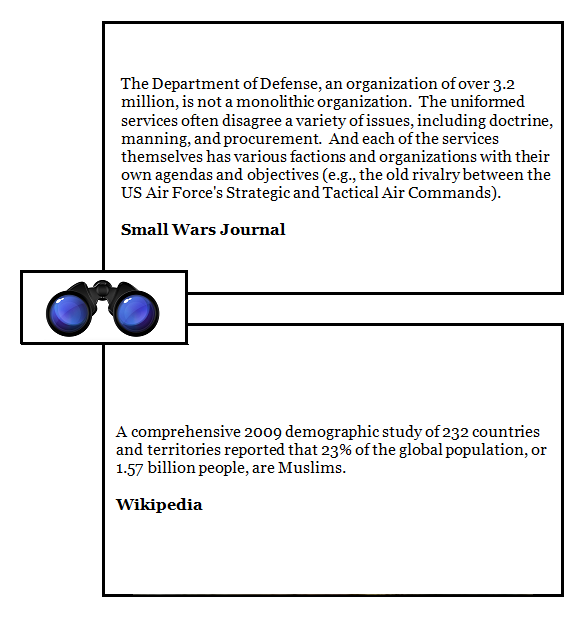
[ by Charles Cameron — regarding the idea that Islam might be monolithic as well as monotheistic, and more generally, the patterns created when concentric ripples intersect ]
.


.

Drop these two pebbles into the pond of thought, and watch the ripples as they intersect, overlap, enhance one another, cancel each other out and continue…

**

It may seem obvious that Islam is not, and could not possibly be, a monolithic entity — but I want to suggest something more than that fairly basic fact.

I want to suggest that just as we have all enjoyed watching the way concentric ripples fan out from the place where a pebble — or a raindrop — hits a pond, and the fascinating ways win which two or more such ripples intersect —

— in much the same way, it can be fascinating — and often illuminating — to watch the way in which ripples of thought in the thought pond intersect.

In fact, that’s the basic “move” behind all creativity.

**

My sources for the two quotes above:

Small Wars Journal, Disruptive thinking
Wikipedia, Islam

My sources for the two images above:

Doodles and jots, ripple effects
David Armano on “ripples of influence”

A Century of Nixon and the Nixonian Century

Wednesday, January 9th, 2013

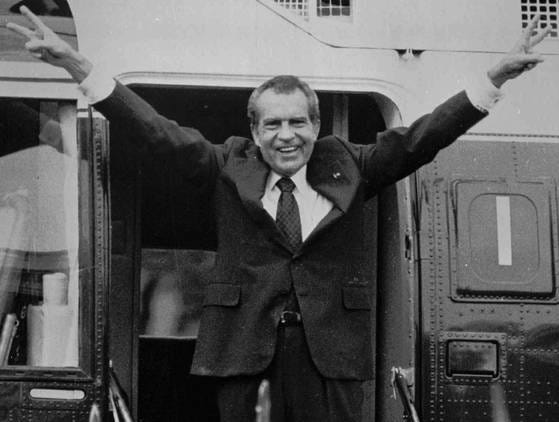
Richard Milhous Nixon, 37th President of the United States of America and the only man to resign that office would was born one hundred years ago.  His life spanned from the Great War, included service in the Second World War and saw the end of the Cold War – an American victory to which Nixon substantially contributed with the deft statesmanship that was his greatest strength. Nixon stood for national office five times and was on the winning ticket in four of them, a political record matched in American history only by Franklin Roosevelt, a record that includes re-election by the second greatest landslide in history. A triumph that was undone by the paranoia, insecurity and bitterness that ate away at him and led Nixon to betray his oath to uphold the Constitution and forced him out of the Oval Office in disgrace.

So numerous and far-reaching were Nixon’s actions that we can justly say, for good and ill, that a century of Richard Nixon may have helped usher in a Nixonian century.

Richard Nixon named four justices to the Supreme Court, shifting the judicial branch in a more conservative direction, built upon by later Republican presidents; he created the EPA and the first affirmative action program, cut the dollar from it’s last tie to the gold standard,  declared war on drugs, ended the draft and began the All-Volunteer Force and began the movement to decentralize power from Washington bureaucracies to the states.

Some of these policies were ultimately disasters and some were a great success, but domestic policy (in contrast to politics) was never more than an irritating chore to Richard Nixon, one he frequently delegated to Bob Haldeman and John Ehrlichman. Nixon’s true, all-consuming passion – from his first days as a freshman member of Congress to his grim final moments “alone in the White House” to a winter street in Moscow as an elder statesman – was foreign affairs. It was on the world stage that Nixon yearned to not just be “in the arena” but win the game.

Sometimes he did.

Richard Nixon, an inveterate poker player, came into office in 1969 with a bad hand and too few chips on the table. The Nixon administration were the victors in a three-way presidential race inherited a losing war in Vietnam begun by the Democratic “Best and the Brightest” that had savagely divided the American people like no other conflict since the Civil War. Richard Nixon in partnership with Henry Kissinger managed to accomplish, by design and improvisation, a restructuring of American relations and the world order. They blunted a potential nuclear war between Communist China and the USSR, opened up detente with the Soviet Union, negotiated the first SALT and ABM treaty with the Soviets, unilaterally initiated the international monetary regime of floating currencies. In the Mideast, Nixon saw critical American support of Israel during the Yom Kippur War  as an opportunity to move toward a future general Arab-Israeli peace negotiation, that later came to pass in the Camp David Accords during the Carter administration.:

TO:        Secretary Kissinger

FROM:  The President

  1. I have just written a note to Brezhnev emphasizing to him that you speak with my full authority and the commitments you may make in the course of your discussions with him have my complete support.  I also told him that you would be conveying to him my strong commitment to devote my personal efforts toward bringing a lasting peace to the area.
  2. I believe that, beyond a doubt, we are now facing the best opportunity we have had in 15 years to build a lasting peace in the Middle East.  I am convinced that history will hold us responsible if we let this opportunity slip by.
  3. The current Israeli successes at Suez must not deflect us from going all out to achieve a just settlement now.  There is no reason to believe that Israel will not win this war now, as it has won all the previous ones, but you and I know that, in the long run the Israelis will not be able to stand the continuing attrition which, in the absence of a settlement, they will be destined to suffer.
  4. It is therefore even in Israel’s best interests for us to use whatever pressures may be required in order to gain acceptance of a settlement which is reasonable and which we can ask the Soviets to press on the Arabs. [….]

And torturous secret negotiations with Hanoi in Paris led to the painful but necessary American withdrawal from the Vietnam while Nixon’s greatest and most far-reaching triumph was opening relations with Communist China:

While some would argue that China’s opening to the world was inevitable, an isolated China at Mao’s death might have seen power pass into the hands of the Gang of Four, with terrible consequences for the Chinese people. It remains Richard Nixon who changed the strategic geopolitical balance at a time of acute weakness for the United States and set forces in motion that have transformed China and have only yet begun to shake the world.

Nixon’s most important achievements in foreign affairs came at the price of managing his administration first through secrecy, then guile then machiavellian intrigue against even his closest associates and finally with a resentful, angry, ill-will that seemed to consume Nixon and turn every “win” sour:

….At eleven o’clock in the morning, Nixon met with his staff in the Roosevelt Room. To many in the room he seemed oddly cool and quietly angry as he thanked them all for their loyalty and said something few of them understood. He said that he had been reading Robert Blake’sDisraeli and was struck by his description a century ago of William Gladstone’s ministers as “exhausted volcanoes” – and then mumbled something about embers that once shot sparks into the sky.

“I believe men exhaust themselves in government without realizing it” the president said “You are my first team, but today we start fresh for the next four years. We need new blood, fresh ideas. Change is important…..Bob, you take over.”

Nixon left then, turning the meeting over to Haldeman. The men and women of the White House stood to applaud his exit, then sat down. The chief explained what Nixon’s words meant: a reorganization of the administration. He told them that they were expected to deliver letters of resignation before the end of the day, then passed out photocopied forms requiring them to list all official documents in their possession. “These must be in by November 10,” he said. “This should accompany your pro forma letter of resignation to be effective at the pleasure of the President”. They were stunned. Speechless. Were they being fired? Haldeman said they would know within a month whether or not they could remain. At noon, the same drama was played out with the entire Cabinet, with Haldeman again passing out the forms. 

The man who had campaigned in 1968 as the smiling “New Nixon” did not want a chief of staff anymore. Nixon craved a “Lord High Executioner” who would keep underlings at bay and reporters and Congressmen away.

H.R. Haldeman, Nixon’s tirelessly faithful right hand man, obliged, even as he struggled in a losing battle to keep Nixon’s dark side and worst impulses under wraps, tabling orders he deemed vindictive, politically unwise or crazy from being carried out until Nixon had calmed down and had time to reflect. Most of the time Nixon sheepishly thanked Haldeman, but Nixon found other willing hands in Colson, Liddy, Hunt and others. It is probable that Nixon himself approved of the Watergate break-in, but even if he had not done so specifically in that instance, he consented to abuses of power and an illegal apparatus with which to carry them out. The most malign proposal toward American democracy during the Nixon administration, known as “The Huston Plan“, was rejected even by J. Edgar Hoover, was later partially revived during the writing of The Patriot Act. An authoritarian trend that will haunt us for a long time to come.

If Richard Nixon is the father of the multipolar world and contributed greatly to the defeat of Communist totalitarianism, he also laid the foundations of the Creepy-state here at home through Watergate, which damaged the faith of Americans in their government and tarnished democracy. This is as much a part of Nixon’s legacy as Detente or China. Nixon had badly needed the free and absolute pardon that he received from Gerald Ford.

Richard Nixon managed a final comeback as an elder statesman, dispensing often wise geopolitical advice at private dinners where, in his early eighties, Nixon held forth at length, speaking without notes, on the dynamics of how the world really worked, at least through the prism of brutal realpolitik which he saw it. He lived to see the husband of the woman who once sought his prosecution, solicit his counsel in the Oval Office. His funeral drew tens of thousands of mourners and four former presidents of the United States. To the very end, Richard Nixon never gave up. We can’t take that away from him.

Let history judge.


Switch to our mobile site