zenpundit.com » America

Archive for the ‘America’ Category

Yiddish humor, US Presidential Election

Friday, August 24th, 2012

[ by Charles Cameron — Jewish Democrats suggest humorous barbs for Jewish Republicans to digest ]
.

As those who follow my strand of posts her on Zenpundit know by now, I’m not a great one for taking sides: I imagine very few bridge builders are, and my real interest is in building bridges.

I am also, in general, interested in the ephemeral signals that go on between and within opposing camps — because they’ll often portray a different side of things from what’s in the official pronouncements.

What I’m offering here, then, is a fleeting glimpse into some Jewish humor from the Democratic side of things:


.
— two “curses” from the from the Yiddish Curses for Republican Jews website.

As wry humor, I’m okay with these. As embittered humor, not so much.

And I don’t know the people who posted these “curses” — though I’m reasonably sure they didn’t intend them as actual, may G*d do this to you and I mean it, curses.

Frankly, I’m interested in the religious content.

**

I’m interested in the jokes.

I’m interested in the leaflets, the comments in the comment sections of websites — and in the winks, the nudges and the nods.

I’m interested in the differences between “in-house” and “external” explanations of things, what the differences may actually mean, and what they may get interpreted to mean. I’m interested in the asides, the sneers and smears, the jokes, the ambiguous threats, the real hatreds, the moments of reflection, the metanoias, changes of heart, repentances.

At times, the materials I run across are threatening, at times witty or droll, at times insightful, and at times completely unhinged from reality, but they usually have something to teach us about undercurrents — about the variousness of human thoughts and feelings.

We humans are a strange lot, each one of us so singular that we have a hard time getting our heads around the differences between us — differences that can make all the difference between peace and war, life and death.

**

I’m not going to explain the jokes, but I am going to take just a quick look at their religious content.

One of the qualities that is, IMO, most likeable about Jewish culture is that it delights in self-mockery. The New York Times journalist Michelle Goldberg tweeted a Jewish joke yesterday, to which I responded with a quote from Martin Luther:

Now I don’t know about Michelle, but I didn’t intend my quote from Luther — “sin boldly” — as representing either my personal advice to the world at large, or Luther’s, except perhaps in a very limited sense such as the one Dietrich Bonhoeffer offered as his explanation of Luther’s meaning.

Bonhoeffer’s question is the obvious one:

Is this the proclamation of cheap grace, naked and unashamed, the carte blanche for sin, the end of all discipleship? Is this a blasphemous encouragement to sin boldly and rely on grace? Is there a more diabolical abuse of grace than to sin and rely on the grace which God has given?

And his response?

Take courage and confess your sin, says Luther, do no try to run away from it, but believe more boldly still. You are a sinner, so be a sinner, and don’t try to become what you are not. Yes, and become a sinner again and again every day, and be bold about it. But to whom can such words be addressed, except to those who from the bottom of their hearts make a daily renunciation of sin and of every barrier which hinders them from following Christ, but who nevertheless are troubled by their daily faithlessness of sin? Who can hear these words without endangering his faith but he who hears their consolation as a renewed summons to follow Christ? Interpreted in this way, these words of Luther become a testimony to the costliness of grace, the only genuine kind of grace there is.

**

So no, I don’t think all religiously-themed tweeting and web-based cursing is to be taken literally.

But I do find it interesting that Michelle jokes about kosher, and I joke about sinning boldly — and that the Yiddish humor displayed on the “curses” website includes references to the LDS practice of proxy baptism for the dead and an indication that it might be uncomfortable for those with strong anti-Muslim feelings to meet the generous hospitality that so often characterizes Muslim cultures.

So let’s dig into those two themes in a little more depth.

**

Official Latter-day Saints doctrine teaches:

Jesus Christ taught that baptism is essential to the salvation of all who have lived on earth (see John 3:5). Many people, however, have died without being baptized. Others were baptized without proper authority. Because God is merciful, He has prepared a way for all people to receive the blessings of baptism. By performing proxy baptisms in behalf of those who have died, Church members offer these blessings to deceased ancestors. Individuals can then choose to accept or reject what has been done in their behalf.

And while the practice of baptizing the dead by proxy may seem strange to most Christians, the Latter-day Saints can point to I Corinthians 15.29:

Else what shall they do which are baptized for the dead, if the dead rise not at all? why are they then baptized for the dead?

and I Peter 4.6 for precedent:

For for this cause was the gospel preached also to them that are dead, that they might be judged according to men in the flesh, but live according to God in the spirit.

Maybe so — but Saints Peter and Paul, though Jewish by birth, are now generally reckoned Christians, having accepted the belief that Jesus was the awaited Jewish Messiah, the Christ — so their epistles are not canonical texts for mainstream Judaism.

**

Feelings in the Jewish community can run pretty strongly on the issue of Mormon believers’ baptisms of Jewish believing dead:

The wrongful baptism of Jewish dead, which disparages the memory of a deceased person is a brazen act which will obscure the historical record for future generations. It has been bitterly opposed by many Jews for a number of years. Others say they will never stop being Jews, simply because there is a paper saying they had been baptized, that the act of posthumous baptism is unimportant and should be ignored. We think this to be a narrow, parochial, and shallow view. We will continue opposing this wrongful act which assimilates our dead to the point where it will not be possible to know who was Jewish in their lifetimes.

[ … ]

A protest drive initiated by Jewish genealogists escalated it to a nationally publicized issue that was followed by public outcry. American Jewish leaders considered it an insult and a major setback for interfaith relations. They initiated discussions with the Mormon Church that culminated in a voluntary 1995 agreement by the Church to remove the inappropriate names. Activists continue to monitor Mormon baptismal lists, seeking removal of inappropriate entries.

Indeed, in February of this year it was discovered that the Holocaust victim Anne Frank had been baptized by proxy — for what one researcher said was the ninth time.

The Nobel laureate Elie Wiesel responded with passionate anger, and the Mormon Church with an apolpogy and a firm statement that the practice was prohibited.

LDS spokesman Michael Purdy made it clear that the Church “is absolutely firm in its commitment to not accept the names of Holocaust victims for proxy baptism.”

There are serious issues here: as humans, we can listen to one another with respect, and work them out.

**

Palestinian Muslim hospitality towards Jews?

Miftah is an Ethiopian who visited some Palestinian shepherds in company with people sympathetic to the Palestinian cause:T

he group I went with was a mostly Israeli – international activists’ group that accompanies shepherds in the village as they graze their herds. Since these shepherds face attacks from settlers and soldiers frequently, the purpose of the trip was to document and confront the settlers or soldiers if they try to harass the shepherds.

These were people the Palestinians had reason to respect, Israelis and foreign activists sympathetic to their cause — but the degree of hospitality they were shown nicely illustrates the innate courtesy of so many pastoral peoples…

As we were heading back from the hills to where our mini-van was, these shepherds we had met offered to take us home for some tea and coffee. Mind you, it’s the Ramadan fasting season and all of them were fasting. They would offer us water, coffee and bread even though the last meal they had was at dawn that morning and would not have any food or water until dusk that evening. In Ramadan, even people who don’t fast don’t eat in public or in front of people who fast. But out of true hospitality, they extended their “‘Mitzvah’ – their act of kindness” to us, as one of the Israeli activists put it

**

The story is an old one: the person of few possessions who will kill one of their handful of sheep to feed the passing stranger…

In this second “curse” we glimpse the long tradition of hospitality to strangers without which the great trade routes of the ancient would would not have permitted China to supply Europe with silks, nor Roman jewelry to have found its way into Japanese tombs

The First Battle — a review

Friday, August 24th, 2012

[by J. Scott Shipman]

The First Battle, Operation Starlite and the Beginning of the Blood Debt in Vietnam, by Otto J. Lehrack, Lt.Col., USMC, Ret.

This is an older book, but important. A few weeks ago I was having lunch with a good friend, Bruce. Bruce is a Vietnam veteran and since both of us are readers many of our lunch conversations revolve around the books we have read, and this meeting was no exception. Bruce enthusiastically recommended The First Battle and No ShiningArmor, both by Lt.Col. Lehrack, and Last Men Out, by Bob Drury and Tom Clavin. He said Lehracks first twenty pages of The First Battle was the best description of the situation that led the United States to become involved in Vietnam. Since my knowledge of Vietnam is embarrassingly meager, I ordered all three when I returned home from lunch. Given Bruce’s descriptions, The First Battle was first up. Lehrack begins the first chapter, Inching Towards the Abyss, with a profound first sentence:

The United States came to this pass in baby steps, characterized more by Cold War fears, hubris, and inattention than by level-headed policy examination.

(Sounds familiar doesn’t it?)

The result of Lehrack’s effort is a readable and powerfully inspiring story of the first battle of the Vietnam War fought only by Americans, specifically, the United States Marine Corps. Code named, Operation Starlite, this “first battle” was a coordinated air, sea, and land attack, but to the green, untested Marines fighting battle-hardened Viet Cong troops nothing about this first encounter was typical or routine.

Lahreck, drawing on interviews with warriors from both sides, provides the reader an up-close view of the savagery and the valor of this battle that resulted in two Americans receiving the Congressional Medal of Honor. The prose is fast paced and detailed, but not so detailed one with no experience/knowledge of Marine Corps jargon can’t keep up. Lehrack includes a fairly exhaustive glossary of the unique terms used, so the military/USMC novice will have a ready guide close-by.

The book is divided in three parts. Part 1 describes general attitudes of the American public, politicians, and military personnel with respect to Vietnam. Part 1 also provides a description of the planning process for the battle and the rationale. Also included is an assessment by the Viet Cong of their American opponents, dated 3 July 1965 (about a month prior to Operation Starlite):

American strong points

  • The have reached the training level of an expeditionary force.
  • Armed with modern weapons, lighter than French expeditionary forces, they have quick transportation, quick movement, have capability of quick reinforcement, thanks to vehicles, aircraft, boats.
  • Usually concentrated in groups.

Weak points compared with French

  • No spirit of combat; afraid of guerillas; always rely on modern weapons, so they lose initiative and self-confidence (when in contact, they call fire for support and reinforcement); sometimes artillery must conduct fire support for the whole period of operation.
  • Lack of combat experience, just know combat in theory only (through field manuals). Moreover, on a strange terrain, they usually walk in the open, bewildered like ducks (we say that American troops are most opportune targets for guerrillas).
  • Much effort required for messing; and water. Food must be supplied for each meal by helicopters. When moving to any place they must use helicopters and artillery fire support, so objective will always be disclosed, brining good opportunity for guerrilla follow up.
  • Cannot undergo long and hard operations. When operating far from base, about seven kilometers, must use vehicles.
  • Not able to bear local weather and climate, so troops will fall ill.
  • Defensive positions sometimes well organized but they are slow to get that way. In one instance it took ten days to organize defenses and thirty to install mines.
  • They do not know the terrain well.
  • They run slowly.

(This list is offered for those readers who have insight into whether these weaknesses persist in our military—I do not know.)

In Part 2, Lehrack describes the battle, and the aims of the American commander “to isolate, and then destroy the enemy.” Lehrack follows individuals and units through the battle, and spares no detail in the hardships, risks, and depravations endured by the participants. He offers a gripping and realistic description of the “fog of war:”

The Marines quickly learned a practical lesson that all warriors have known since ancient times. Theoretically, one is supposed to line up in an assault or other planned formation and fight that way. But once battle is joined the formation rapidly degenerates into a series of isolated small actions. In Starlite, as in most battles, it seemed that the fights generally meant that four or five men on one side would be heavily engaged with a similar number on the opposite side. Each combatant became so preoccupied with taking care of his situation that he often had little knowledge of and didn’t really care what was going on a few yards away. Throw in the sounds, the smells, and the fear and you have the notorious “fog of war” that explains why such widely differing accounts describe the same battle.

Good friend of this blog, Lynn Wheeler adds this observation in another forum on the effect Starlite had on Viet Cong planning/tactics::

Perhaps the most important reason for the so-so result was that the Viet Cong had gained an enormous appreciation of the Marines’ ability to project power from the sea as a result of Starlite. Never again in the course of the war did they permit their units to tarry on the coastal plain. When they had a job to do near the water, they came in and did it, and then they fled inland again. Although they developed good antiaircraft techniques and weaponry during the war they had neither the ordnance nor the expertise to thwart an amphibious landing force.

Part 3 is titled The Blood Debt. As eloquently as Lehrack introduced the reader the to attitudes and assumptions of most Americans in his opening chapter, so he concludes. Fifty-four Americans died and an estimated six hundred of the enemy perished in Operation Starlite. By the numbers and a “body count” mentality, we “won” the battle, but in 1965 the Vietnam War was just getting started, and we know how it ended. Lehrack writes:

America spent another ten years, and more than 56,000 additional lives, to follow a failed policy. Like gamblers who have already lost their gambling money, and then the rent money, and the car payment, and then the grocery money, and then borrowed or stole in the hope of changing their luck, the Johnson and Nixon administrations kept signing markers to America for a debt in gore that they hoped a reversal of fortune would justify.

The criminal portion of this gut wrenching conclusion is that American political leaders had no confidence in a military solution in Vietnam. Lehrack quotes President Johnson speaking with a senator, “They hope they will wear us out. And I really believe they’ll last longer than we do.” Eventually, and thankfully, the American public said, “no more.” Amazingly, Lehrack citing Hugh M. Arnold‘s examination found that of an official justification of the war there “were a total of twenty-two separate American rationales: From 1949 to 1962, the emphasis was on resisting communist agression; from 1962 to 1968, it was on counter-insurgency; after 1968, it was on preserving the integrity of American commitments.”

Lehrack correctly laments American unfamiliarity with Vietnamese culture and their visceral attitude towards foreign invaders. We were making the world safe for democracy, and the Vietnamese fell back on nationalism as a recruiting tool and justification for feeding over a million people into the maw of war. Lehrack also points out that Marine leadership knew early on “that Vietnam was more a political war than military.” The Marines had the Small Wars Manual derived from their actions in the Philippines, Nicaragua, and Haiti while the U.S. Army had four pages in their Field Regulations on guerilla warfare. Lehrack speculates a pacification effort, something the Marines knew well, may have been successful if properly applied to good governance on the part of the South Vietnamese government.

Of course these speculations are just that, and there is little evidence given our current predicament in Afghanistan that we learned our lessons. The shelf-life of hubris is eternal.

Bruce was right; this is a powerful little book, and comes with my highest recommendation.

Addendum: LCDR B.J. Armstrong has an enlightening essay on rotary aircraft, which includes Operation Starlite here.

Cross-posted at To Be or To Do.

Turning Away From Strategy

Thursday, August 23rd, 2012

It appears that the Pentagon no longer intends to educate the most talented members of the officer corps to think strategically.

I say this because the status of the premier professional military education institutions – the war colleges and NDU – have been devalued, their leadership slots demoted and their educational mission degraded. As a guest columnist for Tom Ricks noted back in June:

….The new uniformed leadership of the Armed Forces, i.e., General Dempsey and his staff, apparently intend to prune NDU back to where it was a few decades ago. There will be some modest resource savings, but since the entire university budget doesn’t amount to the cost of a single joint strike fighter, one has to wonder what is motivating all of what is happening here. In the cuts that have been discussed, Dempsey’s deputy, Marine Lt. Gen. George J. Flynn has wielded the meat axe, often with the aid of micromanaging action officers. No one here in the rank-and-file is sure if the urbane chairman is on board with the details of all of this. (Ironically, both the chairman and J-7 are NDU graduates with advanced degrees.)

This set of changes took place in stages. First, while very few general or flag officer slots were cut in the armed forces, the three-star president of the university slot was downgraded to two, and the school commandants, downgraded from two to one star. No big deal, one might say, but one would be wrong, very wrong. A three star in Washington can go head-to-head with a principal on the joint staff or a senior OSD bureaucrat to protect the university. To compound the problem, the last three star president was retired in the spring and the university was left for a few months under the command of a senior foreign service officer, a former ambassador, a woman of great diplomatic talent and experience with no clout in the Pentagon. The new commandant — a highly regarded Army two-star — will not report until deep into June, when all or most of the cuts have been set in concrete. (Interesting question: can an employee of the State Department legally or even virtually assume command of a DoD organization?)

….A new “charter” was subsequently published by the Chairman. It focused the university on joint professional military education and training, which in itself, is a good thing. Immediately, however, the research and outreach activities of the university, often more focused on national strategy than military affairs, came under intense scrutiny. These outfits had grown way beyond their original charters and had become effective and highly regarded servants of a wider interagency community. Much of their work was not done for the joint staff but for OSD Policy, and some of that in conjunction with civilian think-tanks. The research arm of the university was productive, even if not always useful in a practical way to the joint staff. It also was helpful to the colleges in a much more proximate and direct fashion than other think tanks, like RAND.

….The research, gaming, and publications arms of the university — a major part of the big-think, future concepts and policy business here — will be cut to somewhere between half and a third of their original sizes. To make things worse, many of the specific cuts appear to have been crafted in the Pentagon, and nasty emails have come down from on high, about how the university is bankrupt and going into receivership, which was never the judgment of the military and civilian accrediting officials, who inspect us regularly and have generally given the university high marks.

If it would be impressive if some of our senior generals had been as effective on the battlefield as they are in the bureaucracy.

Uncreative destruction of intellectual seed corn is a bureaucrat’s way of telling everyone to shut up, don’t question and get in line. There’s nothing wrong with having excellence at joint operations as an educational goal for most future brigadiers and major generals but our future theater commanders, combatant commanders, service chiefs and their respective staff officers need something more – they need strategy.  More importantly, the Secretary of Defense, the President, the Congress and the American people need the DoD to have an in-house capacity to generate deeply thought strategic alternatives, question assumptions and red-team any self-aggrandizing options the services or bureaucracy feel like offering up in a crisis.

The motivation here is simple, really. If you put out all the strategic eyes of the Pentagon, then the one-eyed men can be King. Or he can always contract out his strategic thinking to highly paid friends to tell him what he wishes to hear.

Naturally, this will have bad effects downstream in a superpower whose civilian leadership seldom has as good a grasp of geopolitics and the fundamentals of classical strategy as they do of law or the partisan politics of running for office. They will be in need of sound strategic advice from uniformed military leaders and they will be much less likely to get it. Instead, they will have senior officers who are less likely to balk when the President’s back-home fixer turned “adviser” or superstar academic with delusions of grandeur pushes a half-baked plan at an NSC meeting to “do something”. When that happens, the jackasses kicking down this particular barn will have long-since retired and cashed out with consultancies and sinecures on boards of directors.

While a lack of strategic thinking can undermine even a lavishly funded and well-trained military, the reverse is also true; strategic leadership can revive an army that is but a half-dead corpse.

A brief illustration:


After WWI the two states that made the most extreme cuts in military power were defeated Germany and the victorious United States. Germany was forced to do so by Versailles, but responded by opting under General von Seeckt to reduce to 100,000 men by making the Reichswehr a qualitatively superior nucleus of a future expanded German Army. Prohibited from having mass, the Germans opted for class with every long-serving recruit being considered officer material and being superbly trained (even to the extent of covert training and weapons testing jointly with the Red Army deep inside the Soviet Union to evade Allied inspections). Von Seeckt also instituted a shadow general staff office that thought deeply about tactical lessons, operations and strategy for the next war. Without the Reichswehr being what it was it is highly dubious that Hitler could have so rapidly expanded the Wehrmacht into a world-class land fighting force in so few years time.

.

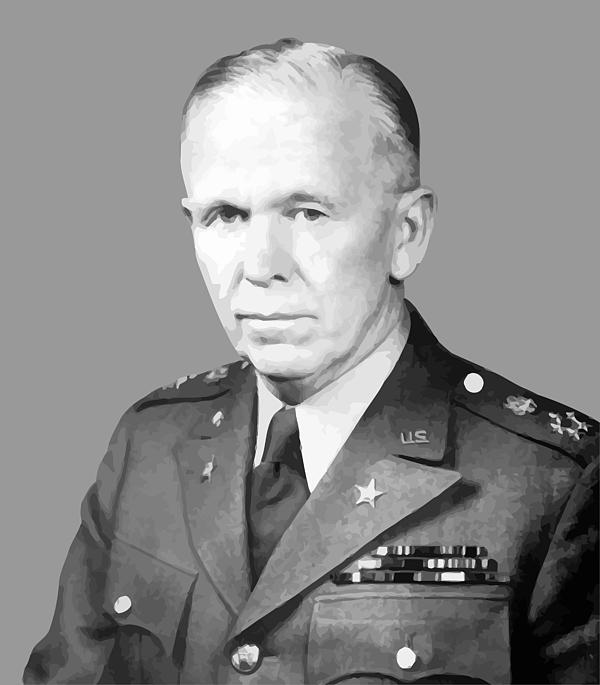
In contrast, the United States radically reduced the size of the regular Army and starved it of weapons, ammunition, gasoline, training and basic supplies. Promotions slowed to a crawl where ancient colonels and elderly majors lingered on active duty and future four and five star generals like Eisenhower, Patton, and Marshall all despaired and contemplated leaving the service. The Army’s – and to extent, America’s – salvation was in the fact that George Marshall persevered as a major and colonel in keeping a little black book of talented, forward thinking, officers and thought deeply and reflectively about building armies, helping enact “the Fort Benning Revolution” in military training. When FDR placed the power in Marshall’s hands as Chief of Staff he knew exactly what to do because he had a well-conceived vision of where the US Army needed to go to meet the national emergency of WWII. He was the American von Seeckt, except that Marshall was an infinite improvement morally, strategically and politically on his German counterpart. We were extremely fortunate to have had him.
.
We may not be as lucky next time.

Glenn Greenwald misses target, hits good guys

Friday, August 17th, 2012

[ by Charles Cameron — I pretty much follow the people I follow because I learn from them, and that builds trust and friendship ]
.

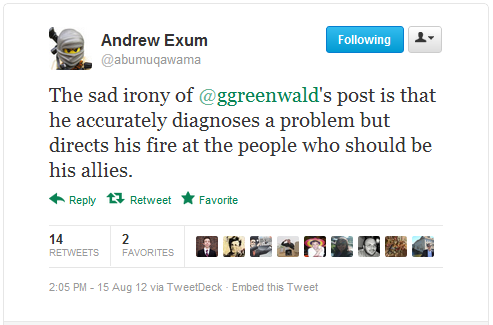
Exum nails it.

I mean, I can well imagine there are some phony “experts” on terrorism out there, but Glenn Greenwald hasn’t done his homework and misfires. Let me explain.

**

I don’t know about you, but I sometimes think the words that someone ends a book with are kinda significant. They’re the ones that give you the impression the author wants to leave you with. That’s partly why I go on and on at such length about the final hundred pages of Abu Musab al-Suri‘s Treatise being devoted to an exposition of apocalyptic hadith with strategic application.

So when Daveed Gartenstein-Ross writes an entire book arguing that al-Qaida’s strategy is to defeat the US by draining its economy – fair enough, given that bin Laden himself said he was continuing a policy of “bleeding America to the point of bankruptcy” – it should come as no surprise when Gartenstein-Ross closes his book with the following words:

When we are facing a crushing national debt, the interest payments for which are projected to eclipse our current defense budget by 2019, we cannot afford to overreact to every terrorist threat and to intervene in every conflict.

The course to maintaining American power in the twenty-first century begins with conserving our resources. And this must be as true of our counterterrorism and military efforts as it is of any other segment of the federal budget.

Likewise, when someone writes a 30-page analysis of the FBI’s infiltration of the Patriot movement, as JM Berger did in his report on PATCON for the New America Foundation, it’s hard to imagine that he’s solely concerned with Islamic terror. Indeed, Berger was researching the “Aryan Republican Army” at least as far back as 2006, when he posted Richard Guthrie’s Suicide: New Details Of ‘Aryan’ Bank Robber And OKBOMB Suspect’s Death In Prison; more recently, he published a piece about the Turner Diaries and today’s Patriot movement in the Daily Beast in June of this year.

**

It’s curious, then, and sad, that these are the two people that Glenn Greenwald specifically picks out by name and photograph to attack in his final, ill-informed piece for Salon, The sham “terrorism expert” industry, writing:

Gartenstein-Ross’ entire lucrative career as a “terrorism expert” desperately depends on the perpetuation of the Islamic Terror threat.

of the fellow who wrote:

we cannot afford to overreact to every terrorist threat

and similarly:

he spends his time doing things like shrieking about the Towering Menace of Anwar al-Awlaki and generally hopping on whatever Muslim-Terrorism-is-a-Grave-Danger train that comes along.

about the fellow who has been tracking many forms of US native terror – including all those mentioned in his piece, A Nation of Spies and Snitches in Foreign Policy in May of this year:

And it isn’t just about Muslims, or even terrorism. In recent months, informants and undercover agents have played a key role in criminal cases involving anarchists in Ohio associated with the Occupy movement and right-wing extremists in Georgia, Arizona, and Michigan

**

Greenwald has gotten this same sort of thing wrong at least once before, when he pilloried Will McCants. Greenwald had written:

I had a somewhat lengthy debate on Twitter last night about the Awlaki assassination with several people often identified as “Terrorism experts” — such as Will McCants and Aaron Zelin — and they and others (such as Andrew Exum and Robert Farley) objected rather vigorously when I said I found the entire concept of “Terrorism expert” to be invalid, as it is a honorific typically assigned due to ideology and interests served rather than actual expertise.

Ouch.

Exum neatly skewered him that time, too, albeit at greater length, writing:

Second, let me consider the case of my friend Will McCants, who Greenwald very much picked on in his Twitter feed along with Aaron Zelin (who I do not know well but who seems really smart in his own right). Greenwald is correct that the decade after the September 11th attacks created all kinds of incentives for self-proclaimed terrorism “experts” to rise to the fore, hawking their “expertise” and opinions on both the consulting market as well as in the mainstream media. Too often, this expertise has been ignorant or barely concealed Islamophobia. Ironically, though, one of the scholars who has done the most to condemn what he calls “CT hucksters” is Will McCants. Will is one of the more rigorously credentialed scholars studying violent Islamist extremist groups as well as being one of the most careful. Will fell into a study of terrorism after doing a Ph.D. in Near Eastern Studies at Princeton. He had no initial academic training in strategic studies or military affairs as far as I know, but his Arabic and understanding of the intellectual currents of political Islam made him ideal to work on al-Qaeda as a case study. And just like I started a dissertation on Hizballah with a background in Middle Eastern Studies and boned up on the theories related to small wars and insurgencies as I went along, so too did Will with respect to terrorism as a phenomenon. At the end of the day, Will is best described as an Arabist, perhaps, but if he is not a bona fide terrorism expert as well — again, no scare quotes necessary this time — I don’t know who is.

History may not repeat, but Greenwald seems to.

The equivalent skewering this time around can be found in Foreign Affairs — in Dan Trombly‘s What’s Glenn Greenwald’s Problem?

**

[ Saving grace note: I don’t think it quite admits me to the clique, but I’ve exchanged emails or tweets with all four of the people Greenwald mentioned with less than due diligence, and consider each of them “virtual acquaintances” and in some cases “friends” ]

The zen of Cage II: from the A Train to Liverpool Street Station

Wednesday, August 15th, 2012

[ by Charles Cameron — two performances of Cage’s 4’33” in the New York and London Times: an interlude in my review of Where the Heart Beats, with a brief meditation on contrapuntal listening ]
.

I began to review Kay Larson‘s Where the Heart Beats in a post here last week, and am not done yet.

**

London:

photo credit: Chris Harris for the London Times

In John Cage’s sound of silence… at Liverpool Street station [London Times, subscription required], Igor Toronyi-Lalic describes performing John Cage‘s silent work 4’33” in what Cage himself — but few others — would have recognized as a concert venue, London’s Liverpool Street Station:

My rendition isn’t going down well. “This is doing my head in!” groans a drunken West Ham supporter as he watches me at the piano outside Liverpool Street station. I hear shuffling. “I can’t dance to this,” someone shouts. The restlessness is in danger of turning to anger. And I probably should have guessed it would. Presenting a performance of one of the most controversial works of music yet written in a rowdy Central London station forecourt on a Friday night on a public piano (one of several that made up the City of London Festival’s Play Me, I’m Yours artwork) was always going to be ambitious.

The work itself is hardly over before it begins — again, a paradox Cage would have enjoyed:

At my Liverpool Street Station performance, there was a symphony of rush-hour noise: commuter patter, train announcements, drunken heckling and the screeching of taxis stopping to pick up fares. Not everyone appreciated the music in this.

“When’s he going to start?” asked one lady as I finished the final movement. Others felt like they’d been had. “I thought you were going to play,” they shouted.

There’s more, and if you can get past the pay-wall you should read it all. I’ll just quote one more snippet here, though, because it leads directly into one strand of the book that I’ll be discussing in Part III of my review of Larson’s book:

“Classical musicians don’t know about Cage. They don’t perform it. We aren’t taught it in schools,” Volkov says.

But, for visual artists, Cage is a revered figure, a key part of the 1950s and 60s New York arts scene and godfather to conceptual and sound art, a connection cemented by Cage’s 40-year creative relationship with his lifelong partner, the late choreographer Merce Cunningham. “Cage worked with Rauschenberg and Cunningham and, at Black Mountain College, he mainly taught music to artists,” observes Volkov, “So, today, in art schools, they teach Cage properly. They teach his ideas.”

**

New York:

photo credit: Christian Hansen for the New York Times

From London’s Liverpool Street Station we pass to New York City’s subway system. I don’t know what it is about trains, but there you are and there you go. Or perhaps the transit is from Times to Times?

Allan Kozinn‘s John Cage Recital? Take the A Train [New York Times] starts by defining “Cage moments”:

You know about Cage moments, don’t you? We all have them, whether we think of them that way or not. They occur when happenstance kicks in, and surprising musical experiences take form, seemingly out of nowhere. They can happen anywhere at any time.

Listening. Listening as though all life is music.

Kozinn is a listener, a listener to music — but he doesn’t always listen for the music in his daily life. This time, as it happens, he did:

On the A train I wasn’t thinking about Cage at all. I had just heard an exquisitely turned, energetic performance of Schubert’s String Quintet in C at a church in Greenwich Village, and Cage could not have been further from my thoughts. Nor did the crowded subway car bring him to mind at first. But I noticed that it was unusually noisy.

**

Then something shifted:

Typically, most of the noise you hear comes from the subway itself: its din drowns out conversations, and people tend to stare at their feet, or at whatever they are reading, and listen to their portable music players. But this Tuesday evening just about all the people were talking, and working hard to drown out both the subway and the chats taking place around them.

I would normally have tuned all this out, but instead I sat back, closed my eyes and did what Cage so often recommended: I listened. I made no effort to separate the strands of conversation or to focus on what people were saying. I was simply grabbed by the sheer mass of sound, human and mechanical. It sounded intensely musical to me, noisy as it was, and once I began hearing it that way, I couldn’t stop.

Okay, this is where it get’s interesting. You remember that I pointed to the pianist Glenn Gould in my Said Symphony posts, and quoted this passage from David Rothenberg‘s Sudden Music:

Gould set himself up to hear the world in a new way. In diners he ate his lunch alone, eaves dropping closely on the voices around him. He learned to hear conversation as music, the lilting lines, the rhythms everywhere up, down, and around, what Bach does to our sense of talk. There are two part inventions in words, themes and variations in the quarrels of couples and the tales told by friends. Gould met the world on his own terms, and he was fascinated by this way of listening to human voices as if they were a musical interplay, not participating in a conversation but taking it all in, as an audience.

What Gould sets out to do — and records for Canadian Broadcasting — Kozinn finds himself doing:

Strand upon strand of the chatter was animated and midrange: there were neither basso profundos nor soaring sopranos in this choir, but after a moment the pitch levels began to sort themselves out as a kind of orchestration. Argumentative voices created driving, punchy rhythms that sailed over more smoothly floating narrative tones.

At least three languages were being spoken, each with its own melodic lilt and rhythmic character. To my left, a woman’s laughter momentarily changed the coloration of this vast choral tapestry and offset the argument to my right.

Within it all, squeaking metal yielded a high-pitched ostinato, and the ever-so-slightly-clattery rumble of the train was the high-tech equivalent of a Baroque basso continuo. As the train pulled into each station, the muted squeal of the brakes, the opening and closing of the doors and the slight shift in the balance of voices as some people left and others entered, already talking, suggested shifts between connected movements.

Again, I recommend reading the entire piece, but will close with just one more short clip:

I have heard “4’33” ” performed by pianists, percussion ensembles, oboists, cellists and orchestras, but none of those versions were as exciting as what I now think of as “4’33”: The Extended Subway Remix” by the A Train Yakkers, an ensemble so conceptual that its members had no idea they were in it.

Cage would have understood.

**

And wherever:

Listening — and listening to the world around us as music — can happen anywhere and everywhere. But as usual, I’d like to take this a step further.

As I never tire of repeating, Edward Said — pianist and music critic as much as writer on Israeli-Palestinian issues — carries the idea of listening to multiple voices a step further, when he suggests:

When you think about it, when you think about Jew and Palestinian not separately, but as part of a symphony, there is something magnificently imposing about it. A very rich, also very tragic, also in many ways desperate history of extremes — opposites in the Hegelian sense — that is yet to receive its due. So what you are faced with is a kind of sublime grandeur of a series of tragedies, of losses, of sacrifices, of pain that would take the brain of a Bach to figure out.

Said’s proposed manner of listening to the many voices of life in counterpoint involves listening to the words, their meanings, their stories, their histories, and thus to a simultaneous listening across time itself — not just to a harmonious blur, “Strand upon strand of the chatter .. a kind of orchestration .. driving, punchy rhythms that sailed over more smoothly floating narrative tones.”

It goes way deeper: my life and concerns, and yours, and yours, heard together — separate and interwoven — in polyphony, in a many-voiced music — in counterpoint.

In conflict, and in hope of resolution.


Switch to our mobile site