zenpundit.com » America

Archive for the ‘America’ Category

Rapturous times, neh?

Saturday, May 21st, 2011

[ By Charles Cameron — apocalyptic movements, best readings, budget shortfalls, lack of support for scholarship in crucial natsec areas — and with a h/t to Dan from Madison at ChicagoBoyz for the video that triggered this post ]
.
.
What with rapture parties breaking out all over, billboards in Dubai proclaiming The End and thousands of Hmong tribespeople in Vietnam among the believers, this whole sorry business of Harold Camping‘s latest end times prediction is catching plenty of attention. I thought it might be helpful to recommend some of the more interesting and knowledgeable commentary on Camping’s failed prophecy.

*

First, three friends and colleagues of mine from the Center for Millennial Studies at Boston University, about which I will have a further paragraph later:

Richard Landes of BU has a text interview here, and a TV interview here. His forthcoming book, Heaven on Earth, is a monumental [554 pp.] treatment of millenarian movements ranging “from ancient Egypt to modern-day UFO cults and global Jihad” with a focus on “ten widely different case studies, none of which come from Judaism or Christianity” — and “shows that many events typically regarded as secular–including the French Revolution, Marxism, Bolshevism, Nazism-not only contain key millennialist elements, but follow the apocalyptic curve of enthusiastic launch, disappointment and (often catastrophic) re-entry into ‘normal time'”.

Stephen O’Leary of USC wrote up the Harold Camping prediction a couple of days ago on the WSJ “Speakeasy” blog. He’s the rhetorician and communications scholar who co-wrote the first article on religion on the internet, and his specialty as it applies to apocalyptic thinking is doubly relevant: the timing of the end — and the timing of the announcement of the end. His book, Arguing the Apocalypse, is the classic treatment.

Damian Thompson of the Daily Telegraph is a wicked and witty blogger on all things Catholic and much else beside — the normally staid Church Times (UK) once called him a “blood-crazed ferret” and he wears the quote with pride on his blog, where you can also find his comments on Camping. Damian’s book, Waiting for Antichrist, is a masterful treatment of one “expecting” church in London, and has a lot to tell us about the distance between the orthodoxies of its clergy and the various levels of enthusiasm and eclectic beliefs of their congregants.

Three experts, three highly recommended books.

*

Two quick notes for those whose motto is “follow the money” (I prefer “cherchez la femme” myself, but chacun a son gout):

The LA Times has a piece that examines the “worldwide $100-million campaign of caravans and billboards, financed by the sale and swap of TV and radio stations” behind Camping’s more recent prediction (the 1994 version was less widely known).

Well worth reading.

And for those who suspect the man of living “high on the hog” — this quote from the same piece might cause you to rethink the possibility that the man’s sincere (one can be misguided with one’s integrity intact, I’d suggest):

Though his organization has large financial holdings, he drives a 1993 Camry and lives in a modest house.

*

Now back to the Center for Millennial Studies.

While it existed, it was quite simply the world center of apocalyptic, messianic and millenarian studies. CMS conferences brought together a wide range of scholars of different eras and areas, who could together begin to fathom the commonalities and differences — anthropological, theological, psychological, political, local, global, historical, and contemporary — of movements such as the Essenes, the Falun Gong, the Quakers, Nazism, the Muenster Anabaptists, al-Qaida, the Taiping Rebellion, Branch Davidians, the Y2K scare, classic Marxism, Aum Shinrikyo and Heaven’s Gate.

And then the year 2000 came and went, and those who hadn’t followed the work of the CMS and its associates thought it’s all over, no more millennial expectation, we’ve entered the new millennium with barely a hiccup.

Well, guess what. It was at the CMS that David Cook presented early insights from his definitive work on contemporary millennial movements in Islam — and now we have millennial stirrings both on the Shia side (President Ahmadinejad et al) and among the Sunni (AQ theorist Abu Mus’ab Al-Suri devotes the last hundred pages of his treatise on jihad to “signs of the end times”)…

Apocalyptic expectation continues. But Richard Landes’ and Stephen O’Leary’s fine project, the CMS, is no longer with us to bring scholars together to discuss what remains one of the key topics of our times. When Richard’s book comes out, buy it and read it — and see if you don’t see what I mean.

Or read Jean-Pierre Filiu‘s Apocalypse in Islam.  Please. Or Tim Furnish‘s recent paper.

*

And while it may not see Judgment Day or the beginning of the end of the world as predicted, what this week has seen is the end of funding of Fulbright scholarships for doctoral dissertation research abroad.  But then as Abu Muqawama points out:

hey, it’s probably safe to cut funding for these languages. It’s hard to see Iran, Afghanistan, Pakistan or anywhere in the Arabic-speaking world causing issues in terms of U.S. national security interests anytime soon.

Right?

So the CMS isn’t the only significant scholarly venue we’ve lost to terminal lack of vision.

Walter Russell Mead on our Oligarchical and Technocratic Elite

Saturday, May 14th, 2011

I am still busy with several posts and a couple of book reviews, none of which are finished and some offline activities. In the interim, Lexington Green sent me this post by Walter Russell Mead. It is long but brilliant, spot on and thoroughly devastating:

Establishment Blues

….By contrast, we have never had an Establishment that was so ill-equipped to lead.  It is the Establishment, not the people, that is falling down on the job.Here in the early years of the twenty-first century, the American elite is a walking disaster and is in every way less capable than its predecessors.  It is less in touch with American history and culture, less personally honest, less productive, less forward looking, less effective at and less committed to child rearing, less freedom loving, less sacrificially patriotic and less entrepreneurial than predecessor generations. 

 Its sense of entitlement and snobbery is greater than at any time since the American Revolution; its addiction to privilege is greater than during the Gilded Age and its ability to raise its young to be productive and courageous leaders of society has largely collapsed.

…We have had financial scandals before and we have had waves of corporate crime.  We have had pirates and robber barons.  But we have never seen a collapse of ordinary morality in the corporate suites on the scale of the last twenty years.  We have never seen naked money grubbing among our politicians akin to the way some recent figures in both parties have cashed in.  Human nature hasn’t changed, but a kind of moral grade inflation has set in and key segments of the American Establishment are increasingly accepting the unacceptable as OK.  Investment banks betray their clients; robo-signers essentially forge mortgage documents day after day and month after month; insider traders are lionized.   Free markets actually require a certain basic level of honesty to work; if we can’t be more honest than this neither our markets nor we ourselves will remain free for very long.

Many problems troubling America today are rooted in the poor performance of our elite educational institutions, the moral and social collapse of our ‘best’ families and the culture of narcissism and entitlement that has transformed the American elite into a flabby minded, strategically inept and morally confused parody of itself….

[ Emphasis mine]

….A leadership class is responsible for, among other things, giving a voice to the feelings of the nation and doing so in a way that enables the nation to advance and to change.  Most of the American establishment today is too ignorant of and too squeamish about the history and language of American patriotism to do that job.  In the worst case, significant chunks of the elite have convinced themselves that patriotism is in itself a bad and a dangerous thing, and have set about to smother it under blankets of politically correct disdain.

This will not end well.

Read the rest here.

I have written about the deficiencies of the elite before, mostly in their inability to think strategically and create a coherent foreign and national security policies but their increasingly oligarchical attitudes of favoring self-dealing fiscal, regulatory and social policies, at the expense of their fellow citizens or the national interest is cause for great alarm.For example a legion of recent national security officials from the current and previous administration, a few barely out of office, have just accepted large wads of lightly laundered Saudi cash to lobby on behalf of the Mujahedeen-e Khalq, a nutty, cultish, Marxist terrorist group that formerly worked for Saddam Hussein. This with no sense of embarrassment or shame that they are putting a dingy cast on their prior public service or awareness that doing so conflicts with solemn oaths some of them have made to the Constitution of the United States. 

How many are also taking Chinese money, I wonder?

We need a new elite

An end-timely reminder

Saturday, May 14th, 2011

[ by Charles Cameron ]

.

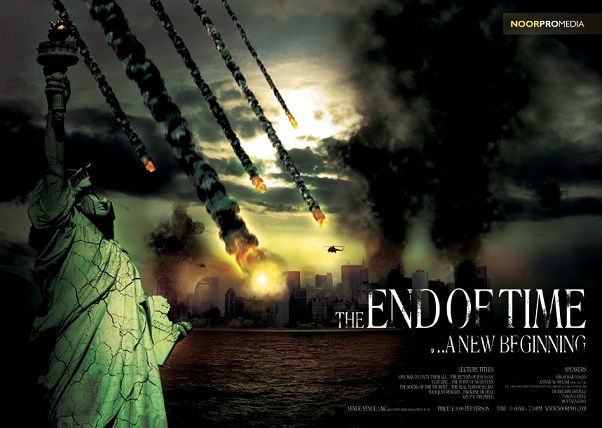
I spend a fair amount of effort as you know, trying to monitor the various forms of end-times religion manifesting in the Abrahamic faiths, so it came as a shock to me to find a seam of material on Sunni Mahdism that I hadn’t previously run across, now a year old, from over on my old side of the pond of all places…

Look what happens to London:

london.jpg

And if that isn’t graphic enough for you — and it really isn’t very graphic — look at what happens to New York

nyc.jpg

The End of Time… A New Beginning…

*

The first image comes from a poster for a tour of Ireland in October of last year — though why the good people of Ireland should be so worried if London is consumed in sulphurous fog and flame is a little hard for me to understand — while the second graphic advertises a conference in London — though why the good people of London should be so concerned if the city of New York… no, I won’t go there, there’s the Special Relationship, isn’t there?  Is there?

I missed both events, alas, living quietly here in the United States, or I might have heard, in Ireland:

a clear description about life in the grave, the trials of the last day, the major and minor signs leading to the last hour and the day of resurrection including Imam Mahdi, The Dajjal and many more.

I could have taken notes, and published them here on Zenpundit. After all, as the advertisements advertised:

On the Day of Judgment those who pass the test will be rewarded with Paradise.

Cliff’s Notes for Judgement Day — a sure best seller!

*

Not to worry, I can still study up on the January 2009 London conference, at which Anwar al-Awlaki reportedly hosted a live video question-and-answer session, presumably beaming in from Yemen — even though tickets are no longer available

If I can just get hold of the DVDs…

end-of-time-awlaki-dvds.jpg\

Sadly, though, they’re out of stock

*

Okay seriously now — three points:

This is associated with al-Awlaki.  This has slick PR, intercontinental video feeds, and DVDs.  And this is Sunni Mahdism.

Check?

Grand Strategy Board II, UK Edition

Tuesday, May 10th, 2011


Aaron Ellis at Egremont, the blog of the Tory Reform Group, has taken a liking to my previous post, Time for a Grand Strategy Board? and decided that the time might be right for Britain:

Should the UK institutionalise its Wise Men?

Ever since the end of the Cold War, this country has found it hard to think strategically. A parliamentary report last year stated, “We have simply fallen out of the habit”. It has also befallen the United States and both our foreign policies have suffered from similar problems. The ‘Big Picture’ is being obscured as policies such as humanitarian intervention and promotion of democracy take the place of grand strategy.

Governments have also found it hard to implement their chosen policies because of the lack of proper strategy – the sort that links ends, ways and means. This has been the case for military action, as we are witnessing in Libya.

The lack of any overarching ideas about our role and our interests has led to an incoherent foreign policy, as competing departments pursue contradictory policies even within the same country.

The problem is partly institutional. Jim Scopes, a former director of strategy at HM Revenue & Customs, has written that current reward and promotion mechanisms in the Civil Service “favour reactive (problem-solving) behaviour rather than proactive (strategic) approaches.” The Public Administration Committee has found that “the ability of the military and the Civil Service to identify those people who are able to operate and think at the strategic level is poor.” As I wrote last month, the makeup of government institutions is not the only factor in making strategies but it is an important one. The world is so unstable right now that it is essential for policymakers to understand the global environment if they are to form a sensible foreign policy – yet the structure of governments influences how they see the world.

If governments are filled with officials more comfortable with solving immediate problems then foreign policy will be reactive and short-termist. We need people to take the longer view…

Read the rest here.

There’s an interesting symmetry here, in the effort to improve the strategic capacity of respectively the United States and the United Kingdom, that derive from the differences in their Constitutional arrangements and national security cultures.

Britain has operated for centuries with an unwritten Constitution and Cabinet government. While these phrases are much more historically complex than meets the eye, the power relationships of Monarch, Houses of Parliament, electorate, peerage, bureaucracy and Party having evolved considerably over time, we can simplify things by stating that the cardinal virtue of the British system was flexibility, to adapt to circumstances. In a crisis, power could rapidly flow to the minister best suited to deal with the trouble at hand and the lack of institutional structures helped ensure that once the crisis had ebbed, concentrated power would just as rapidly dissipate.

The United States, by contrast, has a written Constitution and a Federal government, which while also undergoing historical evolution, is characterized by restraint. Friction is engineered into the American system to thwart or deter concentrations of power and circumscribe it’s exercise within defined parameters . Except in rare instances of overwhelming national consensus, new activities by the US government require the Congress to establish formal institutions that will then fall within the natural gridlock of checks and balances that is the American system.

Ironically, in remediating the lack of strategic vision on both sides of the Atlantic, a Grand Strategy Board would represent an institutionalization of strategy by the British, whose flexible system is in need of a long term, disciplined, focus and a strategic advisory lobby for the Americans, whose more rigid political system periodically requires blue ribbon commissions, panels, study groups and boards to break our habitual political deadlocks.

Elkus on the Troubled History of Raiding

Tuesday, May 10th, 2011


Adam reminds us that punitive raiding is not by itself a substitute for clear strategies or coherent policies in a well-written piece posted at The Atlantic Monthly :

From Romans to SEALs, a Troubled History of Raiding

The Osama bin Laden raid has been hailed as the centerpiece of a new style of “collaborative” warfare that leverages intelligence fusion and networked interagency teams to focus precision force on America’s enemies. Collaborative warfare, while impressive, is only the latest and greatest in a genre of military operation that dates back thousands of years: the punitive raid. From the days of the Roman Empire through Sunday’s raid in Abottabad, Pakistan, governments have relied on punitive raids and manhunts to eliminate challengers to state power without resorting to costly, large-scale occupations. 

But a look at the history and evolution of punitive raiding reveals that it is not a substitute for sound strategy — and can be far more costly than policymakers might suspect and may have political costs that outweigh the strategic benefits. Punitive raids — whether they consist of a large column of raiders advancing by horseback or an airmobile squad of commandos about to drop into an enemy cross-border haven — have always been deceptively appealing as low-cost alternatives…

Read the rest here.


Switch to our mobile site