zenpundit.com » futurism

Archive for the ‘futurism’ Category

Historian vs. Futurist: Antithesis and Synthesis

Friday, May 2nd, 2008

ubiwar points to an excellent post at The Long Now summarizing a debate-discussion between historian Niall Ferguson and futurist Peter Schwartz:

….Ferguson ended with a critique of Schwartz’s book on scenario planning, THE ART OF THE LONG VIEW, which he thought showed signs of “heuristic bias.” When Schwartz asked Ferguson to expand on that idea, Ferguson pointed out there was a whole chapter in the book about “The Global Teenager,” which seemed spurious. It merely reflected Schwartz’s personal experience: “You were a teenager when teenagers mattered. “

Historians also have heuristic biases, Ferguson added, such as their expectation that “great events should have great causes.” Historians have much to learn from complexity theory and evolution, he said. His own work with “counter-factual history” helps expose critical moments in history and provides a way to “think about what didn’t happen.” The counter-factual technique is an application of scenario thinking to the past.

In Schwartz’s opening remarks, he said that his plans to write a book titled THE CASE FOR OPTIMISM were derailed by reading Ferguson’s WAR OF THE WORLD. He’s been grappling with the issues Ferguson raised for 18 months. “You do alternative pasts, I do alternative futures. Where historians commune with the dead, futurists have imaginary friends.”

Historians and futurists use complementary methodologies that can enrich and inspire each other’s work.

Historians, accustomed to analytical searches for causation, are excellent at vetting the plausibility of imagineered, hypothetical scenarios and can inform through historical analogies. Futurists, in turn, are analytically attuned to alternatives and points of divergence and can help unearth what Nassim Nicholas Taleb calls “silent evidence” lurking in the often excessively linear and simplified causation explanations of historical narratives.
Cameron’s Recomended Reading: Michael Wilson

Friday, May 2nd, 2008

I’ve come to greatly appreciate the intellectual depth and range of Charles Cameron ever since having been “introduced” to him (in the online sense) by my seagoing friend, Web 2.0 visioneer Critt Jarvis. Today, Charles pointed me to a veritable archive of writings by Michael Wilson, a futurist, scholar and former member of the IC. Some of the ideas and conclusions that I have been working toward on this blog these past few years were literally being advocated by Wilson well over a decade ago.

I’ve only just begun to look at these and I’m posting them here for those readers whose interests gravitate toward issues of intel analysis and futurism:

7Pillars Partners – Papers by Michael Wilson

Continual & Complete Intelligence: A 21st Century Approach

Addendum:

Charles Cameron is cordially invited to expand on the subject of Mr. Wilson and I will happily publish such remarks here.

Seeds of a Caste Soldiery

Tuesday, April 1st, 2008

I found this news snippet to be intriguing:

In a historic but little-noticed change in policy, the Army is allowing scores of husband-and-wife soldiers to live and sleep together in the war zone – a move aimed at preserving marriages, boosting morale and perhaps bolstering re-enlistment rates at a time when the military is struggling to fill its ranks five years into the fighting.

“It makes a lot of things easier,” said Frazier, 33, a helicopter maintenance supervisor in the 3rd Infantry Division. “It really adds a lot of stress, being separated. Now you can sit face-to-face and try to work out things and comfort each other.”

Throughout history, civilized societies have basically fielded armies with three different orientations: caste, professionals and citizen-soldiers.  The United States opted with the switch to the All-Volunteer Force under the Nixon administration to abandon conscription and adopt a professional ethos. The above policy of the U.S. Army is essentially a humane, on-the-spot, accomodation to demographic changes in the force and the exigencies of war in Iraq; but it also highlights an incipent trend toward the emergence of a military caste within American society.

Much like universities, the American military, as women have been gradually integrated into the services in ever wider roles, has become a social filter bringing men and women of prime marriageable age together. It should be no surprise that some of them, sharing similar values and career interests, are indeed marrying and raising families within the context of military culture. We would need many generations for this practice to play out in order to discern the results, but it would stand to reason that such a policy, if institutionalized, would accelerate the cultural divergence between members of the U.S. military and the mainstream of American society at large to the detriment of both.

The U.S. military as a caste apart, would not be, in my view, an ideal result. Obviously, the answer is not to further burden military personnel already serving in combat zones under the most difficult of circumstances. Instead, other policies should promulgated to narrow the “culture gap” by encouraging greater volunteerism among the civilian population, perhaps by a wider range of military service options and to give career military personnel increased time working in “para-civilian” roles, increasing their “Sys Admin” skill-sets which can later be brought to bear on the spectrum of missions the U.S. military is forced to handle.

Fisking McCaffrey’s Futurism

Monday, March 24th, 2008

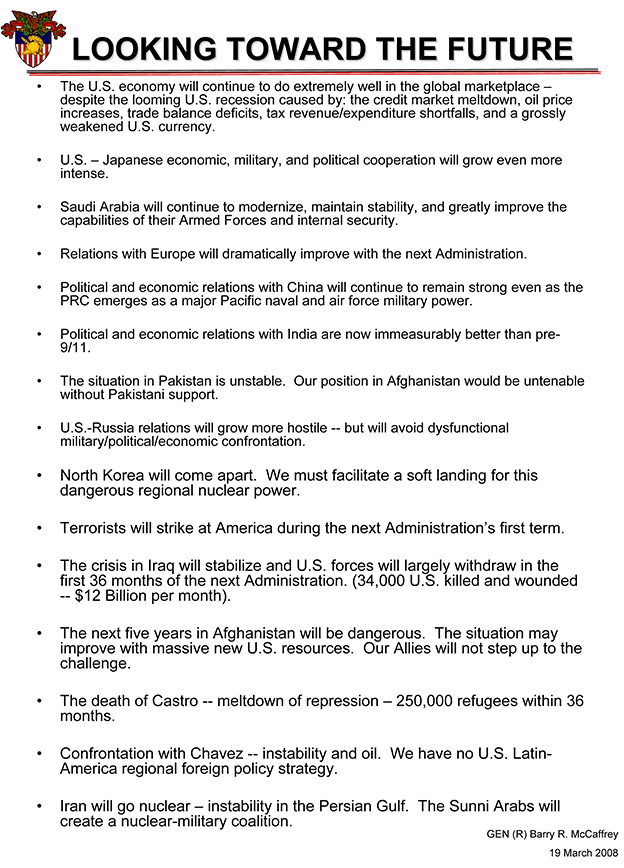
Yesterday, The SWJ Blog ( and blogfriends on Twitter, one of whom characterized it as “weak”) aleted me to a futurist slide by General Barry McCaffrey with his predictions of potential national security events faced by the United States in the near term. I’m certain this was in the context of a much larger presentation, given to a specific group with stated policy concerns; unfortunately, those particulars are unknown to me:

futurism.gif

My commentary:

First of all, one notes the number of “safe” predictions in the sense that none of these represent even the likeliest of outliers much less scenarios representing true, statistical rarity, “Gray Swans”. There’s a certain probalistic logic to doing so – the status quo more often than not in any given scenario will continue uninterrupted except by minor adjustments. On at least half of this list, given the breadth and/or vagueness, I’m certain that McCaffrey will be able in five years to say that he was more right then wrong. Unfortunately, the narrow number of domains from which he is extrapolating – nothing on cutting edge tech, applied science, the environment, macrodemographics, religious fundamentalism or interesting “intersectional” possibilities – leaves  policy makers with a vision that may be more susceptible to a Black Swan event than before by reinforcing previously held expectations.

Sidebar: I’d love to see Art Hutchinson, Tom Barnett, John Robb , Michael Tanji and the gents at Kent’s Imperative also critique the slide.

Now, in fairness, to the good General, a few of his bullet points are more interesting than others. I think McCaffrey’s called a hard landing for Cuba correctly unless Raul Castro has a secret admiration for Deng Xiaoping and the comprehension of economics to execute a Deng-like transition. It will be difficult for Cuba to really open up without the economic logic of the American market and favorable asylum policies for Cubans immediately kicking in as it did for the East Germans when the other Soviet bloc states ceased cooperating with Honecker’s repressive policies. With Chavez too, I think General McCaffrey is correct given that there is a little remarked friction between Venezuela the oil producer and America the refiner of Venezuelan oil ( refining capacity is itself a choke point along with oil production nor is all crude created equal; some is more expensive to refine than others). Finally, the temptation for al Qaida to “send a message” to the new administration and create downstream political effects may prove well-nigh overwhelming; it may even override their present policy of waiting until to pull off a catastropic level act of terror.

How do you see it ? Comments, questions, rants are all welcome.

Credit Where Credit is Due

Sunday, March 9th, 2008

After my Two Quite Reasonable Observations post, I had some uncharacteristically swift and well-informed feedback that pointed to IC amd military working groups, quietly engaged in the very kind of strategic futurism that I hoped to see the USG explore. As I cannot share confidential correspondence, I was delighted that the gents at Kent’s Imperative took up the same cudgel in public.

Vision and error

The recurring debate regarding such matters has once again surfaced in a series of blog posts at Global Guerrillas, Fabius Maximus, Zenpundit, and Opposed Systems Design.We must take exception with John Robb’s comment that there “isn’t a single research organization or think tank that is seriously studying, analyzing or synthesizing the future of warfare and terrorism”. Such statements, of course, are a common enough type of criticism which stems from what is also unfortunately a common error – the assumption that because one is not aware of a particular effort, then it must not exist. While not every shop which concerns itself with the problems of contemporary asymmetric conflict looks up from the current fight, there are a number of efforts which have attempted to answer the question of “what next” alongside the other work exploring the “what” and “so what” which tends to dominate current publications. Among just a few of the recent public aspects of such efforts that we can name off the top of our heads are the Proteus project, JFCOM’s Deep Futures project, and several of the publications authored by folks at the USMC’s Center for Emerging Threats and Opportunities, the Naval War College and Army War College, the Naval Postgraduate School, the Air University, West Point’s Combating Terrorism Center, the National Defense Intelligence College, and many other elements within the khaki tower. Of course, to this we should also add the Global Futures Forum effort where it touches upon related areas of interest.

….We would also argue that this is already occurring to some extent within the intelligence community itself, particularly given the emerging style of smaller, more specific papers circulated in an almost academic fashion as discussion points. Indeed, we see this beginning to reshape coordination efforts prior to more formalized, and more visible assessments for major publications. We certainly see a greater role for outside subject matter experts and other thinkers in the process, but while far from perfect, this is quickly evolving given recent emphasis on analytic outreach.In short, the there that these gentlemen appear to be reaching for is already there – just not evenly distributed….”

This is certainly good news, from my perspective. Hopefully, those readers out there – and there appear to be more than I had realized – who have their hands in this process on ” the inside” will continue to push the USG’s intellectual range and bureaucratic boundaries. We are all well-served by their sub rosa efforts and I offer a hearty “Huzzah!” in their honor.


Switch to our mobile site

