[by J. Scott Shipman]
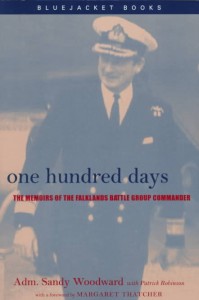
One Hundred Days, The Memoirs of the Falklands Battle Group Commander, Admiral Sandy Woodward
For professional reasons, many trusted colleagues have recommended One Hundred Days, and I finally finished it a few weeks ago. They reminded me the Falklands War “was the first modern anti-access/area-denial (A2/AD) war, pitting a joint expeditionary force against a regional power with modern land, air, and sea capabilities.” [sourced from Proceedings magazine, May 2012, by Commander Jim Griffin, U.S. Navy—strongly recommended] In other words, the scrap in the South Atlantic in 1982 was the last time a “modern” expeditionary force faced a credible adversary with modern capabilities.
Admiral Woodward reminds that no one expected Argentina to invade the Falklands, and even if they did, no one expected the UK to respond with force (even the Royal Navy (RN) was surprised, and many had to find the islands on a map). Woodward departed with the two remaining UK carriers, the Hermes and Invincible which were already on the chopping block due to budget problems (sound familiar?). Fighting was such a distant memory for the RN, having not engaged in significant action since WWII, and Woodward recounts that many of his men had difficulty making the transition from “a sea-going job” to fighting, and possibly dying. I wondered as I read if the U.S. Navy has prepared/is prepared for this transition; and truly both officer and rates proved susceptible. The personal nature of Woodward’s account was bit of a surprise, but provides valued insight into the challenges and frequent frustrations faced by naval leaders.
Commander Griffin’s account in Proceedings referenced above has a very good list of lessons learned, and a few observations and questions are added for consideration:
- Naval warfare is war of attrition. Attrition can occur as a result of sinking or disabling an opponent. In the case of the Brits, many of their ships sustained non-fatal hits that, for practical purposes, removed the ship from any offensive or defensive action. Many of our enemies, while not sophisticated, understand and plan accordingly. As a result numbers are important; numbers of ships and weapons.
- In the age of the missile, response times were/are measured in seconds, so ships and aircraft will be lost…often, quickly.
- Are our systems susceptible to electro-magnetic interference (EMI)?
- Could our ships navigate or fight without GPS or other satellite-dependent technologies?
- Can sailors onboard fix systems when they break (and they will break, see #6 below)? One RN ship had a contractor embarked who made the difference, which was blind luck. Over the last 20 years, the USN has tended towards “operators” over technicians.
- “Murphy” is alive and well. When things can fail (including technologies), they will, at the worst possible time.
- Is the theater commander in command? In the Falklands, Woodward had command of ships, but not submarines—which hampered the effectiveness of his battle group.
- Ship preservation (preventive maintenance) is often paid for in battle. At least two RN ships were unable to use weapons because of salt corrosion rendering missile hatches inoperable. This is engineering problem, too, to be sure, but also an example of how preventive maintenance can pay-off when it counts.
- Damage control training for all-hands; rigorous and often. RN sailors did a masterful job of saving several of their wounded ships.
- Anti-missile capabilities on logistic/support ships.
- Homefront politics and posturing provides fog in war as does the enemy. One curse of modern communications; having the White House Situation Room second-guessing/micromanaging the war.
- The press is often not your friend. On a couple of occasions, the BBC broadcast orders of battle and goals, and the Argentineans planned and acted accordingly.
- The motto of Captain John Coward, RN, of HMS Brilliant, “The essence of war is violence. Moderation in war is imbecility.”
Woodward’s book is the clearest account we have of naval warfare in the missile age. If it is not already, One Hundred Days should be required reading for every naval officer. Strongest recommendation.
National Security Dilemmas, Challenges & Opportunities, Colin S. Gray
Colin Gray is no stranger to the readers of Zenpundit. I read this title over the Christmas break, and have returned to review with some frequency. In fact, my copy is so littered with underlining and marginalia, these periodic “reviews” can take a couple of hours. As the title suggests, Gray outlines the challenges and opportunities facing policymakers, and in so doing provides an accurate glimpse of our current state of political-military affairs. He encourages policymakers to reacquaint themselves with the importance of the concept of victory, and on how to successfully navigate a transition of our military from our previous focus of regular warfare to the realities introduced by enemies using irregular methods. Gray discusses “revolutions in military affairs (RMA)” and deterrence and the implications of both in our thinking and planning. Gray’s concluding section on preemption and preventative war is exceptionally well-presented.
For example, Gray’s section on Achieving Decisive Victory includes:
- Better armies tend to win.
- No magic formula for victory.
- Technology is not a panacea.
- The complexity of strategy and war is the mother of invention.
- Know your enemies.
This book is imminently quotable, so I’ll share a few with my highest recommendation.
The idea that strategy has an essence is deeply attractive. Strategy sounds incredibly rare and valuable, like something that could be bottled and sold. Unfortunately, American understanding of and sound practice in strategy is desperately rare. Strategic thinking and behavior are endangered activities in the United States. This is hardly a stunningly original insight. However, familiar though the criticism should be, it loses none of its bite for reason of longevity. Much as the U.S. defense community periodically is prodded by irregularist anxiety to worry about insurgency and terrorism, so from time to time it remembers the value of strategy. Though American defense professionals do not know what strategy is or how it works, they know that it is a matter of grave importance. The pattern has been one wherein a politician or a senior official with a personal interest has lit the fire of genuinely strategic discussion. The fire briefly flare brightly but then dies away for want of fuel. The fire is not fed, because there is not much demand for the heat and light of truly strategic argument in the United States. Although America is not quite a strategy-free environment, such a characterization would err in the right direction. (page 169 of paperback edition)
Since, inter alia, warfare is a competition in learning between imperfect military machines, fortunately one need only be good enough. (page 178; this is a personal favorite of mine)
There needs to be a continuous, albeit “unequal,” dialogue between civilian and soldier. War and warfare are permeated with political meaning, and consequences. A competent supreme command knows this and behaves accordingly. However, this relationship carries implications for civilian participation in military decisions in wartime that run contrary to the traditional American way in civil-military relations. If the strict instrumentality of force is not to be neglected, there has to be a constant dialogue between policymaker and soldier. Policy is a nonsense if the troops cannot perform “in the field,” while the troops may be so effective in action that policy is left gasping far behind unexpected opportunities by events. (page 179, emphasis added)
Gray’s National Security Dilemmas is a must read for policymakers and practitioners. [btw: it has been my custom to provide selected referenced works in book reviews. Gray’s bibliography is so excellent and comprehensive, I could not make a list that would do it justice.]
That said, I’ll close with more questions, and an apology: Does anyone read anymore? I’m rereading Manchester’s classic American Caesar after an absence of 30+ years, and I’d forgotten how much time both MacArthur the Elder and MacArthur the Younger (Douglas) spent reading. That said, how often do we see military leaders review the books they recommend? A reading list is one thing, explaining why the book made the cut another. With blogs, the internet, and social media, there are no barriers to entry. Recommendation to senior officers, including the General Officers and Flag Officers who post required reading lists: let your folks know why, write it down, explain it—the exercise will do you good, and give your subordinates insights into your thinking.
Now for the apology: there are four of us here at Zenpundit, but I’ve been the anchor man. This is my first post in too long, and I apologize to my colleagues and you, the reader. I’ve been on a tear reading naval stuff, mostly associated with my business endeavors. That said, I’ll endeavor to eat my own cooking and review what I read/have read with greater frequency.