zenpundit.com » physics

Archive for the ‘physics’ Category

Sunday surprise 9: surreal art imitates real life?

Sunday, October 20th, 2013

[ by Charles Cameron — my semi-official idiocy to cap the week ]
.

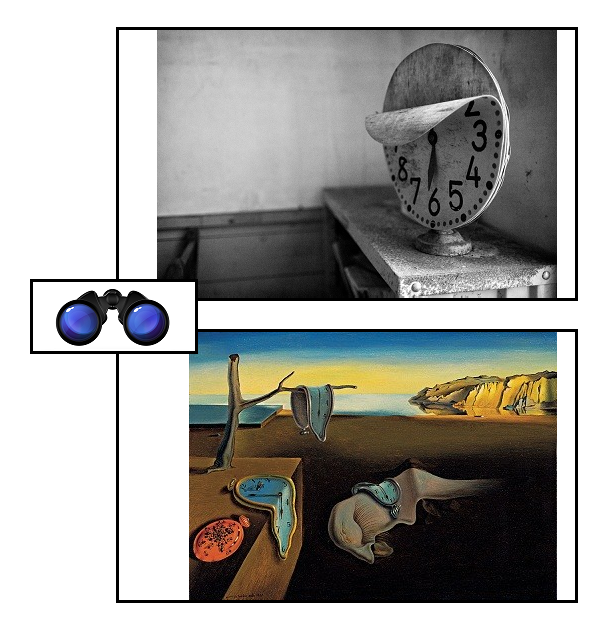
Here, surreal art imitates real life — ahead of time, and or much later.

**

Sources:

  • Tokyo Times, An abandoned and atmospheric Japanese school in the mountains
  • Salvador Dali, The Persistence of Memory

  • A tip of the hat to Bryan Alexander of Infcult
  • **

    Footnote:

    Time itself is a curious business, and the question of its “reality” comes up from time to time. Physicist Sean Carroll talked about it a while back on the pompously named Closer to Truth series, and makes some interesting points. I have to say, though, that I wasn’t overwhelmed — Carroll may be the equivalent of Hawking when it comes to physics, but the equivalent of Wittgenstein when it comes to philosophy he has yet to prove himself.

    But then of course we have never seen Wittgenstein talking off the cuff on YouTube: my sense is that this was a wise decision on his part — although many of the slips of paper on which he typed the aphorisms that go to make up his Zettel might well have been Tweeted, give or take a century.

    Twitter’s immense fan-base does include thousands — and likely hundreds of thousands — of folks who would follow a Witty Wittgenstein twitter-feed among it’s half-billion (2012 estimate) users if wittgenstein were alive and tweeting… Indeed, the entirely posthumous Wittgenstein Tweets feed has more than 4,000 followers, and you might care to join them — although the quotes in the tweets are more than 60 years old at time of tweeting. My own preference for a philosophical feed, btw, runs to Kim Kierkegaardashian.

    But it’s Sunday, we were talking surrealism, and I digress.

    Single Quote: Robert B. Laughlin

    Monday, August 26th, 2013

    [Extracted by Lynn C. Rees]

    From A Different Universe: Reinventing Physics from the Bottom Down (2006) by Robert B. Laughlin:

    The transition to the Age of Emergence brings to an end the myth of the absolute power of mathematics. This myth is still entrenched in our culture, unfortunately, a fact revealed routinely in the press and popular publications promoting the search for ultimate laws as the only scientific activity worth pursuing, notwithstanding massive and overwhelming experimental evidence that exactly the opposite is the case. We can refute the reductionist myth by demonstrating that rules are correct and then challenging very smart people to predict things with them. Their inability to do so is similar to the difficulty the Wizard of Oz has in returning Dorothy to Kansas. He can do it in principle, but there are a few pesky technical details to be worked out. One must be satisfied in the interim with empty testimonials and exhortations to pay no attention to the man behind the curtain. The real problem is that Oz is a different universe from Kansas and that getting from one to the other makes no sense. The myth of collective behavior following from the law is, as a practical matter, exactly backward. Law instead follows from collective behavior, as do things that flow from it. such as logic and mathematics. The reason our minds can anticipate and master what the physical world does is not because we are geniuses but because nature facilitates understanding by organizing itself and generating law.

    An important difference between the present age [i.e. the Age of Emergence] and the age just past [i.e the Age of Reductionism] is the awareness that there are evil laws as well as good ones. Good laws, such as rigidity or quantum hydrodynamics, create mathematical predictive power through protection, the insensitivity of certain measured quantities to sample imperfections or computational errors. Were the world a happy place containing only good laws, it would indeed be true that mathematics was always predictive, and that mastering nature would always boil down to acquiring sufficiently large and powerful computers. Protection would heal all errors. But in the world we actually inhabit, dark laws abound, and they destroy predictive power by exacerbating errors and making measured quantities wildly sensitive to uncontrollable external factors. In the Age of Emergence it is essential to be on the lookout for dark laws and artfully steer clear of them, since failure to do so leads one into delusional traps. One such trap is inadvertently crossing a Barrier of Relevance, thereby generating multiple ostensibly logical paths that begin with nearly identical premises and reach wildly different conclusions. When this effect occurs it politicizes the discussion by generating alternative “explanations” for things that cannot be distinguished by experiment. Another trap is the hunt for the Deceitful Turkey, the mirage law that always manages to be just out of focus and just beyond reach, no matter how much the measurement technology is improved. Ambiguities generated by dark law also facilitate fraud, in that they allow a thing to be labeled quantitative and scientific when it is, in fact, so sensitive to the whim of the measurer that it is effectively an opinion.

    The Greek pantheon came into being through a series of political compromises in which one tribe or group, prevailing over another in warfare, would exercise its authority not by wiping out the gods of the losers, which was too difficult, but by making those gods subordinate to their own. The ancient Greek myths are thus allegories of actual historical events that took place in the early days of consolidation of Greek civilization. While the “experiment” in that case was war, and the “truth” it revealed was some political reality, the psychological elements for inventing mythological laws were the same as those we use today to identify physical ones. You may feel that both are pathological human behaviors, but I prefer the more physical view that politics, and human society generally, grow out of nature and are really sophisticated high-level versions of primitive physical phenomena. In other words, politics is an allegory of physics, not the reverse. Either way, however, the similarity reminds us that once science becomes political it is indistinguishable from state religion. Under a system of truth by consensus one expects false gods to be systematically enshrined in the pantheon as a matter of expedience, and the cosmogony on occasion to become Fictional, just as occurred in ancient Greece, and for the same reasons.

    Greek creation myths satirize many things in modern life, particularly cosmological theories. Exploding things, such as dynamite or the big bang, are unstable. Theories of explosions, including the first picoseconds of the big bang, thus cross Barriers of Relevance and are inherently unfalsiable, notwithstanding widely cited supporting “evidence” such as isotopic abundances at the surfaces of stars and the cosmic microwave background anisotropy. One might as well claim to infer the properties of atoms from the storm damage of a hurricane. Beyond the big bang we have really unfalsifable concepts of budding little baby universes with different properties that must have been created before the infationary epoch, but which are now fundamentally undetectable due to being beyond the light horizon. Beyond even that we have the anthropic principle—the “explanation” that the universe we can see has the properties it does by virtue of our being in it. It is fun to imagine what Voltaire might have done with this material. In the movie Contact the Jodie Foster heroine suggests to her boyfriend that God might have been created by humans to compensate for their feelings of isolation and vulnerability in the vastness of the universe. She would have been more on target had she talked about unfalsifiable theories of the origin of the universe. The political dynamic of such theories and those of the ancient Greeks is one and the same.

    The political nature of cosmological theories explains how they could so easily amalgamate with string theory, a body of mathematics with which they actually have very little in common. String theory is the study of an imaginary kind of matter built out of extended objects, strings, rather than point particles, as all known kinds of matter—including hot nuclear matter—have been shown experimentally to be. String theory is immensely fun to think about because so many of its internal relationships are unexpectedly simple and beautiful. It has no practical utility, however, other than to sustain the myth of the ultimate theory. There is no experimental evidence for the existence of strings in nature, nor does the special mathematics of string theory enable known experimental behavior to be calculated or predicted more easily. Moreover, the complex spectroscopic properties of space accessible with today’s mighty accelerators are accountable in string theory only as “low-energy phenomenology”- a pejorative term for transcendent emergent properties of matter impossible to calculate from first principles. String theory is, in fact, a textbook case of a Deceitful Turkey, a beautiful set of ideas that will always remain just barely out of reach. Far from a wonderful technological hope for a greater tomorrow. it is instead the tragic consequence of an obsolete belief system—in which emergence plays no role and dark law does not exist.

    […]

    The painful echoes of ancient Greece in modern science illustrate why we cannot live with uncertainty in the Age of Emergence. at least for very long. One often hears that we must do so, since the master laws do not matter and the little subsidiary ones are too expensive to ferret out, but this argument is exactly backward. In times of increased subtlety one needs more highly quantitative measurements, not fewer. A measurement that cannot be done accurately, or that cannot be reproduced even if it is accurate, can never be divorced from politics and must therefore generate mythologies. The more such shades of meaning there are, the less scientific the discussion becomes. Accurate measurement in this sense is scientific law and a milieu in which accurate measurement is impossible is lawless.

    The great scientific art-grab

    Wednesday, February 20th, 2013

    [ by Charles Cameron — a poet’s rant against the hubris of scientists and the poverty of so much of what passes for art ]
    .

    Gorgeous. And fascinating.

    **

    I’d like to begin by saying beauty is not the same as prettiness any more than joy is the same as fun or truth than popular opinion. In fact I have an aphorism:

    if you shoot for beauty, you’re liable to hit prettiness; if you want to achieve beauty, shoot for truth.

    Okay? The beautiful can be grotesque, utterly normal, joyously peaceful, extremely violent, or simply gorgeous — and be beautiful in each case.

    Having said that, I’d also like to say that the world, the universe in all it immense scope and scale and variety and possibility, isn’t “science” or “art” — we find science in exploring it one way, find art in exploring it another.

    And when scientists want to impress, they often do it by choosing elements of beauty in what science has recorded of a universe that is neither science nor art but seamlessly filled to the brim with both — by appealing to our aesthetic taste, to the “art” side of our being, while claiming the result is science.

    **

    Case in point:

    The graphic above, from the I fucking love science photo timeline on FaceBook, which comes with the caption:

    Caddisfly larvae build protective cases using materials found in their environment. Artist Hubert Duprat supplied them with gold leaf and precious stones. This is what they created.

    Did you get that? It’s from a site that bills itself I fucking love science that specializes in presenting, how can I make this simple, nature’s art. It’s the recognition of beauty that makes this site so wonderful — and in this particular case, the work of Artist Hubert Duprat.

    **

    I’ve been working with jewelry recently, and as you can see from this image of a Hematite “Tricubi” necklace by Bernd Wolf, the influence goes both ways.

    **

    What is beauty? And why does science as an institution so often want to claim what properly belongs in the realm of art? Or is science, perhaps, an art or cluster of arts? I’m tired of these ceaseless wranglings between two supposedly opposing cultures.

    Paul Dirac:

    I think that there is a moral to this story, namely that it is more important to have beauty in one’s equations that to have them fit experiment.

    As art, the jewel-like protective cases those caddisfly larvae make are simply beautiful. The fact that they make them is fascinating.

    Strategy, Power and Diffusion

    Monday, November 19th, 2012

    “….and therefore, two kinds of reactions are possible on the defending side, depending whether the attacker is to perish by the sword or by his own exertions.

                                                                   – Carl von Clausewitz,  On War

     “Again, if the campaign is protracted, the resources of the State will not be equal to the strain.”

                                                                     – Sun Tzu,  The Art of War 

    A recent estimate for the cost of the war in Afghanistan by the Congressional Research Office is $443 billion dollars to occupy and fight a Pakistani-supported insurgency in a primitive country whose annual GDP is a mere $ 27 billion. A  figure that itself inflated by $ 3-4 billion is remittances, $ 4 billion in NGO aid and $14 billion in direct US aid (2010 figure); when you then subtract opium smuggling ($ 4 billion), Afghanistan’s legitimate economic activity may only be a miniscule GDP of  $ 2 – 3 billion.

    This does not, of course, include the cost of ten years of lavish bribes for Pakistan, a portion of which was used by the ISI to support the Taliban  killing American and ISAF  soldiers  and Afghan civilians.

    This is not a cost-effective or strategic way to run a war. In fact, even for a nation as wealthy as the United States there is nothing in Afghanistan worth such an expenditure of blood and treasure, especially when the bulk of our enemies appear to be based in Pakistan, not Afghanistan. You can approach a strategic problem directly or indirectly but to do so indirectly in the most expensive way logistically possible makes little sense. For example:

    ….Since the ‘war to end all wars’, however, war has not exactly stood still.  Although the US Defense Logistics Agency rather quaintly describes its mission in terms of a supply chain extending ‘from factory to foxhole’, it is, above all, the mobility of military violence that is central to the conduct of late modern war.  But Creveld is adamant that since 1945 the operational freedom of modern ground forces has not markedly increased, not least because their prized mobility is absolutely dependent on supplies of petrol and gasoline.  Since the end of the Second World War the use of petroleum-based fuels by the US military has soared, and as its stripped-down forces have been expected to do more with less (through technological change and outsourcing) so the fuel expended per soldier has increased by 175 per cent to an average of 22 gallons (83 litres) per day. [viii]  As Obama had US forces ‘surge’ into Afghanistan in 2009 so ISAF’s daily fuel consumption rocketed from two million to over four million litres a day. Given these volumes, it is scarcely surprising that the death-dealing capacities of the US military and its allies should have been tied in knots by ‘umbilical cords’ far more convoluted than Creveld could ever have imagined.

    There are three main supply networks to be disentangled in turn.  All of them are ground lines of communication.  Air transportation is extremely, usually prohibitively expensive, and only four airports in Afghanistan are accessible to non-military aircraft, so that until 2011 only 20 per cent of cargo was flown in.  Similarly, onward delivery to combat outposts and forward operating bases has usually only involved airdrops if other options are too dangerous. Still, by the start of 2010 around 30-40 per cent of bases were being supplied by air because the Taliban controlled much of Highway 1, the ring road that loops between Afghanistan’s major cities, and its IED attacks on NATO and Afghan forces were increasingly effective.  The high cost of airdropping pallets of fuel, ammunition, water and supplies has imposed all sorts of fuel economies on the military as it attempts to reduce its carbon footprint – ‘troops have learned to sip, not guzzle’ – but it is still the case that, as one US pilot put it, ‘we’re going to burn a lot of gas to drop a lot of gas’.  According to some estimates it can cost up to $400 a gallon to deliver fuel by air. [ix] 

    Neither war nor strategy are a hard science like physics. That said, there are fields of study and investigation that while not being a science are, like physics, inherently about systems or systemic relationships. Economics  and engineering are two such examples, strategy is another.  Because of this similarity, it is often profitable to employ metaphors or analogies from physics to illustrate strategic problems, as Clausewitz famously did in On War with “friction” and “center of gravity“.

    Diffusion” might be another analogy for statesmen and soldiers to keep in mind.

    Military force, or more broadly, national power marshaled and employed toward a vital objective represents a potent concentration of energy like a red hot iron bar. Thrust deeply into a trough of ice water, the surface of the water yields to the mass and heat of the iron bar in a furious burst of steam and boiling turbulence. Keep the bar submerged and every erg of heat will be sapped out of it by the water and the iron will emerge cold, tempered by the experience and inert. Keep the bar submerged long enough and the water will begin to rust the iron away until nothing is left.

    Vast spaces, hostile populaces and deeply impoverished environments are like ice water to the molten heat of an invading power, as we have discovered in Afghanistan.

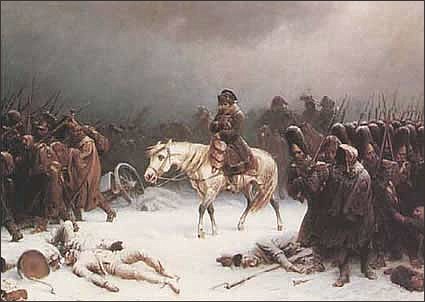
    There are already old military maxims that express a warning about the risks of diffusion, notably “Don’t get into a land war in Asia” or “Don’t invade Russia in winter”.  Napoleon Bonaparte marched his vast and fabled Grand Armee of 600,000 men into the endless steppes of Tsar Alexander’s Russia. Everything gave way before Napoleon’s legions, but the Russians were not the Austrians or Prussians, they retreated, savagely burning and destroying as they went:

    ….Alexander’s proclamation to his people, issued at the time of the French invasion, appealed to these deep seated feelings: Napoleon had come to destroy Russia; the entire nation must rise against ‘this Moloch’ and his ‘legions of slaves’. ‘Let us drive this plague of locusts out! Let us carry the Cross in our hearts and steel in our hands!’ The proclamation was read in all the churches, and the priests supplemented it with embellishments of their own. The Comte de Segur, at this time an aide-de-camp to Napoleon, wrote: ‘They convinced these peasants we were a legion of devils commanded by the Antichrist, infernal spirits, horrible to look upon, and whose very touch defiled”

    In Moscow, the city in flames, even Napoleon the Conqueror, the master of Europe, did not have enough men, or material or speed of movement to either digest and rule the immense spaces of Russia or compel Alexander to come to terms:

    ….Throughout the fall of 1812, Napoleon waited in vain for Alexander’s peace proposals to arrive in the Kremlin. When none came, he made overtures of his own, but Alexander sent no reply. As the days stretched into weeks, Napoleon came to see that he, not Alexander, faced a truly desperate situation, for Russia’s armies grew stronger by the day while his own dwindled from desertions and the ravages of disease. He faced the hopeless prospect of wintering in Russia without adequate food, shelter, or supplies, surrounded by a people so hostile that they burned their grain rather than sell it for French gold. As winter approached, and as the Russian partisans stepped up their attacks on his rear, Napoleon saw that his line of communications, which relied upon a perilously vulnerable corps of couriers who raced from Paris to Moscow in fourteen days, must soon collapse.

    Of the Grand Armee, only five thousand returned home from the snowy wastes of Russia alive.

    The Wehrmacht did little better. Hitler’s imagined drive to the Urals without a surrender and territorial concession by Stalin was a fantastical ambition. The far-flung distance, roadless mud and icy snow alone were too much for panzer armies and Luftwaffe air wings that proceeded to break down with statistical certainty. Supply lines were too long; gasoline and replacement parts were too few, as were replacements for the men for whom the Eastern Front was a grave. To the dogged resistance of the Red Army, the Germans needlessly added the people’s rage of the Russian partisans by demonstrating to the peasantry that the NKVD held no monopoly on atrocity.  Imperial Japan’s coterminous war in China tells exactly the same unhappy tale.

    William Lind and the 4GW school used to like to make the point, regarding your moral and political legitimacy, that ” If you fight the weak, you become weak”. The corollary to that is economic: “If you fight the poor, you become poor”.

    Grinding poverty itself  is a tax upon the invading force. There are no resources for your army to comandeer or buy, no skilled manpower to requisition or hire, no infrastructure for them to use. All of that must be imported and built at great expense by the invader whose troops are accustomed to far less spartan environs. The local population is usually malnourished, illiterate, ignorant, suspicious of outsiders and  rife with disease; their living habits and water sources unsanitary and endanger the troops. Caring for the locals, even minimal administration of humanitarian aid, becomes a bureaucratic and logistical burden consuming time and diverting resources away from urgent military needs.

    The United States under George Bush the Elder, entered into Somalia, a land beset by violent anarchy and it’s people in the grip of a terrible famine and was driven out shortly thereafter under Bill Clinton. The last scenes there being the emaciated Somali followers of  a two-bit warlord,Mohammed Farah Aidid, gleefully swarming over and looting our military’s former…. garbage dump.

    When the enemy has a land so poor that he treasures and makes use of the crap you throw away, the economic spillover of your logistical supply lines will fund his war against you. Used to surviving on bare subsistence, the invader’s presence becomes an economic bonanza for resistance and collaborator alike. Sort of a highly kinetic form of military Keynesianism. The war itself and the occupation become an irreplaceable cornerstone of their economy. They hate you being there, but can’t afford to defeat you and drive you out either – making a “quagmire” irregular conflict their ideal economic equilibrium to maintain.

    What lessons can we draw here?

    • Keep your national power concentrated – don’t diffuse it with unmanageable, ill-defined, tasks of unlimited scope
    • Military power is to be used for a clear and articulated policy end with a defined political settlement in mind
    • If a political settlement is impossible because the problem is intractable, avoid involvement.
    • If you cannot avoid getting involved (i.e. -you were attacked) your best option is to engage in a punitive expedition to destroy the war-making capacity of the enemy and impose  ruinous costs and then immediately leave.
    • Keep campaigns short. In operation, military power is a terrible, swift sword and you should sheathe it just as quickly. 
    • Ruling over enemy population is a wasteful, thankless, burden not to be undertaken except in extremis (Reconstruction and occupation of Germany and Japan were in extremis cases).
    • Maximum gains accrue from the most effective use of the smallest possible force in the shortest period of time.
    • Make an army large enough and the enemy will become a secondary or tertiary concern of its leaders.


    Cross-grain thinking, 1: Mozart and how music reaches us

    Thursday, November 1st, 2012

    [ by Charles Cameron — tracking a single pattern back and forth across the Cartesian divide between “inner” (subjective) and “outer” (objective) realities, and why ]
    .

    .

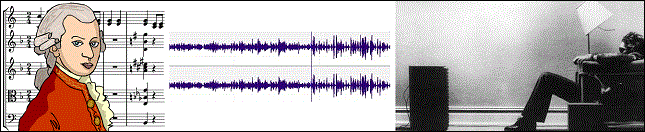
    From God’s lips, figuratively speaking — via Mozart‘s mind and hand onto paper and out to musicians’ eyes and into their minds, then back out through their lips and hands and instruments and air — to your ears, and beyond? One pattern across a variety media.

    We study Mozart’s biography. We study the “chunking” techniques a pianist typically uses to become proficient. My friend Wm. Benzon writes about how the brain’s oscillatory circuits can be internally synchronized through sonic activity and much more. We study how musical tastes correlate with education, or wealth, or class. What we don’t study nearly so intently, it seems to me, is the entire sequence by which a musical pattern makes its way from a composer’s initial thought to a listener’s delighted experience.

    And what makes me want to talk about that is my sense that it requires thinking across the grain — across disciplines, across silos, across assumptions and languages and expectations.

    It helps that I love Mozart. And I’m interested in the way patterns work. And perhaps most significantly, I believe that analytic mapping that doesn’t concern itself with both “inward” subjective experience, thought and emotions as well as “outer” realities, people, processes, and so forth will have us firing on only 50% of our cylinders at best. As I said in an earlier post on Anders Breivik:

    A lot of our maps and models move between one quantity and another, and a lot of our thinking, correspondingly, has to do with materiel rather than morale — but nowhere is there a map or model of how quantity and quality affect each other, or how morale “force multiplies” materiel — even though “real life” moves seamlessly between (subjective, qualitative) mind and (objective, quantifiable) brain.

    We have no map to walk us through the hard problem in consciousness — except our own insight.

    And x-rays do not an insight make.

    Let’s simply call this an early attempt to think about a stretch of the border between subjective and objective worlds, taking Mozart — a reasonably innocuous subject compared with Breivik — to start with.

    **

    There’s a phrase of music in Mozart’s head: it is a pattern – we shall see it later as a pattern in ink on paper, a pattern in keys depressed on a keyboard, on strings struck and vibrating, as a pattern in acoustic waves in air and a pattern of impacts on the ear drum, then of electrochemical activity in the brain, of “Mozart” in the mind – and perhaps in a tapping of the feet on the floor, and from thence, onwards…

    Perhaps Mozart got it, this pattern, consciously or unconsciously, from the starling he wrote a poem to, and gave a burial to when it died [1, 2] … No doubt something of that pattern would have been in the starling’s brain as its throat muscles moved, and in the air that moved and he sang…

    **

    Something goes on with this pattern “inside” Mozart, and he composes, which is itself a hugely complex business involving various parts of his brain — and mind? Just brain, or brain and mind, or mind-brain? That’s the “hard question in consciousness” right there, and it applies as much to the starling, and the eventual listener, as it does to Mozart…

    That “something” going on inside him has been variously described, in any case, and the historian William Stafford has written an enlightening piece comparing the myth of Mozart’s genius (Mozart himself used the term a couple of times in the classic sense of an intuitive guide, much as Socrates too would use the term) with the practicalities of musical skill and concentration.

    **

    Thus there is undoubtedly a romantic “Mozart the genius” slant to the account given by Mozart’s earliest biographer who, working with Mozart’s widow, described his process of composition in these terms:

    Mozart wrote everything with a facility and rapidity, which perhaps at first sight could appear as carelessness or haste; and while writing he never came to the klavier. His imagination presented the whole work, when it came to him, clearly and vividly.

    This idea is even more vividly expressed in the letter, purported to be Mozart’s own words but now widely considered a later effort by the publicist Friedrich Rochlitz and “attributed” to Mozart himself in the spirit of the times:

    When I am, as it were, completely myself, entirely alone, and of good cheer — say, travelling in a carriage, or walking after a good meal, or during the night when I cannot sleep; it is on such occasions that my ideas flow best and most abundantly. Whence and how they come, I know not; nor can I force them. Those ideas that please me I retain in memory, and am accustomed, as I have been told, to hum them to myself. If I continue in this way, it soon occurs to me how I may turn this or that morsel to account, so as to make a good dish of it, that is to say, agreeably to the rules of counterpoint, to the peculiarities of the various instruments, etc.

    All this fires my soul, and, provided I am not disturbed, my subject enlarges itself, becomes methodised and defined, and the whole, though it be long, stands almost complete and finished in my mind, so that I can survey it, like a fine picture or a beautiful statue, at a glance. Nor do I hear in my imagination the parts successively, but I hear them, as it were, all at once (gleich alles zusammen). What a delight this is I cannot tell! All this inventing, this producing, takes place in a pleasing lively dream. Still the actual hearing of the tout ensemble is after all the best. What has been thus produced I do not easily forget, and this is perhaps the best gift I have my Divine Maker to thank for.

    When I proceed to write down my ideas, I take out of the bag of my memory, if I may use that phrase, what has been previously collected into it in the way I have mentioned. For this reason the committing to paper is done quickly enough, for everything is, as I said before, already finished; and it rarely differs on paper from what it was in my imagination…

    **

    In start contrast to this romantic picture, Stafford himself writes in his paper Mozart and Genius, and more briefly in his essay in the Cambridge Mozart Encyclopedia:

    We must suspect a large element of myth-making in all of this, a construction of Mozart and his life in accordance with preconceived ideas.

    and:

    The real Mozart expressed pride in his craft, in the compositional skills he had learned from other musicians and taken to a high level. Much recent scholarship has emphasized the relationship of his creativity to his social milieu. In place of an unreflective genius who composed in a dream, it has given us, as in Konrad Kuster’s recent biography, a musician of the highest technical competence for whom composition presented a series of intellectual and aesthetic challenges that could only be surmounted with considerable effort.

    **

    I suspect that Stafford, too, is giving us his “construction of Mozart and his life in accordance with preconceived ideas”.

    To my mind, it’s just that our own contemporary preconceptions have shifted the emphasis from the “inspiration” to the “perspiration” factor in understanding great works and the exceptional minds and mind-sets that produce them. In my view, both accounts have something to offer us – that what we retrospectively term “genius” happens when a prepared mind (meaning Stafford’s “compositional skills” and so forth) lets go of its controlling urgency, and a deeper, richer mind emerges — an emergence which takes places classically in reverie (Gaston Bachelard) or after some similar disengagement of the active will, from whence we get the phrase “let me sleep on it” in response to the posing of a tricky problem or dilemma

    **

    But the pattern.

    No doubt there are a thousand ways in which Mozart differs from Beethoven, Beethoven from El Greco, El Greco from Einstein, Wittengenstein from Heraclitus, and Heraclitus from the Heraclitus who stepped into “the same river” a while ago…

    What seems to be more stable is the pattern that Mozart wove, as it traveled from the throat of his starling through the intricacies of his own knowledge and practices, his friendships and tastes, his needs and longings and out onto paper, to a pianist or orchestra, and through instruments and voices into concert halls and magnetic wave forms and curious spirals engraved on discs, into sub-woofers and tweeters and full-range drivers..

    And into our minds and hearts, our memories – our quiet hummings to ourselves on long autumn drives between motels.

    **

    I think we should track that pattern, know as much as we can of that pattern, write the biography of the way in which some piece of music weaves between inspiration and thought, composer and instrument, mind and matter, performer and audience, studio and home digital music center…

    Then, perhaps, we could begin to map other patterns – in some ways simpler and more urgent ones.

    Coming up shortly: Cross-grain thinking, 2: AQ’s #3 spot and mapping the jihadist mind. One thing you can be sure of: it will be different.

    Switch to our mobile site