[ by Charles Cameron — ’tis but a short skip from iconography to iconoclasm ]
.
Apparently it happens:
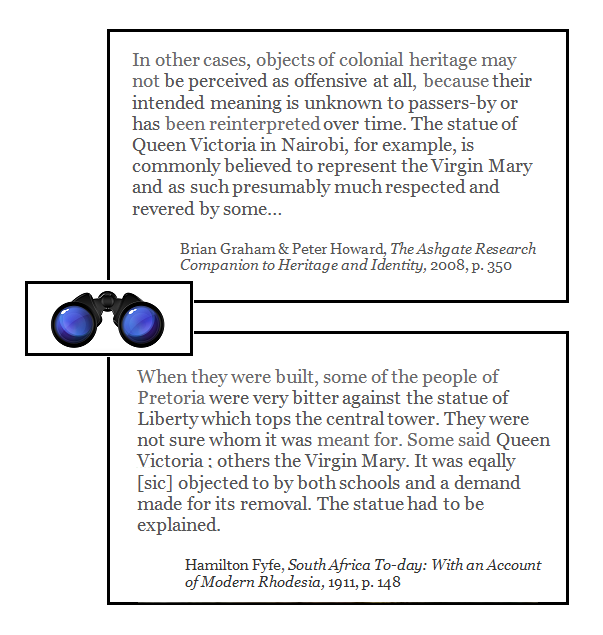
In the case of Nairobi (upper panel), it is Queen Victoria who is mistaken for the Virgin Mary. In the case of Pretoria (lower panel), Justice is mistaken, variously, for both Her Majesty and Our Lady.
**
Is it any wonder people get agitated about graven images?
[ by Charles Cameron — 4th & last in a bizarre series [1, 2, 3] — I must confess I prefer the NASA stars to the game world, but Wm. Blake’s world to all the rest ]
.
My curiosity today leads me to compare two “represented” universes, each of them pretty much guaranteed — not that I place great credence in guarantees these days — to blow my mind or at least my socks off, and / or to quake my universe!
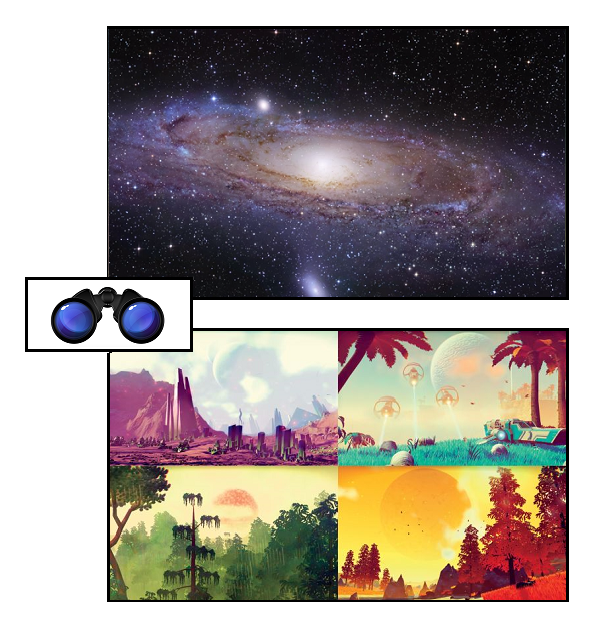
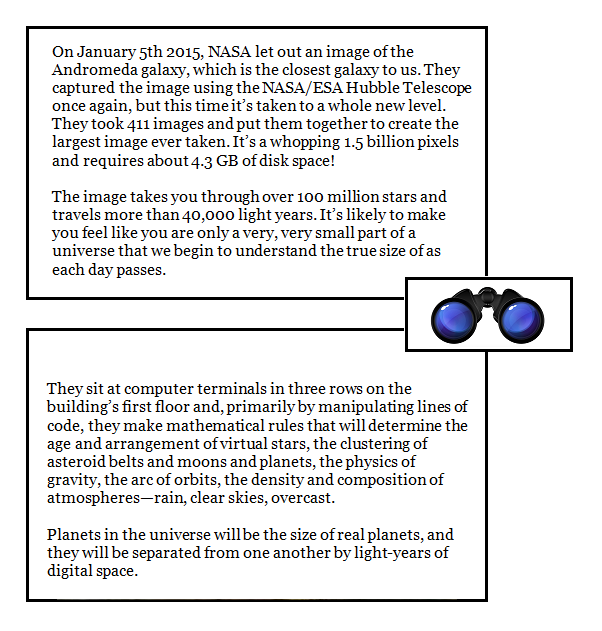
Here, to assist you in making your own comparison, are two text descriptions of the space photo (upper panel) and the game designs (lower):
My own feeling is that both are less awesome than their respective write-ups suggest: the NASA photo because it’s “awesomeness claim” is purely quantitative, whereas the universe is qualitative first and quantitative second; and the game images because they’re pale pastel imitations of our own world — fantastic, yes, but far from imaginative, to use the terminology Coleridge proposed.
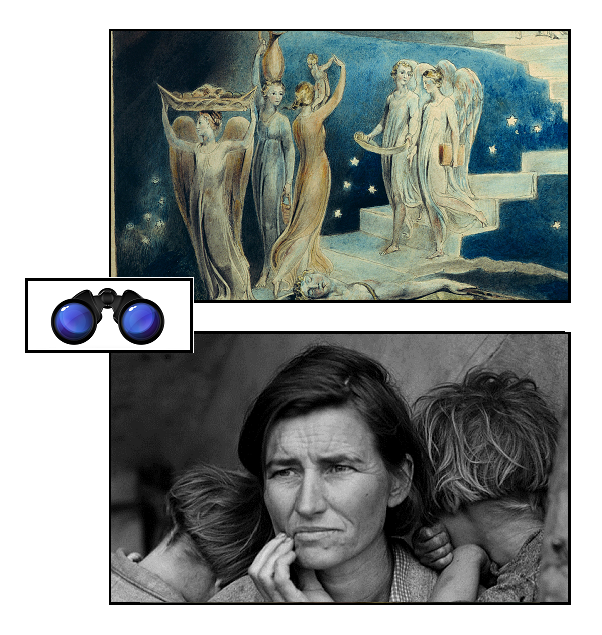
To give us a sense of proportion — one that includes both qualitative and quantitative elements — here are some other images which, along with the ones from NASA and the game, give you a somewhat wider “range of universes” to consider — all of them in fact contained in the one we blog and read in:
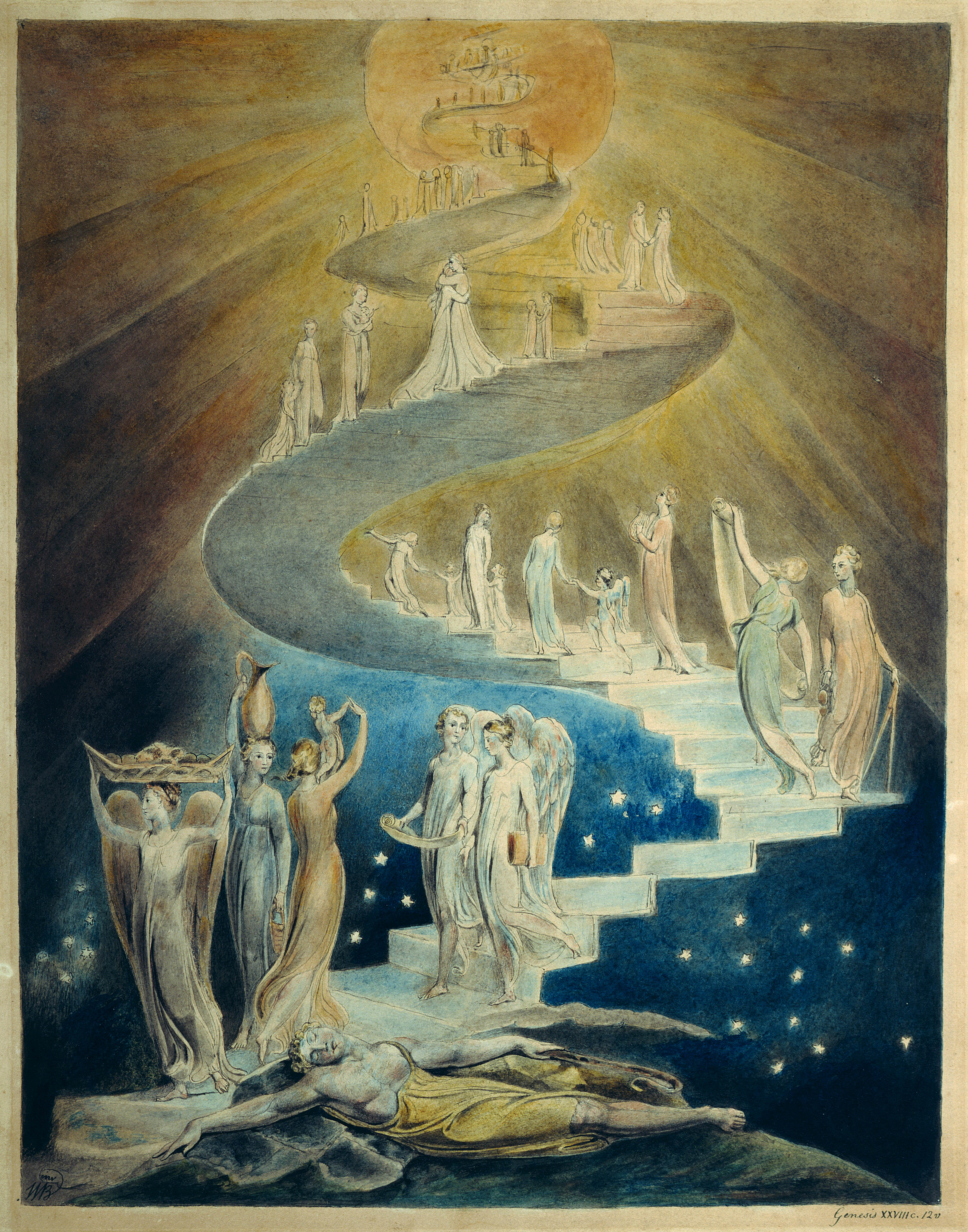
The first pair shows two humanly-generated images, one by the visionary artist and poet William Blake, the other by the documentary photographer Dorothea Lange. Realism, meet mythic imagination.
The second pair — aha! — shows two desert sports: one almost archaic in its brutality, the other something akin to post-modern. In the upper panel we glimpse the Afghan national sport of Bukashi, in which the headless carcass of a goat is captured and carried to the goal by terrifying horsemen; in the lower, one of the robot jockeys who have replaced child-jockeys in the camel-racing of Dubai.
But let’s be fair to the two first screenshots at the top of the page. Here are the respective videos of the NASA Andromeda megapicture and the Hello Games’ No Man’s Sky for you to consider on their merits —
— remember: there’s no accounting for tastes.. not even mine own.
[ by Charles Cameron — beauty is in the viewfinder of this beholder ]
.
Two bodies of water:
Tobago Wave, photograph by Ernst Hass, with permission of the Ernst Haas Estate
**
The closest correlation to this image that comes to mind is from Genesis:
And God made the firmament, and divided the waters which were under the firmament from the waters which were above the firmament: and it was so.
**
I’d like us to explore this juxtaposition of two bodies of water a little farther. Here, for instance, is Terence Stamp, retelling The Tale of the Sands from Idries Shah‘s Tales of the Dervishes:
And to bring that tale, lyrical as it is, home to the realities of twenty-first century living — and indeed the context of national security — consider the matter of the Rios Voadores or Flying Rivers, as described in a National Geographic piece this February, Quirky Winds Fuel Brazil’s Devastating Drought, Amazon’s Flooding:
The loop starts in the Atlantic Ocean, where the winds carry moisture westward over the Amazon. Some falls as rain, but as the air passes, it also absorbs moisture from trees. When these “flying rivers” hit the Andes, they swing south, showering rain over crops and cities in eastern Bolivia and southeastern Brazil.
Beginning a year ago, however, a phenomenon called “atmospheric blocking” transformed that wind pattern. Marengo, a senior scientist at the Brazilian National Center for Early Warning and Monitoring of Natural Disasters (CEMADEN), likens this to a giant bubble that deflected the moisture-laden air, which instead dumped about twice the usual amount of rain over the state of Acre, in western Brazil, and the Bolivian Amazon, where Cartagena lives.
At the same time, cold fronts from the south, which cause precipitation over São Paulo and Rio de Janeiro, were shunted aside, and as the system lingered, the drought took hold ..
Here’s a video to give you a glimpse..
**
Did I mention national security? Here’s what Chuck Hagel said in the second paragraph of his Foreword to the Pentagon’s 2014 Climate Change Adaptation Roadmap:
Among the future trends that will impact our national security is climate change. Rising global temperatures, changing precipitation patterns, climbing sea levels, and more extreme weather events will intensify the challenges of global instability, hunger, poverty, and conflict. They will likely lead to food and water shortages, pandemic disease, disputes over refugees and resources, and destruction by natural disasters in regions across the globe.
I have an analytic post forthcoming on Lapido Media about Water shortages and violence in the Middle East. A hat tip to blog-friend Pundita, who has been blogging intensively on water shortages recently [1, 2, eg]. And my grateful thanks to Victoria Haas for her gracious permission to use her father’s superb photograph at the head of this post.
**
The master’s eye — to catch the two-in-oneness of sky and sea, cloud and wave, water and water so exactly, in so balanced a form.. and then, within that massive, unmissable symmetry in blue and green, the milder asymmetries he captures of left and right — the billowing, the surging. Exquisite.
It is Sunday: treat yourself to a viewing of his portraits of Marilyn Munroe, of Jean Cocteau, of Albert Einstein, his extraordinary Sea Gun. Who has both the wanderlust to find and the eye to see such a thing?
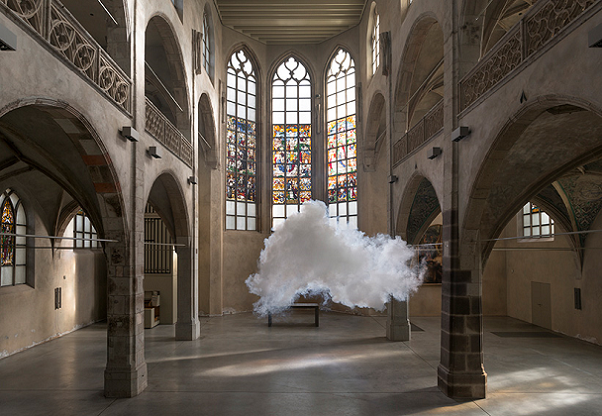
[ by Charles Cameron — this post is mostly concerned with unintended consequences in foreign policy, not Berndnaut Smilde‘s intended and dramatic clouds, but hey! ]
.
Nimbus Sankt Peter, 2014. Artist: Berndnaut Smilde
ISIL is a direct outgrowth of Al-Qaeda in Iraq that grew out of our invasion. Which is an example of unintended consequences. Which is why we should generally aim before we shoot.
**
Rumsefeld said:
As we know, there are known knowns; there are things we know we know. We also know there are known unknowns; that is to say we know there are some things we do not know. But there are also unknown unknowns — the ones we don’t know we don’t know. And if one looks throughout the history of our country and other free countries, it is the latter category that tend to be the difficult ones.
Walt said:
In international relations, at least, none of our theories are all that powerful, the data are often poor, and coming up with good solutions to many thorny problems is difficult. Unintended consequences and second-order effects abound, and policymakers often reject good advice for their own selfish reasons.
Taleb said:
Before the discovery of Australia, people in the Old World were convinced that all swans were white, an unassailable belief as it seemed completely confirmed by empirical evidence. The sighting of the first black swan might have been an interesting surprise for a few ornithologists (and others extremely concerned with the coloring of birds), but that is not where the significance of the story lies. It illustrates a severe limitation to our learning from observations or experience and the fragility of our knowledge. One single observation can invalidate a general statement derived from millennia of confirmatory sightings of millions of white swans. All you need is one single (and, I am told, quite ugly) black bird.
Clapper said:
unpredictable instability is the new normal
**
Let me list them:
unintended consequences
known and unknown unknowns
second-order effects
black swans
unpredictable instability
Are these all what you might call “birds of a feather”?
**
Taleb also said:
Viagra, which changed the mental outlook and social mores of retired men, was meant to be a hypertension drug. Another hypertension drug led to a hair-growth medication. My friend Bruce Goldberg, who understands randomness, calls these unintended side applications “corners.” While many worry about unintended consequences, technology adventurers thrive on them.
and:
Mandelbrot’s fractals allow us to account for a few Black Swans, but not all. I said earlier that some Black Swans arise because we ignore sources of randomness. Others arise when we overestimate the fractal exponent. A gray swan concerns modelable extreme events, a black swan is about unknown unknowns.
It strikes me that we could use a Venn diagram of these things, so we can better understand what we don’t understand.
For He can well be loved, but he cannot be thought. By love he can be grasped and held, but by thought, neither grasped nor held. And therefore, though it may be good at times to think specifically of the kindness and excellence of God, and though this may be a light and a part of contemplation, all the same, in the work of contemplation itself, it must be cast down and covered with a cloud of forgetting. And you must step above it stoutly but deftly, with a devout and delightful stirring of love, and struggle to pierce that darkness above you; and beat on that thick cloud of unknowing with a sharp dart of longing love, and do not give up, whatever happens.
Zenpundit is a blog dedicated to exploring the intersections of foreign policy, history, military theory, national security,strategic thinking, futurism, cognition and a number of other esoteric pursuits.