zenpundit.com » veterans

Archive for the ‘veterans’ Category

Armistice Day, Veterans Day

Sunday, November 11th, 2012

[by Charles Cameron — for the UK, US and others, a day to remember ]
.

.
.

The Great War ended on this date a little short of a century ago, November 11th, 1918. My grandfather, Sir Henry Clayton Darlington, commanded troops at the Hellespont, so for me that war — and the Armistice which ended it — is but one degree of separation from personal memory.

Common British, Canadian, South African, and ANZAC traditions include two minutes of silence at the eleventh hour of the eleventh day of the eleventh month (11:00 am, 11 November), as that marks the time (in the United Kingdom) when armistice became effective.

Poppies grew in the fields of Flanders where so many of our soldiers died, and in the UK poppies are worn in the lapel on this day to remember them. In the words of the Laurence Binyon‘s poem For the Fallen,

At the going down of the sun and in the morning
We will remember them.

**

Small Wars Journal has a history of the various Armistice Day, Veterans Day and Remembrance Day observances.

The poppy pressed between the pages of St Luke’s gospel (image, above) was picked by one Les Forryan, who served with the UK’s Army Service Corps in France and Belgium during the Great War, and the book itself was a “Soldier’s Pocket Testament”, given to him in 1915. The field of poppies and crosses (image, below) was photographed by Brandanno1 in Cardiff, Wales, in 2007. The image of HM Queen Elizabeth II (image, inset) is from a Daily Mail report in 2008.

Splitting the second

Saturday, July 14th, 2012

[ by Charles Cameron — on war, life and death, IEDs, Carl Prine, prayer ]
.

People in general — Americans, British, Israelis, Iranians, Japanese, people from all over — don’t much like the idea of having an atom split right in their faces. But the problem isn’t necessarily so much the splitting of the atom, a technical feat which can be accomplished safely in, say, the heart of the sun — it’s the splitting of life from body, the work of a split second.

Which can also be accomplished by IED.

**

**

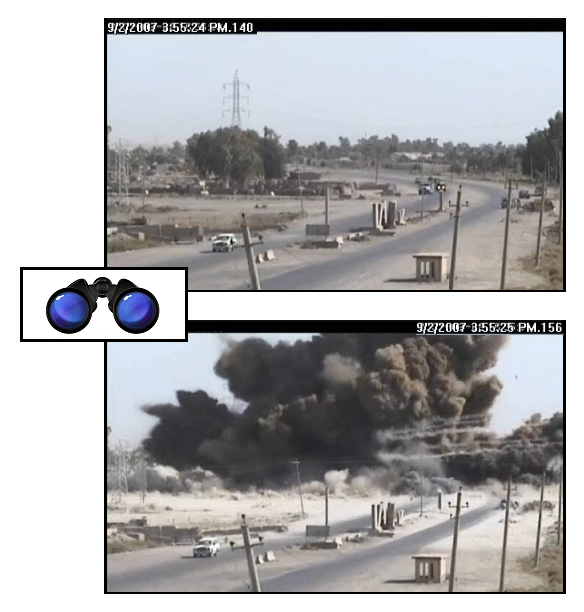
I’ve split these two images, both drawn from the same video one second apart, to give myself the fraying edges of a visceral sense of what that separation of life from body might be about.

See how little the car, bottom left, has advanced between the first image and the second.

The video the two images come from is embedded in Michael Yon‘s tribute to Carl Prine. I’d have embedded the video here myself if I could, but it’s in Vimeo rather than YouTube, and either because I’m incompetent or because Vimeo isn’t set up that way, I couldn’t figure out how to do the embed.

The Marine who sent Yon the video wrote:

This is the type of explosion that our troops are dealing with, not the puny kind we see on television or in the movies. Pass this on… so Americans will now understand what an IED truly is… and what our war veterans are dealing with.

Click on the link in red above if you haven’t already seen the movie nor lived through the event, and get that edge of a visceral sense — like a second-cousin-once-removed of the real thing.

My thoughts and prayers are with Carl Prine and all those battle-scarred in body, mind and soul.

**

One second passes between the first screen-grab and the second: time enough to sneeze, but not time enough to respond, “God Bless you”.

Life and death: a snapshot, a split second.

High Ground

Monday, May 21st, 2012

Hat tip to Kanani Fong of Kitchen Dispatch

The award -winning film HIGH GROUND  is due for release in August 2012:

Since 2002, almost 50,000 U.S. soldiers have returned home from Iraq and Afghanistan with their lives radically altered by war. With the improvement of battlefield medical treatments, these soldiers return alive yet not whole, and face long painful paths to recovery.

Full integration back into their community and the civilian world is a treacherous road, fraught with obstacles and pitfalls. After initial rehabilitation, these veterans are often left to fend for themselves, and struggle with physical and mental roadblocks, depression, and alienation.

This issue affects every aspect of society, not just families and hometown communities, but our national character and our legacy. How these wounded soldiers transition is one of the most important repercussions of these wars and an adversity with which we will contend for generations.

igh Ground was a showcase expedition bringing together disabled war veterans with world recognized mountain climbers to demonstrate what could be achieved by climbing a Himalayan giant. A key outcome of the expedition was to produce a documentary film that would tell the inspiring stories of these heroes and spread a healing message to a national audience.

This film, featuring stunning cinematography and capturing powerful emotions, will touch the hearts of concerned citizens, military families, outdoor enthusiasts and most of all, soldiers who find themselves wondering how to face the days and months and years ahead. It is an honest and gripping portrayal of our American warriors, telling an action packed story that unfolds in unexpected ways as the team makes their way high into the mountains, through the villages of Nepal, over raging rivers and up terrifying steep terrain risking injury and death for a chance at the summit.

A second and equally important goal is to continue to impact those thousands of injured soldiers in the midst of their own daunting recoveries through the use of the film at veteran’s hospitals and military bases around the United States. In the fall of 2011, a multi-city nationwide tour will be launched to welcome our soldiers home, celebrate their spirit and sacrifice, and to encourage them to pursue their dreams.

Efforts are currently underway to assess the potential of additional expeditions and to create a long-term strategy as a non-profit organization. By getting involved and supporting this project you can participate directly in this vital process and connect your company to the message that our soldiers can indeed… return home to live again.


A Wound That Does Not Cease to Bleed: The War in Vietnam

Wednesday, February 29th, 2012

Amigo of ZP blog, West Point military historian Colonel Gian Gentile, throws down the gauntlet in his review of Lewis Sorley’s new biography, Westmoreland: The General Who Lost Vietnam, in The National Interest:

The Better War That Never Was

DID GENERAL Westmoreland lose Vietnam? The answer is no. But he did lose the war over the memory of the Vietnam War. He lost it to military historian Lewis Sorley, among others. In his recent biography of William C. Westmoreland, Sorley posits what might be called “the better-war thesis”—that a better war leading to American victory was available to the United States if only the right general had been in charge. The problem, however, is that this so-called better war exists mostly in the minds of misguided historians and agenda-driven pundits.

In the battle over the memory of the Vietnam War, Sorley annihilates Westmoreland and leaves his character and reputation in smoldering ruins. Yet Sorley’s victory in the fight for the memory of Vietnam has not brought us a balanced historical biography of Westmoreland.  

 ….The better-war thesis argues that if only the U.S. Army had concentrated from the start on building up the South Vietnamese armed forces and winning the hearts and minds of the South Vietnamese people through limited applications of military force, we would have won the war. But the question remains: Precisely how could tactical adjustments early in the war have overpowered the political constraints placed on the army by the Johnson administration, which kept it from taking the fight to the North Vietnamese? Or the dysfunctional nature of the South Vietnamese government and military that precluded them from standing on their own? Or the declining popular support and political will in the United States as the war dragged on without a decent end in sight? Or, perhaps most importantly, how could tactical adjustments toward better methods of counterinsurgency have overpowered a communist enemy that fought the war totally while the United States fought it with limited means? In his Westmoreland biography, Sorley essentially ignores these questions.

Could the United States have prevailed in Vietnam? Yes, but it would have had to commit to staying there for generations, not a mere handful of years. The Vietnam War was an attempt at armed nation building for South Vietnam. Nations and their societies, however, are not built overnight, especially when they are violently contested by internal and external enemies. Thus, to prevail in Vietnam, the United States would have needed the collective will that it mustered to win World War II and would have had to be able to maintain it for generations. That kind of will—or staying power—was never a real possibility.

In war, political and societal will are calculations of strategy, and strategists in Vietnam should have discerned early on that the war was simply unwinnable based on what the American people were willing to pay. Once the war started and it became clear that to prevail meant staying for an unacceptable amount of time, American strategy should have moved to withdraw much earlier than it did. Ending wars fought under botched strategy and policy can be every bit as damaging as the wars themselves.

Well worth the read, not least for Gian’s model of how one historian carefully dismantles the thesis of another.

We are a mere three years from the fiftieth anniversary of Lyndon Johnson’s escalation of the Vietnam War, less than two years from the fiftieth anniversary of the assassination of John F. Kennedy that brought LBJ into power and a year from the fiftieth anniversary of the infamous coup d’etat against American client, President Ngo Dinh Diem, that JFK had approved. Finally,  fifty years ago, Kennedy drastically increased the American military advisory mission to South Vietnam to just under 10,000 men and signed off on clandestine operations against North Vietnam.

All those fiftieth anniversaries amount to a golden jubilee of rancor.

The bitterness sown by the lost war in Vietnam still burns in American politics like red hot coals. Less bright perhaps than the open flame of 1968, but if you scratch the surface, you will find with no less heat. The war spawned division and polarization that twisted our politics and poisoned public debate to this day, echoing now as farce as much as tragedy.

During the 1980’s, Vietnam historiography was virtually a cottage industry. It was the subject that ate the profession as a generation of academics who cut their academic teeth during the era of antiwar protest on campus acquired tenure, middle-aged paunches and lost hair while nursing their political grievances in their scholarship. I personally recall, as an  undergraduate, the war being referenced (usually along with vitriolic abuse of Ronald Reagan) in every humanities class, no matter how remote the course, with some professors being known for the quality of their off-topic rants.

While Westmoreland bears heavy responsibility for his part in a losing a war, even as theater commander in Saigon he was only an executor, not a maker, of strategy, much less national policy. Westmoreland did not lose Vietnam in a stunning battlefield capitulation, so Gentile is right to defend “Westy” from being scapegoated for the poor strategic reasoning hatched in the Oval Office. Where Westmoreland was at fault was in his inability to either intellectually comprehend the bigger strategic picture in which he found himself struggling (most likely) or if he did, to effectively articulate the strategic environment in Southeast Asia to a domineering President who was stubbornly determined to brook no contrary advice (possible). Had Westmoreland tried, he likely would have failed (Brute Krulak’s effort in this regard got him physically ejected from the Oval Office by the seat of his pants by Johnson himself. I am dubious that LBJ would have been any happier with contradiction of policy from Westmoreland).

Gentile, much like my professors of yore, is deeply interested in the congruence between events in his own time with those of the Vietnam era., in particular, the salience of counterinsurgency doctrine in the wars of Iraq and Afghanistan. There is, of course, some continuity between the Vietnam era and today present, a historical thread seized by the COINdinistas themselves in their veneration of Galula and slurping knife-blade portions of soup, but the continuity has limits. I suspect a Millennial generation vet of Kandahar or Fallujah, should they venture to become a historian, will frame and seek to explain their wars without much reference to the societal touchstone that is Vietnam.

Perhaps by then, for American society, Vietnam will have finally ceased to bleed.

Iraq and Afghan Veterans and the American Future

Wednesday, February 8th, 2012

Members of the Grand Army of the Republic, 1892

An estimated 2, 333, 972 Americans have been deployed to Afghanistan and Iraq since September 2001. Of these, 977, 542 were deployed more than once. When final combat operations end in Afghanistan and the numbers from peripheral theater operations against al Qaida are counted, these figures will be somewhat larger.  It must also be remembered, that among these volunteers were 4,683 men and women who did not return, except in a flag draped coffin. This grim statistic too, will increase before the end.

Wars continue to shape the fate of nations long after the guns fall silent.  Mrs. Florence Green, who served in Great Britain’s embryonic Royal Air Force and was the last living veteran of the First World War, died the other day at 110, but we are still grappling with the terrible consequences of the Great War. One of the ways in which wars shape society are through the collective memories and internalized lessons, expressed by it’s veterans.

Not every war produces a great riptide across a national psyche. The Korean War was as silent as the generation that fought it, despite being comparable in some ways to the war in Vietnam, whose images and memories are bitterly iconic.  Other wars loom large. The culture of the trenches and the bloody debacles of the Somme and Verdun produced ex-soldiers who contributed much to revolutionary upheaval and the mass militarization of European politics. In a more benign vein, the Civil War veterans, the “generation whose hearts were touched by fire” and “the greatest generation” of WWII did much to shape the character of  subsequent eras of peace, moderation, stability, social reform and economic growth.

What will the veterans of the wars of 9/11 come to personify?

They are different.  Volunteers in a small professional military, these veterans are far fewer in number and less strictly “generational” than their mass-mobilized predecessors of the world wars, Korea and Vietnam. Every man on D-Day or on Okinawa had “Pearl Harbor” as a common experience, but in 2011, an 18  year old Marine in Afghanistan was only in third grade when planes hit the World Trade Center and the Pentagon.  Their close comrades in combat may include reservists a decade and a half their senior, married and with families. The United States fought it’s wars but not with your grandfather’s army.

They are held in high esteem by a public from which many feel isolated. They have committed suicide at three times the rate of the general population, to a studied indifference from a stultified and mismanaged military personnel bureaucracy. They receive public accolades and parades that eluded those who served in Vietnam but some veterans of Iraq and Afghanistan have had trouble getting the medical attention their injuries required.

These veterans have not yet found their collective “voice” but the early rumblings have been about broken faith in leaders who have let them down.

I suspect we will be hearing that voice soon and it may change our politics for the better.


Switch to our mobile site