zenpundit.com » iraq

Archive for the ‘iraq’ Category

In between Big Bang and Heat Death

Thursday, March 21st, 2013

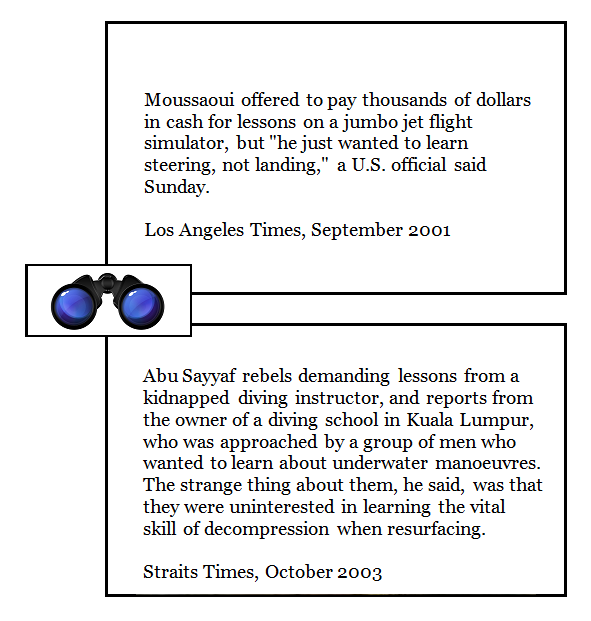
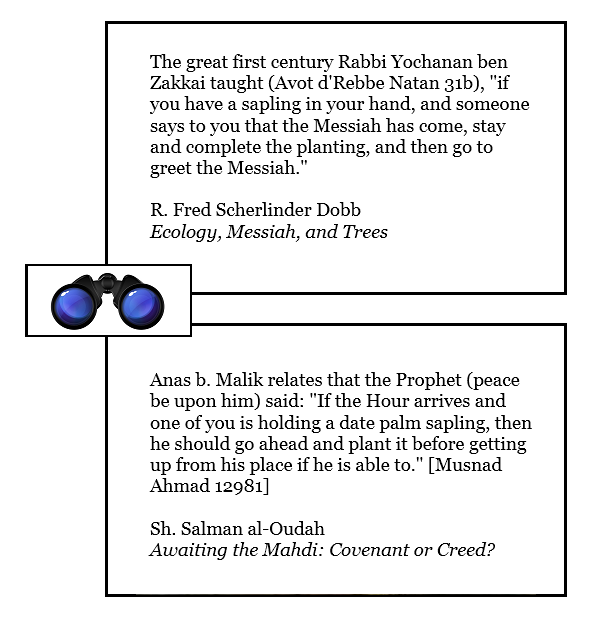
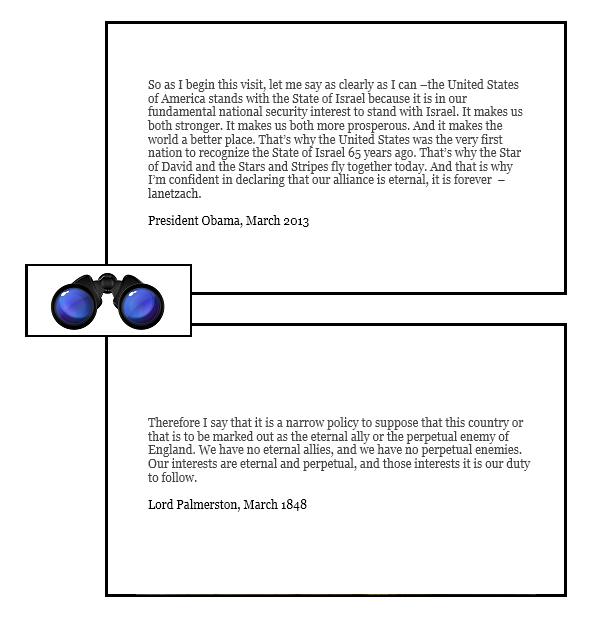
[ by Charles Cameron — a terrific example of the DoubleQuote form, drawing on Obama at Ben Gurion Airport and Palmerston in the House of Commons, and why the form is useful ]
.

Some time in between t-zero and t-aleph-null, some time between the First Day of Creation and Judgment Day, some time in between the Big Bang and the Heat Death of the Universe, there’s a stretch of time known as always.

**

What does juxtaposing the two statements allow us to understand?

  • That times have changed?
  • That what you tell a foreign government is not what you tell your own?
  • That Brits are more understated and Americans more plainspoken?
  • That President Obama is showing specific support for Israel, while Palmerston was expressing the general rule which covers all such utterances?
  • That the word “always” doesn’t necessarily mean “for ever”, “unto the ages of ages” as the Eastern Church has it?
  • Perhaps “for the foreseeable future” would be a better phrase to use, if it didn’t sound so iffy. I’d say it means something closer to “in continuity” than to “in perpetuity”.

    **

    The great thing about DoubleQuotes as a form is that they jump-start you into thinking about samenesses and differences, without demanding which particular implications you will select, thus giving rise to multiple possibilities and enlarging the scope of narrative or discussion.

    And while I’ve sharpened the pairing of quotes — or graphics — into a tool for repeated use, it’s already a habitual form of thinking, as we can see from the fact that these two particular quotes were juxtaposed by Sam Roggeveen in his post, America’s BFF: Obama calls it, in the Lowy Institute’s Interpreter today.

    **

    We naturally pair similars to contrast and compare them: it may be the most basic device that human memory affords us — this reminds me of that.

    Here are a few of my own old favorites…

    **

    You can read Obama’s speech, from which the excerpt above was taken, on this Israel Times page.

    Honor, Shame, Scandal and Integrity

    Friday, March 8th, 2013

    [ by Charles Cameron — reflecting on the anthropology of honor – shame, its relevance to cover ups of many kinds, and its potential for impact in our search for a more peaceable modus vivendi ]
    .

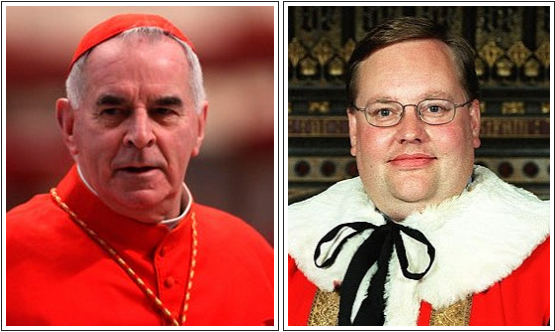
    Cardinal O'Brien & Lord Lennard, their images as juxtaposed on the Cranmer blog


    **

    Recent political news in the United Kingdom, from The Telegraph:

    Liberal Democrat leader Nick Clegg has been forced to admit that his office knew for years of claims that a senior party figure might be sexually molesting volunteers and staff.

    The Deputy Prime Minister changed tack in a statement on Sunday evening over the sex scandal which is engulfing his party.

    He broke into the end of his holiday to admit for the first time that his office had been aware of the allegations surrounding his former chief executive Lord Rennard since 2008. But he said he was personally unaware of the claims.

    Nick Clegg admits his office knew of Lord Rennard rumours for five years

    **

    In today’s Wired, concerning a cover-up in the US Air Force:

    A military jury found Lt. Col. James Wilkerson guilty of groping a sleeping woman’s breasts and vagina. But the Air Force wasn’t done with the “superstar” F-16 pilot. It reinstated Wilkerson to active duty and wiped away his conviction — but, to save face, is pledging not to promote him to full colonel.

    [ … ]

    Now the embarrassed Air Force is looking for a face saving way out of its institutional mess. Its answer thus far, reports Stars & Stripes, is to remove Wilkerson’s name from its promotions list. There’s an opportunity for Wilkerson to appeal the decision.

    Air Force Accountability for Sexual Assault: Not Promoting Convicted Officer

    **

    And concerning Lockheed and China, a short while back from emptywheel:

    I’m just wondering out loud here: what if China did more than just steal data on the F-35 when it hacked various contractors, and instead sabotaged the program, inserting engineering flaws into the plane in the same way we inserted flaws in Iran’s centrifuge development via StuxNet?

    [ … ]

    I don’t know that we would ever know if this clusterfuck was caused with the assistance of China. It’s not like Lockheed would publicize such information, just as it asked for another $100 billion. And I don’t want to underestimate the defense industry’s ability to screw up all by themselves.

    What if China Not Just Hacked — But Sabotaged — the F-35?

    **

    I think one of the least appreciated parts of our human make-up is what anthros call the honor-shame system. It considers the honor of a larger group — the family, the regiment, the city, the nation, the corporation, the church — as of overriding importance, with personal considerations clearly secondary. And by honor I mean the respect with which the rest of society views it.

    That’s the system that gives us “honor killings” in a swathe of countries, and in modified western form it’s also at the root of every cover-up, every attempt by hacks and flacks to put a good face on things — and it’s very much something that investigative journalism exists to uncover, just as PR attempts to cover it up.

    To my mind, this is one of the big battlefronts in the world today, comparable perhaps to the battle post-Descartes between “enlightenment” and “superstition”. And when there’s murky business to cover up or admit to, corporations are often slower than individuals to ‘fess up — if only because the stock market favors appearances rather than realities. Until the bubble bursts.

    And much the same is true for politicians and the electoral market, and for churches and the market in faith.

    **

    My mentor Richard Landes believes honor-shame is a large part of the battlefront between “the Israelis” and “the Arab world” — he quotes these two definitions:

    Politeness is not saying certain things lest there be violence; civility is being able to say those certain things and there won’t be violence.

    and writes:

    In an honour culture, it is legitimate, expected, even required to shed blood for the sake of honour, to save face, to redeem the dishonoured face. Public criticism is an assault on the very “face” of the person criticised. Thus, people in such cultures are careful to be “polite”; and a genuinely free press is impossible, no matter what the laws proclaim.

    Modernity, however, is based on a free public discussion, on civility rather than politeness, but the benefits of this public self-criticism – sharp learning curves, advances in science and technology, economic development, democracy – make that pain worthwhile.

    Leaving aside their applicability to the Israeli-Arab issue, are those fair distinctions between two modes of being? How much of the battle between those forces can be found in the world around us, in our politics, our economics situation, and so on?

    How much impact did the differences between honor cultures and modernity have, in the wars in Iraq and Afghanistan? Where else might this kind of conflict of values confront our leaders and ourselves?

    How can we best handle interfaces between these two ways of experiencing, evaluating and acting in our shared world?

    The Freeland motif

    Tuesday, December 11th, 2012

    [ by Charles Cameron — how those first seen as liberators may later be seen as oppressors ]
    .

    Sir Ian Freeland

    Lt-Gen Sir Ian Freeland, GBE KCB DSO

    I was reading up on Ian Freeland, the husband of my mother’s first cousin and lifelong best friend, in search of some details on his role in The Troubles in Northern Ireland, and ran across his comment on liberators who become oppressors, which rang a bell or two. That was a couple of days ago, and I found the same basic pattern mentioned in a post today on Gulf News:

    FWIW, Ian Freeland’s previous experiences would have been with the Mau Mau in Kenya and in Cyprus during the Makarios days.

    **

    So the purpose of this post would be to raise the question: how far back can we trace this observation, and what are the memorable examples (a) of people saying it, and (b) of events bearing it out?

    Ashura: the Passion of Husayn

    Sunday, November 25th, 2012

    [ by Charles Cameron — today’s solemn commemorations in Iraq, Afghanistan, Pakistan and India in comparative religious perspective ]
    .

    I was listening to Mozart‘s Requiem last night, and it is rich in grief shot through with glory. That’s the thing about mourning celebrations in which death is accompanied by the “sure and certain hope of the Resurrection into eternal life”.
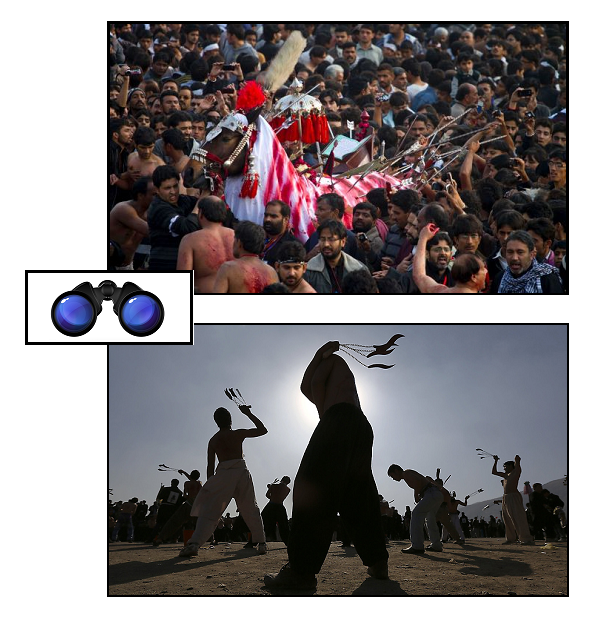
    One such observance is found in Shia Islam, and falls this year on the 25th of November — today. It is the day of Ashura, the 10th day of Muharram in the Islamic calendar, and its epicenter is at Karbala in Iraq. As the saying goes:

    Every day is Ashura and every land is Karbala.

    For the Shia, Ashura commemorates the martyrdom of Husayn, grandson of the Prophet, at the Battle of Karbala, when he refused to give allegiance to the Umayyad caliph Yazid. Husayn’s martyrdom is dramatized in Ta’zieh, passion plays, giving us a hint that the martyrdom of Husayn at Ashura figures in the devotional life of the Shia much as the passion and death of Christ figures within Christianity, both in passion plays such as that at Oberammergau and in Catholic rituals such as the Stations of the Cross. This may seem a far-fetched analogy to some of my readers, but both deaths are viewed as redemptive. As another saying has it:

    A single tear shed for Husayn washes away a hundred sins.

    **

    As you can see depicted in the lower panel above, Shiite mourning can include flagellation with chained blades, not something that sits easily with most westerners — yet as Roy Mottahedeh has said (quoted in SA Hayder, Reliving Karbala: Martyrdom in South Asian Memory):

    Self-mutilation in emulation of the “passion” of heroes who are human yet divine is no stranger to the West: flagellants who whipped themselves both in penance and in remembrance of the scourging and crucifixion of Jesus appeared in almost every western European country in the Middle Ages…

    The upper panel above depicts Husayn’s horse, riderless and bloody, and can perhaps give us some sense of the dark ceremonial beauty of the occasion for those whose grief transcends time and unites them in aspiration with Husayn himself — their flagellation attesting to their wish that they themselves could have stood beside him on that day so long ago, standing for truth against an army of injustice.

    **

    Their grief may be trans-temporal, but the possibility of dying for their faith persists to this day, for Sunni militants of the jihadist sort view Ashura differently — primarily as a day of fasting first performed by Moses and continued by Muhammad — and detest the breakaway sect of the Shia as rafidun, heretics.

    In Iraq, Ashura there has seen millions of pilgrims visiting Karbala this year, with comparatively little violence:

    Millions of Shiites flooded the Iraqi shrine city of Karbala on Sunday for the peak of Ashura rituals, which have been largely spared the attacks that struck pilgrims in past years. A bomb wounded 10 pilgrims in Diyala province, north of Baghdad, but it was the first such attack since a car bomb against pilgrims killed three people on November 17.

    Farther afield, what the Pakstani police describe as a “major terror plot to attack the Muharram processions in Karachi” was avoided this year when “large amounts of explosive material, two suicide jackets and grenades” were confiscated during a raid, with the Minister for Religious Affairs declaring that the Tehreek-e-Taliban were behind the plots. Elsewhere in Pakistan:

    At least five persons were killed and over 70 others injured on Sunday when a Shia procession was targeted with a bomb at Dera Ismail Khan in Pakistan’s restive northwest, the second such attack in the city in as many days.

    Meanwhile in Kabul:

    For the past week, the Afghan capital has been draped with black cloth arches and festooned with huge colored banners. Mournful, pounding chants pour from loudspeakers across the city, filling the air with slow martial intensity.

    The dramatic display is all part of Muharram and the 10-day Shiite festival that commemorates the slaying of Imam Hussein, a 7th-century holy figure and early champion of Islam. But it is also a symbol of the growing religious and political freedom that Afghanistan’s long-ostracized Shiites have had in the past decade.

    That’s from a Washington Post piece yesterday titled Afghan’s Shiite minority fears a return to old ostracism — and the next two paragraphs bear out the title:

    Now, as Western military forces prepare to leave the country by 2014, Afghan Shiites, most of whom are from the Hazara ethnic minority, fear that their window of opportunity may slam shut again, leaving larger rival ethnic groups as well as Taliban insurgents, who are radical Sunni Muslims, dominating power.

    “Everything we have achieved, our ability to come out and participate in society, has been in the shade of the international community and forces,” said Mohammed Alizada, a Hazara Shiite who was elected to parliament in 2009. “We are very concerned that once they leave, the fundamentalists will reemerge, ethnic issues will return, and we will lose what we have gained.”

    Tribal politics, sectarian issues, the impending departure of US forces, the Taliban, cross-border alliances — and the sheer power of devotion — all these are intricately intertwined in today’s Afghanistan and its future. We may do well to understand something of the meaning of this day of Ashura, in our own calendar, 25th November 2012.

    **

    Annemarie Schimmel, the great Harvard scholar of Islamic mysticism, has a fine essay on the poetry of Ashura, encompassing both Sunni and (strongly Shia-influenced) Sufi traditions, Karbala and the Imam Husayn in Persian and Indo-Muslim literature. The mindset is very different from contemporary secular westernism, seeing death itself — and the grief that accompanies it — as a prelude to resurrection, and thus part of the timeless love-play of God with those who love him:

    In having his beloved suffer, the divine Beloved seems to show his coquetry, trying and examining their faith and love, and thus even the most cruel manifestations of the battle in which the ‘youthful heroes’, as Shah Latif calls them, are enmeshed, are signs of divine love.

    The earth trembles, shakes; the skies are in uproar;
    This is not a war, this is the manifestation of Love.

    The poet knows that affliction is a special gift for the friends of God, Those who are afflicted most are the prophets, then the saints, then the others in degrees’, and so he continues:

    The Friend kills the darlings, the lovers are slain,
    For the elect friends He prepares difficulties.
    God, the Eternal, without need what He wants, He does.

    **

    The spirit here is not too far from that of the Greek philosopher Plotinus, who wrote in his Enneads [III.ii.15]:

    Men directing their weapons against each other- under doom of death yet neatly lined up to fight as in the pyrrhic sword-dances of their sport- this is enough to tell us that all human intentions are but play, that death is nothing terrible, that to die in a war or in a fight is but to taste a little beforehand what old age has in store, to go away earlier and come back the sooner.

    together with that of the early Christian Father, Origen, who wrote [De Martyrio, 39]:

    And let each of us remember how many times we have been in danger of an ordinary death, and then let us ask ourselves whether we have not been preserved for something better, for the baptism in blood which washes away our sins and allows us to take our place at the heavenly altar together with all the companions of our warfare.

    **

    In India, indeed, the martyrdom of Husayn takes on an interfaith character in some places, as Hindus and Christians join Muslims in Ashura commemorations, as Naim Naqvi relates:

    One can observe the richness and beauty of the diversity of Indian Culture at the occasion of Muharram. Since the martyrdom of Imam Hussain, Muharram ceremonies are observed all over the world including India. Hindus take part in them with great reverence and devotion. The tragedy of Karbala has become the harbinger for interfaith understanding in the Indian sub-continent. Participation of Hindus in the mourning rituals of Imam Hussain has been a feature of Hinduism for centuries in large parts of India. Hindus, Sikhs, Jains and even Christians observe Muharram. In the city of Varanasi which is the holiest city for Hindus many Hindu families participate in Muharram processions.

    Describing the participation of one such Hindu family in Orissa, we read:

    District police chief Lalit Das said Padhihary family has been doing this every year for the last 338 years, adding other local Hindu families also participate in the procession.

    Muslims said it reflected the perfect harmony between the two communities in the area.
    An army in Sham, an army in Yemen, and an army in Iraq

    Thursday, November 1st, 2012

    [ by Charles Cameron — uh-oh, it’s Mahdi time again.. giving a little wide-angle context, then passing along a hadith of possible current interest — also an aside about an end-times Shiite trinity ]
    .

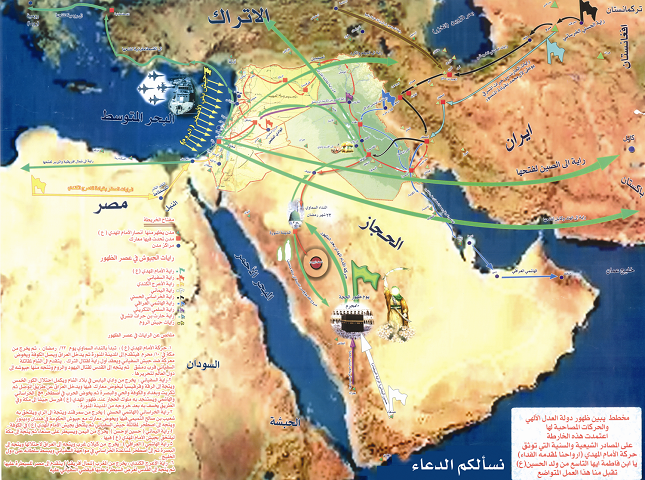
    a ShiaChat map of one end times scenario: the Sufyani will attack Iran, black banners come from Khorasan

    .

    We live, as everyone pretty much agrees, in some place called “here” (although that shifts) at a particular moment called “now” (although that shifts too) in a medium often called “spacetime” in honor of Albert Einstein.

    The Game-changing Coming Ones of many religions and sects – and even their secular variants, the Game-changing Coming Ideologies and Leaders) – are situated in another area of the same “spacetime” continuum for their respective believers: next up after “wars and rumors of wars” or “come the revolution” or “when the Mayan Calendar runs out” or “next year in Jerusalem”…
    .

    When:

    My old friend Stephen O’Leary suggests there’s a shifting “window of opportunity” for people who preach “soon comings” – if you warn people that the world will end in a couple of thousand years, or with the heat death of the sun, or even that sea levels are liable to rise precipitously over the next few decades unless remedial action is taken, the view is long-range enough to seriously diminish your impact. Conversely, if you announce the end of the world will occur three minutes from now, nobody has time to get scared or prepared – or to propagate your message.

    So “soon coming expectations” generally predict the coming is a little ways around the corner, close enough to matter but no close enough to sell all that you possess and climb Mt Ararat this week.
    .

    Where:

    The “where” is interesting, though. We have news cameras focused 24/7 on the Mount of Olives to catch the Second Coming of Christ, although most observant Jews won’t be expecting that Christianity will be finally vindicated as the true inheritor of Judaism’s mantle there any time soon, and many Muslims expect he’ll descend at one of the minarets of the Umayyad Mosque in Damascus.

    And the Mahdi? Two popular points of anticipated arrival are beside the Kaaba in Mecca, or out of the well behind the Jamkaran mosque, not too many miles from Qom.

    But Islamic apocalyptic geography doesn’t end with either place – it extends, minimally, from Khorasan (Iran or Afghanistan) to Jerusalem, with a possible side-expedition to India (the Ghazwa-eh-Hind) and with possible tributaries from Africa and who knows where else… and in at least some Shia strands of apocalyptic thinking, the city of Kufa in Iraq will be the Mahdi’s seat of government.
    .

    And now, the hadith:

    All this is simply to provide some context for a specific hadith that my friend Aaron Zelin pointed to me today, as recorded yesterday on the Kavkaz Center webpage:

    Hadith about Syria, Iraq and Yemen

    Publication time:
    30 October 2012, 14:58

    Sham – the territory of Syria, Palestine, Jordan and Lebanon

    Abdullah ibn Hawalah [Allah's blessings be on him] narrated from the Messenger of Allah (pbuh) that he said:

    "Matters will run their course until you become three armies: an army in Sham, an army in Yemen, and an army in Iraq".

    Ibn Hawalah said:

    "Choose for me, O Messenger of Allah! in case I live to see that day".

    The Messenger of Allah (pbuh) said:

    "You should go to Sham, for it is the best of Allah's lands, and the best of His slaves will be drawn there!

    And if you refuse, then you should go to the Yemen and drink from its wells. For Allah has guaranteed me that He will look after Sham and its people!"

    (Imam Ahmad 4/110, Abu Dawud 2483. Authenticated by Imam Abu Hatim, Imam ad-Diya al-Maqdisi, Sheikh al-Albani and Sheikh Shu'aib Al-Arnaut).

    Department of Monitoring
    Kavkaz Center

    .
    Further reading:

    For more on this, see especially J-P Filiu‘s Apocalypse in Islam, noting in particular his account of “the revelation of Abu Musab al-Suri” (pp. 186-193), including specifically his discussion of “Sham” in a paragraph on p. 189.

    *****

    And an intriguing aside:

    And since were talking Yemen and the greater Sham here, it may be worth noting as an aside, the presence in Islamic apocalyptic traditions of a figure known as the Yemeni — sometimes identified in Iranian Shia apocalyptic as Hezbollah’s Hasan Nasrallah. Filiu writes (p.156) of:

    Shaykh Nazrallah’s transformation into the apocalyptic figure of the Yemeni, completing a very political trinity in which Ayatollah Khamenei served as the standard bearer of the Mahdi and Ahmadinejad as the commander of his armies.

    Filiu’s book was published in France in 2008, but the same trinity can also be found in the fairly recent video The Coming is Upon Us attributed by Reza Kahlili to circles around Ahmadinejad. I’ve taken this account of the video and the trinity as it reports it from the Counter Jihad Report, because their version succinctly draws together the strands that most concern me here:

    A little-noticed documentary titled “The Coming is Upon Us” was produced by Ahmadinejad’s office last year and it lays out the regime’s beliefs and planned path forward, much like Mein Kampf did. And it debunks the notion that the U.S.S.R. and the Iranian regime are equivalent. The film makes the case that the regime’s leaders are the incarnations of specific End Times figures foretold in Islamic eschatology.

    Iran is the “nation from the East” that paves the way for the Mahdi’s appearance. Supreme Leader Khamenei is Seyed Khorasani, “the preparer” who comes from Khorasan Province with a black flag and a distinct feature in his right hand. Khamenei’s right hand is paralyzed from an assassination attempt. Khorasani’s commander-in-chief is Shoeib-Ebne Saleh, who the film says is President Ahmadinejad. Hezbollah chief Hassan Nasrallah is the incarnation of Yamani, a commander with a Yemeni ancestry who leads the Mahdi’s army into Mecca.

    These three “preparers” wage war against the Antichrist and “the Imposters”-the U.S., Israel and the West’s Arab allies. The film also mentions that a figure named Sofiani will side with Islam’s enemies. Former Iranian Revolutionary Guards officer Reza Kahlili, who leaked the film, told me that the full-length version identifies him as Jordanian King Abdullah II.

    The film lists various End Times prophecies that have been fulfilled to argue that the Mahdi’s appearance is near. The 1979 Islamic Revolution in Iran; the invasion of Iraq from the south and subsequent sectarian violence and death of Saddam Hussein; the Houthi rebellion in Yemen; the fall of Egyptian President Hosni Mubarak and the increasing amount of open homosexuality, cross-dressing, adultery and women taking off the hijab are correlated to specific Islamic prophecies.

    As to the video’s authenticity and provenance, I can only express my ignorance and keen interest — but whatever the case, it seems likely that the split between Khamenei and Ahmadinejad, together with the latter’s “soon going” from office, renders that particular strain of prophecy moot.

    Particular prophetic timelines may fail, and indeed do so repeatedly — the apparatus of apocalyptic hope simply incorporates new figures and events into its calculations, and moves its sense of urgency a little further up along the timeline…


    Switch to our mobile site